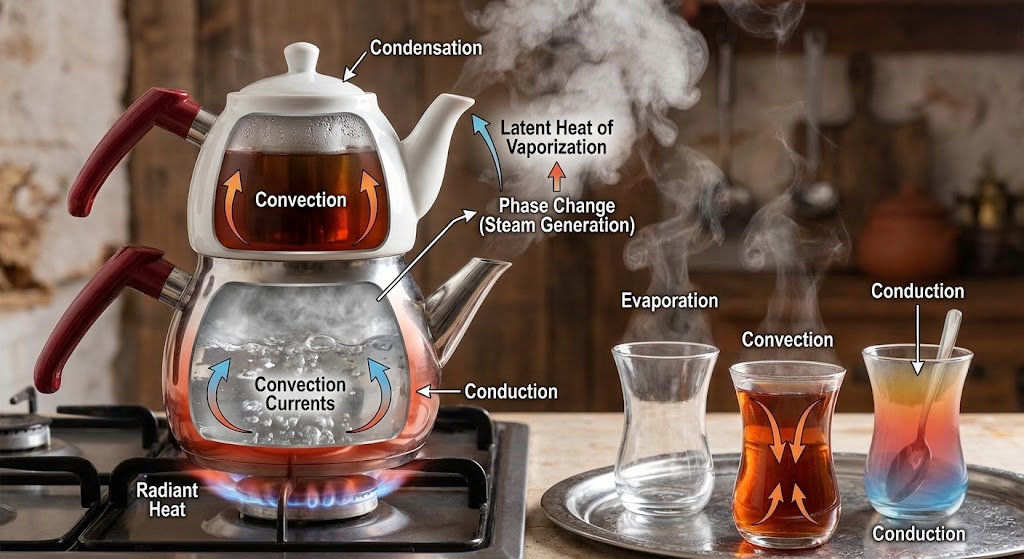
1. Theçaydanlık Double-Boiler System: Thermodynamic Elegance
Turkish tea culture centers on theçaydanlık (teapot)actually two stacked vessels functioning as integrated brewing system. The bottom kettle (demlik alt) boils water continuously. The top teapot (demlik st) holds concentrated tea leaves steeping in small amount of water. Steam from boiling water below keeps concentrate hot without additional boiling, while providing dilution water on demand.
The thermodynamics: bottom kettle maintains 100C through active heat source (gas stove or electric). Top pot reaches equilibrium at 85-9°C through conductive heat transfer via shared metal base and radiant steam heating. This temperature is perfect for maintaining extraction without over-steepingif concentrate boils vigorously, tannins become astringent and tea turns bitter (the "kpek ayi" or "dog tea" insult).
The system's genius is dilution control. Strong concentrate (3-4 tbsp tea per 200mL water in top pot) is poured into glass (filling 1/4 to 1/2), then diluted with boiling water from bottom kettle. Each drinker customizes strength: "koyu" (dark/strong), "orta" (medium), or "aik" (light/weak). This contrasts with Grandpa style's single-pot continuous infusion or Gongfu's complete brew-dump cycles.
| Bottom Kettle (Demlik Alt) | Top Pot (Demlik st) | |
|---|---|---|
| Temperature | 100C (boiling water) | 85-9°C (below boiling, steam-heated) |
| Contents | Plain water (for dilution) | Concentrated tea (3-4 tbsp in 200mL water) |
| Function | Heat source + dilution reservoir | Gentle steeping, no active boiling |
| Capacity | 2-3 liters (serves many guests) | 500-750mL (concentrate lasts 10-15 servings) |
| Refill Strategy | Refill frequently, never empties | Replace when concentrate becomes too strong/bitter (every 2-3 hours) |
2. Tulip Glass Physics: Heat Retention Through Geometry
Turkish tea is served in distinctive tulip-shaped glass (ince belli bardak = thin-waisted glass), not porcelain cups. The geometry is thermal engineering: narrow waist (3-4cm diameter) reduces surface area for heat loss, while flared top (6-7cm diameter) allows aromatic compounds to volatilize and reach nose during sipping.
The glass material (thin soda-lime glass, 1-2mm thick) provides visual feedbackdrinkers judge tea strength by color before tasting. Proper "tavsan kani" (rabbit's blood) color is dark amber-red (not brown, not orange). The transparency also prevents serving weak teasocial embarrassment function similar to noon chai's pink requirement.
Expert Tip: The Two-Finger Test
Hold filled tulip glass up to light. If you can see your fingers clearly through the tea, it's too weak (kpek ayidog tea). If completely opaque, it's too strong (demlik ayiteapot tea, undrinkable without dilution). Proper strength: fingers visible as dark shadows, but not distinct. This visual test works because glass transparency allows instant strength assessmentimpossible with opaque ceramic.
The thin glass also serves tactile function: too hot to hold = tea is freshly poured (compliment to host for attentiveness). Comfortably warm = tea has sat too long (implies neglect). Turks often hold glass by rim using thumb and forefingerminimizing contact with hot lower portion. This differs from British saucers (insulation layer) or handles (complete isolation from heat).
3. Rize Tea: The Black Sea Terroir
Turkey's domestic tea production is concentrated in Rize province (Black Sea coast)the world's northernmost commercial tea-growing region (41N latitude, vs. Darjeeling's 27N). The cool, wet climate (2000-2500mm annual rainfall) produces tea with high polyphenol content and pronounced astringencynecessary qualities forçaydanlık brewing.
Rize tea is processed as CTC (Crush, Tear, Curl) black tea, creating small granules (1-2mm) rather than whole leaves. This aggressive processing maximizes surface area for rapid extractioncritical for concentrate method. Whole-leaf tea would extract too slowly in small top pot, yielding weak concentrate. The CTC method parallels Assam CTC and East Frisian blendsall designed for strong, fast extraction.
| Growing Region | Latitude | Tea Characteristics |
|---|---|---|
| Rize, Turkey (Black Sea) | 41N (cool climate extreme) | High tannin, astringent, CTC processing standard |
| Darjeeling, India (Himalayas) | 27N (high altitude) | Delicate, muscatel, whole-leaf orthodox (see Darjeeling guide) |
| Assam, India (tropical lowland) | 26N (hot, humid) | Malty, bold, CTC for strength (see Assam tea) |
| Ceylon/Sri Lanka (mountain) | 7N (equatorial) | Bright, citrus, varies by elevation (see Ceylon tea) |
| Yunnan, China (subtropical) | 22-25N (ancient tea trees) | Sweet, smooth, Pu-erh aging potential (see Pu-erh) |
4. National Beverage Statistics: 309 Liters Per Capita
Turkey ranks #1 globally for per-capita tea consumption at 309 liters annually (2022 data)exceeding UK (193L), Ireland (297L), and even tea-origin China (68L). This translates to ~1300 cups per person per year, or 3.5 cups daily for every Turkish citizen (including infants and tea abstainers).
The statistic reflects tea's role as social lubricant: offered to guests immediately upon arrival (refusal is minor social offense), consumed during work breaks (Turkish labor law requires tea breaks), served at business negotiations, and drunk throughout family meals. Tea drinking is continuous background activity rather than discrete "tea time" eventcontrasting with British afternoon tea formality.
Expert Tip: The Refusal Protocol
In Turkish hospitality, refusing first tea offer is acceptable only with legitimate excuse ("I just had tea" or health reason). Refusing second offer signals you want conversation to end. Accept at least one glasssip slowly if you don't want more (slow drinking = polite refusal of refills). Never leave tea completely untouched (insults host). Take few sips minimum, then place glass on saucer when satisfiedempty glass = instant refill.
The 309L figure also reflects sugar consumption: typical Turkish tea contains 2-3 sugar cubes per glass. This adds ~100g sugar daily for heavy tea drinkerscontributing to Turkey's diabetes rates (13% adult population). Health campaigns now promote "sekersiz ay" (unsweetened tea), with limited success against cultural norm of sweet tea as hospitality marker.
5. Sugar Cube Dissolution: The Between-Teeth Method
Two competing sugar methods exist: dissolve cubes in tea (modern, Western-influenced), or hold cube between teeth while sipping (traditional "kahve sekeri" method). The between-teeth technique creates gradient sweetnessfirst sip intensely sweet (sugar-saturated saliva), subsequent sips decreasing sweetness as cube dissolves.
The practice has economic roots: when sugar was expensive (Ottoman era through mid-20th century), holding cube between teeth made one cube last entire glass instead of 2-3 cubes dissolved in liquid. Modern Turks maintain practice as cultural identity marker and texture experiencecrunch of dissolving crystal adds sensory dimension. This mirrors Persian ghand pahlou (identical technique, Iranian origin) and distinguishes from East Frisian Kluntje (rock sugar dropped in tea).
6. Tea Gardens and Social Space: ay Bahesi Culture
Turkish ay bahesi (tea gardens) are outdoor social venues where tea is primarynot secondary to food. Located along Bosphorus, in parks, beside mosques, these spaces serve continuous tea from early morning until midnight. Men gather to play backgammon (tavla), discuss politics, smoke (despite indoor bans), while waiters circulate with fresh glasses on serving trays.
The ay bahesi democratizes tea consumption: unlike Victorian tea salons (class-exclusive) or Japanese tea rooms (ceremony-focused), Turkish tea gardens are accessible to all economic classes. A single glass costs ~2-3 lira (US$0.10)cheaper than bottled water. The low cost makes tea garden residency possible for unemployed men spending entire afternoons over single glass.
Expert Tip: Tea Garden Etiquette
At ay bahesi, you pay upon leaving, not per-glass (waiter tracks mentally or marks card). Sitting for hours over few glasses is socially acceptabledon't feel pressured to order constantly. If table is crowded, sharing with strangers is normal (communal seating). Tipping: round up to nearest 5 lira or leave 10-15% for exceptional service. Don't photograph people without askingtea gardens are private social space despite being public venue.
7. ay vs. Kahve: The Historical Displacement
Turkey is globally associated with coffee (Turkish coffee = UNESCO heritage), yet tea dominates actual consumption by 20:1 ratio. This reversal occurred post-WWI when Ottoman coffee supply chains collapsed (Yemen lost to British, African sources disrupted). Republic-era government promoted domestic Rize tea cultivation (1930s-40s) as import-substitution economic strategy.
By 1960s, tea had displaced coffee in daily life. Coffee became special-occasion beverage (served at weddings, fortune-telling sessionssee tasseography for tea equivalent). Tea's triumph reflects practicality: cheaper (domestic vs. imported), faster preparation çaydanlık vs. cezve brewing), larger serving capacity (feeds multiple guests vs. tiny coffee cups).
| Beverage Aspect | Turkish Coffee (Kahve) | Turkish Tea (ay) |
|---|---|---|
| Daily Consumption | ~15L per capita/year (occasional) | 309L per capita/year (constant) |
| Preparation Time | 5-7 minutes (cezve method, single-serve) | 15 minutes initial, then continuous çaydanlık serves many) |
| Serving Size | 50-60mL (demitasse cup) | 125-150mL (tulip glass, multiple refills expected) |
| Economic Source | Imported (Yemen, Ethiopia, Brazil)vulnerable to trade disruption | Domestic (Rize production)economic self-sufficiency |
| Cultural Function | Special occasions, fortune-telling, formal hospitality | Everyday social lubricant, workplace standard, casual hospitality |
8. Modern Innovations: Electricçaydanlık and Tea Bags
Contemporary Turkey has electricçaydanlık (automatic temperature control, timer functions) and tea bags (poset ay)both controversial. Traditionalists argue electric models can't achieve proper steam circulation (inferior heat distribution), while tea bags yield weak, flavorless concentrate compared to loose Rize CTC.
Yet electricçaydanlık sales dominate urban markets: faster heating (10 vs. 20 minutes on gas stove), automatic shutoff (prevents burning concentrate), compact design (fits small kitchens). The technology parallels electric kettles disrupting British tea culture and automatic brewing machines globallyconvenience trumping tradition.
Tea bags represent greater cultural threat: they enable individual serving (contradicts communal pot culture), require no dilution skill (eliminates koyu/orta/aik customization), and often use lower-quality dust/fannings instead of proper Rize CTC. Purists view tea bags as Westernization erosionsimilar to bubble tea fusion anxiety in Taiwan or matcha latte debates in Japan.
9. Step-by-Step: Traditionalçaydanlık Method
Equipment:çaydanlık (double teapot setif unavailable, use two separate pots with bottom pot larger), Rize CTC black tea (or substitute strong Assam/Ceylon CTC), tulip glasses, sugar cubes, small spoons.
Step 1 - Fill and boil: Fill bottom kettle (demlik alt) with cold water (2-3L depending on serving size). Place on stove, bring to rolling boil. Meanwhile, add 3-4 tbsp loose tea to top pot (demlik st)do NOT add water yet.
Step 2 - Create concentrate: When bottom water boils, pour 200-250mL boiling water into top pot (covering tea leaves by 2cm). Stir briefly to ensure even wetting. Immediately place top pot on bottom kettle (stacked configuration). Reduce heat to low simmer.
Step 3 - Steep concentrate: Let system steam-heat for 10-15 minutes. Top pot should NOT boil vigorouslyvisible steam wisps are okay, but bubbling surface means heat too high (reduces to medium-low). Concentrate will turn very dark brown, almost opaque. Refill bottom kettle with water as level drops.
Step 4 - Serve with dilution: Pour concentrated tea from top pot into tulip glass, filling 1/4 to 1/2 way (less concentrate = weaker tea). Top off with boiling water from bottom kettle while leaving 1cm space at rim (prevents spilling). Aim for "rabbit's blood" amber-red color when held to light.
Step 5 - Sweeten and sip: Add 2 sugar cubes (or hold 1 cube between front teeth if using traditional method). Sip slowlytea should be hot but not scalding (80-8°C serving temp). Refills expected: when glass is 1/4 full, add more concentrate + water. Replace concentrate in top pot when it becomes too bitter (2-3 hours maximum steep time).
Maintenance: Never let top pot boil dryadd water from bottom kettle if concentrate evaporates too much. Cleançaydanlık daily with baking soda (removes tannin stains)avoid soap which leaves residue affecting tea flavor. Traditional copperçaydanlık requires occasional polishing, but stainless steel is now standard (easier maintenance, no copper leaching concern).
Comments