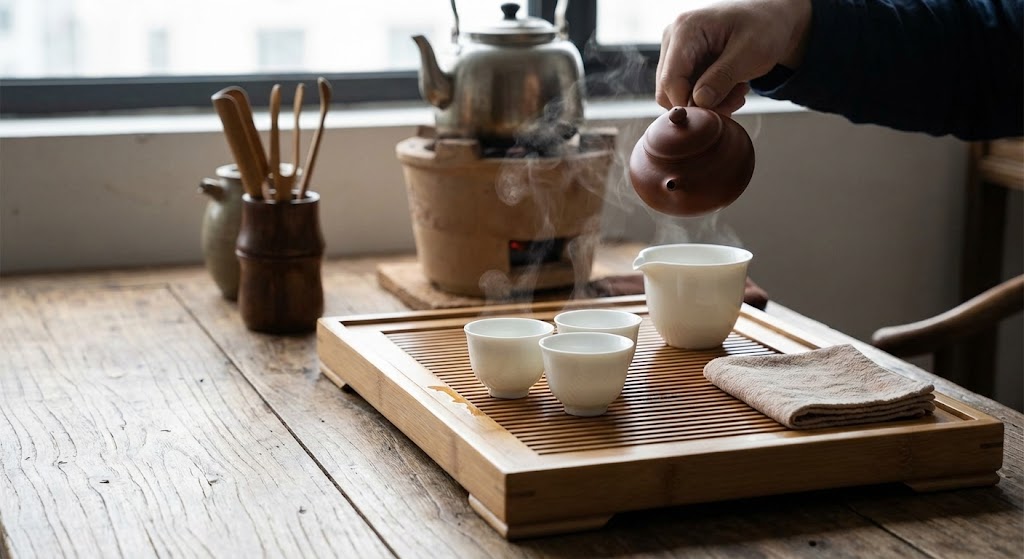
1. Gongfu Origins: Chaozhou as Tea Ceremony Birthplace
Gongfu cha (???, "making tea with skill") originated in Chaozhou region (eastern Guangdong Province, China) during Qing Dynasty (1644-1912). The practice evolved from Ming Dynasty scholar tea culture but added Chaoshan regional obsession with precision and ritual. Unlike grandpa style's casualness or Song whisked tea's competition focus, Gongfu became aesthetic meditationvaluing process over outcome.
The regional specificity matters: Chaozhou produces Phoenix oolong (Fenghuang Dancong), a high-elevation tea with complex floral-fruity profile requiring skilled brewing to reveal. Local merchants developed elaborate preparation methods to showcase tea quality to buyersritualized performance proving expertise. By late Qing/Republic era (1900s-1930s), Gongfu spread to Fujian (home of Tie Guan Yin oolong) and became standardized practice among tea connoisseurs.
Modern Gongfu is both historical preservation and active innovation. Traditional Chaozhou Gongfu uses charcoal brazier, Yixing purple clay teapot, specific pour sequences. Contemporary "competition-style Gongfu" emphasizes gaiwan (lidded bowl), fairness pitcher (gong dao bei), timed infusions. Both share core principle: small vessel + high leaf ratio + multiple quick steeps = maximum flavor extraction and evolution across infusions.
| Gongfu Element | Traditional Chaozhou Style | Modern Competition Style |
|---|---|---|
| Brewing Vessel | Yixing clay teapot (100-150mL, seasoned for specific tea) | Gaiwan (porcelain, 100-120mL, neutral flavor) |
| Heat Source | Charcoal brazier (precise temp control, aesthetic smoke) | Electric kettle (convenience, consistent temp) |
| Water Pour | High pour (phoenix noddingaeration, showmanship) | Circular pour (even leaf saturation, no splash) |
| Serving | Direct pot-to-cup (3-4 tiny cups, 20-30mL each) | Via fairness pitcher (equalizes strength across cups) |
| Social Context | Family ritual, merchant hospitality, male-dominated | Tea shop performance, gender-neutral, Instagram-friendly |
2. The Leaf-to-Water Ratio: 1:15 Precision
Gongfu tea's defining characteristic is extreme leaf ratio: 6-8g tea for 100mL water (1:12 to 1:15 ratio). Compare to Western brewing: 2-3g per 200-250mL (1:75 to 1:100). This high concentration means first infusion (20-30 seconds) would be undrinkably strong in large teapot, but in small Gongfu vessel produces 50-60mL of intense, complex liquor that's consumed in 2-3 sips.
The ratio enables multiple infusions: same leaves steeped 6-12 times with progressively longer steeps (30s ? 45s ? 60s ? 90s...). Each infusion reveals different flavor compoundsearly steeps extract volatile aromatics (floral, fruity), middle steeps bring out amino acids (umami, sweetness), late steeps yield deeper mineral and woody notes. This flavor journey is Gongfu's aesthetic coresingle pot becomes tasting flight.
Expert Tip: The Scale Investment
Gongfu requires digital scale (0.1g precision minimum). Eyeballing 6g vs. 8g creates 33% variancehuge flavor difference. Weigh leaves until muscle memory develops (may take 50-100 sessions). Even experienced practitioners verify occasionallytea leaf density varies by type (fluffy white tea vs. tightly rolled oolong). Budget $15-30 for decent jewelry scale. Skip this and you're not doing Gongfu, you're doing random steeping.
3. Temperature Precision: The 5C Window
Different teas demand different water temperatures in Gongfu: Green tea: 75-8°C (prevents bitterness), White tea: 85-9°C (gentle extraction), Oolong: 95-10°C (opens tightly rolled leaves), Black tea: 95-10°C (full tannin extraction), Pu-erh: 100C (aged tea needs boiling to activate). Deviation by 10C changes extraction chemistry significantlyunder-temp = weak, over-temp = astringent.
Traditional Chaozhou method uses visual cues: "shrimp eyes" (tiny bubbles, ~70-7°C, similar to sencha's cooling vessel temperature drops), "crab eyes" (medium bubbles, ~80-8°C), "fish eyes" (large bubbles, ~90-9°C), full rolling boil (100C). Modern practitioners use variable-temp electric kettles (set precise degrees) or boil-and-wait method (thermometer verification). The temperature control parallels specialty coffee precisionboth crafts where 5C swing is detectable in cup.
| Tea Type | Optimal Water Temp | Reasoning |
|---|---|---|
| Green Tea (Long Jing, Mao Feng) | 75-8°C | Prevents chlorophyll degradation (bitter notes), preserves amino acids |
| White Tea (Silver Needle, White Peony) | 85-9°C | \nGentle extraction, naturally low tannins need moderate heat | \n
| Oolong (Tie Guan Yin, Dancong, Wuyi) | \n95-10°C | \nTightly rolled leaves require high heat to unfurl, roasting withstands heat | \n
| Black Tea (Dian Hong, Keemun) | \n95-10°C | \nFull oxidation creates robust structure, needs boiling for complete extraction | \n
| Ripe Pu-erh (Shu) | \n100C (rolling boil) | \nFermented compounds need maximum heat, earthy notes emerge at high temp | \n
| Raw Pu-erh (Sheng, aged) | \n95-10°C | \nYoung sheng: 90-9°C (mellower), Aged sheng: 100C (activate aged character) | \n
4. Yixing Purple Clay: The Seasoned Teapot
\nTraditional Gongfu uses Yixing teapot (?? yxing, from Jiangsu Province)unglazed purple clay (zisha 紫砂) that's porous and absorbs tea oils over time (similar seasoning process as mate gourds or tea pets developing patina). The practice: dedicate one pot to single tea type (oolong pot, pu-erh pot, never mixinglike Hong Kong's tea sock dedication), and after months/years of use, pot becomes "seasoned"absorbing flavor compounds that enhance subsequent brews (paralleling kulhar's clay interaction or sencha kyusu seasoning). Legendary old pots supposedly brew flavorful tea with hot water alone (no leaves needed)exaggeration, but seasoned pots do contribute subtle complexity.
\n\nThe chemistry: purple clay contains iron oxide (gives reddish-brown color), kaolinite, and quartz. Porosity allows air exchange during steeping (micro-oxygenation, similar to wine aging in oak barrels), while clay minerals interact with tea polyphenols. Believers claim clay "softens" water (mineral ion exchange), skeptics argue it's placebo. Regardless, Yixing pots are cultural iconcollectors pay $500-$50,000+ for master-crafted pots, considering them functional art.
\n\nExpert Tip: Gaiwan for Beginners
\nDon't start Gongfu with expensive Yixing potuse porcelain gaiwan instead. Gaiwan is cheaper ($10-40 vs. $100-500+ for decent Yixing), neutral flavor (no seasoning commitment), easier to clean (dishwasher-safe porcelain vs. never-soap clay), and versatile (try all tea types). Master gaiwan technique first, then invest in Yixing if you become serious practitioner. Many competition brewers prefer gaiwan permanentlyargues flavor comes from tea skill, not pot seasoning.
\n5. Timed Infusions: The 20-Second Starting Point
\nGongfu brewing is rhythmic: Rinse (5 sec): Pour hot water over leaves, immediately discard"wakes up" compressed leaves, removes dust. Infusion 1 (20-30 sec): First drinkable steep, captures volatile aromatics. Infusion 2 (30 sec): Often considered peakbalance of aromatics + flavor compounds. Infusion 3-5 (45-90 sec): Progressively longer steeps as leaves exhaust. Infusion 6+ (90-120+ sec): Extended steeps until flavor fades completely.
\n\nThe timing creates conversation rhythm: each infusion takes 30-60 seconds brew + 1-2 minutes drinking/discussing. A Gongfu session lasts 30-60 minutes for 6-10 infusionssocial event, not quick caffeine delivery. This contrasts with Turkish tea's continuous availability or grandpa style's all-day sipping. Gongfu is bounded experiencebeginning, middle, endcreating ceremonial structure without Japanese tea ceremony's rigid choreography.
\n\n6. The Fairness Pitcher: Equalizing Flavor
\nModern Gongfu uses gong dao bei (???, "fairness pitcher")a small serving vessel (150-200mL) where tea is decanted from gaiwan/pot before distributing to individual cups. This ensures each person receives identical strength teafirst pour from teapot is weaker (top liquid), last pour is stronger (bottom concentrate). Without fairness pitcher, the first guest gets weak tea, last guest gets bitter sludgesocial faux pas.
\n\nThe physics is density stratification: stronger tea (higher tannin concentration) has marginally higher density, settling toward bottom. Vigorous pour into pitcher mixes layers, homogenizing flavor. The fairness pitcher also allows host to inspect tea color (quality control) and provides visual center for group (communal object focus, similar to mate gourd rotation).
\n\nExpert Tip: The Last Drop Technique
\nAfter decanting from gaiwan to fairness pitcher, shake gaiwan gently to dislodge last drops clinging to leavesthese are most concentrated (contact time with leaves longest). Final pour into pitcher is crucial \"last drop\" containing peak flavor. Leaving liquid in gaiwan leads to over-extraction (leaves steep continuously until next infusion). Empty gaiwan completely every timeprecision matters.
\n7. Tea Tray and Wastewater: Managing the Mess
\nGongfu generates significant wastewater: rinse water, spills from gaiwan pouring, cup warming water, teapot/cup rinsing between infusions (contrasting with grandpa style's zero-waste simplicity or senchado's measured precision). The tea tray (cha pan 茶盤) is shallow tray with slatted top and drainage reservoir beneathallows liberal water use without floor puddles. Traditional trays use bamboo slats (echoing Japanese tea room's natural materials or chabana's bamboo vessels), modern versions use plastic/metal mesh. The tray's drainage becomes part of ritualwater flowing through slats is visual/auditory aesthetic element (paralleling teh tarik's pouring performance or Song whisking's foam observation).
\n\nThis infrastructure requirement explains why Gongfu remained restaurant/tea shop practice historicallyhome kitchens lacked drainage systems. Modern electric tea trays (with pumps that drain to attached bucket) enable home practice. The wastewater tolerance distinguishes Gongfu from Japanese tea ceremony's minimalist approach (every drop measured, minimal waste) or grandpa style's zero-waste method (all water consumed).
\n\n8. Social Hierarchy and Tea Service Order
\nTraditional Gongfu observes serving order: eldest first, then by age descending. In business context: client/guest before host. Among friends: no strict order, but host serves self last (humility gesture). The tiny cups (20-30mL) mean continuous refillinghost's job is maintaining everyone's cup full, creating service rhythm throughout session.
\n\nModern practice relaxes hierarchy: young people hosting parents may serve parents first (respect), but peer groups often self-serve from fairness pitcher (egalitarian). The flexibility contrasts with Persian tarof protocol (strict offer-refusal ritual) or Mongolian ger seating (architectural determinism). Gongfu's social rules are guidelines, not absolutesadapting to contemporary casual contexts while maintaining ceremonial bones.
\n\n9. How to Practice Gongfu Tea at Home
\nEssential Equipment (Budget: $50-100): Gaiwan or small teapot (100-120mL), fairness pitcher (150mL), 3-4 tasting cups (30-50mL), tea tray (with drainage, or use large plate/tray), digital scale (0.1g precision), variable-temp kettle or thermometer, tea pick/needle (to break up compressed leaves), tea towel.
\n\nTea Selection for Learning: Start with forgiving oolong (Tie Guan Yin or Dongding)robust flavor, hard to ruin. Avoid delicate greens (unforgiving) or heavily aged pu-erh (requires experience to appreciate).
\n\nStep 1 - Prepare workspace: Set tea tray on table, place gaiwan in center, fairness pitcher and cups to side. Boil water and bring to appropriate temperature for tea type (oolong = 95-10°C).
\n\nStep 2 - Measure and add leaves: Weigh 6-7g tea leaves on scale (for 100mL gaiwan). Place leaves in gaiwan. Ratio is ~1:15 leaf-to-water. This will look like A LOT of leavesthat's correct for Gongfu.
\n\nStep 3 - Rinse (5 seconds): Pour hot water over leaves to fill gaiwan, immediately pour out into waste tray (don't drink rinse). This hydrates leaves and removes surface dust. For compressed tea (balls, cakes), rinse twice to help unfurling.
\n\nStep 4 - First infusion (20-30 sec): Pour hot water to fill gaiwan, place lid on. Wait 20-30 seconds (use timer initially, develop feel over time). Decant entirely into fairness pitcherhold gaiwan lid slightly ajar to strain leaves. Pour from pitcher into individual cups (distribute evenly).
\n\nStep 5 - Taste and adjust: Sip first infusion. Too weak? Increase next steep time to 40 seconds. Too strong/bitter? Reduce to 15 seconds next time (or use less leaves in future sessions). The beauty of Gongfu: immediate feedback loop, adjust on-the-fly.
\n\nStep 6 - Continue infusions: Pour more hot water into gaiwan (leaves still inside), steep 30-40 seconds (slightly longer than first). Decant to pitcher, serve. Repeat with progressively longer times: 40s, 50s, 60s, 90s, 120s. After 6-8 infusions, leaves will be exhausted (tea tastes like hot water). Discard leaves, enjoy the journey you've experienced.
\n\nCleanup: Dump leaves into compost/trash. Rinse all vessels with hot water (no soap on Yixing if using claysoap damages seasoning). Drain tea tray reservoir. Dry all pieces with towel, leave gaiwan/pot inverted to air-dry completely (prevents mold in porous clay or ceramic crazing).
\n\n"}
Comments