1. The Yi Xing Connection: Pottery Masters and Tea Culture
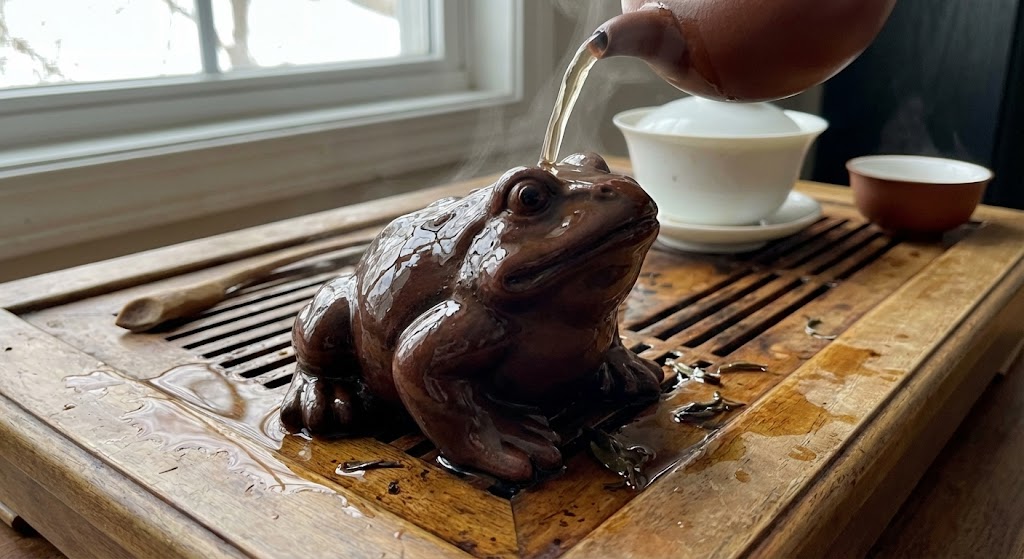
Tea pets (茶宠 chá chǒng, "tea companion") originated in Yixing, China (Jiangsu Province, famous for purple clay teapots): Material: Zisha clay (紫砂 "purple sand," high iron content 2-5%, porous structure—absorbs tea over time, develops patina like bamboo tea trays aging with use). Historical emergence: Yuan Dynasty (~1300s CE) or earlier, but popularized Ming-Qing Dynasties (1400s-1900s) alongside Gongfu tea culture. Original purpose: (1) Absorb wastewater (first pourings discarded to rinse leaves, poured on pet like tea tray drainage systems), (2) Test water temperature (some pets change color with heat—thermochromic minerals), (3) Table decoration (aesthetic addition to tea tray), (4) Luck symbols (traditional Chinese auspicious creatures—dragons, toads, pigs, pixiu).
The chemistry of patina formation: Yixing clay is porous: 10-20% porosity (microscopic voids between clay particles similar to terracotta kulhar's evaporative cooling structure), allowing liquid penetration. When tea poured repeatedly: Tannin absorption: Polyphenols (catechins, theaflavins from processing chemistry) seep into clay ($ \\text{Tea} + \\text{Clay} \\rightarrow \\text{Stained Clay} $), darkening surface over months/years. Mineral deposits: Water minerals (calcium, magnesium—hardness $ >200 $ ppm in Chinese well water) precipitate in pores, creating crusty buildup. Oxidation: Iron in clay (Fe²⁺ → Fe³⁺) oxidizes on surface, producing reddish-brown patina (rust chemistry $ 4Fe^{2+} + O_2 + 2H_2O \\rightarrow 4Fe^{3+} + 4OH^- $ like oxidation reactions in noon chai). The result: gradual color transformation (new pet = pale brown/gray, aged pet = deep mahogany/black, glossy sheen—visual proof of years of tea ritual).
The cultural meaning: "Raising" a tea pet (养茶宠 yǎngg chá chǒng) is metaphor for cultivation: Patience: Patina takes years (like bonsai, skill development, character building—slow transformation valued in Gongfu's deliberate precision). Mindfulness: Daily tea ritual (pouring leftover tea on pet = deliberate act, not waste disposal—conscious practice like tea room's meditative architecture). Witnessing: Pet "watches" your tea sessions (companion metaphor—sits on table, "drinks" with you, accumulates shared history). Impermanence: Patina records time (Buddhist concept—nothing permanent, beauty in aging/change similar to chabana's ephemeral seasonal flowers). The philosophy: tea pet is teaching tool (object lesson in dedication, visible reward for consistent practice, material embodiment of habit formation).
| Tea Pet Symbol | Chinese Name & Meaning | Why It's Popular | Raising Difficulty |
|---|---|---|---|
| Three-Legged Toad (金蟾) | Jīn chán = wealth toad. Coin in mouth, sits on treasure. Attracts money/prosperity. | Most common pet. Business owners love (display in shops, attract customers/sales). Feng shui auspicious. | EASY (large surface area, many crevices for tea pooling—develops patina fast, 3-6 months visible) |
| Pixiu (貔貅) | Pí xiū = mythical creature. No anus (eats wealth, can't poop it out—accumulates fortune). Guardian. | Collectors/investors favor (keeps wealth, prevents loss). Dragon-like, powerful aesthetic. | MODERATE (smooth body, fewer texture details—takes 6-12 months to see obvious patina development) |
| Laughing Buddha (弥勒佛) | Mílè fó = Future Buddha. Big belly, happy face. Contentment/happiness symbol. | General good fortune. Friendly vibe (non-threatening spirituality). Tourist appeal (recognizable icon). | EASY (lots of folds in robe, wrinkles in belly—tea accumulates in creases, rich patina 4-8 months) |
| Dragon (龙) | Lóng = imperial symbol. Power, transformation, good luck. Emperor's emblem. | Prestige (most "noble" pet, masculine energy). Detailed sculpture shows craftsmanship. | HARD (intricate scales, spines, details—requires careful pouring to coat evenly, 1-2 years for full patina) |
| Pee-Pee Boy (尿尿小童) | Niàoniào xiǎotóng = urinating child. Hollow, squirts water when hot tea poured. Temperature test + comedy. | Novelty factor (guests laugh, kids love, party trick). Functional (tells water temp—squirts = ready to brew). | N/A (Doesn't develop patina—glazed ceramic, not porous clay. Fun, but not "raised" in traditional sense.) |
2. The Ritual: How to Raise a Tea Pet
Step 1: Choosing your pet. Select based on: Symbolism: What do you need? (Wealth = toad, protection = pixiu, happiness = Buddha, love = mandarin ducks like traditional tea symbolism). Material: Must be Yixing zisha clay (porous, unglazed—avoid cheap glazed ceramics, won't absorb tea, no patina). Size: 2-4 inches typical (fits on tea tray, manageable—too small = lost easily, too large = dominates table). Craftsmanship: Hand-carved details (deeper textures = better patina accumulation, cheap molded pets have smooth surfaces, less interesting aging). Price range: $10-50 for decent pet (basic mold), $100-500 for artisan work (hand-carved, artist signature, collectible quality like premium teaware craftsmanship).
Step 2: Daily feeding ritual. During Gongfu tea session: (1) First infusion: Discard first steep (rinse leaves—this water poured on pet, not drunk, similar to traditional Chinese brewing protocols). (2) Wastewater: Any leftover tea (dregs in cup, cooled tea, over-steeped pot—pour on pet using tea tray's drainage system). (3) Brush gently: Use soft tea brush (pig bristle traditional, 2-3 inches long—brush pet while wet, spread tea evenly across surface). (4) Air dry naturally: Don't wipe (let tea dry on pet, gradual evaporation concentrates tannins in clay). (5) Consistency matters: Daily pouring best (even small amount better than weekly soaking—patina forms from repeated exposure, not volume).
The science of "feeding": Capillary action: Tea seeps into clay pores ($ h = \\frac{2\\gamma \\cos\\theta}{\\rho g r} $ where $ h $ is height liquid rises, $ \\gamma $ surface tension, $ \\theta $ contact angle, $ \\rho $ density, $ r $ pore radius—smaller pores = deeper penetration, same physics as tea leaf adhesion in tasseography). Evaporation concentration: Water evaporates (leaving behind polyphenols, minerals—same principle as making tea syrup or noon chai's reduction, compounds concentrate as liquid reduces). Polymerization: Polyphenols oxidize and cross-link (forming larger molecules, darker color, more stable—irreversible chemical transformation like Song Dynasty processing methods). Bacteria/mold prevention: Polyphenols are antimicrobial (catechins inhibit bacterial growth—pet won't rot despite constant moisture, as long as it dries between sessions). The requirement: must dry fully (24 hours between feedings minimum—otherwise mold risk, musty smell, health hazard).
Expert Tip: Accelerating Patina Development (For Impatient Tea Drinkers)
Traditional method takes years (1-3 years for rich patina), but you can speed up: Use strong tea: Ripe pu-erh or aged black tea (high tannin content—darker, stains faster than green tea). Brush vigorously: Soft toothbrush works (scrub pet while wet—drives tea deeper into pores, exposes fresh clay surface for more absorption). Boiling water bath: Once monthly, submerge pet in boiling tea (10-15 minutes soak—heat opens clay pores, accelerates absorption, BUT risks cracking if temperature changes too fast, cool slowly). Dedicated pet per tea type: Don't mix (pu-erh pet for pu-erh only, oolong pet for oolong—prevents flavor contamination, creates "seasoned" pet like cast iron skillet). Warning: Rushing defeats purpose (point is meditative slow process, not instant result—but if you must, above methods double patina speed, 6-12 months instead of 2-3 years). The wisdom: sometimes journey more valuable than destination. Slow tea pet = lesson in patience (modern world lacks delayed gratification—tea pet teaches it). But if you're genuinely impatient, at least enjoy the acceleration physics (heat + concentration + agitation = basic chemistry, applied to folk art).
3. Color-Changing Pets: Thermochromic Chemistry
Modern innovation: thermochromic tea pets (变色茶宠 biànsè chá chǒng) change color with temperature: Mechanism: Embedded minerals or pigments react to heat (thermochromic materials transition at specific temperatures—typically 40-60°C, ideal for tea testing like Senchado's precise temperature control). Common designs: (1) Lotus flower (closed when cold, "blooms" red when hot water poured), (2) Dragon (black when cold, golden when hot), (3) Fish (pale when cold, bright orange when hot). Purpose: Visual feedback (tells when water temperature correct for brewing—no thermometer needed, pet indicates readiness like visual cues in teh tarik's foam quality).
The chemistry: two types of thermochromic mechanism: Type 1: Reversible leuco dyes. Organic compounds (leuco = colorless base form, color developer, weak acid—three components mixed). At cool temperature: components bonded (colored complex, stable). At warm temperature: bonds break (colorless state, reversible). Formula: $ \\text{Colored complex} + \\text{Heat} \\leftrightarrow \\text{Colorless form} $. Used in mood rings, baby spoons, novelty mugs. Type 2: Mineral transitions. Some minerals change color with temperature (cobalt chloride: CoCl₂·6H₂O = pink hydrated form, CoCl₂ = blue anhydrous form—loses water when heated, color shifts). Implementation in pets: Mix thermochromic powder into clay before firing (embeds in ceramic matrix, hundreds of color cycles before degrading—lasts years with normal use).
The practical application: Green tea brewing: Needs 70-80°C water (boiling = too hot, destroys amino acids, makes bitter). Pour water on thermochromic pet first—if it changes color = too hot, wait 2-3 minutes. If no change = ready for green tea (visual temperature check, no equipment). Black tea brewing: Needs 95-100°C (near boiling like East Frisian standards). If pet changes color quickly/intensely = good, proceed. If slow/weak color change = water too cool, reheat. The advantage: eliminates guesswork (thermometers clunky, experience-based judgment takes years—color-changing pet gives instant feedback, even beginners can calibrate like professional tea shop precision). The critique: ruins traditional "raising" practice (thermochromic pets usually glazed, don't develop patina—fun but shallow, gadget not companion). The middle ground: own both (traditional pet for daily cultivation, thermochromic pet for functional brewing aid—different tools, different purposes).
4. Symbolism and Feng Shui: More Than Decoration
Tea pets carry cultural weight: Three-legged toad (金蝉 jīn chán): Liu Hai legend (immortal who captured greedy toad, forced it to vomit coins—represents converting evil to good, wealth from nothing like traditional tea prosperity symbolism). Placement: facing inward (toward room center, "bringing wealth in"—never toward door, implies wealth escaping). Pixiu (貔貅 pí xiū): Son of Dragon King, eats gold/silver but has no anus (accumulates wealth, can't expel—perfect guardian for valuables like protecting precious tea). Mythology: guards Emperor's treasure, fierce loyalty, protective energy. Use: businesspeople display near cash register (attracts customers, protects profits).
Elephant (象 xiàng): Pronunciation same as "auspicious" (吉祥 jíxiáng), homophone wordplay common in Chinese culture. Trunk position matters: Up: Attracting good luck (spraying blessings, active energy). Down: Storing luck (grounded, stable accumulation). Buddha (佛 fó): Laughing Buddha (Budai/Hotei—different from historical Buddha, folk deity). Symbolizes contentment (full belly = material satisfaction + spiritual enlightenment, both important). Gesture: holding gold ingot = wealth, holding ruyi scepter = wishes granted, holding beads = enlightenment path.
The Feng Shui logic: objects absorb energy (tea pet sits on table daily, witnesses conversations/emotions—becomes charged with household qi like tea room architecture shaping consciousness). Positive feedback loop: Happy home → pet absorbs joy → radiates positivity → reinforces happiness (placebo? maybe, but placebo effect is real effect). Material matters: Yixing clay is earth element (grounding, stable, nurturing—balances wood [tea] and fire [boiling water] elements). Placement on tea tray: Right side = yang (active, outgoing luck—business, social). Left side = yin (receptive, internal luck—health, relationships). Center = balance (general good fortune like Persian tarof's balanced hospitality). The modern view: whether metaphysical energy exists or not (unfalsifiable), symbolism affects psychology (seeing wealth symbol daily primes financial thinking, protection symbol reduces anxiety—neuroplasticity via visual cues). Tea pet as cognitive anchor (daily ritual object, embeds intentions through repetition).
| Tea Pet Placement | Feng Shui Meaning | Best For | What to Avoid |
|---|---|---|---|
| Front Right of Tea Tray (yang position) | Active outward energy. Attracts external opportunities (new clients, friends, adventures). | Wealth pets (toad, pixiu), career symbols (horse, dragon—aggressive growth energy) | Yin symbols (turtle, sleeping cat—conflicts with active placement, wastes potential) |
| Front Left of Tea Tray (yin position) | Receptive inward energy. Nurtures internal peace (health, family harmony, emotional stability). | Buddha (contentment), lotus (purity), mandarin ducks (love—gentle, receptive energy) | Fierce guardians (pixiu, dragon—too aggressive for yin side, creates imbalance) |
| Center/Back of Tea Tray (neutral position) | Balanced, observing energy. Witnesses tea ceremony, general blessing (not specialized function). | Monk/sage figures, zodiac animal of owner's birth year (personal connection, holistic luck) | Multiple pets competing (center crowded = confused energy—choose one primary pet for center) |
| Facing Toward Owner (common practice) | Pet "serves" owner. Projects energy toward tea drinker (direct blessing, personal fortune). | Protection pets (guardian lions, pixiu—shield owner), companion pets (elephant, pig—friendly energy) | Wealth toad facing owner (superstition: money flows away from you—should face inward to room instead) |
5. The Economics: From Folk Art to Collectible Market
Tea pet market stratified: Mass-produced ($5-20): Factory-molded (slip-cast Yixing clay or imitation), simple designs (generic Buddha, toad—no artist signature). Quality: functional (develops patina, technically authentic material), but artistically mediocre (soft details, uniform molds, no uniqueness). Distribution: AliExpress, Amazon, tourist shops. Target: beginners, casual tea drinkers, gift-givers. Artisan mid-range ($50-200): Hand-finished (artist refines mold-cast base, adds details, signs piece like quality teaware craftsmanship). Limited production (small batches, regional artists, some reputation). Quality: good craftsmanship (crisp lines, personality, some sculptural merit). Distribution: specialty tea shops, Etsy, artist websites. Target: serious tea enthusiasts, collectors starting out.
Master artist ($500-5000+): Fully hand-sculpted (no molds, original designs, decades of skill). Signatures matter (famous Yixing artists command premiums—same as pottery masters for teapots, like Da Hong Pao mother tree pricing dynamics). Quality: museum-worthy (expressive faces, dynamic poses, innovative forms—art objects that happen to function as tea pets). Distribution: galleries, auctions, direct artist commission. Target: wealthy collectors, investment buyers (appreciates like art—rare pieces sell for $10,000+ at auction similar to historical tea artifacts). Antique pets ($1000-$20,000+): Qing Dynasty (1644-1912) or earlier, provenance crucial (authenticity certificates, auction house verification). Collectibility: extreme (100+ year patina = unreproducible, historical/cultural artifact, not just tea accessory).
The investment argument: Appreciation potential: Famous artist's early works (bought for $200 in 2000s, worth $2000+ in 2020s—10× return over 20 years similar to rare tea price appreciation). Cultural cache: Chinese tea culture globalizing (Western specialty tea shops, gongfu converts—demand growing, supply of quality vintage/artisan pets limited). Durability: Yixing clay lasts centuries (unlike stocks/crypto, pet doesn't crash—worst case, retains intrinsic value as functional art). The risk: market manipulation (fake signatures, artificially aged pets with chemical staining like monkey-picking fabrications, auction price rigging—requires expertise to avoid). The alternative view: tea pet should never be investment (defeats spiritual purpose—buying for profit corrupts mindfulness practice, turns companion into commodity). The wisdom: if you love it, price doesn't matter (use it, raise it, enjoy it—appreciation = bonus, not goal). If you're buying to flip (wrong hobby—stick to stocks, leave tea pets for tea lovers).
Expert Tip: Spotting Fake Yixing Tea Pets (Buyer Protection)
Market flooded with imitations (chemical-stained, glazed ceramics, plastic even—sold as "genuine Yixing" for inflated prices): Touch test: Real Yixing feels slightly rough (porous surface, matte texture), fake is smooth/glossy (glazed or sealed ceramic—won't absorb tea, no patina). Sound test: Tap with fingernail—real Yixing sounds dull/thuddy (porous absorbs sound), fake rings clearly (dense ceramic, high pitch). Water test: Pour hot water on unglazed area—real Yixing darkens immediately (absorbs liquid), fake beads water/rolls off (impermeable surface). Smell test: Genuine Yixing smells earthy when wet (clay/mineral scent), fake smells chemical (paint, sealant, plastic off-gassing). Price sanity check: $5 "Yixing" pet impossible (real Yixing clay costs $20-30/kg wholesale, artist time, firing costs—under $15 retail = definitely fake). Signature verification: Google artist name (established artists have online presence, exhibition history—if name yields nothing, probably fabricated). Buy from reputable dealers: Specialized tea vendors stake reputation on authenticity (Yunnan Sourcing, Crimson Lotus Tea—curated selection, less risk). The learning curve: handling dozens of pets builds tactile literacy (experienced collectors identify fakes instantly by feel—newbies should buy cheap first, learn differences, then invest in quality). Fake isn't necessarily bad IF: (1) You know it's fake (honest pricing), (2) You just want decoration (function over authenticity). But paying Yixing prices for fake = theft. Educate yourself before spending.
6. Regional Variations: Beyond Yixing
While Yixing dominates (95%+ of market), other traditions exist: Dehua white porcelain pets (Fujian Province): Smooth white ceramic (高白瓷 gāobái cí "high-white porcelain," translucent when thin, Blanc de Chine famous since Ming Dynasty). Aesthetic: minimalist elegance (no painted decoration, pure form—monk figures, lotus, abstract shapes like chabana's wabi-sabi simplicity). Patina: none (glazed, non-porous—purely decorative, not "raised"). Use: aesthetic contrast on tea tray (white pet + dark Yixing teapot + bamboo tray = color/texture interplay). Japanese tea pets: Rare (Senchado sometimes uses small ceramic figures, but not central to practice like Chinese gongfu). Style: naturalistic (frogs, turtles, seasonal animals—understated, wabi-sabi aesthetic like tea room design philosophy). Korean tea pets: Even rarer (celadon glaze, simple forms—tea culture less elaborate than Chinese, pets uncommon).
Modern global fusion: Western adaptations: Etsy artisans make "tea pets" (often polymer clay, resin, non-traditional materials—unicorns, dinosaurs, pop culture characters). Authenticity question: Is Star Wars Yoda tea pet still "tea pet" if not Yixing clay? (form vs. function debate—purists say no, inclusivists say ritual matters more than material like grandpa style's anti-formality philosophy). Anime influence: Japanese manga tea culture (cute animal characters, Kawaii aesthetic—crossover appeal in Asian youth markets like bubble tea's modern evolution). Minimalist movement: Some specialty tea drinkers reject pets entirely (distraction from tea, unnecessary clutter—preference for empty tray, pure focus on leaves like Senchado's intentional simplicity). The diversity: tea pet practice is living tradition (evolving, adapting, fragmenting—not museum piece, but dynamic folk art responding to modernity).
7. Psychological Function: Object Attachment and Ritual
Tea pets provide psychological benefits: Object permanence: In transient modern life (frequent moves, job changes, relationship turnover—tea pet is constant like swagman's portable tea kit). Carrying 2-inch figurine across continents (portable stability, familiar object in unfamiliar places). Witness consciousness: Pet "watches" your practice (external observer effect—people behave better when observed, even by inanimate object like tea room's tokonoma scroll witnessing ceremony). Psychological trick: pet's gaze reminds you to be mindful (sloppy tea = disrespecting pet, silly but effective behavioral cue). Progress visualization: Patina = visible proof of effort (like plant growth, weight loss charts, savings account—tangible reward for abstract habit). Neurological: brain releases dopamine seeing progress (motivation system hijacked for tea practice—gamification via gradual color change).
The Tamagotchi effect: 1990s virtual pet taught responsibility (feed digital creature daily or it dies—millions of kids learned habit formation). Tea pet similar: Daily obligation: Must pour tea on pet (creates routine, locks in gongfu practice—"I have to make tea, my pet needs feeding"). Guilt avoidance: Skipping tea session means neglecting pet (absurd logically—it's clay, doesn't suffer—but emotionally potent). Pride of ownership: Well-raised pet = status symbol among tea friends ("Look at my 5-year pixiu patina!"—community recognition, social reinforcement like East Frisian 3-cup cultural validation). The mechanism: parasocial relationship (one-sided bond with non-sentient object, human tendency to anthropomorphize—naming pet, talking to it, feeling affection). Bizarre? Yes. Effective? Also yes (whatever motivates daily practice is valid tool—rational or not, if it works, it works).
The ritual anchor function: Transition object: Psychologist Donald Winnicott's concept (teddy bear helps child transition from home to world—intermediate object easing anxiety). Tea pet similar for adults (workplace stress → come home → make tea → feed pet = transition ritual from work mode to personal mode like Victorian tea gown's domestic transformation). Mindfulness cue: Seeing pet triggers mental shift (same as meditation cushion, prayer beads, running shoes—context-dependent memory, object signals behavioral mode switch). Permission to pause: Modern guilt about "doing nothing" (productivity culture, always-on pressure—tea feels frivolous like tasseography being dismissed as superstition). Pet provides excuse ("I'm not wasting time, I'm raising my tea pet"—silly rationalization that actually works, gives permission for self-care). The wisdom: humans are symbolic creatures (we need objects, rituals, physical anchors for abstract values—tea pet embodies patience, mindfulness, tradition in 2-inch clay form like chabana's seasonal flowers embodying impermanence). Dismissing as superstition misses point (function is psychological/social, not supernatural—and psychology is real science, even when expressed through folk practice).
Expert Tip: Choosing Your First Tea Pet (Beginner's Guide)
Overwhelmed by options? Start here: Step 1 - Budget: Spend $20-40 first pet (quality enough to develop patina, cheap enough to not stress over damage—learn on affordable pet before investing). Step 2 - Symbolism: What do you need? Wealth = three-legged toad (classic, fast patina, universally recognized). Happiness = laughing Buddha (positive vibe, detailed folds for texture). Protection = pixiu (sleek, elegant, modern aesthetic). Step 3 - Size: 2-3 inches ideal (fits standard gongfu tray, manageable, not overwhelming). Step 4 - Texture: Choose detailed sculpture (more crevices = faster visible patina, rewarding for beginners). Avoid smooth minimalist pets first (take longer to show change, frustrating for new raisers). Step 5 - Where to buy: Yunnan Sourcing (tea-pets category, $15-50, verified Yixing, reliable), Teavivre (budget-friendly, good starter selection), local Chinatown tea shop (can touch/inspect, expert advice, support small business). First tea to use: Ripe pu-erh (dark, high tannins, fast staining—shows progress quickly, builds enthusiasm). Commitment: Daily or every-other-day minimum (3-4× weekly bare minimum for visible results within 6 months—less frequent = years before patina, discouraging). The goal: build habit before caring about "perfect" pet (first pet is practice, second pet is investment—learn with cheap one, cherish expensive one later).
8. The Dark Side: Tea Pet Neglect and Mold
Improper care ruins pets: Mold growth: If pet stays wet (humid storage, insufficient drying time—24 hours minimum between feedings), mold spores colonize (especially in crevices, underside). Mold types: White fuzzy (Aspergillus—common, allergenic), black spots (Stachybotrys—toxic, dangerous), green patches (Penicillium—musty smell). Health risk: breathing mold spores (asthma triggers, lung irritation, serious for immunocompromised—tea pet should never smell musty, any odor = problem). Rescue protocol: (1) Soak in boiling water 15 minutes (kills mold), (2) Scrub with stiff brush + baking soda (physical removal), (3) Dry in sunlight 2-3 days (UV kills remaining spores), (4) Resume feeding only when completely dry. Prevention: Always air-dry fully, store in ventilated area (not sealed container—air circulation essential).
Mineral buildup: Hard water (high calcium/magnesium) leaves white crust (limescale same as in kettle $ CaCO_3 $ precipitation like çaydanlık maintenance issues). Problem: obscures patina (crusty white layer hides beautiful tea staining, ruins aesthetic). Removal: (1) Vinegar soak (5% acetic acid dissolves carbonate $ CaCO_3 + 2CH_3COOH \\rightarrow Ca(CH_3COO)_2 + H_2O + CO_2 $, 30-60 minutes), (2) Gentle scrubbing (toothbrush + patience), (3) Rinse thoroughly (vinegar residue affects tea flavor). Prevention: Use filtered or distilled water for pet feeding (tap water for drinking tea fine, but pet needs pure water—avoids mineral interference with patina). Broken pets: Clay is fragile (dropped pet = heartbreak, sometimes literal cracks like disposable kulhar's intentional impermanence). Repair possible (food-safe epoxy, careful gluing—but never same, visible seams, diminished value). The lesson: handle with care (tea pet is meditation on impermanence, but also teaching care/attention—clumsiness has consequences).
9. The Modern Meaning: Why Tea Pets Matter Today
In hypermodern life (screens, speed, disposability—tea pet is counter-cultural): Slow culture: Patina takes years (defies instant gratification, values process over product—philosophical middle finger to Amazon Prime). Analog ritual: No app for tea pet (can't outsource, automate, or optimize—must physically pour tea, human action required). Material connection: Digital natives crave tactile (pottery, vinyl records, film photography—backlash against dematerialized digital life). Tea pet offers: weight, texture, temperature, physical presence (grounding in material reality). Generational transmission: Parent teaches child to raise pet (shared practice, cultural continuity—rare in fractured modern families, tradition lost/regained).
The COVID-19 effect: lockdowns (2020-2022) drove tea ceremony adoption (home-based ritual, meditative practice, beautiful objects—antidote to isolation/anxiety like tea room's contemplative refuge). Tea pet sales surged (anecdotal reports from vendors—30-50% increase 2020-2021, sustained demand). Reason: people needed companionship (even clay companion helps loneliness—irrational but emotionally real), routine (daily tea feeding = structure in chaotic times similar to Persian tarof's stabilizing rituals), progress (watching patina develop = hope, visible improvement when world felt frozen). The lesson: tea pets fulfill deep needs (not just decoration, but psychological tool for meaning-making, time-marking, self-soothing). Whether traditional Chinese or adopted by global tea culture (function transcends origin—tea pet works because humans need ritual, objects, slow transformation). That's universal.
The future: as specialty tea globalizes (third-wave tea like third-wave coffee—quality focus, origin transparency, ritual appreciation like Gongfu's precision standards), tea pets spread (Western converts buying Yixing, Chinese diaspora maintaining tradition, fusion innovations emerging). The prediction: 20 years from now, tea pets as common in Western tea culture as they are in Chinese (already happening—any serious tea shop stocks them, online communities share raising tips, generational adoption beginning similar to yerba mate's diaspora preservation). The evolution: form may change (new materials, designs, regional styles like bubble tea's global adaptations), but function persists (humans will always need small objects to care for, rituals to mark time, companions for solitary practices). Tea pet is modern koan (seems silly until you try it, then reveals depth—clay toad teaching patience, mindfulness, impermanence through daily tea ritual like Senchado's intuitive wisdom). That's beautiful. That's why it matters. That's why tradition survives.
Comments