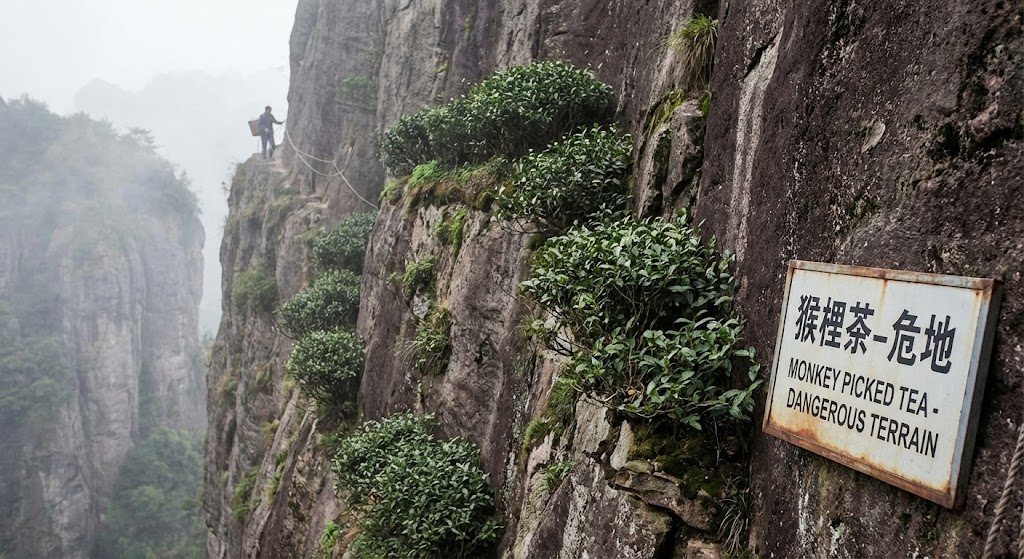
1. The Myth: Trained Monkeys Harvesting Wild Tea
The legend: In remote Wuyi Mountains (Fujian Province, China), wild tea trees grow on inaccessible cliffs—too dangerous for humans to reach. Solution: train monkeys (macaques) to climb, pick tender leaves, bring down harvest. Marketing claim: "Monkey-picked oolong" (猴采茶 hóu cǎi chá) commands premium prices ($100-500+ per 50g vs. $20-50 for regular Da Hong Pao)—marketed as rare, wild-harvested, ethically questionable animal labor. The appeal: Exotic origin story (adventure narrative, romantic past like clipper ships), exclusivity (supposedly limited quantity), and "natural" authenticity (wild trees vs. plantation cultivation, similar mystique to original mother tree legends).
The reality: Complete marketing fiction. No credible evidence of monkey tea-picking in modern era: Historical mentions: References in Tang Dynasty texts (Lu Yu's Cha Jing mentions monkeys near tea plants, but as wild animals, not trained laborers), Ming Dynasty accounts (travelers' tales, unverified anecdotes—same credibility as medieval bestiaries). Modern practice: Zero documented cases (no videos, photographs, or eyewitness accounts from reputable sources—suspicious for supposedly active industry). Animal behavior: Macaques can't be trained for selective tea picking (require discrimination between leaf grades, gentle handling to avoid bruising—beyond primate cognitive capacity for commercial viability). Economics: Training/maintaining monkey workforce costs MORE than human labor (food, veterinary care, handler wages, liability—irrational business model).
The physics of cliff tea harvesting: Real method: Human climbers with ropes and harnesses (like Sen no Rikyu's commitment to tea mastery, requires dedication). Wuyi cliff tea (岩茶 yán chá "rock tea") grows on steep slopes—accessible but dangerous: Harvest technique: (1) Early morning climb (4-6am, cool temperatures, dew makes rock slippery), (2) Rope systems (anchored at top, climber rappels/traverses), (3) Selective picking (two leaves + bud, same standards as lowland tea, requires expertise like Gongfu precision), (4) Basket transport (woven bamboo, slung over shoulder, capacity ~2-5kg per climb). Daily yield: Experienced climber harvests 10-20kg fresh leaves/day (vs. 30-50kg on flat plantation—cliff access reduces efficiency 50-70%, justifying higher prices WITHOUT monkey mythology).
Spot Fake "Monkey-Picked" Tea
Price test: If under $200/50g, definitely not real (even if monkeys existed, labor cost justifies $500+). Seller credibility: Reputable vendors like specialty Gongfu suppliers don't claim monkey-picking—only tourist traps do. Certificate absence: No official Chinese certification for monkey labor (would require animal welfare documentation—doesn't exist). Smart buy: Purchase legitimate Wuyi cliff tea (岩茶 label, producer name, harvest date)—pays for terroir and artisan processing like Song masters, not fabricated animal story. Save money, get better tea.
2. Why the Myth Persists: Marketing Psychology
Storytelling premium: Consumers pay for narrative (Joseph Campbell's Hero's Journey applied to tea—monkeys = magical helpers, quest for rare treasure, like clipper race drama). Neuromarketing: Stories activate brain regions (hippocampus, amygdala—emotion + memory formation), creating stronger brand attachment than factual descriptions. Study example: Wine tasting experiments (identical wine, different backstories—participants rate "monk-blessed vineyard" 20-30% better than "industrial bottling," measurable placebo effect). Same principle: "monkey-picked" tea tastes better because brain expects superiority (anticipation shapes perception via cultural expectations like Turkish tulip glasses).
Exoticism fetish: Western markets especially vulnerable (Orientalism, Edward Said critique—Asia as mysterious/magical Other, consumers want "authentic" exotic experience). Monkey picking fits stereotype: Colonial gaze: Reinforces primitive/natural Asia trope (vs. modern industrialized West—ignores China's sophisticated tea technology, reduces complex culture to tourist fantasy). Privilege display: Buying expensive exotic tea signals wealth/sophistication (Thorstein Veblen's conspicuous consumption—paying premium for story = status marker, like Persian ghand ritual's social currency). Guilt-free luxury: "Wild-harvested" implies eco-friendly (vs. plantation monoculture—though wild tea often MORE environmentally destructive, disrupting ecosystems for profit).
The psychology of belief: Motivated reasoning: After spending $400 on "monkey tea," cognitive dissonance forces belief (admitting scam = acknowledging foolishness—easier to defend purchase, convince self it's real). Social reinforcement: Telling friends dramatic story ("My tea was picked by trained monkeys!"—gets attention, admiration, like Victorian parlor fortune-telling performances). Sunk cost fallacy: Invested money + ego = resistant to contrary evidence ("All those scientists are wrong, MY tea is special"—confirmation bias locked in). The tragedy: real Wuyi cliff tea IS special (mineral-rich rock soil creates unique flavor profile, skilled processing, genuine terroir—doesn't NEED monkey fiction, but fiction sells better than chemistry).
| Tea Marketing Myth | Kernel of Truth | Fabricated Elements | Price Premium |
|---|---|---|---|
| Monkey-Picked Oolong (modern claims) | Wuyi cliff tea hard to harvest (human climbers, dangerous, labor-intensive like Kashmiri hand-churning) | Trained monkeys doing work (no evidence, economically irrational, animal behavior impossible) | 300-500% markup over regular Wuyi oolong (fiction tax) |
| Virgin Girl Pickers (historical + modern) | Young workers often preferred (nimble fingers, better at selective picking like Gongfu precision) | Must be unmarried virgins, sexual purity affects tea (patriarchal control, fetishization) | 50-200% markup ("imperial tribute" branding) |
| Panda Dung Tea (modern gimmick) | Animal manure fertilizes tea plants (nitrogen-rich, common practice like East Frisian local cultivation) | Panda dung specifically superior (bamboo diet = nutrient-poor fertilizer, worse than cow/chicken manure) | 1000%+ markup ($200+/50g, novelty drives price not quality) |
| Silver Needle Poison Detection (historical myth) | Silver tarnishes (oxidation reaction with sulfur compounds, real chemistry) | Detects poison in tea (most poisons don't react with silver—arsenic, cyanide undetectable) | Ceremonial value only (modern replicas $50-200, decorative like chabana vessels) |
3. The Genuine Cliff Tea: Wuyi Rock Oolong Terroir
Why Wuyi tea costs more (legitimately): Geology: Danxia landform (red sandstone cliffs, iron/manganese-rich soil pH 4.5-5.5—mineral uptake creates distinct flavor, similar terroir concept to Rize's Black Sea climate). Microclimate: Mist-shrouded valleys (high humidity 70-90%, moderate temperatures 15-25°C year-round, filtered sunlight—slow growth concentrates compounds). Biodiversity: Old-growth forest surrounds tea (ecosystem complexity, beneficial insects, mycorrhizal fungi—plant health without pesticides, like Mongolian wild-harvested plants). Age of plants: Some bushes 50-100+ years old (deep root systems tap subsoil minerals, genetic diversity from seed propagation vs. clonal plantation monotony).
The chemistry of rock tea: Mineral absorption: Tea roots extract from sandstone (iron → floral notes, manganese → sweetness, potassium → umami, trace minerals → complexity). Polyphenol profile: Higher catechin oxidation (oolong processing 30-70% oxidation creates theaflavins + thearubigins—fruity, roasted, smooth like Song Dynasty tea masters' craft). Volatile aromatics: >100 compounds identified (linalool, geraniol, indole—floral/fruity/roasted notes, concentration varies by microterroir within 70 sq km Wuyi region). Yan yun (岩韵): "Rock rhyme," minerality character (umami aftertaste, cooling throat sensation, persistent sweetness—subjective but consistent among tasters, like grandpa style's flavor evolution).
Processing mastery: Wuyi oolong requires 20+ steps (withering, tossing, oxidation monitoring, kill-green, rolling, roasting—each stage affects final flavor like Tang Dynasty's 24 implements): Charcoal roasting: Traditional method (longyan charcoal 龙眼 "dragon eye" wood, low temperature 90-120°C, 8-12 hours, repeated 2-4 times over months—caramelizes sugars, reduces astringency, extends shelf life). Master roaster skill: Apprenticeship 10-20 years (reading tea moisture, adjusting heat, timing—tacit knowledge like tea master Sen no Rikyu's discipline). Result: Complex flavor (orchid, cinnamon, roasted nuts, sweet aftertaste—justifies $50-150/50g for premium craft, NO monkey needed).
Brew Wuyi Oolong Properly
Gongfu method essential: 6-8g per 100ml gaiwan (high ratio like Chaozhou 1:15), 95-100°C water, 20-30 second first steep. Multiple infusions: 6-10 steeps typical, flavor evolves (early = floral, middle = roasted depth, late = sweet mineral—experience like Senchado's contemplative progression). Vessel: Yixing pot or porcelain gaiwan (clay absorbs/seasons like tea pets, porcelain neutral). Water quality: Filtered/spring water crucial (minerals compete with tea's—soft water lets rock terroir shine). Taste the geology, not the mythology.
4. Historical Monkey References: Lost in Translation
Tang Dynasty mentions: Lu Yu's Cha Jing (760 CE) describes wild tea areas "where monkeys gather" (猴采 hóu cǎi could mean "monkey-gathered" as in monkeys EAT tea shoots, not PICK for humans—nuance lost in translation, like Tang salt debates). Buddhist texts: Monks encountering monkeys near mountain tea groves (animals as fellow forest inhabitants, not laborers—spiritual metaphor about nature's harmony, misread as practical instruction). Poetic language: Chinese classical poetry uses animals symbolically ("monkey picks tea" = metaphor for remote/wild/difficult harvest, not literal description—Western readers take figurative as factual).
Colonial-era distortions: European tea traders (1700s-1800s) wrote travelogues (exotic tales to justify prices, like clipper ship race romanticism): Robert Fortune (1848): British botanist infiltrating China's tea regions (mentions hearing about monkey picking—third-hand rumor, never witnessed, but published as fact in A Journey to the Tea Countries of China). Amplification: British press sensationalized ("Curious Method of Chinese Tea Harvest!"—sold newspapers, embedded myth in Western consciousness). Persistence: Once in Victorian literature (reprinted, referenced, assumed true—pre-internet information ecosystem couldn't fact-check, like Victorian spiritualism spreading unchecked).
The telephone game effect: Original: "Tea from places where monkeys live" (describes habitat). Translation 1: "Monkey area tea" (ambiguous). Translation 2: "Monkey-picked tea" (active labor implied). Marketing: "Trained monkeys harvest rare cliff tea!" (full fabrication). Modern result: Sellers believe own marketing (repeat lie enough, becomes truth—merchants genuinely think it's historical practice, like tea magic beliefs). The lesson: verify primary sources (read original Chinese texts, consult historians, don't trust English tea marketing—applies to Da Hong Pao legends and virgin picker myths too).
5. Animal Labor in Tea: What's Actually Real
Water buffalo plowing: Used in some tea plantations (Yunnan, Assam—draft animals prepare soil, like mate plantation agriculture). Elephants: Historical timber transport in tea regions (logs for factory construction, fuel—not tea harvest itself). Guard geese: Some organic farms use (aggressive honking deters thieves, pesticide-free pest control—actually documented unlike monkeys). Cats/dogs: Pest control (mice eat stored tea, dogs/cats protect warehouses—normal farm animals, not exotic labor). Insects: Pollination for tea seed production (bees visit tea flowers, but commercial tea = vegetative propagation/clones, so minimal insect involvement).
Why monkeys AREN'T used: Selectivity impossible: Tea picking requires judgment (two leaves + bud, avoid damaged/old leaves—monkeys lack fine discrimination, would grab random foliage like CTC bulk processing). Handling damage: Rough grasping bruises leaves (premature oxidation, quality loss—requires gentle pinch-and-twist technique, beyond primate motor control). Training cost: Months to train basic tasks (sit, fetch—selective tea picking = PhD-level for monkey cognition, impractical). Safety liability: Macaques bite (carry disease, unpredictable aggression—worker's comp nightmare, insurance impossible). Efficiency: Human picker = 30-50kg/day, hypothetical trained monkey = maybe 5-10kg/day at 10× training/supervision cost (economically absurd).
The ethical dimension: IF monkey picking were real (it's not, but hypothetically): Animal welfare: Forced labor violates ethics (captivity, coercion, stress—comparable to virgin picker exploitation, different victim). Conservation impact: Capturing wild monkeys depletes populations (macaques already threatened by habitat loss, poaching for pet trade—tea industry adding pressure = ecological damage). Consumer complicity: Buying "monkey tea" funds abuse (even if fake, normalizes idea of animal labor—creates market incentive to make it real). The irony: People buy "monkey tea" thinking it's eco-friendly wild harvest (actually supports either fabrication or potential cruelty—like greenwashing in modern tea marketing).
Support Ethical Tea Sourcing
Ask questions: Vendor claims exotic harvest? Request documentation (harvest photos, picker interviews, certification—legitimate producers provide, scammers deflect like tarof vs genuine hospitality). Fair-trade certified: Ensures human pickers paid living wages (no child/forced labor, safe conditions—more important than fake monkey story). Direct trade: Importers visiting farms (relationship transparency, verifiable sourcing like Chaozhou's artisan networks). Price reality: Premium tea costs more for REAL reasons (terroir, processing skill, labor—not fiction). Support craftsmanship, reject marketing theater.
6. The "Natural" Fallacy: Wild vs. Cultivated Tea
Wild tea appeal: Marketing implies superior (untouched nature, no chemicals, primordial purity—romantic ideal like swagman's bush tea). The reality: Wild tea is just different, not better: Genetic variability: Wild plants = diverse genetics (inconsistent flavor year-to-year, batch-to-batch—exciting for adventurous drinkers, frustrating for consistency seekers like Hong Kong cha chaan teng standards). Environmental stress: Wild trees face harsher conditions (drought, pests, competition—can increase polyphenols/aromatics OR create bitter/astringent tea, unpredictable). Lower yield: Wild harvest = scattered plants (not efficient rows, requires hiking/searching—10× labor vs. plantation, genuinely higher cost).
Cultivated tea advantages: Selective breeding: Centuries of variety development (Tieguanyin, Da Hong Pao cultivars—optimized for flavor, yield, disease resistance, like East Frisian regional varieties). Quality control: Managed fertilization, pruning, shade (manipulates plant chemistry—increases amino acids, controls bitterness, consistent results like Japanese precision). Accessibility: Flat plantations easier/safer to harvest (no cliff climbing, no rope work—lower labor cost, lower price, more accessible quality). Sustainability: Well-managed plantations preserve land (vs. wild foraging that can denude natural areas, like overharvesting wild plants).
The "natural" marketing trap: Appeal to nature fallacy: Natural ≠ better (arsenic is natural, vaccines are artificial—nature doesn't care about human preferences, like pre-scientific beliefs). Purity myth: Wild tea still gets processed (withered, oxidized, roasted—human intervention shapes final product regardless of origin). Environmental cost: Increased demand for wild tea = habitat destruction (people enter forests, trample vegetation, deplete rare plants—opposite of eco-friendly, like unsustainable harvesting). The wise approach: Judge tea by cup quality (taste, aroma, mouthfeel—origin story is entertainment, flavor is reality), support sustainable practices (organic certification, fair labor, reforestation—actual environmentalism vs. "wild" marketing).
7. Debunking Process: How to Verify Tea Claims
Step 1: Demand specificity. Vague claims = red flags ("ancient method," "secret recipe," "rare harvest"—if seller can't name: specific farm, harvest date, processing steps, cultivar = hiding something like Da Hong Pao clone deception). Step 2: Google the seller. Established reputation (years in business, customer reviews, transparent contact info—scammers use new websites, stock photos, fake addresses). Step 3: Check Chinese sources. If claim is "traditional Chinese practice," verify in Chinese (Baidu search, Chinese tea forums—monkey picking = 猴采茶, zero credible Chinese sources confirm modern practice).
Step 4: Price sanity test. Too cheap = fake ("monkey tea" for $30/50g impossible—even fake labor costs more), too expensive = exploitation (>$500/50g unless documented rarity like actual mother tree harvest from museum). Step 5: Ask for evidence. Photos of harvest (with metadata/geotags), third-party certification (organic, fair-trade, origin), farmer contact info (email/WeChat—if seller refuses connection = suspicious). Step 6: Taste blindly. Remove packaging, brew without knowing story (if "monkey tea" tastes same as regular Wuyi oolong = you paid for fiction, like cold reading tricks). Step 7: Consult experts. Post in r/tea, TeaChat forums, specialty tea Discord (experienced community spots scams instantly, shares vendor warnings).
The burden of proof: Extraordinary claims require extraordinary evidence (Carl Sagan principle): Monkey tea claim: Extraordinary (violates known animal behavior, economics, documented practice). Evidence required: Video of training process, financial records showing costs, veterinary certification, government permits (none exist publicly—claim fails). Null hypothesis: Assume false until proven true (opposite of marketing's "assume true, disprove if you can"—science demands proof, consumers should too). The lesson: Skepticism protects wallet and supports honest producers (gullibility rewards fraud, punishes transparency—every dollar spent on fake monkey tea = dollar NOT spent on legitimate artisan tea).
| Verification Method | What to Look For | Red Flags | Green Flags |
|---|---|---|---|
| Seller Transparency (contact/history) | Years in business, physical address, owner bio (like Rize family tea gardens) | New website, PO box only, stock photos, no owner name, generic descriptions | 10+ years operating, tea house address, owner travels to origin, customer testimonials with photos |
| Product Details (specificity test) | Farm name, harvest date, cultivar, processing method (precise like Gongfu ratios) | "Ancient recipe," "secret location," "mysterious process," no dates, vague origin | "Zhengyan Shuixian, Huiyuan farm, April 2025 harvest, medium roast charcoal 3×" (specific = verifiable) |
| Pricing Logic (economic sanity) | Cost breakdown (labor, processing, import—transparent like Persian tea shop economics) | Huge markup with only story justification, "priceless" claims, auction comparisons to museum pieces | Premium 2-3× base tea due to documented factors (elevation, age of plants, roasting time, hand-processing) |
| Community Reputation (social proof) | Reviews on r/tea, TeaChat, Steepster (unbiased like cha chaan teng word-of-mouth) | Only reviews on own site, all 5-star, generic praise, no photos, suspected bots | Mixed reviews (honest criticism + praise), detailed brewing notes, community discussion, repeat customers |
8. The Real Heroes: Human Tea Pickers
Invisible labor: Monkey myth erases human workers (romanticizes harvest, ignores actual pickers—mostly women, low wages, hard conditions like imperial virgin myths). Harvest reality: 4am start (before heat, dew on leaves makes picking easier like East Frisian morning rituals), 8-10 hour days (bent over plants, repetitive motion injuries, back pain, no breaks), quota pressure (paid by weight, encourages speed over selectivity—conflicts with quality, like CTC mass production). Wages: $2-10/day in many regions (below living wage, no benefits, seasonal employment—poverty despite producing luxury product).
The skill involved: Expert pickers work by touch (fingers recognize leaf grade without looking, 30-50kg high-quality harvest/day vs. 10-20kg for beginners—experience matters like Gongfu tea mastery). Training: 2-5 years apprenticeship (learning plant varieties, seasonal timing, weather adaptation—comparable to Song Dynasty tea competitions). Physical demands: Finger dexterity (arthritis common, repetitive strain—hands ruined by 40s for many pickers), heat tolerance (30-40°C sun exposure, dehydration risk, heat stroke danger), terrain navigation (cliff tea pickers = elite athletes, climbing skills like outback swagmen's endurance).
The ethical imperative: Fair wages: Living wage = $15-30/day minimum (triple current rates, still tiny fraction of retail price—$400 tea could easily pay $10 more to picker, 2.5% cost increase for 300% wage raise). Safe conditions: Shade breaks, water access, first aid, harnesses for cliff work (basic dignity, like suffragette labor rights). Job security: Year-round contracts not seasonal (provide stability, benefits, retirement—same employment standards we expect in West). Recognition: Name pickers on packaging ("Harvested by Zhang Wei team, 20 years experience"—credits labor like wine names winemakers, like artisan tea pet signatures). The choice: Support brands prioritizing people (fair-trade certified, direct-trade transparent, worker profit-sharing—costs slightly more, tastes like justice).
Find Ethically-Sourced Oolong
Certifications: Fair Trade USA, Rainforest Alliance, UTZ (verify labor standards like mate cooperatives). Direct-trade vendors: Yunnan Sourcing (owner visits farms yearly), Crimson Lotus Tea (transparent sourcing), White2Tea (direct farmer relationships like Chinese tea culture). Ask questions: Email vendor about picker wages, working conditions (responsive transparency = good sign, deflection = avoid). Pay fairly: $50-100/50g for quality Wuyi oolong supports real farmers (not monkey theater). Taste labor dignity in every cup.
9. Moving Forward: Better Tea Stories
What to celebrate instead: Terroir science: Geology shapes flavor (rock composition, water minerality, microclimate—fascinating chemistry like Kashmiri pink transformation). Processing artistry: Master roasters' skill (charcoal management, timing, sensory judgment—decades of apprenticeship like Sen no Rikyu's discipline). Cultivar diversity: Hundreds of tea varieties (Rougui, Shuixian, Tieguanyin—genetic heritage worth preserving like Japanese cultivar knowledge). Human expertise: Pickers, processors, blenders (skill and labor deserving recognition, not fictional animals). Cultural heritage: Centuries of tea tradition (philosophical depth, aesthetic refinement, community ritual—richer story than monkey gimmick).
The narrative shift: From exotic/mysterious to respectful/accurate: Old marketing: "Trained monkeys climb sacred cliffs to harvest rare treasure for wise emperors!" (Orientalist fantasy, erases reality). New marketing: "Expert pickers harvest 50-year-old bushes from mineral-rich cliffs, hand-roasted by fifth-generation master using traditional charcoal methods" (equally compelling, actually true, honors craft). The benefit: Educated consumers demand quality (not fiction), support ethical producers (not scammers), preserve culture (not caricature—like Tang Dynasty reverence). The result: Better tea industry (rewards authenticity, punishes fraud, raises standards for everyone).
The final lesson: Tea doesn't need lies. Real stories are better: Cliff tea's geology (millions of years of tectonic uplift creating perfect soil), human endurance (pickers risking life for harvest like clipper sailors), artisan mastery (roasting knowledge passed through generations like Emperor Huizong's obsession), chemical complexity (hundreds of compounds creating flavor, like teh tarik's foam science). The truth is enough. Monkeys are cute, but reality is profound. Choose depth over theater. Support honest producers. Drink tea that respects intelligence—yours and the people who made it. That's the real premium: tea with integrity, stories with truth, prices that reflect value not fantasy. No monkeys required. Just skill, patience, earth, and human hands. That's the authentic magic.
Comments