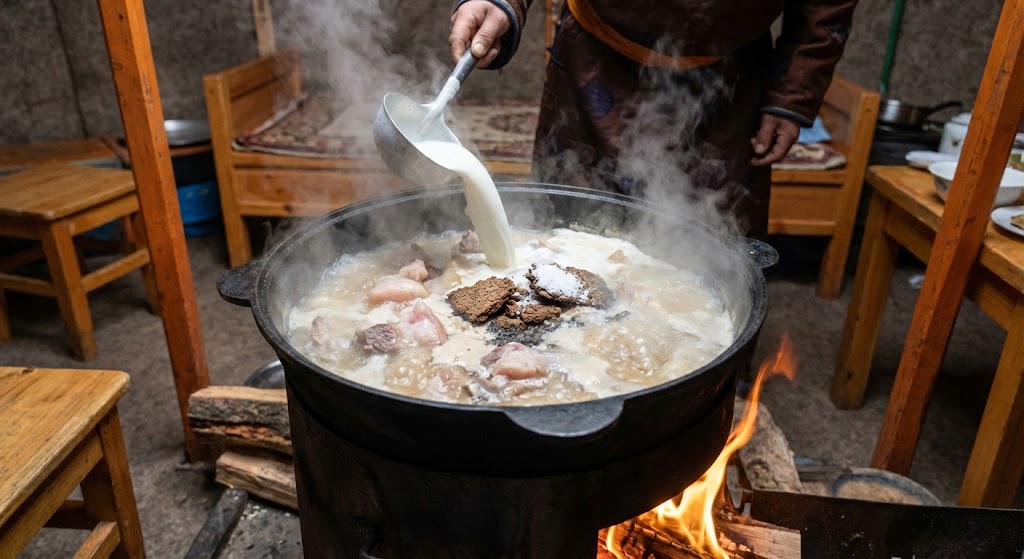
1. Salt-Tannin Chemistry: Why Suutei Tsai Isn't Bitter
Mongolian suutei tsai (salt milk tea) defies expectations: despite using low-quality brick tea and long boiling times (30-60 minutes), it tastes smooth rather than astringent. The secret is sodium chloride chemistry. Salt ions (Na+ and Cl-) bind to polyphenol compounds in tea, reducing their ability to precipitate salivary proteins—the molecular mechanism behind astringency perception.
When tea tannins (primarily epigallocatechin gallate and theaflavins in aged brick tea) encounter salt, the chloride anions form hydrogen bonds with hydroxyl groups on polyphenol molecules. This molecular occupation prevents tannins from cross-linking with proline-rich proteins in saliva—the reaction that creates "dry mouth" sensation. The result: even heavily oxidized, coarse brick tea becomes palatable.
This chemistry contrasts sharply with sweet tea traditions. In Persian tea, sugar masks bitterness through taste competition (sweetness vs. astringency). In Southern sweet tea, cold temperatures reduce polyphenol solubility. Mongolian salt tea actively neutralizes bitterness at molecular level—a solution born from necessity when only coarse tea grades reached the steppe.
| Tea Component | Molecular Weight | Salt Interaction | Effect on Taste |
|---|---|---|---|
| EGCG (Epigallocatechin Gallate) | 458 g/mol | Cl- binds to 8 hydroxyl groups | Reduced astringency, less protein precipitation |
| Theaflavins | 564-868 g/mol | Na+ disrupts polyphenol aggregation | Smoother mouthfeel, less "grippy" texture |
| Caffeine | 194 g/mol | Minimal (caffeine is polar, not affected by salt) | Bitterness remains (salt doesn't mask caffeine taste) |
| Thearubigins | ~1000 g/mol (variable) | Complex formation with cations | Mellowed "browned" flavor, less harsh |
2. Mutton Fat Emulsification: Lipid Physics on the Steppe
Traditional suutei tsai includes mutton fat (tail fat or bone marrow), creating an emulsion that modern Western palates find challenging but Mongolian nomads require for survival. In winter temperatures reaching -40°C, the average herder burns 3500-4500 calories daily (vs. 2000-2500 for sedentary adults). Tea becomes liquid calorie delivery system.
Mutton tail fat is 95% saturated fat (primarily palmitic and stearic acids), solid at room temperature but liquid above 40°C. When added to boiling tea (98-100°C at high altitude), fat droplets disperse through mechanical agitation. Milk proteins (casein micelles) act as natural emulsifiers—their hydrophobic regions bind fat, hydrophilic regions face water, creating stable suspension.
Expert Tip: Modern Fat Substitutions
Contemporary urban Mongolians often substitute butter or ghee for traditional mutton fat—easier to store and less gamey. Use 1-2 teaspoons butter per liter of tea. The emulsion won't be as stable (butter has lower protein content than mutton marrow), but flavor is milder for uninitiated palates. Never use vegetable oil—lack of saturated fat means oil floats rather than emulsifies, creating unpleasant slick on surface.
Compare this to Tibetan butter tea which uses yak butter with churning technique, or Kashmiri noon chai with buffalo milk fat. All are high-altitude, high-calorie adaptations to extreme climates—lipid-rich tea as survival food rather than luxury beverage.
3. Brick Tea Logistics: The Compression Advantage
Mongolian tea culture is inseparable from brick tea (tuiles de thé in French colonial trade, zhuancha in Chinese). Compressed tea isn't artisanal choice but logistics necessity. Loose leaf tea would disintegrate during horseback transport across thousands of kilometers from Chinese tea-growing regions to Mongolian grasslands.
Brick tea production involves steaming tea leaves (typically coarse grades or "seventh grade" tea—stems and mature leaves), compressing into molds under hydraulic pressure (50-100 PSI), then drying. The resulting brick is 90% less volume than equivalent loose tea, survives mechanical stress, and resists moisture damage. Historical Tea-Horse Road caravans could carry 10x more product as bricks vs. loose leaf.
| Transport Format | Volume Efficiency | Durability | Historical Use |
|---|---|---|---|
| Compressed Brick (zhuancha) | 10:1 compression ratio | High (survives horseback, extreme temps) | Tea-Horse Road, Silk Road, Mongolian trade |
| Loose Leaf | 1:1 (no compression) | Low (crumbles, moisture-sensitive) | Short-distance trade, local consumption |
| Tuo Cha (Bowl-shaped) | 5:1 compression | Medium-high (stackable, less impact resistance) | Yunnan-Tibet trade routes |
| Bamboo Tube Tea | 3:1 compression (limited by tube diameter) | Medium (bamboo protects but brittle) | Dai minority regions, jungle transport |
| Tea Bags (modern) | 1:1 (pre-portioned, packaging overhead) | Low (moisture-sensitive, fragile) | 20th century innovation, convenience over transport |
4. Boiling Protocol: The 60-Minute Simmer Philosophy
Unlike Grandpa style steeping or Gongfu precision, Mongolian tea is boiled aggressively for 30-60 minutes. This extended extraction serves multiple functions: maximum caffeine extraction (critical for alertness during night herding), complete tannin release (neutralized by salt), and pasteurization of water sources that may be contaminated.
The long boil also breaks down large polyphenol molecules into smaller, more bioavailable compounds. Studies show that 60-minute boiling extracts 95% of EGCG vs. 60% from 5-minute steeping. While this would create undrinkable bitterness in unsalted tea, the salt-tannin binding makes it palatable. The practice is closer to Tang Dynasty soup tea than modern infusion methods.
Expert Tip: The Rehydration Rule
Brick tea is bone-dry (2-5% moisture vs. 7-9% for loose leaf). Before boiling, break off chunks and soak in cold water for 10-15 minutes—this rehydrates compressed leaves and reduces initial "dusty" flavor from broken cell walls. Nomads traditionally use morning snow melt for this step. Modern preparation: use filtered water at room temperature, discard soak water, then proceed with boiling fresh water + tea.
5. Milk Choice: Mare's Milk vs. Cow's Milk Chemistry
Traditional suutei tsai uses mare's milk (airag-related fermented dairy) or sheep's milk, not cow's milk. The difference is protein structure. Mare's milk has lower casein content (18 g/L vs. 26 g/L in cow's milk) and higher whey protein—making it less prone to curdling when added to acidic, tannin-rich tea.
When milk proteins encounter tea polyphenols, casein micelles can aggregate and precipitate—creating "tea scum" that floats on surface. Mare's milk's lower casein ratio and smaller micelle size (150 nm vs. 200 nm for bovine casein) reduces this effect. Modern Mongolians using store-bought cow's milk often add milk first, then tea—preventing temperature shock that triggers curdling (similar to British milk-first vs. tea-first debate).
| Milk Type | Fat Content | Protein Content | Curdling Risk in Tea |
|---|---|---|---|
| Mare's Milk | 1-2% | 1.8% (high whey ratio) | Low (small casein micelles, acid-tolerant) |
| Sheep's Milk | 6-8% | 5.5% (high casein) | Medium (rich flavor, stable at high temps) |
| Cow's Milk (whole) | 3.5% | 3.3% (high casein) | Medium-High (depends on tea acidity and temp) |
| Yak Milk | 6-7% | 4.5-5% | Low (adapted to high-alt, acidic foods, see Tibetan butter tea) |
| Buffalo Milk | 7-8% | 4.5% | Medium (used in noon chai, high fat stabilizes) |
6. Ger Architecture and Tea Service: Spatial Anthropology
In traditional Mongolian ger (yurt), tea service follows strict spatial hierarchy tied to architecture. The ger door always faces south; the north side (khoimor) is sacred space where family altar sits. Tea is served clockwise from elder (seated north-west, position of honor) to youngest (seated near door, lowest status). This mirrors mate circle rotation but adds architectural dimension.
The central hearth (where tea simmers continuously) divides ger into male (west) and female (east) sides. Women prepare and serve tea from east side, but serving order respects age and visitor status over gender. Refusing tea is social offense—travelers in Mongolian grasslands report being served 8-10 bowls daily when visiting multiple gers.
Expert Tip: The Receiving Gesture
When offered suutei tsai, receive bowl with right hand supporting from beneath, left hand touching right elbow—this "two-handed" receiving gesture shows respect. Sip three times minimum (similar to East Frisian 3-cup rule) before setting bowl down. Never dump tea outside ger (insults host), but if full, hold bowl without drinking—signal you're satiated. The continuous pot on hearth means endless refills unless you actively signal completion.
7. Nomadic Nutrition: Tea as Electrolyte Replacement
Mongolian herders lose significant sodium through sweat during summer migrations (moving entire camps 50-100 km seasonally). Salted tea provides electrolyte replacement without refrigeration or complex preparation. The typical recipe (1 tsp salt per liter) delivers ~2300 mg sodium—nearly the entire RDA in beverage form.
This contrasts with modern sports drinks (800-1100 mg sodium per liter) which are dilute by comparison. The high salt concentration also triggers thirst suppression (paradoxically making people drink less water later), beneficial when water sources are scarce on open grassland. The practice parallels Somali shaah's sugar-heavy formula (energy in hostile climate) or British builder's tea with sugar for manual laborers.
8. Modern Adaptations: Instant Suutei Tsai
Urban Mongolia now has instant suutei tsai packets (tea powder + milk powder + salt), dissolving tradition into convenience. Brands like "Khan Tea" market these to diaspora Mongolians and curious tourists. The chemistry is similar to instant Hong Kong milk tea powders or bubble tea mixes—spray-dried tea extract with maltodextrin carriers.
Purists argue this destroys ritual and flavor complexity (no fat emulsion, no brick tea earthiness), but packets serve modern lifestyles. Young Mongolians in Ulaanbaatar apartments lack space for 60-minute simmering but crave nostalgic connection to nomadic heritage. The instant format parallels matcha's transformation from whisked ceremony to Starbucks lattes—tradition commodified for global market.
9. Step-by-Step: Making Traditional Suutei Tsai
Ingredients: 50g brick tea (Pu-erh or dark tea), 1.5L water, 500mL milk (mare's, sheep's, or whole cow's), 1-2 tsp salt, 1 tbsp butter or mutton fat (optional), grain (millet/rice) or dried meat (optional for boortsog-style "tea soup").
Step 1 - Break and soak: Break brick tea into 2-3cm chunks with knife or hammer. Soak in 250mL cold water for 10-15 minutes, drain and discard soak water (removes dust and excessive bitterness).
Step 2 - Boil water: Bring 1.5L fresh water to rolling boil in heavy pot (cast iron or enamel—never aluminum which reacts with tannins). Add rehydrated tea chunks.
Step 3 - Simmer: Reduce to low simmer, partially cover pot. Simmer 30-60 minutes, stirring occasionally. Tea should turn dark brown, almost black. Add water if level drops significantly.
Step 4 - Add salt and fat: Add 1-2 tsp salt (to taste—start with less, add more). If using butter/fat, add now and stir vigorously to emulsify (should disperse into tiny droplets, not float as oil slick).
Step 5 - Add milk: Pour in milk, stir gently. Return to simmer for 5-10 minutes (do not boil vigorously—prevents curdling). Taste and adjust salt. Strain out tea leaves if desired (traditional method leaves them in pot for continuous brewing).
Step 6 - Serve: Ladle into bowls immediately. Suutei tsai is drunk hot—unlike iced tea cultures. Serve with boortsog (fried dough) or dairy products for complete nomadic meal.
Comments