The Princess and the Tea Horse Road
Tibet is too cold and high to grow tea. Yet, it consumes more tea per capita than almost anywhere else. How did this happen? The answer lies in a political marriage.
In 641 AD, the Tibetan King Songtsen Gampo married the Chinese Princess Wencheng of the Tang Dynasty. According to legend, she brought with her sophisticated Han culture, Buddhism, and—crucially—tea. The Tibetan aristocracy quickly adopted the drink, but it wasn't until the 11th century that it became a staple for the common people.
This insatiable demand created the Chamagudao, or the Tea Horse Road. Tibet had powerful war horses that China needed to fight nomadic invaders. China had the tea Tibet craved. A massive trade network emerged, winding through the treacherous mountains of Yunnan and Sichuan. Human porters carried up to 90kg of tea on their backs, trekking for months to reach Lhasa.
The Holy Trinity: Tea, Butter, Salt
Po Cha is not just tea; it is a meal. The recipe evolved out of necessity. In the thin, dry air of the Himalayas, dehydration is a constant threat, and the body burns fat rapidly to maintain core temperature. A watery green tea offers no sustenance.
1. The Tea: Hei Cha (Dark Tea)
You cannot use Lipton for this. The tea used is Hei Cha (Dark Tea), specifically compressed "Tea Bricks" from Sichuan (Ya'an) or Yunnan (Pu-erh). These bricks were made from coarse leaves and twigs, fermented to withstand the long journey. This fermentation creates a probiotic-rich, mellow, earthy base that aids digestion—crucial for a diet heavy in yak meat and barley.
2. The Fat: Dri (Yak) Butter
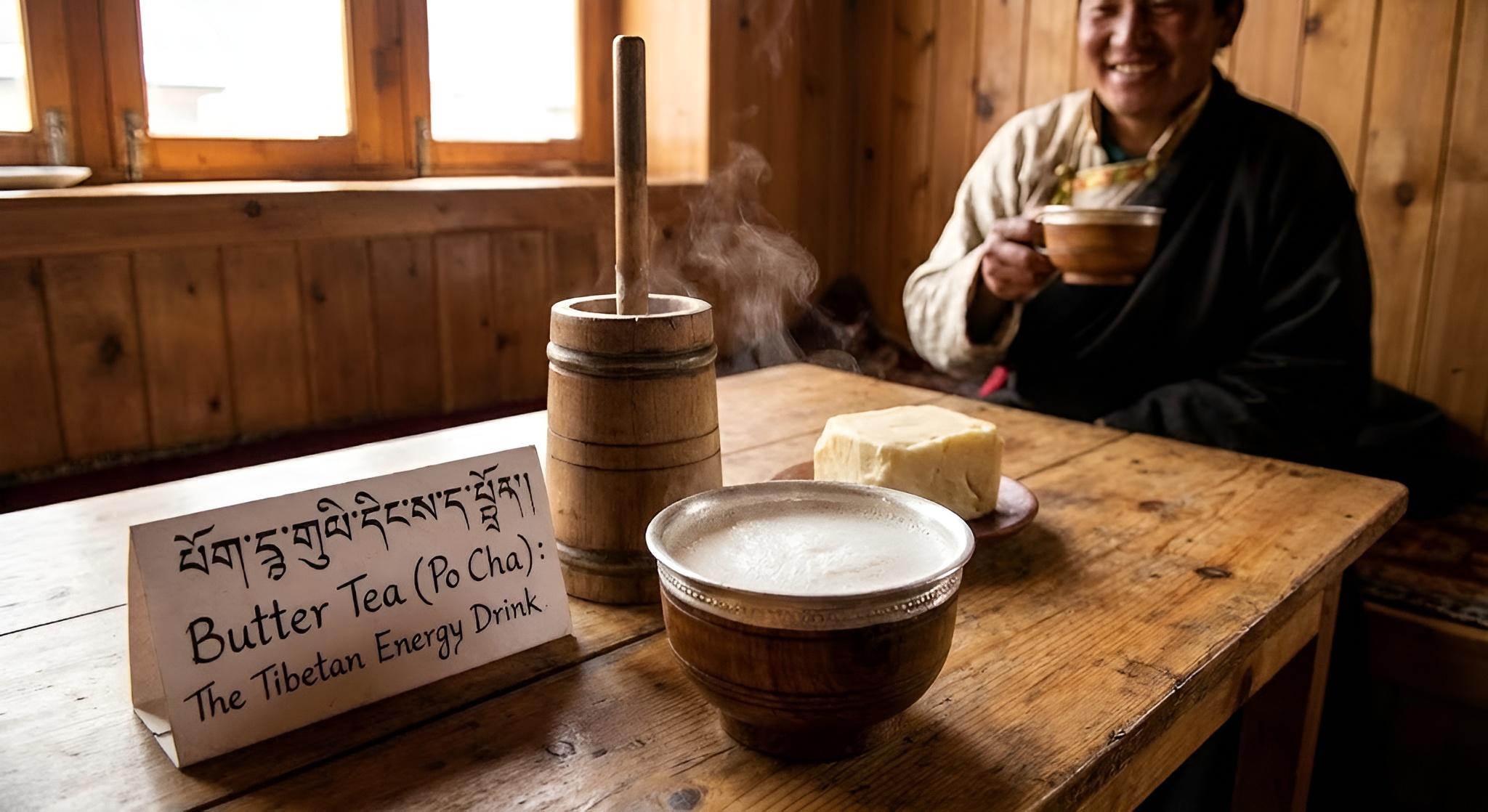
Authentic Po Cha uses butter made from the milk of the Dri (female Yak). It has a higher fat content than cow milk and a distinct, pungent, cheesy aroma that can be challenging for foreigners. The fat provides immense caloric density (energy) and coats the lips, preventing them from cracking in the dry wind.
3. The Salt: Electrolytes
Sugar was historically rare and expensive in Tibet. Salt, harvested from high-altitude salt lakes, was abundant. Adding salt to the tea replaces electrolytes lost through sweat and exertion, preventing cramping and altitude sickness.
Expert Tip: Why Bricks?
Tea was compressed into bricks for two reasons: density and currency. A porter could carry more tea if it was a solid block rather than loose leaves. Furthermore, the bricks were so valuable they were used as money. Even today, in remote parts of the Himalayas, tea bricks are sometimes bartered for goods.
The Technology: The Dongmo Churn
Making Po Cha is a workout. The tea leaves are first boiled for hours until the liquid is almost black (a concentrate called chaku). This liquid is then poured into a Dongmo—a tall, slender wooden cylinder with a plunger inside.
The butter and salt are added, and the mixture is churned vigorously. This is not just mixing; it is emulsification. The churning forces the fat droplets to suspend in the water, creating a thick, creamy, latte-like consistency. Without churning, you would just have greasy black water with oil floating on top.
In modern Tibetan homes, the wooden Dongmo is often replaced by an electric blender, which achieves the same emulsion in seconds. But the principle remains: fat + water + force = energy.
The Ritual of the Bottomless Cup
In Tibetan culture, hospitality is sacred. If you are a guest in a Tibetan home (or a monastery), your cup will never be empty. The host will pour you a cup of Po Cha.
The Rules:
1. You must wait for the host to pour before sipping.
2. You sip a little. The host immediately refills it to the brim.
3. You sip again. They refill again.
4. If you have had enough, do not drain the cup. Leave it full. This signals you are satisfied.
5. Only when you are about to leave do you drain the cup completely as a sign of respect and finality.
Drinking Po Cha is a marathon, not a sprint. It keeps the body warm and hydrated throughout a long session of conversation or prayer.
Tsampa: The Butter Tea Snack
Po Cha is rarely drunk alone. It is almost always accompanied by Tsampa—roasted barley flour. Tsampa is the staple food of Tibet. It is nutty, hearty, and ready-to-eat.
The eating method is unique: You leave a little butter tea in the bottom of your bowl, dump a pile of Tsampa flour into it, and then use your fingers to knead the flour and tea into a dough ball called "Pa." You then pop this dough ball into your mouth. It is essentially a high-energy survival bar made fresh in the bowl.
Scientific Validation: Was the Nomad Right?
Modern science vindicates the Tibetan diet. The combination of caffeine (from the tea) and medium-chain triglycerides (from the butter) provides a specific type of energy. Caffeine stimulates the central nervous system, while fat provides slow-burning fuel.
Unlike a sugar crash, fat-based energy is sustained. Furthermore, the fermentation of the Dark Tea provides gut-healthy bacteria, aiding digestion in an environment where fresh vegetables are scarce. The salt maintains hydration balance. It is, chemically speaking, the perfect high-altitude survival formula.
Expert Tip: The "Bulletproof" Connection
In 2004, Dave Asprey, a Silicon Valley entrepreneur, was hiking in Tibet. Exhausted and suffering from altitude sickness, he was given a bowl of creamy yak butter tea. He felt instantly rejuvenated. He returned to the US and adapted the concept, swapping tea for coffee and yak butter for grass-fed cow butter/MCT oil. Thus, the multi-million dollar "Bulletproof Coffee" trend was born—a direct descendant of Po Cha.
How to Taste It Today
Authentic Po Cha is hard to find outside the Himalayas because Yak butter is impossible to export fresh. However, you can make a very close approximation at home using cow butter, heavy cream, and strong Pu-erh tea. While it may lack the "cheesy" funk of the yak, the savory, warming comfort remains.
It is an acquired taste—think of it as a creamy soup rather than a sweet tea—but once you acquire it, you understand why it has sustained a civilization on the roof of the world for a thousand years.
Comments