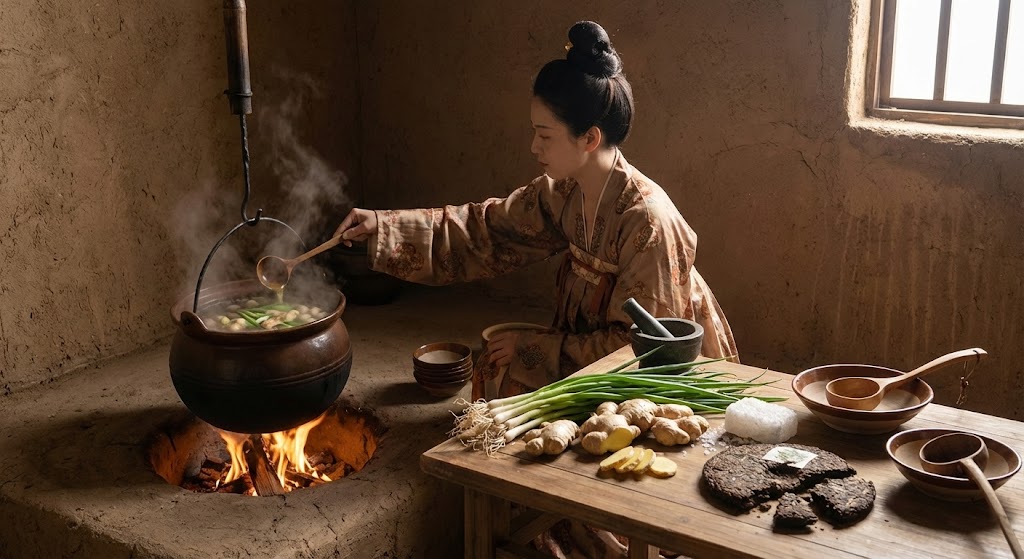
1. Lu Yu and The Classic of Tea: Founding Document
Tang Dynasty boiled tea codified by Lu Yu (陸羽, 733-804°CE) in Cha Jing (茶經, "The Classic of Tea," completed ~760 CE)—first comprehensive tea treatise, established tea as high culture (not just medicinal drink). Lu Yu was orphan raised by Buddhist monk, rejected monastic life, became tea merchant/scholar, spent decades researching tea preparation, cultivation, history. The Cha Jing systematized existing practices: specified proper water sources (mountain spring best, river water acceptable, well water worst), described ideal tea processing (steaming, drying, compressing into cakes), detailed equipment (24 specialized tools for full ceremony), and prescribed exact preparation method (boiling, not steeping).
The revolutionary impact: before Lu Yu, tea was regional folk practice (varied widely, no standardization, considered rustic). After Cha Jing, tea became literati art (scholarly pursuit, aesthetic philosophy, status marker). Emperor Tang Dezong (780-805°CE) made Lu Yu's method imperial standard—court adopted boiled tea ritual, cementing its prestige. The text survived 1200+ years (still studied today), influencing all subsequent East Asian tea culture. Modern parallels: Lu Yu for tea ≈ Brillat-Savarin for gastronomy, Escoffier for French cuisine—foundational theorist elevating practice to art form.
Lu Yu's philosophy: tea preparation as meditation (requires focus, precision, mindfulness like Gongfu's UNESCO-recognized skill), water quality as determinant of tea quality (chemistry understanding pre-dating scientific method—empirical observation of mineral content effects similar to noon chai's alkaline manipulation), and simplicity as refinement (minimal additives, pure tea flavor emphasized contrasting Victorian tea's elaborate service). This contrasted with earlier medicinal tea (mixed with onion, ginger, orange peel, salt—"soup tea") and later Song Dynasty elaborate whisking. Tang boiled tea occupied middle ground: sophisticated but not fussy (unlike Hong Kong milk tea's labor-intensive straining), flavorful but not cluttered. The lost balance: simpler than Song, more refined than early medicinal usage—never fully recovered after Tang collapse (907 CE).
| Dynasty/Era | Tea Preparation Method | Cultural Status | Why Method Changed |
|---|---|---|---|
| Pre-Tang (before 618 CE) | Medicinal soup (tea + herbs, spices, salt, fermented together) | Utilitarian medicine (treat illness, provide energy, folk remedy) | Lu Yu's Cha Jing elevated tea to aesthetic practice (pure tea > mixed soup) |
| Tang (618-907°CE) | Boiled cake tea + minimal salt (Lu Yu method, roasted/ground cake boiled in water) | Literati art (poetry, philosophy, refined taste, imperial endorsement) | Song Dynasty competition culture demanded more theatrical/complex method |
| Song (960-1279°CE) | Whisked powdered tea (no boiling—hot water whisked into powder, froth competition) | Elite performance art (tea contests, aesthetic judging, emperor patronage) | Ming Dynasty simplification movement rejected Song extravagance |
| Ming-Qing (1368-1912) | Steeped loose leaf (modern method, leaves in teapot/gaiwan, multiple infusions) | Everyday refinement (accessible to merchant class, less ritualized, practical) | Communist era de-emphasized tea culture, then modern revival diversified methods |
| Modern (1950-present) | Multiple coexisting methods (Gongfu, grandpa style, bagged, whisked matcha revival) | Fragmented (traditional revival + global fusion + convenience culture) | Ongoing evolution—no single dominant paradigm |
2. Cake Tea Processing: From Leaf to Brick
Tang Dynasty used compressed tea cakes (茶餅 chábing), not loose leaves: Harvest: Spring tea leaves (first flush, highest quality) picked and steamed immediately (halts oxidation, preserves green color). Pounding: Steamed leaves pounded in mortar until pulverized (breaks cell walls, releases sticky sap that binds cake). Compression: Pulp pressed into molds (round cakes, 200-500g typical), creating dense disc (1-2cm thick, 10-15cm diameter). Drying: Cakes air-dried or lightly roasted (reduces moisture to <10%, prevents mold), perforated with hole (for threading string, storage on racks). Aging: Some cakes aged months to years (develops flavors, similar to modern pu-erh aging), though Tang preference was fresh-year tea.
The functional advantages: compressed tea travels better (survives horse/caravan transport without crumbling, crucial for Silk Road trade), stores longer (dense cakes resist moisture/mold better than loose leaf), standardizes dosing (break off chunk by weight, consistent brewing), and resists adulteration (solid cake harder to cut with filler materials than loose leaf). The trade-offs: processing damages leaves (pounding destroys whole-leaf integrity, affects flavor complexity), limits tea selection (only robust leaves survive compression—delicate greens unsuitable), and creates barrier to consumption (must roast, grind before use—labor-intensive vs. modern loose-leaf simplicity).
Modern survivals: Pu-erh tea (Yunnan Province) maintains compression tradition (cakes, bricks, tuocha shapes), though processing differs (fermentation vs. Tang steaming). Liu'an basket tea (Anhui Province) compresses black tea into bamboo baskets (similar storage logic to billy tea's portable tins). Tibetan brick tea continues Tang-style compressed tea (boiled with salt, butter—parallel preservation of ancient method in periphery culture like Mongolian traditions). The geographic pattern: compression survived in边疆 (frontier regions)—Tibet, Yunnan, Mongolia—where transport difficulties and preservation needs persist (contrasting mate's regional identity or East Frisian isolation). Central China abandoned compression when Ming Dynasty introduced loose-leaf steeping (~1400s)—convenience won over tradition in wealthy core (like builder's tea's working-class pragmatism), necessity preserved it in remote areas.
Expert Tip: Recreating Tang Cake Tea at Home
Approximate Tang cake tea using modern pu-erh: Buy raw (sheng) pu-erh cake ($20-50 for quality cake), break off ~5g chunk with pu-erh knife. Roast chunk over low flame (or in 150°C oven, 5-10 minutes) until fragrant—this mimics Tang pre-brewing roasting. Grind roasted tea in mortar/pestle until coarse powder (not fine—Tang didn't have modern grinders, texture was rough). Boil water, add ground tea, simmer 3-5 minutes. Add tiny pinch salt (1/4 tsp per pot—Lu Yu specifies salt "awakens" flavor). Strain into cups. Result approximates Tang flavor profile: roasted, slightly salty, robust, earthy. Not authentic (pu-erh processing differs from Tang steamed cakes), but closest modern experience to 8th-century tea.
3. The Boiling Process: Three-Stage Water Science
Lu Yu described three boiling stages (fish eyes, string of pearls, raging torrent), each with distinct physics: Stage 1 - "Fish Eyes" (魚目 yú mù): Small bubbles (2-3mm) form on kettle bottom, rise slowly. Water temperature ~70-80°C, dissolved gases escaping (CO₂, O₂ come out of solution as solubility decreases with heat). Sound: quiet hissing. Lu Yu: "Not yet ready." Stage 2 - "String of Pearls" (連珠 lián zhū): Continuous stream of bubbles (5-8mm), rising rapidly from multiple points. Temperature ~90-95°C, approaching boiling point. Sound: active bubbling, musical chime. Lu Yu: "Perfect moment—add salt here." Stage 3 - "Raging Torrent" (騰波鼓浪 téng bō gǔ làng): Vigorous rolling boil, large bubbles breaking surface, water churning. Temperature 100°C+, full phase transition (liquid → vapor). Sound: loud rumbling. Lu Yu: "Add tea immediately, or water is ruined (over-boiled, 'dead water')."
The chemistry: each stage affects tea differently. Under-heated water (<85°C): Insufficient extraction (lower temperatures don't break down tea compounds efficiently—weak flavor, limited caffeine/tannins released). Optimal temperature (90-95°C): Balanced extraction (enough heat to release flavors without destroying delicate aromatics, Tang tea's robust roasted character tolerates high heat). Over-boiled water (100°C+ prolonged): Dissolved oxygen depleted (prolonged boiling drives off O₂, creates "flat" water—less lively taste), volatile aromatics lost (escape with steam), water becomes "hard" (mineral concentration increases as volume decreases—scale formation accelerated). Modern chemistry validates Lu Yu's empirical observations: stage 2 water is chemically optimal (hot enough for extraction, oxygenated enough for flavor brightness, minimal mineral concentration).
The lost skill: reading water by sound/sight requires experience (modern electric kettles auto-shut at boiling, no stage discrimination unlike teh tarik's 70-80°C precision or Turkish çaydanlık's double-boiler control). Tang tea practitioners trained years to recognize perfect moment—visual cues (bubble size, rise pattern), auditory cues (pitch changes, rhythm shifts), tactile cues (heat radiating from kettle similar to Persian tea glass holding). This sensory expertise parallels Gongfu tea's timing precision (7-second steep vs. 10-second—experience-based judgment, not timer-measured), and Hong Kong milk tea's pour technique (hand-feel, not temperature probe). Pre-industrial tea culture demanded embodied knowledge—modern tools automate it away, gaining consistency but losing craft intimacy.
4. Salt Addition: The Controversial Ingredient
Lu Yu specified salt addition at stage 2 boiling (before tea added): "Taste salt to adjust water. Add until water acquires flavor." The amount: approximately 1g salt per 1L water (0.1% solution, barely perceptible—threshold taste concentration). Modern chemistry explains salt's effects: Mineral balancing: Soft water (low mineral content) tastes flat, benefits from sodium/chloride ions (enhances perceived body, "rounds out" flavor). Umami enhancement: Sodium glutamate naturally present in tea (especially in steamed green tea like Tang cakes), salt amplifies umami (synergistic effect—small salt addition makes tea taste richer without tasting salty). Bitterness suppression: Salt ions compete with bitter compounds (caffeine, tannins) for taste receptors, reducing perceived bitterness (similar to salt on grapefruit—makes fruit taste sweeter by masking bitterness).
The cultural rejection: Song Dynasty abandoned salt (considered salt addition "vulgar," pure water emphasized), cementing no-salt norm for Chinese tea culture. Why the shift? Aesthetic purism: Song tea competitions judged foam quality, color purity—salt potentially affects appearance (slight cloudiness, altered surface tension reduces froth). Class distinction: Salt = common peasant seasoning (cheap, accessible), pure tea = elite refinement (no additives, appreciating tea's natural flavor—demonstrates wealth, educated palate). Water quality improvement: Tang era had variable water quality (well water, river water—often needed correction), Song era better infrastructure (spring water delivered to cities, less need for mineral adjustment).
Regional survivals: Tibetan butter tea (similar to Mongolian salty tea) uses heavy salt (2-3g per cup—10× Tang level), plus butter, creating savory soup-tea. Kashmiri noon chai (pink salt tea) uses salt + baking soda (alkaline chemistry creates unique color). British salt trick: Some British tea drinkers add tiny salt pinch to tea (old-timer practice, reduces bitterness in over-steeped tea—functional parallel to Tang method, though culturally independent discovery). The pattern: salt-in-tea persists where tea is nutritional (harsh climates, nomadic cultures—Mongolia, Kashmir, Tibet) or where water quality poor (areas with hard well water). Aesthetic tea cultures (China, Japan, Taiwan) rejected salt—flavor purity over functional adjustment.
| Tea Culture | Salt Usage | Salt Amount (approx.) | Rationale |
|---|---|---|---|
| Tang Dynasty China (Lu Yu method) | Light salting (mandatory in Cha Jing protocol) | ~1g per 1L water (0.1%—barely perceptible) | Water balancing, umami enhancement, bitterness suppression |
| Tibetan Butter Tea | Heavy salting (essential—savory drink, not sweet) | 2-3g per cup (~0.5-1%—clearly salty taste) | Nutritional (electrolytes in harsh climate), butter emulsification, soup-like sustenance |
| Mongolian Salty Tea | Moderate-heavy salting + milk + fat | 1-2g per cup (~0.3-0.5%) | Survival nutrition (calories + salt for nomadic life), tradition from Tang influence |
| Kashmiri Noon Chai | Light-moderate salting (plus baking soda for pink color) | 0.5-1g per cup (~0.15-0.3%) | Alkaline chemistry (creates color), regional taste preference, warmth in cold climate |
| Modern Chinese/Japanese/Western | None (salt = taboo, considered adulterating pure tea) | 0g (zero tolerance for salt in aesthetic tea) | Purity philosophy (appreciate tea's natural flavor), Song Dynasty legacy (rejected Tang salt practice) |
Expert Tip: The Salt Test for Over-Steeped Tea
Accidentally over-steeped tea (too long, too hot, double-bagged) becomes bitter/astringent—undrinkable. Modern rescue: add tiny salt pinch (literally 5-10 crystals, <0.01g) to cup, stir. Wait 30 seconds, taste. The bitterness diminishes noticeably (salt blocks bitter receptors, not magic—just chemistry). This won't restore delicate tea's subtlety (damage done), but salvages utility (makes tea drinkable when otherwise wasted). Especially useful for builder's tea style (robust black tea, often over-brewed) or office tea (forgotten mug, over-extracted). The Lu Yu legacy: salt's flavor-correcting power survives 1200+ years, even if cultural practice died. Emergency tool, not standard practice—but effective when needed.
5. The Boiling Ritual: Step-by-Step Tang Method
Step 1 - Prepare tea cake: Break ~5g chunk from compressed cake (use knife or strong thumbnail, crumble along natural compression lines). Place chunk on metal plate or flat stone, hold over charcoal fire (or modern gas flame), rotate constantly. Roast until fragrant (30-60 seconds—tea emits toasted aroma, changes from green-grey to brown), surface chars slightly (carbonized flavor appreciated). Remove from heat before burning (burnt tea is ruined—bitter, acrid). Step 2 - Grind roasted tea: Place roasted chunk in mortar, pound vigorously with pestle. Grind to consistency of coarse breadcrumbs (not fine powder—Tang didn't have precision grinders, rough texture standard). Total grinding time ~2-3 minutes for 5g portion.
Step 3 - Heat water to stage 2: Fill kettle with fresh water (Lu Yu preferred mountain spring, accepted river water, rejected well water—mineral content hierarchy). Place over heat source (charcoal brazier traditional, modern gas/electric works). Watch for fish-eye bubbles (stage 1—wait), then string-of-pearls (stage 2—act now). Sound cue: transition from quiet hissing to active musical bubbling. Step 4 - Add salt: At stage 2, add small pinch salt (~1g per 1L water), stir with bamboo whisk. Lu Yu: "Taste water—it should acquire character without tasting salty." Modern measurement: 0.1% salinity, threshold detection level.
Step 5 - Add tea and boil: Wait for water to reach stage 3 (raging boil, 100°C). Add ground tea all at once, stir vigorously. Boil together 3-5 minutes (prolonged boiling extracts full flavor from coarse grounds—roasted tea withstands heat better than delicate greens). Lu Yu specified "three boilings" (boil until foam rises → remove from heat → return to boil → remove → third boil → done). This cools slightly between boils, prevents overflow, develops foam (aesthetic value—foam indicates quality tea). Step 6 - Serve immediately: Pour into handleless bowls (ceramic, 50-100mL capacity), distribute foam evenly (skilled pourer gives each guest equal share—social equity demonstrated through technique). Drink while hot (Tang tea not re-steeped—single decoction, discard grounds after).
6. The 24 Implements: Lu Yu's Tea Equipment
Lu Yu's Cha Jing specified 24 specialized tools (complete tea ceremony demanded full set—lacking even one item was improper): Category 1 - Processing tools (7 items): Roasting basket (竹篮), grinding mortar + pestle (碾 + 杵), silk sieve (罗), tea storage jar (茶瓶), scoop (则), bamboo tea box (茶笼), charcoal container (火铛). Category 2 - Water tools (4 items): Water cauldron/kettle (釜), bamboo fire-tongs (火筴), bamboo dipper (瓢), water storage jar (水方). Category 3 - Serving tools (6 items): Tea bowls (碗), bowl rack (畚), waste water container (建), cleaning cloth (巾), bowl basket for transport (笼), serving tray (札).
Category 4 - Accessories (7 items): Salt container (鹾簋), salt spoon (揭), bamboo whisk (扎), water filter (漉水囊), cooling rack (鹾), documentation scroll (茶经), implement storage chest (具列). The completeness obsession: owning full 24-implement set signaled wealth (custom-crafted tools, quality materials, dedicated storage—expensive investment), cultural refinement (knew proper usage, studied Lu Yu's text, participated in literati culture), and serious tea commitment (not casual drinker, but practitioner of tea art). Modern equivalent: professional Gongfu tea set (teapot, pitcher, cups, tongs, trays, tools—$200-2000 investment for complete setup).
The lost materiality: most Tang implements were organic (bamboo, wood, silk) and disintegrated (archaeological evidence scarce—few surviving examples). Modern knowledge comes from text descriptions (Lu Yu's detailed specifications), Song Dynasty copies (replicas made when Tang method still recent memory), and Japanese preservation (Tang-era tools brought to Japan ~800s CE, maintained in temple collections). The reconstruction challenge: exact dimensions unknown (Lu Yu gives ratios, not absolute measurements), material sourcing difficult (specific bamboo species, rare woods, hand-forged metals), and cultural context missing (how tools felt in use, social meanings of specific forms—embodied knowledge lost when practice died). Modern Tang tea recreations are educated guesses—functionally plausible, culturally uncertain.
7. The Social Context: Tea as Literati Performance
Tang tea culture was elite practice: Participants: Scholar-officials (literate class, government bureaucrats, Confucian-educated), Buddhist monks (temple culture, early tea adopters, philosophical discussions), wealthy merchants (upwardly mobile, imitating aristocracy, buying cultural capital), imperial court (emperor patronage, palace tea ceremonies, government-sponsored tea farms). Excluded groups: Peasants (tea too expensive, time-consuming preparation impossible during agricultural labor), urban poor (no access to quality water/equipment), women (largely excluded from public tea gatherings—Tang gender norms restricted female participation, though palace women had separate tea culture).
The performance dimension: tea ceremony was social theater—host demonstrated: Wealth (expensive tea cakes, quality equipment, leisure time for elaborate preparation). Education (knowledge of Lu Yu's text, proper technique, ability to discuss tea philosophy). Aesthetic judgment (water source selection, equipment choices, serving presentation—taste refined through study). Social skill (hospitality, conversation facilitation, graceful hosting). Success measured not just by tea quality, but by total performance—the gathering as art form, not merely consumption event. Parallels: Japanese tea ceremony's ritualized performance (every movement choreographed, aesthetic total environment), Victorian afternoon tea (social display, class performance, gendered ritual).
The written culture: Tang tea gatherings generated poetry (participants composed verses about tea, water, friendship—literary output was point, tea was catalyst), calligraphy (tea-induced mental state ideal for brush work, aesthetic connection), and philosophical discussion (Buddhism, Daoism, Confucianism—tea as context for intellectual exchange). The tea-poetry connection persisted through Chinese history—still assumed that serious tea drinkers write poetry, and poets drink tea. The cultural logic: both require refinement (developed taste, educated perception), contemplation (slow, mindful practice), and aesthetic sensibility (beauty appreciation, not just utility). Tea drinking as gateway to literary culture—or literary culture requiring tea as fuel. Causality unclear, association permanent.
Expert Tip: Modern Tang Tea Gatherings
Recreate Tang tea ceremony as educational/cultural event: (1) Preparation: Research Tang Dynasty history, read Cha Jing translations (Google Books has public-domain versions), prepare simplified Tang-style tea (roasted pu-erh + salt method above). (2) Setting: Low table, floor cushions (Tang style vs. chairs), minimal decoration (scroll, simple flower arrangement, not cluttered—Daoist simplicity). (3) Structure: Explain historical context (who was Lu Yu, why boiled tea, how method differs from modern), demonstrate preparation (roasting, grinding, three-stage boiling—performance aspect), serve tea while discussing flavors (compare to modern tea, identify salt effect). (4) Literary element: Read Tang Dynasty tea poems (translated), or write haiku/short verse about experience (continue tea-poetry tradition). Creates educational ritual—historical appreciation through embodied practice, not just book-learning.
8. Why Tang Boiled Tea Disappeared
Song Dynasty (960-1279°CE) replaced boiling with whisking: Competitive culture shift: Song court sponsored tea competitions (鬥茶 dòuchá, "tea battles")—judges ranked teas by foam quality, color, duration. Whisked powdered tea produced better foam than boiled cake tea (smaller bubbles, longer-lasting froth, more dramatic appearance). Competition pressure drove method change—winning tournaments brought prestige, employment, wealth. Aesthetic evolution: Song taste preferred subtle complexity (delicate flavors, refined techniques) over Tang robustness (roasted, boiled flavors considered crude by Song standards). The Chinese cultural pattern: each dynasty rejected predecessor's style (establishing legitimacy through aesthetic innovation—Song needed to differentiate from Tang, prove superiority through new tea culture).
Technical improvements: Song-era tea processing advanced (finer grinding possible, powder creation techniques, better quality control in imperial tea gardens). These improvements enabled whisking method (requires fine powder—Tang grinding produced coarse meal, insufficient for whisking). Economic factors: Song government monopolized tea trade (state-controlled production, official pricing, tax revenue stream). Whisking required more processed tea (powder vs. cake—more labor-intensive, higher value-added, greater taxation potential). The method shift coincided with profit motive—government benefit from promoting complex preparation requiring expensive processed tea.
The Ming reversal (~1400s): Zhu Yuanzhang decree (1391): Ming Dynasty founder banned compressed tea (ordered switch to loose-leaf), ended imperial tea competitions (considered wasteful, frivolous), and simplified tea culture (反对奢侈 oppose luxury—Ming legitimacy built on anti-Song populism). The rationale: Song tea culture had become absurdly elaborate (tribute tea cakes cost more than gold, competition culture bred corruption, tea aristocracy controlled economy). Ming reform was deliberate primitivization—return to simpler tea, break Song elite's power, make tea accessible to broader population. But Ming simplification chose steeping (convenient, economical), not Tang boiling (still too complex, required roasting/grinding). Tang method never recovered—caught between Song sophistication and Ming convenience, fit neither paradigm. The lost middle way.
9. Recreating Tang Tea Today: Practical Guide
Equipment needed (Budget: $30-80): Mortar & pestle (ceramic or stone, $15-30—used for grinding roasted tea). Metal tongs or long fork ($5-10—for holding tea during roasting). Kettle (traditional: cast iron, $30-60; modern: any boiling kettle works, $15-25). Tea bowls (small handleless Chinese teacups, $2-8 each, buy 4-6 for guests). Strainer (fine-mesh, $5-10—removes ground tea when serving). Optional: bamboo whisk (matcha whisk works, $8-15—for stirring). Total: $30-80 depending on equipment quality (can start cheaper with what you own, upgrade later).
Ingredient sourcing: Tea: Raw pu-erh cake ($20-50 for 357g cake—lasts 70+ sessions), or Tie Guan Yin oolong ($15-30 for 100g—traditional choice). Avoid delicate greens (won't survive roasting/boiling). Salt: Sea salt or kosher salt (NOT iodized table salt—iodine creates off-flavors), $3-5 for container lasting years. Water: Spring water (bottled, $1-2 per session) or filtered tap water (avoid distilled—too pure, tastes flat). Charcoal (optional authenticity): Lump charcoal or binchotan ($10-30), creates smoky roasted flavor (modern gas stove works fine, less atmospheric).
Simplified modern method: 1. Roast tea (2 min): Break 5g from pu-erh cake, hold with tongs over gas flame (medium heat), rotate until fragrant and slightly charred. 2. Grind (3 min): Mortar-and-pestle the roasted tea into coarse grounds (breadcrumb texture). 3. Boil water (5 min): Heat 600mL water, watch for string-of-pearls bubbling (90-95°C), add tiny salt pinch (1/4 tsp). 4. Add tea and boil (5 min): Once raging boil (100°C), add ground tea, simmer 3-5 minutes, stirring occasionally. 5. Strain and serve (1 min): Pour through strainer into bowls, distribute evenly. Drink immediately while hot. Total time: ~15 minutes preparation, yields 4-6 small servings. Flavor profile: Roasted, robust, slightly salty, earthy, full-bodied—very different from modern steeped tea (more savory, less delicate, satisfying in primal way).
Common beginner mistakes: Burning tea during roasting: Scorched tea tastes acrid (ruined batch). Keep moving, pull off heat before blackening. Grinding too fine: Powder creates muddy tea (hard to strain, gritty texture). Aim for coarse meal. Adding tea too early: If water not at full boil (100°C), tea under-extracts (weak, bland). Wait for raging boil. Too much salt: Even 2× Lu Yu amount makes tea taste salty (unpleasant). Start with less than you think (can always add, can't remove). Expecting modern tea flavors: Tang tea tastes different (roasted, boiled, salty)—not better or worse, just different. Approach with curiosity, not modern expectations. Appreciate as historical artifact-flavor, not daily driver.
Comments