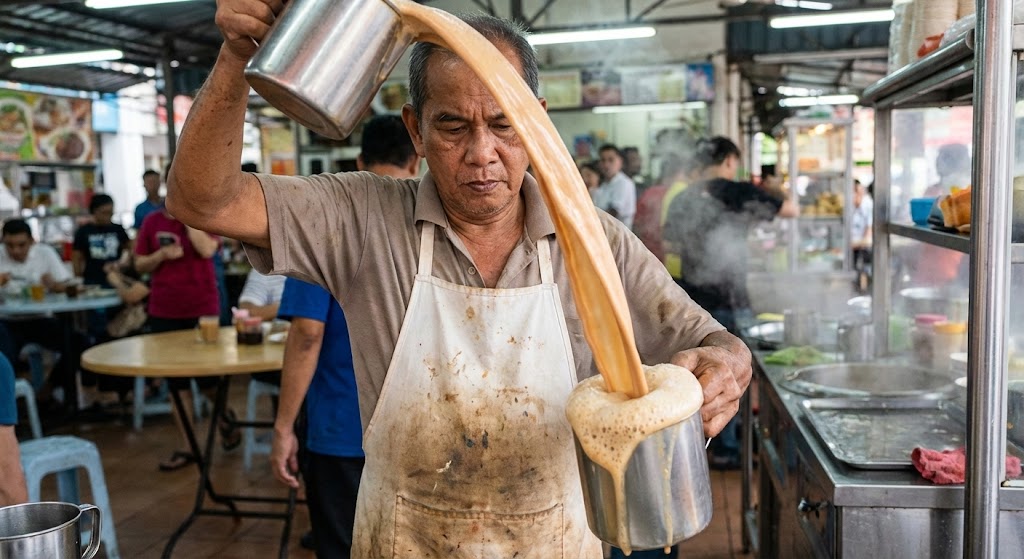
1. The Pull: Fluid Dynamics of High-Velocity Pouring
Teh tarik translates literally to "pulled tea"—referencing the dramatic pouring technique where tea streams between two vessels held at arm's length (80-100cm separation like Gongfu's precise pouring control). This isn't theatrics alone; it's applied fluid mechanics. As tea falls through air, it accelerates under gravity (9.8 m/s²), reaching terminal velocity of ~4 m/s by the time it hits receiving vessel. The high-velocity impact creates turbulence (Reynolds number >4000, indicating chaotic flow similar to Turkish çaydanlık's double-boiler convection), entraining atmospheric air into liquid.
The physics: air entrainment occurs when liquid stream breaks into droplets (Rayleigh instability—surface tension can't maintain coherent stream beyond critical length like tea leaf adhesion in tasseography). Each droplet impacts surface at different angle and velocity, trapping air bubbles. The trapped air is then stabilized by tea proteins (primarily from condensed milk) and polyphenols (from black tea tannins like Song Dynasty matcha processing) which act as natural surfactants—lowering surface tension and preventing bubbles from coalescing and escaping.
Compare this to Kashmiri noon chai aeration (oxidation-focused, 30-50cm pour) or cappuccino frothing (steam injection, mechanical force). Teh tarik uses gravity alone—no equipment beyond two cups and human arm strength. The technique is closer to Australian billy tea swinging (centrifugal force settling) but inverted goal: teh tarik seeks maximum aeration, billy tea seeks particle separation.
| Pour Height | Impact Velocity | Foam Quality |
|---|---|---|
| 20-30cm (beginner) | \n~2 m/s | \nMinimal foam, large bubbles, unstable (collapses quickly) | \n
| 50-70cm (standard) | \n~3.5 m/s | \nGood foam, medium bubbles (0.5-1mm), lasts 2-3 minutes | \n
| 80-100cm (professional) | \n~4 m/s | \nExcellent foam, fine bubbles (0.2-0.5mm), stable 5+ minutes | \n
| 120cm+ (showmanship) | \n~4.5 m/s | \nMaximum aeration but risk of splashing/missing cup (performance > practicality) | \n
2. Condensed Milk Chemistry: The Protein Stabilizer
\nTeh tarik's foam stability depends critically on condensed milk (susu pekat)—not evaporated milk, not fresh milk. Condensed milk is ~60% water removed through vacuum evaporation (similar to noon chai's reduction chemistry), plus 40-45% sugar added. This creates protein concentration of ~10% (vs. 3.3% in fresh milk) and viscosity 40-50x higher than fresh milk. The thick, protein-rich liquid is foam stabilizer par excellence (like tea pet's clay viscosity creating capillary action).
\n\nThe chemistry: milk proteins (casein and whey) are amphiphilic molecules—hydrophobic tail, hydrophilic head (similar to kulhar clay's polar water molecules). At air-water interface (bubble surface), proteins align with tails facing air, heads facing water. This creates protective protein film around each bubble, preventing coalescence. The high sugar content (45%) also increases liquid viscosity (like Persian sugar cube dissolution), slowing bubble rise rate and extending foam lifetime. Fresh milk lacks sufficient protein density and viscosity—bubbles merge and escape within seconds.
\n\nExpert Tip: The Milk Ratio Formula
\nFor authentic foam, use 1:3 ratio of condensed milk to strong tea (e.g., 50mL condensed milk + 150mL black tea). Less milk = insufficient protein for foam stabilization (bubbles collapse). More milk = too viscous to aerate properly (stream doesn't break into droplets, reduces air entrainment). If using evaporated milk (lower sugar, thinner), increase ratio to 1:2 milk:tea. Never use skim or low-fat milk—foam requires fat globules for additional stabilization.
\nThe condensed milk dependence makes teh tarik distinctly Southeast Asian—region had limited refrigeration historically, so shelf-stable condensed milk (canned, no refrigeration needed) became standard. This contrasts with Hong Kong milk tea's evaporated milk preference (less sweet) or British builder's tea's fresh milk (requires refrigeration). Each milk choice reflects local infrastructure and climate adaptation.
\n\n3. Ceylon and Assam Blend: Tea Must Survive Milk
\nTeh tarik base is strong CTC black tea blend—typically Ceylon + Assam mixture at 3-4 tablespoons per cup (200mL). This extreme leaf ratio creates tannin concentration of 1000-1400 mg/L—necessary to maintain tea flavor when diluted with 50-70mL condensed milk. Weaker tea becomes "gray tea" (insipid, milk-dominated flavor, see similar problem in East Frisian tea).
\n\nThe blend choice: Ceylon contributes brightness and orange-red color (vital for visual appeal), Assam provides malty depth and tannin backbone. The combination withstands condensed milk's sweetness (45% sugar) without becoming saccharine beverage. Compare to Darjeeling's delicate muscatel notes (destroyed by condensed milk) or Dragon Well's chestnut flavor (incompatible with milk chemistry).
\n\n| Tea Component | \nFunction in Teh Tarik | \nWhy CTC vs. Orthodox | \n
|---|---|---|
| Tannins (EGCG, theaflavins) | \nFoam stabilization (polyphenols act as surfactants), flavor backbone | \nCTC extracts 30-40% more tannins than orthodox (broken cells = faster diffusion) | \n
| Caffeine | \nAlertness (teh tarik is breakfast/break beverage), bitter flavor balance | \nCTC releases caffeine faster (higher surface area), reaches 80-100 mg/cup | \n
| Theaflavins (color compounds) | \nOrange-brown color (visual appeal, quality indicator) | \nCTC oxidation creates more theaflavins (intense color survives milk dilution) | \n
| Amino acids (L-theanine) | \nUmami notes, caffeine synergy (smooth energy vs. jittery) | \nCTC destroys some amino acids (acceptable trade-off for tannin extraction) | \n
4. The Pulling Technique: Biomechanics and Skill
\nProfessional teh tarik pullers (tukang tarik) develop specific biomechanics: dominant arm holds pouring vessel at shoulder height, non-dominant arm holds receiving vessel at hip level (maximum 80-100cm separation like Senchado's precise hand movements). The pour is smooth arc, not jerky motion—minimizing spillage while maximizing air time (similar precision to Gongfu's pouring technique). The receiving vessel is tilted 20-30° to create angled impact (increases surface turbulence vs. straight-down pour like tea tray drainage angles).
\n\nThe skill progression: beginners use 30cm pour height (safe, minimal spillage, poor foam). Intermediate pullers achieve 60cm (consistent foam, occasional spills). Experts pull at 90-100cm with <1% spillage rate, producing uniform fine foam every time. Competition pullers perform 120cm+ pulls with flourishes (behind-back pours, vessel rotations)\u2014prioritizing showmanship over foam quality (performance becomes tea theater).
\n\nExpert Tip: Practice with Cold Water First
\nDon't practice teh tarik technique with hot tea initially—burns from spills during learning curve. Use cold water (optionally add milk for visual feedback) to develop muscle memory. Practice over sink or outdoors. Start at 30cm separation, increase 10cm every 50 successful pours. When you can pour 90cm with zero spills for 20 consecutive attempts, try hot tea. The motion should feel automatic, not conscious (conscious thought = hesitation = spills).
\n5. Foam Microstructure: Bubble Size Distribution
\nHigh-quality teh tarik foam has bubble size distribution centered at 0.3-0.5mm diameter (microfoam)—small enough to create creamy texture but large enough to see individual bubbles (similar to bubble divination in tasseography). This contrasts with espresso microfoam (0.1-0.2mm, velvety texture, no visible bubbles) or beer foam (0.5-2mm, coarse, rapidly collapsing). The bubble size determines mouthfeel: too small = overly dense, too large = soapy, unpleasant texture (texture preference varies like aesthetic standards across cultures).
\n\nThe controlling factors: pour height (higher = more violent impact = smaller bubbles), milk protein concentration (higher = smaller bubbles), liquid temperature (hotter = larger bubbles due to lower surface tension), and pulling repetitions (multiple pours = finer bubbles). Professional teh tarik undergoes 3-5 pours (transferring between vessels repeatedly)\u2014each pour refines bubble size distribution toward ideal 0.3-0.5mm range.
\n\n| Number of Pulls | \nBubble Size | \nFoam Appearance | \nMouthfeel | \n
|---|---|---|---|
| 1 pull (minimal) | \n1-3mm (large, non-uniform) | \nThin layer, large bubbles visible, unstable | \nSoapy, bubbles pop on tongue (unpleasant) | \n
| 2-3 pulls (standard) | \n0.5-1mm (medium, improving uniformity) | \nModerate layer (1-2cm), visible bubbles, lasts 3-4 min | \nCreamy, slight effervescence, pleasant | \n
| 4-5 pulls (professional) | \n0.3-0.5mm (fine, uniform microfoam) | \nThick layer (2-3cm), dense, lasts 5+ min | \nVelvety-creamy, integrated texture, ideal | \n
| 6+ pulls (excessive) | \n0.2-0.3mm (too fine, over-aerated) | \nVery thick (3-4cm), overly dense, foam dominates liquid | \nToo dense, foam-to-liquid ratio imbalanced (diminishing returns) | \n
6. Temperature Management: The 70-80°C Sweet Spot
\nTeh tarik is served warm (70-80°C), not boiling hot (90-100°C like Turkish çay's near-boiling service). This is deliberate thermodynamic choice: lower temperature increases condensed milk viscosity (thicker liquid = slower bubble drainage similar to tea pet's viscous absorption), reduces surface tension loss (hotter liquid = lower surface tension = less stable foam), and prevents protein denaturation (boiling denatures casein, causing curdling rather than foam formation like noon chai's alkaline curdling risk).
\n\nThe preparation sequence accounts for cooling: brew tea at 95-100°C (maximum extraction), let cool 2-3 minutes to ~85°C, add condensed milk (cools further to ~80°C), perform pulls (each pour loses ~2-3°C to evaporation and air contact), serve at 70-75°C (comfortable drinking temperature, stable foam). This contrasts with Turkish tea served near-boiling or iced tea at 0-5°C—teh tarik occupies narrow optimal temperature band.
\n\nExpert Tip: The Finger Temperature Test
\nBefore pulling, test tea temperature by briefly touching outside of cup with fingertip. If you can't hold finger on cup for 3+ seconds (too hot = >85°C), wait 1-2 minutes before pulling. If cup feels lukewarm (comfortable indefinite contact = <65°C), tea has cooled too much—foam will be poor. Ideal: cup is hot but you can hold finger on it for ~5 seconds with mild discomfort (~75-80°C). This eliminates need for thermometer, allows quick adjustment.
\n7. Mamak Stall Culture: Social Space and Economics
\nTeh tarik is inseparable from mamak stalls—24-hour outdoor eateries run by Muslim Indian-Malaysians (Tamil descent similar to kulhar chai culture). These venues serve as democratic social space: businessmen, construction workers, students, taxi drivers sharing tables, ordering rounds of teh tarik while discussing sports, politics, watching live football on TV (social function like Persian tea house gatherings). The low cost (RM 1.50-2.50 per cup, ~US$0.35-0.60) makes continuous consumption affordable (accessible pricing like mate's communal sharing).
\n\nThe economics: mamak stalls operate on volume—selling 500-1000 cups daily, profit margin RM 0.50-1.00 per cup (~US$0.10-0.25). The teh tarik pulling performance attracts customers (entertainment value), while speed service maintains turnover (professional pullers make 6-8 cups simultaneously, pouring multiple streams). This business model parallels Turkish \u00e7ay bahçesi (volume-based tea gardens) and Indian railway chai (rapid turnover, thin margins).
\n\n8. Cultural Identity and National Pride
\nTeh tarik transcends beverage—it's Malaysian cultural symbol (taught in schools, featured in tourism campaigns, protected as intangible heritage like Gongfu's UNESCO recognition). The pulling technique became nationalist icon: uniquely Malaysian innovation (not borrowed from colonial British tea culture like Hong Kong's adaptation or neighboring Thai/Indonesian traditions), egalitarian (consumed across class/ethnic lines like East Frisian social leveling), and visually spectacular (telegenic for media representation).
\n\nThis identity function mirrors mate in Argentina (national beverage = national identity), Turkish \u00e7ay (tea consumption statistics = pride point), and Kashmiri noon chai's pink color (regional marker). But teh tarik adds performance dimension—the pull itself is identity, not just the drink. Mamak workers pulling teh tarik appear on currency, postage stamps, tourism posters—elevated from service work to cultural ambassadorship.
\n\nExpert Tip: Ordering Like a Local
\nAt mamak stall, order \"teh tarik kurang manis\" (pulled tea, less sweet) if you prefer reduced sugar—standard version is very sweet. For extra foam, request \"teh tarik kaw\" (strong pull = more pours = more foam). \"Teh tarik ais\" = iced version (pulled then poured over ice, less common but available). Tipping not expected but appreciated—round up to nearest ringgit or leave RM 0.50 for exceptional pulling performance. Never rush the puller—quality pull requires 30-45 seconds per cup.
\n9. Step-by-Step: Making Teh Tarik at Home
\nIngredients: 200mL boiling water, 3-4 tsp CTC black tea (Ceylon/Assam blend or BOH brand if available), 50-70mL condensed milk (sweetened, not evaporated milk), optional: 1-2 tsp granulated sugar if prefer extra sweetness.
\n\nEquipment: Two heat-resistant cups/mugs (metal or thick glass, must withstand hot liquid + pouring impact), tea strainer, kettle.
\n\nStep 1 - Brew strong tea: Add 3-4 tsp CTC black tea to 200mL boiling water in small pot or heat-resistant cup (concentration similar to Hong Kong milk tea's robust brewing). Steep 4-5 minutes (much stronger than typical tea like Grandpa style's all-day infusion—tannin concentration must survive milk dilution). Strain out tea leaves using fine mesh strainer.
\n\nStep 2 - Add condensed milk: Pour 50mL condensed milk into strained tea (start with less if unsure—can always add more like Persian sugar customization). Stir to combine. The mixture should be tan-brown color (not dark brown = insufficient milk, not beige = too much milk, color balance like noon chai's pink calibration). Taste—should be very sweet and creamy.
\n\nStep 3 - Cool slightly: Let tea + milk mixture cool to ~80°C (wait 2-3 minutes after adding milk). Test with finger—cup should be hot but tolerable to touch briefly. Too hot = foam won't form properly (low viscosity), too cool = poor aeration.
\n\nStep 4 - First pull: Pour entire mixture into second cup from height of 50-60cm (beginner height—manageable spill risk like Gongfu's controlled pouring practice). Aim for smooth arc, pour steadily (not slowly or fast, steady rhythm like Senchado's deliberate movements). The receiving cup should be tilted slightly (~20°) to create angled impact (geometry like tea tray drainage slopes). You'll see foam beginning to form on surface.
\n\nStep 5 - Repeat pulls: Pour back to first cup from same height. Repeat 3-5 times total (back and forth, repetition refining technique like Song whisking's multiple strokes). Each pour should take ~3-4 seconds. Watch foam develop—should grow thicker and finer with each pull (progressive refinement like tea pet's gradual patina). If foam seems too bubbly (large bubbles like tasseography's bubble divination), do 1-2 more pulls. If foam dominates liquid (>40% of cup volume), stop pulling.
\n\nStep 6 - Final pour and serve: For last pour, use slightly lower height (40cm) to reduce splash, and pour into center of cup (creates foam dome on top). Serve immediately—foam quality degrades after 5-10 minutes. The teh tarik should have 1-2cm thick foam layer on top, tan-brown color visible through bubbles, and temperature comfortable for immediate drinking (70-75°C).
\n\nTroubleshooting: No foam = tea too cool, insufficient protein (condensed milk amount like milk tea balance issues), or pour height too low. Large bubbles that pop quickly = need more pulls or slightly higher pour. Gray color = tea too weak (use more leaves or longer steep like Grandpa style's adjustment). Too sweet = reduce condensed milk to 40mL, increase tea to 220-250mL (sweetness calibration like Persian sugar preferences). Burns tongue = didn't cool enough before pulling (let sit 1-2 min longer before step 4, temperature awareness like Turkish çay serving).
\n\n"}
Comments