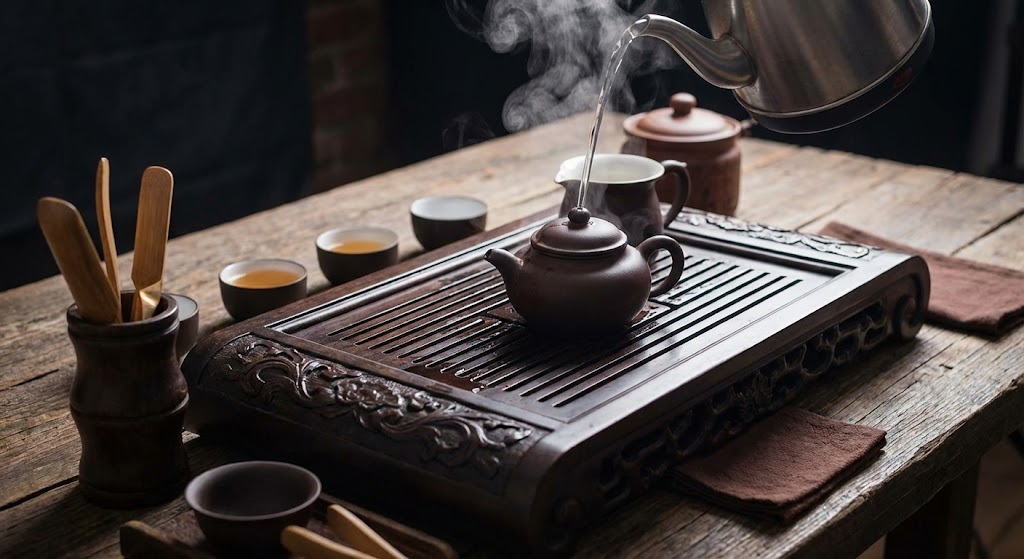
1. The Chinese Origin: Tea Boats and Overflow Management
Tea trays (Chinese: 茶盘 chápán) emerged during Ming Dynasty (1368-1644) alongside small-teapot brewing culture (precursor to modern Gongfu cha). The functional problem: small Yixing clay teapots (100-200mL capacity) required frequent rinsing (warm pot before use, rinse tea leaves, discard initial steep—"washing" the tea). This wastewater needed containment—pouring on floor/table was messy, unsanitary. Solution: shallow wooden/bamboo tray with raised edges, catching spills and allowing deliberate overflow during brewing ritual.
The earliest trays were simple: flat wood platform with ~2cm raised rim, no drainage (water sat until manually emptied). By Qing Dynasty (1644-1912), sophisticated versions appeared: dual-layer construction with slatted top surface (water drains into lower reservoir through gaps), hidden drainage tubes (manual pour-off or gravity drain to waste bucket). These "tea boats" (茶船 cháochuán) allowed messy Gongfu technique—pouring hot water over teapot exterior (warms clay, creates aesthetic steam), generous rinsing, and performative splashing—all without flooding the table.
The modern electric tea tray (1990s+ innovation) adds water pump: drainage reservoir has electric pump (activated by switch or automatic when water level rises), pumps wastewater to attached bucket (2-5L capacity, emptied daily). This enables home Gongfu practice without plumbing access—apartment dwellers can brew tea with professional-level water use, no sink required. The electric tray represents peak tea-tray evolution: 600 years from simple wooden plate to self-draining appliance.
| Tea Tray Type | Construction | Drainage Method | Typical Use Context |
|---|---|---|---|
| Dry Tray (Traditional) | Solid surface (wood, bamboo), raised rim, no holes | None—water sits until manually poured out | Careful brewing (minimal spills), formal settings, antique display |
| Slatted Tray (Classic) | Dual-layer: slatted top, solid reservoir below, gaps ~5-10mm | Gravity—water drips through slats into reservoir, manual pour-off | Gongfu practice, allows generous water use, traditional aesthetic |
| Electric Pump Tray | Plastic/wood body, slatted top, motorized pump in base | Electric pump drains to attached bucket (2-5L), auto or manual activation | Home use (no sink needed), commercial tea shops, high-volume brewing |
| Stone/Ceramic Tray | Carved stone or ceramic, integral drain channel | Gravity channel to waste bowl/bucket (no reservoir—direct drain) | Aesthetic statement piece, luxury/artisan trays, permanent tea table |
| Portable Travel Tray | Collapsible silicone or lightweight plastic, compact | Manual removal (fold and pour), or self-contained reservoir | Outdoor tea, office desk, travel brewing, space-limited environments |
2. Wastewater Aesthetics: The Beauty of Overflow
Gongfu tea brewing is deliberately wasteful by Western standards: Pot warming: Pour boiling water over teapot exterior (300-500mL wasted). Tea washing: First steep discarded entirely (100mL). Cup warming: Pour hot water in cups, discard (200-400mL for 3-4 cups). Spillage: Pouring from gaiwan/teapot creates drips, splashes (50-100mL). Total wastewater: 650-1000mL per session—more water discarded than consumed as tea.
The rationale: quality over conservation. Hot teapot brews better tea (thermal mass prevents temperature drop during short steeps), washed tea removes dust/impurities (and "wakes up" compressed leaves), warm cups maintain serving temperature. The waste is functional sacrifice—prioritizing perfect tea over water efficiency. This contrasts with grandpa style's zero-waste approach (all water becomes tea) and Western tea bags (single-use, minimal rinsing).
The aesthetic dimension: water flowing through tray slats is visual/auditory performance—gentle splashing sound (soothing white noise), steam rising from hot water (atmospheric effect), dark wet wood (patina develops over time, showing tray's history). The overflow is controlled chaos—deliberate messiness within bounded space (tray contains excess, prevents disorder from spreading). This parallels tea room architecture (controlled roughness within rigid structure) and chabana (natural randomness within formal placement).
Expert Tip: The Patina Development Strategy
Bamboo/wood tea trays develop patina (tea-stained surface) over months/years—dark areas where hot water repeatedly poured, lighter areas less exposed. This aging is desirable (proves tray's use, shows practice dedication), similar to Yixing teapot seasoning. To accelerate patina: (1) Never use soap on tray (strips oils, prevents staining), rinse with water only. (2) Leave tray slightly damp between sessions (promotes tea absorption). (3) Pour occasional tea directly on wood (intentional staining—very strong pu-erh works well). (4) Rub wet tea leaves on surface (polishes while staining). After 6-12 months, tray transforms from new-wood color to rich chocolate brown—visual record of practice.
3. Material Science: Bamboo vs. Wood vs. Stone
Bamboo: Traditional material, fast-growing (sustainable), naturally water-resistant (silica in fibers), lightweight, affordable ($30-80 for quality tray). Ages beautifully (darkens evenly, develops smooth patina). Disadvantage: less durable than hardwood (cracks after 3-5 years heavy use), warps in very humid/dry climates, lower prestige than exotic woods. Best for: Beginners, sustainable-minded practitioners, Asian aesthetic preference.
Hardwood (ebony, rosewood, wenge): Dense wood (600-1200 kg/m³ density), highly water-resistant (natural oils prevent absorption), beautiful grain patterns, long lifespan (10-20+ years). Expensive ($150-500+), heavy (harder to move), environmental concerns (tropical woods often unsustainably harvested). Best for: Serious practitioners, permanent tea table, luxury aesthetic, heirloom piece. Stone (granite, slate, soapstone): Impervious to water (zero absorption), extremely durable (lifetime use), cool surface (keeps tea from overheating in summer), modern minimalist aesthetic. Very heavy (10-20kg typical—immobile once placed), expensive ($200-800), requires custom fabrication (carved channels for drainage). Best for: Dedicated tea room, architectural statement, modern design preference.
The material hierarchy mirrors tea culture values: bamboo = natural/humble/accessible (wabi-sabi aesthetic, Rikyu's poverty-chic), exotic hardwood = refinement/permanence/seriousness (Chinese literati taste), stone = modern/minimalist/Western adaptation. Your tray choice signals tea philosophy—what you value, who you are (or aspire to be).
4. Size and Portability: Desk vs. Dedicated Table
Tea tray dimensions vary by use: Small/portable (25-35cm × 15-20cm): Office desk, travel, space-limited apartments. Holds gaiwan/small pot + 2-3 cups + water kettle (off-tray). Reservoir 200-500mL (enough for 1-2 brewing sessions). Weight 1-2kg (easily moved). Medium/standard (35-50cm × 25-35cm): Home tea table, 3-5 people brewing. Holds full Gongfu setup (pot, pitcher, 4-6 cups, tools). Reservoir 1-2L (3-4 sessions). Weight 3-6kg. Large/ceremonial (50-80cm × 40-60cm): Tea room centerpiece, professional tea shop, performance brewing. Accommodates multiple teapots, extensive cup collection, decorative elements. Reservoir 2-5L (all-day use). Weight 8-15kg (essentially furniture).
The portability trade-off: small trays limit brewing style (less dramatic water-pouring, careful not to overflow), but enable flexible tea practice (move from desk to living room to outdoor patio). Large trays allow full Gongfu expression (generous wastewater, theatrical technique), but anchor practice to single location. Most serious practitioners own multiple trays: portable for daily casual tea, large for formal sessions or teaching. The collection grows over years—each tray has character, history, specific use case.
5. Drainage Engineering: Gravity, Pumps, and Maintenance
Effective tea tray drainage requires: Slat design: Gaps 5-10mm wide (allows water through, prevents cups/pots falling into gaps), smooth edges (no splinters), ~15-25 slats typical (balances drainage vs. structural strength). Reservoir depth: 3-5cm minimum (holds 1-2L depending on tray surface area), removable or drain-plug access (for emptying). Slope: Slight angle toward drain point (1-2° incline—invisible to eye, ensures water flows rather than pooling).
Electric pump systems: Pump capacity: 3-5 watts typical (low power, quiet operation), 500-1000mL/minute flow rate. Activation: Float switch (automatic when reservoir fills to threshold), or manual button (user controls when to pump). Hose connection: 10-15mm diameter tube drains to waste bucket (typically 5L capacity—emptied every 2-3 days for heavy use). Noise: Quality pumps nearly silent (40-50 dB—library quiet), cheap pumps noticeably loud (70-80 dB—distracting hum). Maintenance: Clean pump filter monthly (tea sediment clogs impeller), descale every 6 months (calcium buildup from hard water reduces efficiency).
The drainage philosophy: perfect tray disappears—user never thinks about water management (it "just works"). Poor drainage forces constant attention (manually dumping reservoir, wiping spills, worrying about overflow). The infrastructure quality determines practice quality—excellent tray enables flow state (focus entirely on tea), terrible tray creates friction (constant problem-solving breaks concentration).
Expert Tip: The DIY Tray Build Option
Bamboo tea trays are simple woodworking project (weekend build, basic tools): (1) Buy bamboo plywood sheet (60cm × 40cm × 2cm, $30-50 from lumber yard), (2) Build frame box (4cm tall walls, create reservoir), (3) Cut slats from bamboo strip (1cm × 60cm, cut 15-20 slats), (4) Sand smooth (220-grit, prevent splinters), (5) Oil finish (food-safe mineral oil, 2-3 coats), (6) Assemble (wood glue + small nails). Total cost: $50-80 vs. $150-300 for commercial equivalent. Benefit: custom size (fit exact table dimensions), satisfaction of using self-made tool, repair knowledge (if breaks, you know how to fix). Drawback: time investment (8-12 hours labor), requires tools (saw, drill, sanders), learning curve (first attempt may be imperfect).
6. Tea Pet Integration: The Tray as Stage
Chinese tea trays often feature tea pets (茶宠 cháchǒng)—small clay figurines placed on tray, "fed" by pouring wastewater over them. Common forms: mythical creatures (dragons, pixiu), animals (frogs, elephants), Buddhist figures (laughing Buddha, monks), zodiac symbols. The pets serve: (1) Luck/prosperity symbols (pixiu attracts wealth, frogs bring fortune—superstition blended with tea practice). (2) Aesthetic accent (decorative element on otherwise plain tray, conversation starter). (3) Patina development tracker (pets change color as tea stains them—visual record of practice frequency).
The "raising" ritual: pour first tea rinse over pet ("feeding" it), rub gently with tea-soaked cloth after each session (polishes surface, accelerates color change). Over months/years, raw clay pet transforms from pale tan to deep chocolate brown—proving dedication. Some pets have special features: color-changing clay (turns from brown to green when hot water poured—thermochromic minerals), water-squirting mechanisms (hollow body with hole—squeeze and water sprays from mouth). The playful elements lighten tea's seriousness—pets are permission for fun within formal practice.
7. Cleaning and Maintenance Rituals
Daily maintenance (after each session): (1) Dump reservoir water (don't leave sitting—stagnant water breeds bacteria, smells bad). (2) Rinse tray surface with clean water (removes tea residue before it dries/stains permanently). (3) Wipe with clean cloth (absorbs excess water, prevents mold in humid climates). (4) Air-dry completely (leave in ventilated area, don't store wet—causes warping/mold). Time required: 3-5 minutes.
Weekly deep clean: (1) Remove slats (if detachable—some trays have lift-out tops). (2) Scrub reservoir with brush + hot water (removes tea sediment buildup). (3) Clean slat underside (where dripped tea accumulates, often overlooked). (4) Check drainage holes (ensure not clogged with leaf particles). (5) Dry thoroughly before reassembly. Time: 15-20 minutes. Monthly maintenance: (1) Oil wood/bamboo (food-safe mineral oil or tung oil—prevents drying/cracking, enhances patina). (2) Inspect for cracks (repair small splits with wood glue before they spread). (3) Clean electric pump filter (if applicable—remove, rinse, reinstall). (4) Descale reservoir (white vinegar soak for hard water deposits).
The neglect consequences: unclean tray develops mold (black spots on wood—health hazard, ruins appearance), rancid smell (stagnant water + old tea = foul odor), warping (moisture retention causes wood expansion/contraction cycles—permanent deformation), pump failure (sediment clogs motor—expensive replacement). Maintenance is preservation—proper care extends tray life from 3-5 years to 10-20+ years. The ritual care mirrors teapot seasoning (daily attention builds relationship with tools over time).
8. Regional Styles: Chaozhou vs. Taiwan vs. Modern
Chaozhou (Southern China origin): Large hardwood trays (40-60cm), deep carvings (dragon motifs, landscapes, calligraphy), integral drain channel (carved groove leading to reservoir), tea pet placement areas (designated spots). Heavy (8-12kg), expensive ($200-600), artisan craftsmanship. Aesthetic: traditional, ornate, cultural heritage. Taiwan style: Moderate size (30-45cm), lighter woods or bamboo, minimalist design (fewer carvings, clean lines), electric pump common (practical convenience over tradition). Modern aesthetic merging tradition with usability. Price: $80-250. Western/modern: Stone or high-end plastics, architectural minimalism (no decoration, pure geometry), integrated drainage (no visible mechanism), dishwasher-safe components. Prioritizes hygiene/convenience over tradition. Price: $150-400.
The generational divide: older tea practitioners prefer Chaozhou style (authentic, culturally rooted, proves seriousness), younger practitioners choose Taiwan/modern (practical, apartment-friendly, less pretentious). The style conflict mirrors broader tradition-vs-modernity tension: is tea practice cultural preservation (demands traditional tools), or living art (evolves with contemporary needs)? No consensus—both camps coexist, occasionally judging each other.
9. Choosing and Using Your First Tea Tray
Budget recommendations: $30-50 (starter): Small bamboo dry tray, manual reservoir dump, portable size. Good for: testing if you'll actually use tray (many buy, rarely use—start cheap to avoid waste). $80-150 (intermediate): Medium bamboo slatted tray with manual drainage, or small electric pump tray. Good for: committed home practice, Gongfu learning phase. $200-400 (serious): Large hardwood or stone tray, electric pump, premium materials, permanent tea table centerpiece. Good for: dedicated practitioners, tea room investment, heirloom piece.
Usage tips for beginners: (1) Position tray strategically: Place near sink (easy to refill kettle, dump reservoir) or have large waste bucket nearby. Don't put on expensive furniture (spills happen—protect surfaces). (2) Start with minimal water use: New users over-pour (excited by permissive overflow)—wastes water, creates unnecessary mess. Pour deliberately at first, increase water use as confidence grows. (3) Clean immediately after use: Don't leave wet tray overnight (forms bad habits, accelerates degradation). Build ritual: session ends → dump reservoir → rinse tray → done. Takes 3 minutes, saves hours of deep cleaning later. (4) Don't stress about patina: New trays look naked/pale—accept this. Patina develops naturally over months (can't rush, shouldn't fake). Enjoy watching transformation occur organically.
When to skip tea tray entirely: If brewing grandpa style (single glass, no waste), Western tea bags (mug brewing, minimal mess), or Japanese sencha (careful pouring, not splash-heavy Gongfu)—tea tray is unnecessary expense. Trays serve Gongfu brewing specifically (Chinese method, generous water use). Don't buy because "serious tea people have trays"—buy because your brewing method requires overflow management. Right tool for right job, not status symbol collection.
Comments