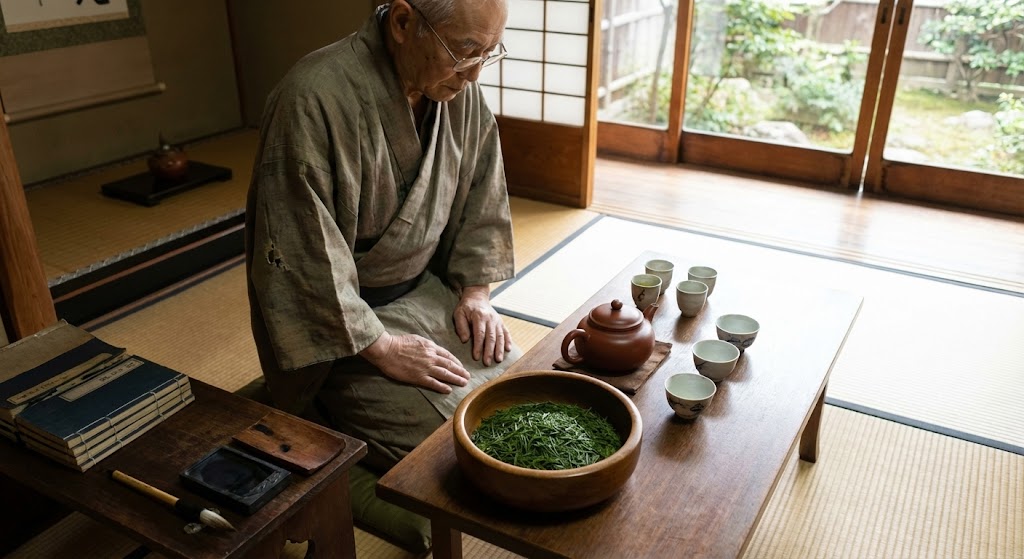
1. Baisao: The Tea-Selling Monk Who Rejected Matcha
Senchado (煎茶道 senchadō, "the way of sencha tea") emerged 18th century Japan as deliberate counter-movement to dominant Chanoyu (茶の湯, "Way of Tea," the formal matcha ceremony). The founder: Baisao (売茶翁, 1675-1763, "Old Tea Seller")—wandering Buddhist monk who sold simple leaf tea in Kyoto streets, rejecting Chanoyu's rigid aristocratic formalism. Baisao's philosophy: tea should be accessible, natural, spontaneous—not expensive ritual requiring years of study.
The historical context: by 1700s, Chanoyu had ossified into expensive status performance—tea masters charged high fees, utensils cost fortunes, elaborate rules governed every movement. The practice became exclusive domain of samurai class and wealthy merchants. Baisao, influenced by Chinese literati tea culture (Ming Dynasty scholar simplicity), introduced sencha (loose-leaf green tea) as alternative—cheap, easy to prepare, emphasizing conversation and nature over ceremony.
The philosophical tension mirrors broader Japanese cultural divide: kurai (暗い, darkness, mystery, formality—Chanoyu) vs. akarui (明るい, brightness, openness, informality—Senchado). Chanoyu follows wabi-sabi aesthetic (poverty, imperfection, asymmetry). Senchado embraces karumi (軽み, lightness—Basho's haiku principle)—refined simplicity without pretension. The two paths represent different responses to tea's meaning: sacred ritual vs. cultivated casualness.
| Dimension | Chanoyu (Matcha Ceremony) | Senchado (Sencha Way) |
|---|---|---|
| Tea Type | Matcha (powdered green tea, whisked) | Sencha (loose-leaf green tea, steeped) |
| Philosophy | Zen Buddhism, wabi-sabi (rustic simplicity) | Confucian literati, karumi (bright lightness) |
| Aesthetic | Dark, austere, asymmetric (茶室 chashitsu tearoom) | Bright, natural, elegant (outdoor or airy rooms) |
| Utensils | Raku tea bowls (irregular, handmade, expensive) | Chinese porcelain teapots (refined, delicate, imported) |
| Social Class | Samurai, aristocrats, wealthy merchants (exclusive) | Scholars, poets, intellectuals, commoners (accessible) |
| Training Duration | Years to decades (master-apprentice system) | Months to years (more flexible learning) |
| Modern Status | Globally famous, UNESCO Intangible Heritage | Obscure, declining, few practitioners |
2. Chinese Literati Influence: Ming Tea Culture in Japan
Senchado's aesthetics derive from Chinese wenren (文人, literati scholar) tea culture—especially Ming Dynasty (1368-1644) practices. Chinese literati drank loose-leaf tea (not powdered), using small Yixing clay teapots (similar to Gongfu cha), emphasizing tea's natural flavor + refined conversation + calligraphy/painting. This culture reached Japan via Chinese texts, imported utensils, and rare direct contact with Chinese scholars.
Baisao studied Chinese tea classics: Lu Yu's Classic of Tea (茶経 Cha Jing, 760 CE—Tang Dynasty's foundational tea preparation manual), and Ming Dynasty texts praising simplicity over ritual. He adopted Chinese literati tools: small teapots (急須 kyusu—Japanese adaptation of Chinese Yixing style), porcelain cups, bamboo tea trays. The aesthetic was conscious cultural import—Japanese form of Sinophilia (China worship among educated elite, common in Edo period 1603-1868), paralleling how Victorian Britain adopted Asian aesthetics or European tea trade fetishized Chinese culture.
The cultural borrowing creates irony: while Japan is famous for matcha ceremony (exported globally as "Japanese tea culture"), Senchado represents reverse cultural flow—Japan importing Chinese tea culture after exporting matcha to China centuries earlier (Song Dynasty 960-1279 adopted Japanese-influenced whisked tea, later abandoned for loose-leaf during Ming). Tea culture ping-pongs between civilizations, each claiming ownership while freely borrowing—similar to how bubble tea spread from Taiwan globally, Hong Kong milk tea fused British and Cantonese traditions, or British afternoon tea claimed Chinese leaves as their own ritual.
Expert Tip: Sencha vs. Matcha Taste Profiles
If you've only tried matcha (thick, creamy, intensely vegetal, slight bitterness), sencha will surprise—lighter, more delicate, grassy-sweet with marine/umami notes (nori seaweed flavor from amino acids). Matcha is espresso-like concentration; sencha is filtered coffee elegance. Don't over-steep sencha (common beginner error): 60-90 seconds max for first infusion at 70-80°C. Longer steeping = bitter astringency, ruins tea. Use 3g tea per 100mL water (higher ratio than Western brewing, lower than Gongfu). Sencha reveals subtlety—quiet flavor requiring attention, unlike matcha's loudness.
3. Sencha Brewing Physics: Temperature and Timing Precision
Sencha preparation is chemically delicate: Japanese green tea (unoxidized, steamed to halt oxidation) contains high levels of amino acids (L-theanine ~20mg/g—creates umami/sweet) and catechins (EGCG and related polyphenols ~12-15%—creates astringency/bitterness). The goal: extract maximum amino acids, minimum catechins. This requires precise temperature control.
The temperature chemistry: L-theanine dissolves readily at 50°C+, extraction increases with temperature but plateaus by 70°C. Catechins extract minimally below 60°C, increase sharply above 70°C, fully extract at 80°C+. Sweet spot: 60-70°C water maximizes umami while limiting bitterness. Higher-grade sencha (gyokuro, first-flush) uses lower temps (50-60°C) due to higher amino acid concentration and delicate flavor. Lower-grade sencha (bancha, late-flush) tolerates 70-80°C—less amino acid, more robust structure.
The timing: first infusion 60-90 seconds releases bulk of amino acids + light catechins (sweet, umami). Second infusion 30-45 seconds extracts remaining amino acids + more catechins (balanced). Third infusion 90-120 seconds pulls final compounds (slightly bitter, mineral). After 3 infusions, leaves are exhausted—unlike oolong Gongfu (6-12 infusions possible due to oxidation/roasting complexity) or grandpa style's all-day continuous steeping. Sencha's delicacy means fast depletion—fragile flower vs. robust tree, more similar to tea-leaf reading's single-use leaves than mate's 10-20 refills.
| Sencha Grade | Water Temperature | Leaf Ratio | First Steep Time |
|---|---|---|---|
| Gyokuro (玉露, "Jade Dew"—shade-grown premium) | 50-60°C | 5-6g per 100mL (high ratio) | 90-120 seconds |
| Sencha (煎茶, "Seared Tea"—standard grade) | 60-70°C | 3-4g per 100mL | 60-90 seconds |
| Bancha (番茶, "Common Tea"—later harvest, larger leaves) | 70-80°C | 2-3g per 100mL | 45-60 seconds |
| Hojicha (焙じ茶, "Roasted Tea"—roasted bancha/sencha) | 90-100°C (roasting withstands heat) | 3g per 100mL | 30-45 seconds |
4. The Kyusu Teapot: Side-Handle Ergonomics
Senchado uses kyusu (急須)—Japanese teapot with side-handle (横手 yokote style) instead of rear-handle (like Chinese/Western pots). The side-handle allows single-handed pouring while seated (no need to lift arm high), creating smooth low-pour motion. This design prioritizes table-level brewing—seated on floor (tatami), pouring into small cups arranged on tray, minimal vertical movement.
The material: traditional kyusu are unglazed stoneware (similar to Yixing purple clay), porous surface that absorbs tea oils over time, creating "seasoned" pot. Modern kyusu use glazed ceramic (easier to clean, no seasoning). The internal feature: fine mesh filter (tea strainer built into spout or removable basket)—prevents tea leaves from pouring into cups. Mesh fineness is critical: too coarse = leaf particles in tea (gritty), too fine = clogs easily (slow pour). Ideal mesh: ~200 microns (allows liquid + fine particles, blocks leaf chunks).
The pouring technique: multiple short pours into several cups rather than filling one cup completely. This ensures even strength across all cups (same principle as Gongfu's fairness pitcher or Persian tea's samovar equalization)—pouring "round-robin" style (cup A → B → C → A → B → C) until pot is empty. Final shake of kyusu dislodges last concentrated drops (paralleling Hong Kong's thorough pantyhose squeezing)—never leave liquid in pot (over-extracts leaves, ruins subsequent infusions, similar issue as Tang Dynasty's timing precision).
Expert Tip: Water Cooling Without Thermometer
Senchado traditionally lacks thermometers—practitioners use cooling vessels (yuzamashi 湯冷まし) to drop water temperature. Technique: Boil water (100°C), pour into yuzamashi (water drops ~10°C), pour from yuzamashi to empty teapot (drops another ~10°C to ~80°C), then into cups to pre-warm them (drops to ~70°C), finally pour warmed cup water back into teapot with leaves (now ~60-65°C—ideal for sencha). Each vessel transfer drops temp by ~10°C—ancient thermometer-free method. Modern shortcut: boil water, wait 5 minutes = ~80°C, wait 10 minutes = ~70°C. Use timer instead of cooling vessels if impatient.
5. Senchado Schools: Fragmentation and Decline
Unlike Chanoyu (unified schools with clear lineages—Urasenke, Omotesenke, Mushanokojisenke—three main branches from Sen Rikyu), Senchado fragmented into numerous schools with competing philosophies. Major schools include: Ogawa-ryu (小川流, emphasizes Chinese literati aesthetics), Higashiyama-ryu (東山流, focuses on kyoto local traditions), Hosen-ryu (方円流, modernizing movement). Each school developed distinct rituals, utensil preferences, and philosophical interpretations—creating confusion and preventing unified cultural identity.
The decline began Meiji era (1868-1912) when Japan modernized and embraced Western culture—tea drinking shifted to British-style black tea (fashionable, cosmopolitan), and traditional practices seemed outdated. Chanoyu survived by positioning itself as quintessential Japanese art (nationalistic appeal), while Senchado's Chinese influences made it culturally suspect. Post-WWII, Senchado further declined—modern Japanese drink sencha casually (no ceremony), and formal practice became obscure hobby.
Today: estimated fewer than 10,000 serious Senchado practitioners in Japan (vs. 2-3 million Chanoyu practitioners). Schools struggle to attract students—young Japanese see Senchado as boring/old-fashioned, prefer coffee culture or casual tea drinking (similar challenges facing Persian tea culture, Turkish tea among youth, and British builder's tea traditions). Ironically, Senchado's original goal (make tea accessible, reject elitism) may have caused its downfall—without formal structure and cultural prestige (like afternoon tea's social currency or Gongfu's skill demonstration), the practice lost appeal. The accessible alternative became too mundane to preserve.
6. Sencha Equipment and Utensil Aesthetics
Senchado practitioners collect specialized utensils: Kyusu (teapot): Small (100-200mL), side-handle, built-in strainer. Yuzamashi (water cooler): Handle-less vessel for temperature reduction. Sencha cups (yunomi): Small cylindrical cups (50-80mL), no handles, porcelain or stoneware. Tea caddy (chatsubo): Ceramic jar for storing sencha, often decorative. Tea scoop (chashaku): Bamboo scoop for measuring leaves (different from matcha's ceremonial scoop—more utilitarian). Tea tray (chakin): Wooden or bamboo platform for arranging utensils.
The aesthetic emphasizes Chinese porcelain—blue-and-white patterns, delicate painting, refined craftsmanship. This contrasts with Chanoyu's rustic Japanese ceramics (rough raku, asymmetric shapes). Senchado practitioners value symmetry, elegance, lightness—Confucian harmony vs. Zen roughness. The equipment collecting can become expensive (antique Chinese teapots cost $500-5,000+), though modern versions are affordable ($30-100).
The spatial arrangement: Senchado doesn't require dedicated tea room (unlike Chanoyu's chashitsu architecture). Practice occurs in regular room, preferably with natural light, view of garden, tatami mats (but not essential). The informality is intentional—tea should fit into life, not require special architecture. Modern practitioners often use tables/chairs instead of floor seating—further casualization, purists complain, pragmatists accept.
7. Seasonal Sencha: First Flush vs. Late Harvest Chemistry
Sencha quality varies dramatically by harvest time: First flush (Shincha, 新茶): Harvested late April-early May, after winter dormancy. Highest amino acid content (L-theanine peaks—sweet, umami), low catechins (minimal bitterness), vibrant green color, grassy-fresh aroma. Premium grade, expensive ($30-100+ per 100g). Second flush (Nibancha, 二番茶): June harvest, moderate quality—lower amino acids, higher catechins, more astringent. Third flush (Sanbancha, 三番茶): August harvest, lowest quality—used for bancha or processing into hojicha (roasted tea). By late summer, tea plants are depleted, sun exposure has reduced amino acids and increased catechins—harsh, bitter flavor.
The chemistry: L-theanine accumulates in tea plants during winter dormancy (nitrogen storage), concentrated in new spring growth. Summer heat + sun exposure converts amino acids to catechins (sun protection for plant—catechins are antioxidants). This creates seasonal quality hierarchy—spring tea is sweet peak, summer tea is bitter nadir. The cycle parallels wine vintage variation—annual environmental conditions create flavor differences, connoisseurs pay premiums for good years.
Modern challenge: climate change shifting harvest dates (warming springs = earlier flushes, heat stress reducing quality), and labor shortages (hand-picking young leaves is skilled work, aging farmers, no young replacements). Some producers experiment with machine harvesting (cheaper, faster) but quality suffers—machines can't selectively pick tender new growth. The tension between tradition and economics threatens sencha culture's future.
| Harvest Season | Timing | Quality Characteristics | Typical Use |
|---|---|---|---|
| First Flush (Shincha 新茶) | Late April - Early May | Highest L-theanine, lowest catechins—sweet, umami, fresh, vibrant green | Premium sencha, Gyokuro—highest grade, special occasions |
| Second Flush (Nibancha 二番茶) | June | Moderate amino acids, moderate catechins—balanced, slightly astringent | Standard sencha—daily drinking grade |
| Third Flush (Sanbancha 三番茶) | August | Low amino acids, high catechins—bitter, astringent, dull color | Bancha (common tea), Hojicha (roasted tea)—low-cost options |
| Autumn Flush (Shuutobancha 秋冬番茶) | September-October (rare, not all farms) | Very low quality—minimal flavor, processed for commercial blends | Restaurant-grade tea, tea bags, bottled tea drinks |
8. Senchado Philosophy: Cultivated Naturalness
Senchado's core paradox: achieving spontaneity through practice. Unlike Chanoyu's emphasis on prescribed movements (kata, 型—choreographed forms repeated identically), Senchado values natural flow—each tea session unique, adapting to season, company, mood. However, this naturalness requires cultivation—years of practice to internalize principles until "effortless" motion emerges. The concept is shu-ha-ri (守破離): first obey rules (守 shu), then break rules (破 ha), finally transcend rules (離 ri)—creative freedom earned through mastery.
The philosophical influence: Daoist wu wei (無為, "effortless action") via Chinese literati culture. The ideal Senchado practitioner is like bamboo—flexible, natural, unforced. Tea preparation becomes meditation, conversation flows like water, utensils are tools not fetishes. This contrasts with Chanoyu's intense deliberation—every gesture measured, silence valued, aesthetic tension cultivated. Senchado seeks opposite effect: relaxed conviviality, intellectual exchange, wine-party atmosphere (without alcohol—tea as intoxicant for conversation).
Expert Tip: Pairing Sencha with Japanese Sweets
Traditional Senchado sessions include wagashi (和菓子, Japanese confections)—not random sweets, but seasonally specific, carefully paired with tea. Spring: sakuramochi (cherry blossom rice cake) with first-flush sencha (floral harmony). Summer: mizu yokan (chilled sweet bean jelly) with chilled sencha (cooling effect). Autumn: kuri kinton (chestnut paste) with roasted sencha (nutty resonance). Winter: hot dorayaki (red bean pancakes) with strong sencha (warming sweetness). The sweetness resets palate between infusions, highlighting tea's changing character across steeps. Never eat sweet during tea drinking—consume between infusions only. This rhythm creates alternating taste waves—sweet → umami → sweet → umami—enhancing both.
9. Practicing Senchado at Home: Simplified Method
Equipment (Budget: $40-80): Kyusu teapot (100-150mL, side-handle, built-in strainer), 2-3 small cups (50-70mL each), kettle (variable-temp if possible, or regular + thermometer), small tea scoop or measuring spoon, quality sencha (buy from Japanese tea specialist, not grocery store generic).
Tea Selection for Beginners: Start with mid-grade sencha (~$20-30 per 100g)—forgiving if over-steeped, clear flavor profile, affordable enough to practice without anxiety. Avoid starting with gyokuro (too expensive, too delicate) or bancha (too crude, doesn't showcase Senchado's subtlety).
Step 1 - Prepare water: Boil water in kettle. If using variable-temp kettle, set to 70°C. If using regular kettle, boil then let cool 8-10 minutes to reach ~70°C (use thermometer to verify initially, develop feel over time). Water temperature is most critical variable—wrong temp ruins tea.
Step 2 - Measure and warm teapot: Add 4-5g sencha to kyusu (roughly 1 heaping tablespoon, or weigh on scale). Pour small amount of hot water into teapot, swirl to warm vessel, discard water. This pre-warming prevents rapid cooling when brewing water added.
Step 3 - First infusion: Pour 100-120mL water (70°C) into kyusu with leaves. Place lid on, wait 60 seconds (use timer initially—easy to lose track, over-steeping by even 20 seconds damages flavor). Do not agitate or swirl teapot—gentle still steeping only.
Step 4 - Pour into cups: Pour from kyusu into cups using "round-robin" method—small amount to cup 1, then cup 2, then cup 3, repeat until teapot empty. This equalizes strength across all cups (first pour weakest, last pour strongest—mixing them distributes flavor). Shake kyusu gently at end to dislodge last drops. Never leave liquid in teapot between infusions.
Step 5 - Taste first infusion: Sip slowly, note flavor profile—should be grassy-sweet with umami depth, slight marine/seaweed note (from amino acids), minimal bitterness. Color should be pale yellow-green, clear not cloudy. If bitter: next time use lower temp or shorter steep. If weak/watery: increase leaf amount or steep time slightly.
Step 6 - Second infusion: Immediately pour fresh 70°C water into kyusu (same leaves still inside). Steep only 30 seconds this time (leaves already hydrated, extract faster). Pour into cups using same round-robin method. Second infusion often considered peak—fuller flavor, balanced sweetness-astringency, slightly stronger than first.
Step 7 - Third infusion (optional): Pour water, steep 90-120 seconds (leaves nearly exhausted, need longer extraction). Third infusion will be lighter, more mineral, slight bitterness emerging. After third steep, discard leaves—no useful flavor remains. Some teas yield 4th infusion if high quality, but most are done after third.
Cleanup: Dump spent leaves (compost if possible—excellent fertilizer). Rinse kyusu with water only (no soap—damages porous clay if unglazed, and seasoning desirable). Turn teapot upside-down to air-dry completely (prevents mold in humid environments). Store sencha in airtight container, cool dark place, away from strong odors (tea absorbs smells easily—never store near spices, coffee, etc.).
Comments