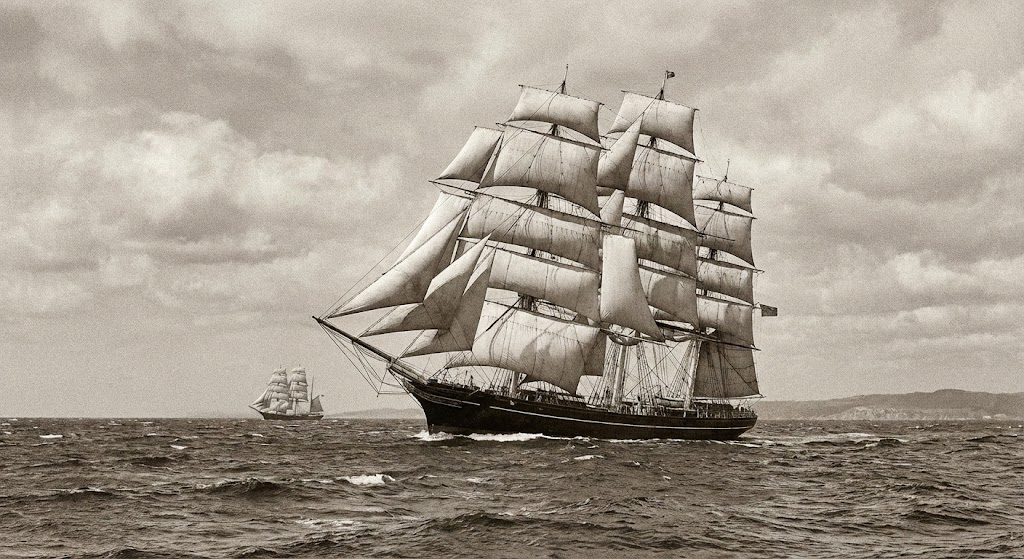
1. The First-Flush Premium: Why Speed Mattered
Tea clipper races (1860s-1870s) emerged from economic reality: fresh spring tea commanded higher prices in London market. First-flush tea (spring harvest, March-April in China/India) had superior quality: tender young leaves (higher amino acids, sweeter flavor, less bitterness), vibrant green color (chlorophyll content peak, visual appeal), delicate aromatics (volatile compounds fresh, not degraded by heat/time). Market premium: First ship to deliver new season's tea could sell at 2-3× price of later arrivals (scarcity value, freshness premium, merchant competition for earliest stock). Time sensitivity: Each week's delay reduced price (tea degrades in transit—moisture absorption, oxidation, flavor loss), creating extreme pressure for speed.
The chemistry of tea degradation: during sea voyage (3-4 months typical, pre-Suez Canal), tea undergoes: Oxidation: Polyphenols react with oxygen (catechins → theaflavins → thearubigins—creates browning, increases bitterness like noon chai's alkaline oxidation, reduces freshness). Rate follows $ k = Ae^{-E_a/RT} $ (Arrhenius equation—higher temperature accelerates reaction exponentially similar to Song processing temperature control). Moisture absorption: Tea is hygroscopic (absorbs water from air), increasing from 3% moisture (optimal) to 8-12% (humid ship hold)—enables mold growth, degrades flavor. Volatile loss: Aromatic compounds evaporate (terpenes, aldehydes—responsible for fresh tea scent like monkey-myth oolong's fragrance), leaving stale flavor. The physics: shorter voyage time = less oxidation/moisture/volatile loss = higher quality = higher price. Speed literally meant money—every day saved was profit earned.
The financial stakes: cargo value was immense. A clipper carrying 1.2 million pounds of tea (typical load) worth £3-5 per pound (wholesale) = £3.6-6 million total cargo value (equivalent to ~£300-500 million today, adjusting for inflation like Da Hong Pao's modern auction prices). Winning first-arrival premium (20-50% price increase) = £720,000-3 million bonus (£60-250 million modern equivalent). Ship owners could recoup entire vessel construction cost in single successful season—but lose fortune if ship slow/damaged. The gambling: each voyage was massive bet (invest in fast ship, skilled crew, optimal route—win big or lose big). No middle ground—tea trade was boom-or-bust speculation, racing was rational economic behavior given prize structure.
| Ship Type | Typical Speed | Voyage Time (China → London) | Cargo Capacity |
|---|---|---|---|
| East Indiaman (1600s-1830s) | 5-7 knots average (slow, heavy, armed merchant ship) | 12-18 months (via Cape of Good Hope, monsoon-dependent) | 500-800 tons (large but inefficient, part cargo was cannons/supplies) |
| Early Clipper (1840s-1850s) | 10-12 knots average (fast, streamlined, lightly built) | 4-5 months (optimal winds, efficient routing) | 600-1000 tons (sacrificed some capacity for speed) |
| Extreme Clipper (1850s-1860s, peak era) | 14-16 knots average, 18-20 knots in ideal winds | 3-3.5 months (record runs—Thermopylae, Cutty Sark class) | 800-1300 tons (maximum speed-to-capacity optimization) |
| Steam Ship (1860s+, early models) | 8-10 knots consistent (wind-independent, reliable but slow early engines) | 2.5-3.5 months (Suez Canal route from 1869—direct vs. Cape of Good Hope) | 1500-3000 tons (much larger—but coal fuel ate cargo space early on) |
| Modern Steam (1880s+) | 12-15 knots consistent (reliable, efficient engines) | 1.5-2 months (Suez Canal, no wind dependency) | 3000-8000 tons (dominated trade, clippers obsolete) |
2. The Cutty Sark: Engineering Speed into Wood and Canvas
Cutty Sark (launched 1869, Dumbarton, Scotland) was extreme clipper designed for maximum speed: Dimensions: 212.5 feet length, 36 feet beam, 21 feet depth (length-to-beam ratio 5.9:1—very narrow, minimizes drag). Displacement: 963 gross register tons (relatively light for size—thin hull planking, minimal ballast). Sail area: 32,000 square feet maximum (enormous spread—more sail = more power, assuming crew could handle it). Hull design: Composite construction (iron frames, teak planking—iron strength with wood hydrodynamics), sharp entry (narrow bow angle cuts water cleanly), long fine run (gradual stern taper reduces turbulent wake).
The physics of clipper speed: $ V = \\sqrt{\\frac{2F}{\\rho C_D A}} $, where $ V $ is velocity, $ F $ is propulsive force (sail thrust), $ \\rho $ is water density, $ C_D $ is drag coefficient, $ A $ is wetted surface area. To maximize $ V $: Increase $ F $: More sail area (Cutty Sark's massive rig), efficient sail shapes (tight weave, proper cut), skilled trim (optimizing angle-of-attack for wind conditions). Decrease $ C_D $: Streamlined hull (smooth planking, fair curves, no protrusions), copper sheathing (prevents barnacle fouling—marine growth increases drag dramatically), narrow beam (less water displaced = less drag). Decrease $ A $: Minimize wetted surface (shallow draft, fine entry/exit—less hull in water = less friction). Cutty Sark optimized all three variables—relentless speed focus in every design choice.
The construction innovation: Iron frames with wood planking: Iron ribs provided strength (enabled longer ships without hogging—sagging in middle), teak planking maintained smooth surface (wood hydrodynamics superior to iron plating—less surface roughness, better flow like terracotta's surface properties). Copper sheathing: Entire underwater hull covered in copper sheets (prevents teredo worm boring, resists barnacle adhesion—maintained smooth surface). Copper corrodes slowly, creating biocidal surface (copper ions toxic to marine organisms similar to tea pet antimicrobial properties), requiring replacement every 4-5 years (expensive maintenance—£2000-3000 re-coppering cost, but essential for speed). Lightweight construction: Sacrificed durability for speed (thin planking, minimal frames, reduced ballast)—clippers were fragile (couldn't handle heavy seas like traditional ships), but fast (design priority hierarchy: speed first, safety second).
Expert Tip: Visiting the Cutty Sark Museum (Greenwich, London)
The real Cutty Sark survives as museum ship (Greenwich, London—dry-docked, open to public). Worth visiting for tea history enthusiasts: Hull viewing: Walk underneath ship (raised display shows copper sheathing, hull lines—rare chance to see clipper's underwater design). Hold exploration: Original cargo hold preserved (shows tea chest stacking, storage organization, scale of cargo). Deck experience: Stand on deck (feel ship's size, see rigging complexity, understand crew working conditions). Interactive displays: Tea trade history, race timelines, life-at-sea exhibits. Practical tips: Book online (£15-18 adult admission, cheaper advance), allow 2-3 hours (don't rush—ship is big), combine with National Maritime Museum (same area, free admission, more tea trade context). Best for: history nerds, engineering enthusiasts, anyone curious about globalization's sailing-ship era. Not just tea—whole age of sail preserved in one hull.
3. The Great Tea Race of 1866: Legendary Competition
The 1866 tea race was most famous clipper contest: Participants: Five premium clippers (Ariel, Taeping, Serica, Fiery Cross, Taitsing—all loaded with season's first tea, departed Fuzhou China within days). Stakes: First ship to London won premium prices (estimated £10,000+ advantage—£1+ million modern equivalent), plus bragging rights (fastest ship reputation = future cargo contracts). Route: Fuzhou → Sunda Strait (Indonesia) → Indian Ocean → Cape of Good Hope → Atlantic → English Channel → London Docks, ~14,000 nautical miles, typical time 110-130 days.
The result: After 99 days at sea, three ships (Ariel, Taeping, Serica) arrived London within hours of each other—September 6, 1866. Ariel and Taeping docked same tide (literally tied—judges couldn't determine winner), Serica arrived 2 hours later. The closeness was unprecedented: 99 days × 24 hours = 2,376 hours total voyage, final gap < 3 hours = 0.13% time difference over 14,000 miles. The statistical improbability: three independently-sailed ships matching speed to within hours over 3+ months = extraordinary coincidence (different winds encountered, different tack decisions, different sail configurations—yet converged). Some historians suspect collusion (captains agreed to tie, share premium—unproven but plausible given suspicious timing).
The legacy: 1866 race became legendary (newspapers covered extensively, public fascination, betting pools), immortalized clipper era (peak of sail technology, never surpassed), and demonstrated speed limits of wind power (couldn't improve much beyond 1866 times—approaching physical limits of hull speed, sail efficiency). Within decade, steam power surpassed clippers (Suez Canal 1869 made steam viable—couldn't navigate narrow canal with sails, required engines). The 1866 race was swan song—clippers' final glory before technological obsolescence. Like many "golden ages," recognized as such only retrospectively (participants didn't know they were living end of era—but we see 1866 as climax before decline like Tang Dynasty's tea culture peak).
4. Life Aboard: Speed's Human Cost
Clipper racing demanded brutal labor: Crew size: 28-35 sailors typical (minimal crew for ship size—cost-cutting, but also speed advantage: fewer people = less food/water weight = faster ship). Work schedule: Four-hour watches (4 hours on duty, 4 hours off, rotating—chronic sleep deprivation), all-hands for sail changes (entire crew called on deck during storms, tacking, emergencies—interrupted sleep common). Diet: Hardtack (dried biscuit, weevil-infested after weeks), salt pork/beef (preserved in brine, barely edible like swagman's survival rations), dried peas (boiled to mush), occasional fish (if caught). Scurvy common (vitamin C deficiency—bleeding gums, loose teeth, death), dysentery (contaminated water), injuries (falling from rigging, crushed by cargo shifts).
The danger statistics: clipper mortality rate ~5-10% per voyage (2-3 crew deaths expected on 99-day passage)—causes included: Falling from rigging: Working 100+ feet above deck in gale winds, wet ropes, darkness (night sail changes). Swept overboard: Waves crashing over deck (some ships lost entire watch crews in single storm). Crushed by cargo: Improperly secured tea chests shifting in rough seas (heavy loads becoming projectiles). Disease: Cholera, typhoid, tuberculosis (confined quarters, poor sanitation, no medical care—ship's doctor rare on cargo vessels). Captain brutality: Flogging, confinement, deliberate starvation (discipline was violent, captains had absolute authority, murder occasionally unpunished if victim was "insubordinate" sailor).
The wage structure: ordinary seamen earned £3-4 per month (£36-48 per year—poverty wages, equivalent to ~£3000-4000 modern purchasing power), able seamen £5-6/month (£60-72/year with skills), officers £10-20/month (£120-240/year). Compare to cargo value (£3-6 million ship cargo vs. £2000 total crew wages for voyage—labor was 0.03-0.07% of cargo value). The exploitation: immense profits extracted from near-slave labor (crews were expendable, easily replaced from port slums, powerless against owners/captains similar to colonial labor extraction in tea shops). This parallels modern supply chains (fast fashion, Amazon warehouses—speed prioritized over worker welfare, profits privatized while costs externalized onto laborers). The clipper = precursor to modern just-in-time logistics (speed obsession, human cost ignored, efficiency trumps ethics).
| Crew Position | Monthly Wage | Responsibilities | Mortality Risk |
|---|---|---|---|
| Ordinary Seaman (Entry-level) | £3-4 (~£250-330/month modern) | Basic deck work (swabbing, cargo handling), learning ropes, night watch | Highest (inexperienced, assigned dangerous tasks, worked to exhaustion) |
| Able Seaman (Skilled sailor) | £5-6 (~£420-500/month modern) | Sail handling (reef, set, trim), rigging work, helm steering, knot-tying, splicing | High (worked aloft in storms, long shifts, experienced but still vulnerable) |
| Carpenter/Sailmaker (Specialist) | £8-12 (~£660-1000/month modern) | Repairs (hull leaks, sail tears, rigging breaks), maintenance, emergency fixes at sea | Moderate (valuable skills = some protection, but still exposed to dangers) |
| Mate (Junior Officer) | £10-15 (~£830-1250/month modern) | Watch supervision, navigation assistance, cargo management, discipline enforcement | Lower (command position, less physical risk, but shared ship's fate in disasters) |
| Captain (Master) | £20-30 + % bonus (~£1650-2500/month + profit share) | Navigation, route decisions, crew management, cargo safety, ship operations, owner liaison | Lowest individual risk, highest responsibility (career ruined by ship loss, but usually survived to face consequences) |
Expert Tip: Reading Clipper Ship Logs (Historical Research)
Many clipper ship logs survive (maritime museums, archives, digitized collections—Mystic Seaport, National Maritime Museum Greenwich, Library of Congress). Accessible primary sources revealing daily life: What to look for: (1) Weather notation (wind direction/speed, sea state—shows navigation decisions), (2) Sail changes (crew activity, response to conditions), (3) Punishment records (floggings, confinements—reveals captain's temperament, crew discipline), (4) Death/injury entries (understated usually—"John Smith fell from mainmast"—code for "died horribly"), (5) Navigation calculations (latitude/longitude, distance run—track actual routes vs. ideal). Online access: Google "clipper ship log [ship name]" finds digitized examples. Many are surprisingly readable (cursive but legible, English entries, technical terms decipherable with glossary). Gives visceral sense of voyage reality—boredom + terror + exhaustion, captured in terse daily entries. The historical intimacy: reading captain's handwriting from 1866 voyage, connecting across centuries through shared tea obsession.
5. The Suez Canal: Technology Kills Tradition (1869)
Suez Canal opened November 1869 (connecting Mediterranean to Red Sea, shortening Europe-Asia route by ~7000 miles), immediately dooming clippers: The route advantage: Old route (around Cape of Good Hope): London → Cape Town → India/China, ~14,000-16,000 miles, 90-120 days under sail. Suez route: London → Gibraltar → Suez → India/China, ~8,000-10,000 miles, 45-60 days under steam (enabling rapid Turkish tea imports). The distance saved: ~40-50% shorter route, nearly halving voyage time. The critical difference: Suez Canal was narrow (190 feet wide initially like tea tray drainage channels), shallow (26 feet draft limit), required precise steering (one ship at a time through most sections)—impossible for sailing ships (wind direction unpredictable, couldn't navigate tight canal under sail power alone). Steam ships could motor through (independent of wind, precise control), gaining massive time advantage.
The economic math: Steam ship Suez route: 50-day voyage × lower fuel costs (coal cheaper than crew wages for equivalent speed) + higher cargo capacity (no sail rigging, less ballast weight needed) + reliability (schedule-independent of weather—consistent arrival times) = lower per-ton transport costs despite expensive engines. Clipper Cape route: 100-day voyage × higher crew costs (need skilled sailors, dangerous work demands premium) + lower capacity (sail rigging占space, lighter construction limits cargo weight) + unreliability (storm delays, calm periods—arrival date uncertain) = higher costs, lower profit. By 1875, steam had decisive advantage—tea trade shifted to steamers, clippers relegated to wool/coal/bulk cargo trades (low-value goods where speed didn't matter).
The cultural loss: clipper era (1845-1875) represented peak of sail technology (beautiful ships, skilled crews, romantic adventure—last gasp of wind power before steam industrialization). Steam was efficient but soulless (no elegance in smoke-belching iron hulls, no skill in following coal-powered schedule, no romance in predictable machinery). The nostalgia: even contemporaries mourned clipper demise (newspapers lamented "end of sail," artists painted clipper scenes, sailors wrote memoirs), recognizing beauty lost to progress. The pattern repeats: every technological transition kills something lovely (hand-weaving → factories like kulhar disposability replacing craftsmanship, steam trains → airplanes, film → digital—efficiency destroys craft). Clippers were objectively worse (dangerous, expensive, unreliable), but subjectively glorious (graceful, demanding human excellence, connecting to nature like tea room's intentional slowness). We still mourn them—Cutty Sark museum exists because we miss sailing ships, even knowing we'd never actually want to crew one.
6. Cutty Sark's Second Career: Wool Trade and Survival
After tea trade collapsed (1870s), Cutty Sark pivoted: Australia wool run: Carrying wool bales (Sydney → London, ~12,000 miles, 70-80 days typical like swagman trade routes). Wool didn't require extreme speed (not perishable like tea, price less time-sensitive), but fast delivery still advantageous (earlier arrival = earlier market sale, freed capital faster for reinvestment). Cutty Sark excelled (set records—67-day Sydney-London run, consistently fastest wool clipper 1880s-1890s). Why clippers survived in wool trade: Wool is light (ship could carry huge volume without exceeding weight limits—clippers' large holds useful), clean (no oil/moisture to damage ship unlike coal cargo), and profitable enough to justify sail costs (premium Australian merino commanded good prices, speed bonus still relevant though smaller than tea).
The gradual decline: even wool trade mechanized (steam ships improved, canal access, economies of scale). By 1895, Cutty Sark struggling (old ship, maintenance expensive, fewer cargo contracts). 1895-1922: Sold to Portuguese owners (renamed Ferreira), used as cargo tramp (carrying whatever paid—timber, coal, general freight), reduced to ordinary merchant ship (no racing, no glory). 1922: Retired from active service (too old, too slow, engines more efficient). 1954: Preserved as museum ship (brought to Greenwich, dry-docked, restored to 1869 appearance). The survival: pure luck (most clippers scrapped 1880s-1920s—wood rot, iron corrosion, not worth maintaining). Cutty Sark survived because: (1) Continuously used (active ships get maintenance, idle ships deteriorate), (2) Portuguese ownership延long service (owner couldn't afford replacement, kept repairing), (3) Historical value recognized early (1950s preservation movement saved it before too degraded). Thermopylae (Cutty Sark's rival, arguably faster) wasn't saved—scrapped 1907. The survivor isn't always the best, just the luckiest.
7. The Clipper Legacy: Speed Culture and Global Trade
Clippers established modern shipping norms: Just-in-time logistics: Delivering goods exactly when needed (fresh tea before quality degraded like Gongfu's timing precision), not whenever convenient—modern Amazon same-day delivery is clipper philosophy scaled. Speed premium: Faster delivery commands higher prices (express shipping fees, priority mail, overnight delivery—time-value-of-goods concept from tea races). Extreme specialization: Clippers designed for single purpose (tea transport like specialized teaware forms), sacrificing versatility for excellence—modern logistics similar (refrigerated trucks, container ships, specialized aircraft—optimized for specific cargo types). Human cost ignored: Clipper crews expendable, paid minimum, worked to death—modern warehouse workers, gig economy drivers, garment factory labor exploited similarly (speed/efficiency prioritized over worker welfare).
The globalization acceleration: clippers compressed world (reduced voyage times 50-60% vs. previous ships), making global trade viable for time-sensitive goods. Before clippers: only durable goods worth shipping (spices like Kashmiri salt chemistry, porcelain, metals—could survive year+ voyages). Clippers enabled: fresh tea, seasonal fashions (like Victorian tea gown imports), perishable goods (with ice)—wider variety of global exchange. This expanded markets (creating demand for exotic goods, connecting producer to consumer faster), increased competition (multiple suppliers could reach market simultaneously, reducing monopoly power), and standardized trade routes (optimal paths discovered through racing, became standard for all ships). The modern parallel: airplanes further compressed world (24-hour delivery anywhere), internet compressed it to instant (digital goods travel at light speed)—but clippers started this process, began shrinking globe through engineering.
Expert Tip: Clipper Ship Model Building (Hobbyist Historical Recreation)
Building scale model teaches clipper design intimately: Beginner kit: Revell Cutty Sark 1:96 scale ($40-60, plastic, snap-together—easy introduction, 10-15 hours build time). Intermediate: Amati Cutty Sark 1:130 scale wood kit ($200-300, laser-cut planks, rigging included—40-60 hours, requires patience/precision). Advanced: Model Shipways Cutty Sark 1:64 scale ($600-1200, museum-quality, plank-on-frame construction like real ship, brass fittings, 200-400 hours—serious commitment). Skills learned: Hull shaping (how hull lines affect speed), rigging complexity (understanding sail plan, why specific rope arrangements), construction techniques (how wooden ships were built, engineering challenges solved). Community: Model ship clubs (local hobby shops, online forums—modelshipbuilder.com, shipsofscale.com), competitions, museum displays (some museums accept donated models). The meditative appeal: slow craft work, historical accuracy research, tactile connection to sailing era. Plus: beautiful display piece (finished model = conversation starter, teaches guests about clipper history).
8. The Romantic Myth vs. Brutal Reality
Popular imagination romanticizes clippers: The myth: Graceful sailing ships (billowing canvas, sleek hulls, adventure on high seas), heroic captains (skilled navigators, mastering elements, conquering distance), and glorious competition (gentleman's sporting contest, celebrated achievement). The reality: Brutal labor exploitation (sailors worked to death, expendable labor, inhuman conditions), environmental destruction (copper sheathing toxic, exotic woods depleted, whale oil for ship maintenance), and ruthless capitalism (profit over safety, speed over crew welfare, owners enriched while workers died like colonial tea shop labor systems). The historical sanitization: we remember beauty (ships' elegance), forget ugliness (human suffering enabling that beauty like monkey-picking fabrications hiding exploitation).
The class dimension: ship owners (wealthy merchants, aristocrats) profited enormously (£100,000+ per successful voyage—£8+ million modern), captains earned well (£240+ per year plus bonuses—upper-middle-class income), but sailors remained impoverished (£36-60/year—barely subsistence, no savings, one injury = destitution). The wealth extraction: tea profits flowed upward (owners > captains > officers > nobody else), creating Victorian inequality (Downton Abbey wealth built on trades like this—aristocratic leisure funded by working-class death like tea gown luxury vs. servant labor). Modern parallel: Amazon profits ($20+ billion annual) while warehouse workers earn minimum wage, injured frequently, surveilled constantly—same structure, different industry. Speed culture always exploits labor—efficiency demands human sacrifice, logistics profits require low wages.
9. Why Tea Culture Remembers Clippers
Tea enthusiasts romanticize clipper era: Quality association: Clipper-race tea was finest available (first-flush like Da Hong Pao's premium harvests, carefully transported, arrived fresh—genuinely superior to later shipments). Adventure narrative: Tea drinking connected to exotic travels (Chinese ports, monsoon storms, global trade—sipping tea = participating in worldly sophistication like Gongfu's cultural prestige). Nostalgic simplicity: Pre-industrial era seems purer (before mass production, when craft mattered like artisan teaware traditions, individual ships had character—vs. anonymous container shipping). Aesthetic appeal: Clippers were beautiful (paintings, photographs, museum ships—visually stunning objects like chabana's aesthetic philosophy, unlike modern cargo vessels). The selective memory: we remember speed/beauty/adventure, forget exploitation/danger/brutality.
The lesson: tea's global culture emerged from violence (colonial exploitation, labor abuse, environmental damage—clipper era was neither innocent nor gentle). Modern specialty tea tries to address this (fair-trade certification, organic farming, direct-trade relationships—ethical consumption attempts). But structural problems persist (low wages for tea pickers, unsafe working conditions, economic dependence of tea-growing regions). The clipper parallel: fast delivery still demands low wages (modern shipping crews, agricultural laborers, warehouse workers—speed efficiency requires cost-cutting somewhere, usually labor). We can't simply nostalgize past (clippers were beautiful but brutal), nor assume present is better (modern supply chains refined exploitation, made it invisible). The honest approach: appreciate clipper aesthetic while acknowledging human cost, drink tea while supporting ethical production, remember history's complexity—both glory and horror, beauty and suffering, speed and sacrifice. Cutty Sark teaches: speed is never free, someone always pays the price, and sometimes that someone is grinding tea leaves in Fuzhou while someone else races ship to London. The global tea trade: centuries of connection built on inequality. We inherit both legacy's beauty and its shame.
Comments