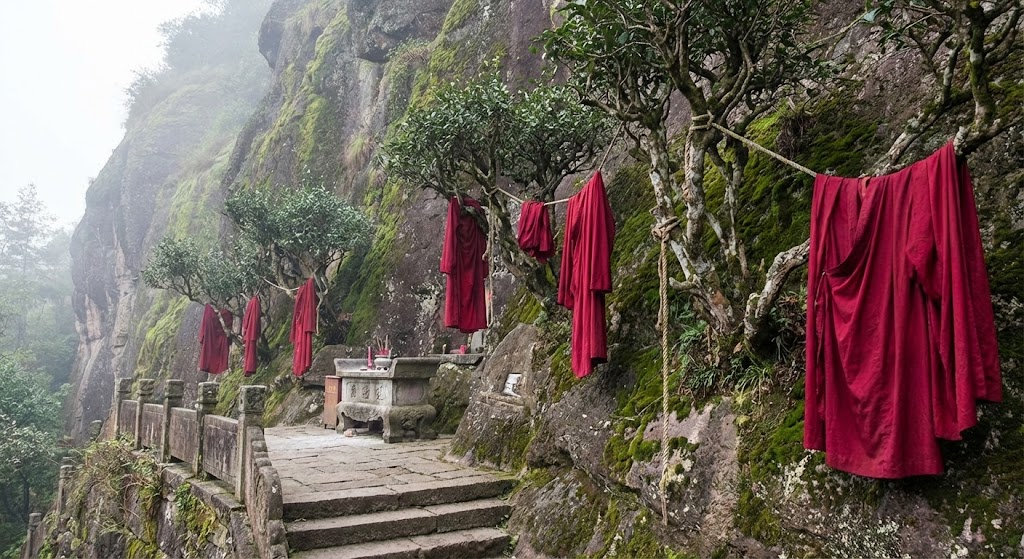
1. The Mother Tree Legend: Miracle Cure and Imperial Gratitude
The story: Ming Dynasty (1368-1644°CE), Emperor's mother falls gravely ill—palace physicians fail, death imminent. Scholar traveling through Wuyi Mountains discovers monks brewing special oolong (大红袍 dà hóng páo "Big Red Robe"). Scholar brings tea to palace, Empress drinks it, miraculously cures her ailment. Grateful Emperor sends red silk robe to drape over tea bushes (honoring plants that saved mother), hence name "Big Red Robe." Variations: Some versions say scholar cured (not Empress), others claim Tang Dynasty (not Ming), details shift but core = magical healing tea rewarded by royalty.
The four original mother trees: Located on Jiulong Ke cliff (九龙窠 "Nine Dragon Nest"), Wuyi Mountain scenic area—still alive, 350+ years old (if Ming story true). Current status: Protected as national treasure (fenced enclosure, 24/7 surveillance cameras, tourist viewing platform 50m away—cannot touch, pick from elite labor restrictions). Last harvest: 2005 (20g produced, auctioned for $30,000—$1,500/gram, most expensive tea transaction recorded). Post-2006: Chinese government banned further harvest (preserve trees for heritage, prevent exploitation—now purely symbolic like ceremonial relics).
2. The Biological Reality: Clones and Genetics
What "mother tree" actually means: Not miraculous individual, but source genetics: Vegetative propagation: Cuttings from original bushes produce clones (genetically identical plants, same DNA—standard horticultural practice like regional cultivar preservation). Modern Da Hong Pao: 99.99% is clones (descendants of original four trees, same genetics, commercially grown on thousands of acres). Quality variation: Despite identical DNA, tea quality varies by terroir (soil minerals, elevation, microclimate—location matters as much as genetics, like Rize geography).
The chemistry: What makes Da Hong Pao distinct (genetic + environmental): Polyphenol profile: Higher catechin concentration (oxidized during processing into theaflavins, creates reddish-brown color, fruity notes like premium tea chemistry). Volatile aromatics: Cinnamon/orchid compounds (cinnamaldehyde, linalool—cultivar produces these naturally, roasting amplifies). Yan yun (岩韵 "rock rhyme"): Mineral character from Danxia terroir (iron-rich sandstone, pH 4.5-5.5 soil, mist-shrouded valleys—environment shapes flavor like Kashmiri altitude chemistry). Roasting technique: Charcoal roasting 3-5 times (months-long process, caramelizes sugars, reduces astringency—skill matters as much as genetics, like Lu Yu's processing mastery).
| Da Hong Pao Type | Source | Price Range (per 50g) | What You're Actually Buying |
|---|---|---|---|
| Mother Tree Original (stopped 2006) | Four original bushes, Jiulong Ke cliff (350+ years old, museum specimens now) | $750,000+ (2005 auction $30,000/20g = theoretical $75,000/50g, unavailable) | Historical artifact (not for sale, last harvest went to National Museum—pure provenance, genetics identical to clones) |
| Zhengyan (正岩 "true cliff") | Core Wuyi scenic area (70 sq km, original mother tree microclimate, mineral-rich terroir like premium regions) | $100-500/50g (certified origin, limited production, artisan roasting like Gongfu quality) | Legitimate premium (terroir + skill, genetically mother tree, environmentally closest to original—worth the money) |
| Banyan (半岩 "half cliff") | Wuyi periphery (adjacent areas, less ideal elevation/soil, still regulated production zone) | $30-80/50g (good quality, genetically authentic, terroir compromised vs. Zhengyan like mid-tier sourcing) | Solid drinking tea (same genetics, less terroir magic—fair value, honest product) |
| Waishan (外山 "outer mountain") | Outside Wuyi region (Fujian Province broadly, different soil/climate, sometimes different cultivar entirely) | $10-25/50g (budget option, may not be true Da Hong Pao cultivar—oolong labeled as DHP for marketing like generic blends) | Oolong tea (drinkable but questionable authenticity—buyer beware, check certifications) |
| Blended/Commercial | Multiple oolongs blended (Shuixian, Rougui, other Wuyi varietals—not pure DHP, assembly like spice blends) | $8-20/50g (everyday drinking, consistent flavor, no terroir claims—honest if labeled "blend") | Oolong blend (tastes like Da Hong Pao style, not authentic cultivar—fine for casual drinking, don't pay premium prices) |
Buy Authentic Da Hong Pao
Check certification: Wuyi Rock Tea geographical indication (官方认证, official stamp, verifies origin like Iranian saffron authentication). Price reality: Under $50/50g = probably not Zhengyan (legitimate cliff tea costs more due to limited area, labor-intensive harvest like premium shipping). Trusted vendors: Yunnan Sourcing (transparent sourcing), Wuyi Origin (direct farm relationships like mate cooperatives). Taste test: Real DHP = cinnamon/orchid notes, mineral aftertaste, 6-8 infusions (thin/bitter/short = fake). Genetics matter less than terroir + roasting skill—pay for craft, not mythology.
3. Historical Accuracy: Separating Fact from Folklore
Problem 1: Timeline doesn't match. Legend says Ming Dynasty (1368-1644°CE), but: Tea naming conventions: "Big Red Robe" term doesn't appear in Ming texts (earliest written record = Qing Dynasty 1700s, 100+ years later). Wuyi tea development: Oolong processing technique developed late Ming/early Qing (1600s-1700s, earlier tea was mostly Tang compressed or Song whisked—Da Hong Pao requires semi-oxidized oolong method, anachronistic for early Ming). Conclusion: Story may reference earlier event, but modern Da Hong Pao cultivar = Qing Dynasty development (retrofitted legend to claim ancient origins, like poison detection myths).
Problem 2: No documentary evidence. Ming Dynasty kept detailed records (imperial archives, tax ledgers, tribute lists—bureaucracy documented everything), yet: No mention: Emperor's mother illness/tea cure not in palace records (suspicious omission for miraculous healing). No reward documentation: Red robes gifted to plants would've required imperial edict, fabric allocation, official ceremony (bureaucrats recorded EVERYTHING, absence = strong evidence against). Local oral tradition: Story first appears in late Qing folklore (1800s-1900s, passed down orally—typical origin myth pattern, like Victorian fortune-telling tales). Tourist amplification: 1980s-2000s Wuyi Mountain tourism boom (government promoted legend, built narrative for visitors—economic incentive to embellish history).
Problem 3: Medical implausibility. What tea CAN do: Hydration, antioxidants (polyphenols reduce inflammation), caffeine (mild stimulant, alertness)—real health benefits similar to noon chai's effects. What tea CANNOT do: Cure serious illness (no tea reverses cancer, organ failure, infectious disease—requires actual medicine). Placebo power: Believing tea helps CAN improve outcomes (stress reduction, positive mindset affects recovery—psychology matters, like divination's therapeutic value). Likely reality: If story has any truth, Empress had minor ailment (headache, indigestion, stress—tea's real benefits helped, exaggerated into miracle cure for legend-building).
4. The Auction Spectacle: $1.4 Million Tea (2002)
The event: 2002 Guangzhou Tea Expo, 20g mother tree Da Hong Pao auctioned for RMB 180,000 (≈$28,000 USD, later sales hit $30,000+ for similar quantity). Buyer: Wealthy businessman (anonymous, publicity stunt suspected—tea likely never drunk, displayed as trophy like ceremonial tea objects). 2005 repeat: Another 20g sold similar price (last harvest before government ban—final chance for collectors, drove price insanity). Media frenzy: "Most expensive tea in world!" headlines (Guinness Book consideration, global coverage—publicity windfall for Wuyi tea industry).
The economics of hype: Loss leader strategy: Mother tree tea LOSES money (cost of security, insurance, opportunity cost of not harvesting > auction price)—but marketing value astronomical (free global advertising, elevates ALL Da Hong Pao prices 50-200%). Prestige by association: $30,000 mother tree tea makes $200/50g Zhengyan seem "reasonable" (anchoring bias, like luxury fashion pricing psychology). Collectible market: Creates investor interest (tea as asset class, speculation drives prices beyond drinkability—tulip bulb parallel, clipper tea race economics). Local economy boost: Wuyi Mountain tourism surges post-auction (visitors want to see famous trees, stay in hotels, buy commercial DHP—multiplier effect worth millions).
The critique: Wealth display grotesque: $30,000 for 20g tea (while tea pickers earn $5/day—obscene inequality, like exploitation contrast). Disconnection from taste: At that price, impossible to judge objectively (expectation bias overwhelms actual flavor—paying for story not substance, like monkey tea scam). Speculation damages culture: Transforms tea from beverage to commodity (financial instrument replacing contemplative practice—opposite of Gongfu philosophy). Trickle-down myth: High prices don't benefit pickers (profits go to middlemen, auctioneers, collectors—workers see zero increase, like class extraction).
5. Brewing Da Hong Pao: Honoring Craft Over Myth
Gongfu method essential: Ratio: 7-8g per 100ml gaiwan (high leaf-to-water like Chaozhou 1:15 precision). Water temperature: 95-100°C (near boiling, oolong's oxidation level tolerates heat—releases roasted aromatics). First infusion: 10-15 seconds (rinse + awaken leaves, discard—pour on tea pet). Subsequent steeps: 20-30 seconds each, increase 5-10 sec per round (6-8 infusions typical, good DHP goes 10+ rounds like continuous extraction). Flavor evolution: Early = floral orchid notes, middle = cinnamon roasted depth, late = sweet mineral aftertaste (yan yun emerges in later steeps—patience rewarded).
Vessel selection: Yixing clay pot: Seasoned for oolong (porous clay absorbs tea oils, enhances flavor over time—dedicated DHP pot ideal, like pet养护). Porcelain gaiwan: Neutral alternative (doesn't absorb, shows true flavor, easier to clean—good for comparing different batches). Water quality: Soft spring water (low mineral content lets tea's own minerals shine—hard tap water masks terroir like water chemistry importance). Tasting notes to expect: Legitimate Zhengyan DHP = cinnamon bark (cinnamaldehyde), orchid florals (linalool), roasted nuts (Maillard reactions), rock sugar sweetness (residual aftertaste), cooling throat sensation (yan yun signature—if missing, probably lower grade or fake).
Store Da Hong Pao Properly
Airtight container: Tin or ceramic (blocks oxygen, prevents staling like Japanese storage). Cool/dark location: Cupboard away from heat/light (18-22°C ideal, UV degrades polyphenols). Aging potential: Heavily roasted DHP improves 2-5 years (flavors mellow, harshness fades—like aged cake tea). Re-roasting: Every 2-3 years, professionals can re-roast (refreshes flavor, extends shelf life—find specialist through tea forums). Stored well = decades of drinking (treat as investment in future cups, not immediate consumption like campfire brewing).
6. The Cultural Impact: How Legends Shape Markets
Positive effects: Cultural preservation: Legend drives tourism (funds Wuyi Mountain conservation, maintains historic tea terraces—economic incentive preserves ecology). Craft revival: High prices support traditional charcoal roasting (artisans can earn living wage, apprentices learn skills—transmission continues like imperial tea mastery). Quality standards: Geographical indication protects authenticity (government regulation prevents fraud, maintains Wuyi reputation). Global awareness: Da Hong Pao introduces Western consumers to oolong (gateway tea, leads to deeper exploration of Chinese tea culture).
Negative effects: Fraud epidemic: Fake DHP floods market (estimate 90%+ of "Da Hong Pao" is mislabeled oolong blend or cheaper cultivar—consumers deceived, honest producers undercut). Price inflation: Legend justifies absurd markups ($300 for $30 tea—story premium extracts excess profit from gullible buyers like monkey-picking scam). Environmental damage: Demand drives unsustainable expansion (clearing forests for new plantations, pesticide overuse, soil degradation—destroying terroir to exploit it). Worker exploitation: High retail prices DON'T increase picker wages (profits captured by brands/retailers/auctioneers—labor remains underpaid like historical extraction).
The balance: Legends are double-edged (inspire appreciation BUT enable exploitation). Responsible engagement: (1) Learn real history (understand myth vs. fact, like reading this article—knowledge prevents manipulation). (2) Support transparent vendors (buy from importers who visit farms, verify claims, show evidence like cooperative transparency). (3) Pay fair prices (not inflated mythology prices, not suspiciously cheap prices—middle range reflects quality + labor). (4) Share knowledge (educate other tea drinkers, reduce market for fraud—collective action like suffragette organizing). The goal: Preserve cultural heritage without perpetuating exploitation (celebrate craft, reject hype—nuanced appreciation).
7. Beyond Da Hong Pao: Other Wuyi Rock Teas
Rougui (肉桂 "cassia bark"): Spicy cinnamon character (even more pronounced than DHP, aggressive roasted notes—appeals to bold flavor seekers like heavily spiced tea). Price: $40-150/50g Zhengyan grade (excellent value, sometimes better than DHP—less mythology tax). Shuixian (水仙 "water sprite"): Floral orchid emphasis (softer than DHP, elegant complexity—comparable quality, lower price due to less hype). Price: $30-120/50g (underrated, connoisseurs' secret—sophisticated without celebrity premium). Bai Jiguan (白鸡冠 "white cockscomb"): Rare cultivar, limited production (delicate vegetal notes, mineral finish—different profile, specialty item like rare Japanese cultivars). Price: $100-300/50g (genuinely scarce, justifies premium—unlike mythological scarcity).
Tieluohan (铁罗汉 "Iron Arhat"): One of "Four Famous Bushes" (historical significance, robust roasted flavor—traditional choice). Beidou (北斗 "Big Dipper"): DHP sub-variety (slightly different terroir, similar genetics—often blended as "DHP" but labeled honestly). The advantage of exploring: Less famous = better value (same terroir, similar quality, 30-50% lower prices—escape hype tax). Diversify palate: Each cultivar teaches different aspect of Wuyi terroir (Rougui = spice, Shuixian = florals, DHP = balance—tasting range like regional variety appreciation). Support breadth: Buying beyond DHP encourages cultivar preservation (monoculture risk if only DHP planted—biodiversity matters for long-term tea culture).
Host Wuyi Rock Tea Comparison
Buy 3-4 varieties: DHP, Rougui, Shuixian, Bai Jiguan ($25-50 samples each from reputable vendor). Blind tasting: Label cups A/B/C/D, brew simultaneously (same water, ratio, timing—isolate cultivar differences like Gongfu precision). Note differences: Aroma intensity, roast level, aftertaste, yan yun presence (develop sensory vocabulary). Reveal identities: Match preferences to cultivars (discover your palate—maybe you prefer "lesser" teas over DHP!). Share results: Post to r/tea, TeaChat forums (community learning, compare notes with others). Outcome: Educated palate resistant to marketing (taste over story, quality over hype—tea wisdom like cultural literacy).
8. The Modern Pilgrimage: Visiting Wuyi Mountain
Tourist infrastructure: Wuyishan City (武夷山市) = UNESCO World Heritage Site (both natural/cultural—tea culture + biodiversity). How to reach: High-speed train from Fuzhou/Shanghai (2-4 hours, direct service—accessible like Hong Kong tea districts). Tea tour options: (1) Scenic area ticket (views mother trees from platform, $30-50 entry, crowded touristy experience). (2) Tea farm visits (contact farms directly via WeChat, harvest season March-May, participate in picking/processing—authentic but requires Chinese language/connections). (3) Guided tea tours (specialized companies like Wuyi Origin, 3-7 day packages $500-2000, English-speaking guides, farm access, tasting sessions—educational immersion).
What to see: Mother trees: Jiulong Ke scenic spot (viewing platform, historical context plaques, photo opportunity—10 minutes sufficient, overhyped). Traditional processing: Small family factories (charcoal roasting demonstrations, hand-rolling, oxidation monitoring—THIS is worthwhile, see actual craft like Lu Yu's implements). Tea markets: Wuyishan downtown tea street (dozens of vendors, sample freely, negotiate prices—practice discernment, lots of fakes mixed with gems). Hiking trails: Tianyou Peak, Nine Bend River (see terroir firsthand, understand geography's role in flavor—terrain like outback challenges). Tea houses: Traditional Gongfu service (watch experts brew, ask questions, deepen understanding of proper technique).
Buying tea on-site: Pros: Direct from source (potentially lower prices, wider selection, freshness guaranteed). Cons: Language barrier (most vendors Chinese-only, hard to verify claims without fluency), pressure sales (touristy shops aggressive, inflate prices for foreigners), quality uncertainty (need expertise to judge on spot, easy to overpay). Strategy: Visit to learn (taste many teas, understand range, meet farmers—build relationships like mate circle etiquette), buy samples NOT bulk (25-50g to try at home), purchase full amounts from trusted Western importers post-trip (better consumer protection, return policies, consistent quality). Pilgrimage value: Not about buying cheapest tea (that's logistics), about understanding context (terroir, labor, culture—depth transforms casual drinking into informed appreciation, like tea ceremony philosophy).
9. The Takeaway: Appreciating Tea Without Mythology
What to celebrate: Real Da Hong Pao excellence: Genetics + terroir + skill create genuinely special tea (cinnamon-orchid complexity, 8+ infusion endurance, mineral aftertaste—verifiable quality beyond story). Artisan roasting mastery: Fifth-generation roasters' knowledge (charcoal management, sensory judgment, 3-5 roast cycles over months—decades of apprenticeship like Emperor Huizong's devotion). Wuyi terroir uniqueness: 70 sq km microclimate (Danxia geology, mist valleys, biodiversity—irreplaceable natural heritage). Worker expertise: Pickers navigating cliffs, processors monitoring oxidation (human skill deserving recognition over fictional emperors).
What to reject: Miraculous healing claims: Tea is beverage not medicine (enjoy health benefits, don't expect cures—scientific humility). Price-as-quality proxy: Expensive ≠ better (blind taste tests prove $100 tea often beats $500 tea—diminishing returns beyond craft premium, like monkey myth debunking). Mythology over reality: Red robe legend is charming folklore (appreciate as story, don't pay premium for fiction—invest in actual quality). Speculation culture: Tea is for drinking (not financial instrument, not status symbol—return to contemplative roots like grandpa style simplicity).
The balanced approach: Legends enrich tea culture (add narrative depth, historical continuity, emotional connection—value stories as stories). Real quality stands alone (chemistry, geography, human skill—testable, verifiable, worthy of appreciation). Drink Da Hong Pao mindfully: Taste the Danxia minerals (geology in your cup), smell the charcoal roasting (artisan labor's aroma), feel the yan yun aftertaste (terroir's signature). Honor reality: These are genuine marvels (earth + time + human mastery = tea complexity, like Japanese tea philosophy). No emperor needed: The miracle is ordinary reality—volcanic rock, patient roasting, centuries of refinement. That's the real magic. That's worth celebrating. That's Da Hong Pao without the mythology: still extraordinary, just honestly so.
Comments