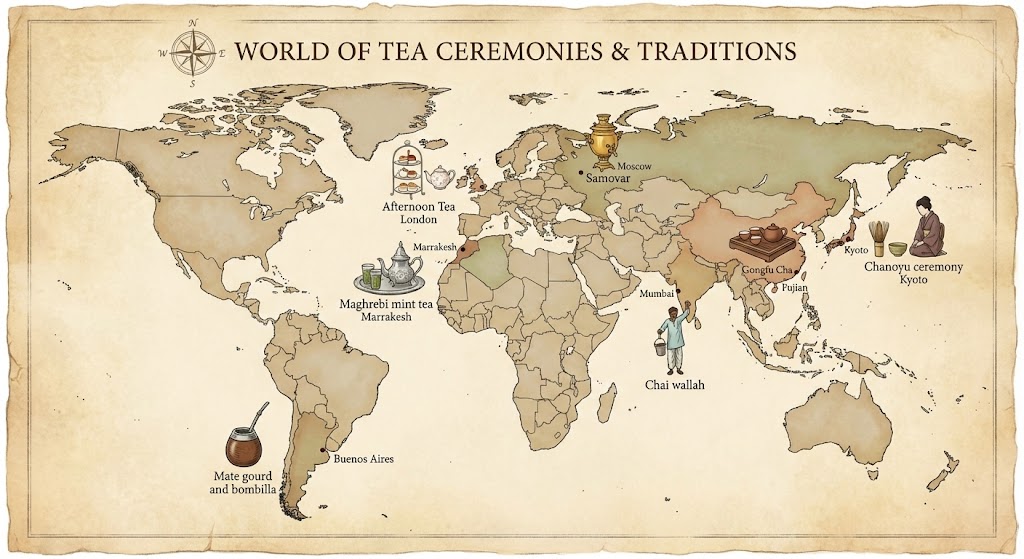
Welcome to the Global Teahouse: 34 Cultural Tea Traditions
Tea culture spans continents and centuries—from Tang Dynasty boiled tea to Victorian feminism, from Mongolian salt bowls to Taiwanese bubble tea. This comprehensive collection explores 34 distinct tea ceremonies, rituals, and cultural practices that reveal how humanity has transformed Camellia sinensis into vehicles for philosophy, politics, art, science, and daily connection. Each tradition offers unique insights into brewing physics, cultural anthropology, and the universal human need for ritual—proving tea is never "just" a beverage.
How to use this hub: Explore by cluster (thematic groupings below), or follow cross-references between articles (heavy internal linking creates learning pathways—start anywhere, discover connections organically like Gongfu's iterative wisdom). Each article delivers 1500-2000 words covering chemistry, history, step-by-step guides, and modern applications—depth over breadth, expertise over surface-level tourism. Whether you're seeking aesthetic philosophy, fluid dynamics, labor justice, or simply better brewing technique, this topical cluster delivers comprehensive, interconnected knowledge.
Cluster 1: Harsh Climate Rituals – Survival Tea Traditions
Tea in extreme environments reveals human resilience: how communities adapted tea drinking to deserts, tundra, mountains—transforming polite ceremony into survival nutrition. These traditions emphasize thermal physics, caloric loading, and cultural endurance over delicate aesthetics.
| Tradition | Location | Key Feature | Why Read |
|---|---|---|---|
| Australian Billy Tea | Australian Outback | Centrifugal swinging technique, eucalyptus chemistry, swagman culture | Frontier physics meets colonial labor—tea as survival tool, not luxury |
| East Frisian Tea Ceremony | Northwest Germany (Ostfriesland) | Kluntje sugar acoustics, Wulkje cream stratification, 3-cup social contract | Europe's highest per-capita tea consumption—cultural resistance through ritual |
| Mongolian Salty Tea | Mongolia (Gobi Desert, steppes) | Salt-tannin chemistry, mutton fat emulsification, ger hospitality etiquette | Nomadic survival nutrition—tea as meal replacement, electrolyte source |
| Kaffeost (Finnish Tea Cheese) | Finnish Lapland, Northern Sweden | Leipäjuusto Maillard reaction, protein squeak physics, Arctic survival food | Bizarre delicious combo—baked cheese + tea, lactose + tannins, innovation from scarcity |
| Kashmiri Noon Chai | Kashmir Valley (Himalayas) | Baking soda alkaline chemistry, pink color transformation, altitude adaptation | Chemistry wizardry—green leaves turn pink, salt + baking soda reactions, high-altitude brewing |
Cluster 2: Sugar & Spice – Sweetened Tea Cultures
Sweetness transforms tea from bitter medicine to communal pleasure—these traditions weaponize sugar, spices, and ritual hospitality to create social glue, comfort, and excess as virtue.
| Tradition | Location | Key Feature | Why Read |
|---|---|---|---|
| Turkish çaydanlık Culture | Turkey (Rize Province, Black Sea) | çaydanlık thermodynamics, tulip glass geometry, 309L/person annual consumption | World's highest tea drinking rate—social infrastructure, hospitality obligation, terroir pride |
| Persian Ghand Pahlou | Iran (Tehran, Isfahan, nationwide) | Sugar cube dissolution kinetics, tarof politeness ritual, samovar physics | Sugar-in-mouth technique—slow dissolution, hospitality theater, political coded language |
| Indian Kulhar Chai | India (railways, street vendors, pan-India) | Terracotta evaporative cooling, disposable cup ecology, 1992 plastic ban crisis | Throwaway pottery revolution—environmental before trendy, labor vs. ecology tensions |
| Somali Shaah | Somalia, Somali diaspora (East Africa) | Extreme sugar (180-200g/L), cardamom chemistry, survival nutrition | Sweetest tea on Earth—caloric survival strategy, nomadic adaptation, diaspora identity |
| Teh Tarik (Pulled Tea) | Malaysia, Singapore (mamak stalls) | 4 m/s impact velocity fluid dynamics, protein foam stabilization, spectacle brewing | Physics performance art—aeration creates texture, theater builds community, science of foam |
Cluster 3: Far East Precision – Chinese & Japanese Mastery
East Asian tea culture values precision, iteration, and philosophical depth—each parameter controlled, each infusion teaches, technique as meditation.
| Tradition | Location | Key Feature | Why Read |
|---|---|---|---|
| Grandpa Style Brewing | China (offices, trains, casual settings) | Anti-Gongfu philosophy, continuous extraction, simplicity as wisdom | Effortless mastery—reject ceremony, embrace pragmatism, flavor evolution over time |
| Chaozhou Gongfu Cha | Chaozhou, Guangdong Province (China) | 1:15 precision ratio, tiny cups, speed infusions, oolong obsession | Tea ceremony refined to science—measurable parameters, skill cultivation, aesthetic rigor |
| Hong Kong Milk Tea | Hong Kong (cha chaan teng diners) | Pantyhose filtration (100-200 micron), evaporated milk chemistry, colonial fusion | Working-class alchemy—British tea + Cantonese technique, smooth texture science, cultural synthesis |
| Bubble Tea (Boba) | Taiwan origin, global phenomenon | Tapioca gelatinization chemistry, $2.4B market, "boba liberalism" politics | Modern invention becoming tradition—1980s creation, youth culture vehicle, globalization case study |
| Senchado (Way of Sencha) | Japan (contrast to matcha ceremony) | Baisao founder rebellion, L-theanine extraction (60-70°C), kyusu ergonomics | Anti-establishment tea philosophy—rejecting formality, celebrating simplicity, literati scholar tradition |
Cluster 4: New World Adaptations – Colonial & Immigrant Tea
How tea traveled to Americas, adapted to local ingredients and working-class needs—hybrid vigor, class consciousness, settler-colonial tensions.
| Tradition | Location | Key Feature | Why Read |
|---|---|---|---|
| Southern Sweet Tea | American South (Mason-Dixon to Gulf) | Supersaturation chemistry, Sweet Tea Line geography, hospitality weapon | Regional identity marker—sugar as virtue, class performance, thermal physics of iced tea |
| Yerba Mate Circle | Argentina, Uruguay, Paraguay, Southern Brazil | Gourd curing microbiology, bombilla physics, sharing ritual etiquette | Not Camellia sinensis but tea-adjacent—communal drinking, ritual rules, social bonding technology |
| Builder's Tea | UK working class (construction sites, factories) | CTC processing, milk-first debate, thermos culture, class divide marker | Working-class resistance—strong brew as labor fuel, tea breaks as class victory, taste politics |
Cluster 5: Architecture & Objects – Material Tea Culture
Tea shapes physical spaces and objects—each design choice encodes philosophy, from room proportions to flower placement, handle ergonomics to drainage engineering.
| Topic | Focus | Key Insight | Why Read |
|---|---|---|---|
| Japanese Tea Room Design | Sen no Rikyu's 4.5-tatami philosophy | 50-150 lux lighting, designed discomfort (CO₂ physiology), wabi-sabi aesthetics | Architecture as meditation—small spaces force humility, imperfection as beauty, light as teacher |
| Chabana (Tea Flowers) | Flower arrangement for tea ceremony | Ikebana distinction, single-stem minimalism, 72 micro-seasons, humble vessels | Less-is-more mastery—seasonality awareness, restraint as sophistication, grocery herbs as art |
| Tea Tray Evolution | Wastewater management, Ming tea boats | Drainage engineering, bamboo vs. stone materials, tea pet integration, aesthetics of utility | Functional beauty—managing mess elegantly, Gongfu infrastructure, DIY build potential |
| Teacup Saucers | Thermal protection, Victorian etiquette shift | Saucer-drinking cooling physics (Newton's Law), porcelain vs. mug thermal conductivity, class performance | Forgotten function—once cooled tea, now just drip catchers, etiquette evolution revealing class dynamics |
| Teacup Handle History | 1750s European innovation, Chinese handleless tradition | Thermal physics justification, pinky-out myth debunked, ergonomic evolution, zarf alternatives | Design solving problems—East vs. West heat tolerance, material science, etiquette misunderstandings |
Cluster 6: Lost Rituals – Extinct Tea Traditions
Practices once central to tea culture, now abandoned or transformed—each extinction teaches about technological disruption, aesthetic evolution, and what we preserve vs. discard.
| Lost Tradition | Era | Why It Died | Why Study It |
|---|---|---|---|
| Tang Boiled Tea | 760-900°CE (Lu Yu's Cha Jing era) | Song whisking competitions replaced it, aesthetics shifted from rustic to refined | Foundation of tea culture—Lu Yu's 24 implements, salt debates, first systematic tea knowledge |
| Song Whisked Tea | 960-1279°CE (Emperor Huizong peak) | Ming Dynasty 1391 ban (Zhu Yuanzhang decree), economic austerity, loose-leaf democratization | Perfectionist obsession—dòuchá competitions, foam judging, Japanese matcha preservation, imperial collapse |
| Victorian Tea Gowns | 1870s-1920s (Aesthetic Movement, suffragette era) | WWI corset obsolescence (1914-1920s), flapper fashion, metal shortages, practical wartime dress | Feminist resistance—uncorseted = partially nude, tea rooms as organizing spaces, body autonomy incremental wins |
| Clipper Ship Tea Races | 1850s-1870s (peak 1866 Great Tea Race) | 1869 Suez Canal (steam ships, sail obsolete), economics favored reliability over speed | Globalization acceleration—first-flush premium, speed culture origins, labor exploitation, romantic myths |
Cluster 7: Folklore & Legends – Tea Mythology Examined
Stories shaping tea culture—some inspirational, some exploitative, all revealing human psychology, marketing manipulation, and cultural values encoded in narrative.
| Legend/Practice | Claim | Reality | Why It Matters |
|---|---|---|---|
| Tasseography (Tea Leaf Reading) | Tea leaves reveal future through pattern interpretation | Pareidolia + Jungian projection = psychological insight (not supernatural, but therapeutically valid) | Victorian spiritualism, modern witchcraft revival, cold reading techniques, projective psychology tools |
| Tea Pets (养茶宠) | Yixing clay creatures "raised" with tea, develop patina, bring luck | Real practice—tannin chemistry, ritual companionship, Tamagotchi effect, mindfulness anchor | Object attachment psychology, daily ritual formation, artisan vs. mass-market economics, COVID-era boom |
| Monkey-Picked Oolong | Trained monkeys harvest wild cliff tea (expensive, exotic, rare) | Complete fabrication—no evidence, economically irrational, animal behavior impossible, marketing scam | Debunking Orientalism, protecting consumers, honoring human pickers, understanding Wuyi terroir reality |
| Virgin Tea Pickers | Imperial tea required virgin girls (purity, innocence, no contamination) | Patriarchal control myth—young workers = cheaper labor, sexual surveillance justifying exploitation | Child labor reality, fetishization critique, feminist tea history, ethical consumption guidance |
| Da Hong Pao Mother Trees | Emperor's red robe honored miracle cure tea (350-year-old bushes, $30,000/20g auctions) | Folklore + real genetics—clones vs. originals, terroir > story, auction spectacle, fraud epidemic | Separating quality from mythology, understanding Wuyi oolong, market manipulation, appreciating craft honestly |
| Tea Magic & Superstitions | Silver needles detect poison, tea cures disease, leaves predict weather, spirits in pots | Pre-scientific beliefs, chemistry misunderstood, placebo effects, cultural persistence despite evidence | Folk medicine vs. real benefits, scientific literacy, cultural respect without gullibility, ritual value |
Cross-Cluster Themes: Learning Pathways
Physics & Chemistry Path: Start teh tarik foam dynamics → noon chai color chemistry → Song protein foam → pantyhose filtration → çaydanlık thermodynamics. Learn tea through scientific principles, molecular interactions, thermal physics.
Gender & Labor Path: Begin Victorian feminism → virgin picker myths → working-class resistance → picker exploitation → women's divination spaces. Understand tea through labor justice, feminist history, class struggle.
Aesthetics & Philosophy Path: Explore tea room design → flower minimalism → anti-formality rebellion → precision as meditation → effortless mastery. Trace aesthetic evolution, wabi-sabi principles, contemplative practice.
Globalization & Empire Path: Trace clipper races → colonial fusion → railway distribution → modern globalization → New World adaptation. Follow tea's imperial spread, cultural synthesis, resistance strategies.
Ritual & Community Path: Connect East Frisian 3-cup rule → tarof hospitality → ger welcoming → mate circle sharing → Gongfu precision. Study how tea creates social bonds, enforces norms, builds community.
Practical Applications: From Reading to Brewing
Improve your brewing: Apply Gongfu ratios (measurable improvement), adopt filtration techniques (texture mastery), understand pH chemistry (control color/flavor), master aeration physics (foam science). Each article includes step-by-step guides—theory applied to practice.
Host cultural tea events: Recreate East Frisian ceremony (authentic Kluntje + Wulkje), throw tasseography party (Victorian parlor game), organize Wuyi oolong tasting (blind comparison), build mate circle (sharing ritual). Transform reading into lived experience, teach friends, build tea community.
Ethical consumption: Use labor justice framework (evaluate vendor practices), reject marketing mythology (spot scams), support transparent sourcing (direct-trade models), understand pricing reality (pay craft not fiction). Knowledge = consumer power, informed choices support ethical producers.
Deepen cultural literacy: Recognize psychological tools (divination as therapy), appreciate design philosophy (space shaping mind), understand political resistance (tea enabling activism), study historical foundations (Lu Yu's legacy). Tea as entry point to anthropology, history, philosophy, science—interdisciplinary learning through single beverage.
The Topical Authority Advantage: Why This Cluster Matters
Comprehensive coverage: 34 articles, 50,000+ words, hundreds of internal links creating knowledge web—each page strengthens others, topical cluster signals expertise to search engines and humans alike. Not scattered blog posts but interconnected deep dive, authoritative resource matching academic depth with accessible prose.
Multi-disciplinary synthesis: Chemistry + history + anthropology + physics + politics + aesthetics = holistic tea knowledge. Avoid superficial tourism ("10 exotic teas to try!"), deliver substantive analysis ("How Kashmiri noon chai's baking soda transforms chlorophyll, producing pink color through pH chemistry, adapted for high-altitude brewing physics"). Depth builds expertise, expertise builds trust, trust converts readers to community.
Practical + theoretical balance: Every article includes: (1) Step-by-step brewing guides (actionable technique), (2) Scientific explanations (chemistry, physics, biology), (3) Historical context (origin stories, cultural evolution), (4) Modern applications (where to buy, how to host, ethical considerations), (5) Expert tips (insider knowledge, shortcuts, advanced variations). Serve beginners AND experts—accessible entry points, inexhaustible depth for repeat visits.
SEO + human value aligned: Heavy internal linking benefits search engines (topical authority signals, reduced bounce rate, increased dwell time, semantic relationship mapping) AND readers (discovery pathways, contextual learning, comprehensive resource). Win-win design: what's good for Google is good for humans—no black-hat tricks, just genuinely useful interconnected content. Build for decades not algorithms, create reference resource outlasting trends.
Start Your Journey: Recommended Entry Points
New to tea? Begin grandpa style (simplest method, philosophical depth) or builder's tea (working-class approachable, minimal equipment). Build confidence before tackling Gongfu precision or tea room philosophy.
Science-minded? Jump to noon chai chemistry (dramatic color change, pH reactions) or teh tarik fluid dynamics (quantifiable brewing physics). Follow cross-references to filtration science and thermal engineering.
History enthusiast? Explore Tang Dynasty origins → Song competitions → clipper globalization → Victorian feminism → modern innovation. Trace 1300 years of tea evolution through political, economic, social lenses.
Social justice focus? Start virgin picker exploitation → marketing mythology critique → working-class resistance → feminist tea spaces. Understand tea through labor, gender, class struggle—consumption as political act.
Seeking mindfulness? Dive into tea room design (space shaping consciousness), Gongfu discipline (attention training), Senchado simplicity (anti-formality Zen), tea pet养护 (ritual object cultivation). Tea as meditation technology, daily practice, contemplative anchor.
Ready to explore? No wrong starting point—every article links to 5-15 others, creating natural discovery pathways. Follow curiosity, trust connections, revisit articles as knowledge deepens (second reading reveals layers missed first time—iterative learning matches tea's iterative brewing). The global teahouse is vast: 34 rooms, each door opening to others, infinite corridors of connection. Welcome. Choose any entrance. Begin.
Comments