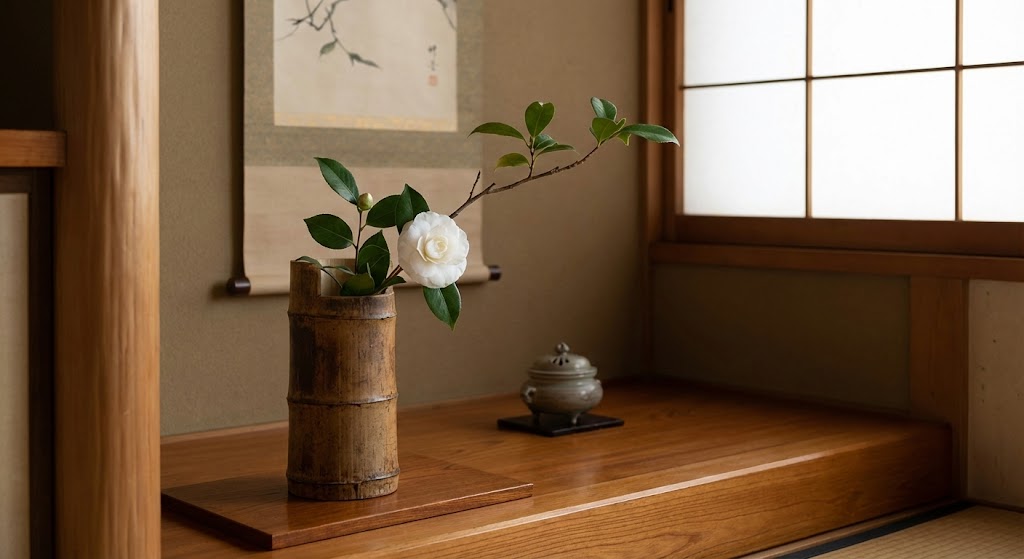
1. Chabana vs. Ikebana: Less is Different
Chabana (茶花 cha-bana, "tea flower") is minimalist flower arrangement for tea ceremony, distinct from ikebana (生け花 ike-bana, "living flowers"elaborate formal flower arranging). The philosophical divide: Ikebana: Multiple stems, calculated composition, artificial structure (wire supports, foam), symmetrical/asymmetrical balance, showcase arrangement"look at this beautiful thing I made." Chabana: Usually single stem, appears naturally growing, no visible supports, perfectly imperfect placement, humble presentation"look at this flower being itself."
The aesthetic distinction mirrors tea ceremony's wabi-sabi philosophy: ikebana is art (human creativity imposed on nature like Song Dynasty's foam competitions), chabana is nature appreciation (minimal human interference echoing grandpa style's casualness). Rikyu's teaching: "Flowers should look as though growing in field"ideal chabana is plucked wildflower placed in vase so naturally that viewers forget it was arranged, contrasting with Victorian elaborate floral displays. The anti-design design: success measured by invisibility of effort, opposite of ikebana's visible virtuosity or teh tarik's performative skill.
The historical split: both emerged from Buddhist altar offerings (flowers offered to Buddha, 6th-7th century Japan). Ikebana developed into standalone art form (schools, masters, competitions, commercial arrangements for homes/events). Chabana remained tied to tea ceremony (never independent practice), emphasizing simplicity as resistance to ikebana's increasing complexity. By Sen no Rikyu's era (1500s), ikebana had become elaborate status displayRikyu's chabana was deliberate rejection, paralleling his tea room architecture rejecting palatial grandeur.
| Dimension | Ikebana (Formal Flower Arranging) | Chabana (Tea Ceremony Flowers) |
|---|---|---|
| Number of Stems | Multiple (3-20+ stems typical, complex compositions) | Usually one, occasionally 2-3 (extreme minimalism) |
| Support Structure | Wire, foam, kenzan (pin frog), visible artifice | None visiblestem leans naturally against vase neck |
| Aesthetic Goal | Perfect composition, "heaven-human-earth" balance, showcase beauty | Natural randomness, "as if growing wild," humble understatement |
| Vessel | Decorative vases, matched to arrangement, part of display | Simple bamboo, rustic ceramic, often imperfect/agedvessel invisible |
| Training | Years of study, formal schools (Ikenobo, Sogetsu, Ohara), certification | Learned through tea ceremony practice, no separate schools |
| Social Context | Standalone art (exhibitions, home decoration, professional florists) | Tea ceremony onlynever displayed outside tokonoma alcove |
2. The Single-Stem Rule: Minimal Intervention Philosophy
Classic chabana uses one flowering branchsingle camellia stem, lone iris, solitary morning glory. The radical simplicity forces attention: viewers cannot distract themselves with composition analysis (no multiple elements to compare), must engage with flower's individual characterpetal texture, stem curve, leaf positioning. The single stem becomes portrait subject, not decorative object.
The botanical selection emphasizes ephemeral beauty: flowers chosen for brief peak bloom (camellia petals fall within hours, morning glories wilt by noon, cherry blossoms last days). This impermanence (mujo ??Buddhist concept of transience) is aesthetic virtueflower's mortality makes beauty precious, viewers appreciate moment knowing it won't last. This contrasts with Western floral tradition (roses bred for week-long vase life, dried flowers for permanence)chabana celebrates decay as essential to beauty.
Expert Tip: The "Cut the Morning Of" Principle
Chabana flowers should be cut morning of tea ceremonynot day before, not bought from florist (commercial flowers lack spontaneity). Walk garden at dawn, observe which flower is at perfect moment (bud half-open, dew still clinging, stem still fresh), cut with sharp knife (clean diagonal cut), place immediately in water. This freshness is detectableflower has vitality that purchased flowers lack (24+ hours post-cutting). If no garden access, forage wild areas (roadsides, parks, with permission)wildness matters more than species. A perfect dandelion beats mediocre hothouse rose.
3. Seasonal Awareness: The Calendar as Constraint
Chabana follows strict seasonal appropriateness (kisetsu ??): Spring: Plum blossom (February), camellia (March), cherry blossom (April), wisteria (May). Summer: Iris (June), hydrangea (July), morning glory (August). Autumn: Chrysanthemum (September), bush clover (October), maple leaves (November). Winter: Bare branches (December), pine (January), winter camellia (February). Using out-of-season flowers is serious errorreveals host's ignorance or disrespect for natural cycles.
The micro-seasonality: within each month, specific weeks have traditional flowers. Early November = peak autumn color (momiji maple), late November = first bare branches (winter approaching). Tea masters memorize 72 micro-seasons (ko ?5-day periods with specific natural phenomena), selecting flowers matching exact moment. This extreme seasonal awareness parallels sencha's harvest timing (first flush vs. late flush changes character) and climate-adapted tea rituals.
Modern challenge: global supply chains disrupt seasonalityflorists sell tulips year-round (greenhouse forcing, Southern Hemisphere imports like bubble tea's global spread), making "out of season" concept obsolete for commercial flowers. Chabana practitioners resist this: insist on locally-grown seasonal flowers (even if imperfect specimens like builder's tea's robust simplicity), rejecting perfect-but-wrong hothouse blooms. The stance is environmental and philosophicalhonoring natural rhythms (like Persian tea's seasonal hospitality or Turkish tea's all-day availability), rejecting consumer capitalism's denial of seasons. Flower choice becomes political act.
4. Vessel Selection: Bamboo, Basket, and Humble Ceramics
Chabana containers are deliberately simple: Bamboo tubes (tsutsumi ?): Natural bamboo section, sealed at one node (bottom), open at cut end (top)holds water, hangs on wall or stands upright. Irregular surface, natural cracks (wabi-sabi imperfection). Baskets (kago ?): Woven bamboo, often asymmetric shape, lined with copper/glass insert (holds water). Rustic craft object, sometimes antique (aged patina valued). Ceramic vases: Rough stoneware, unglazed or matte glazes, irregular shapes (slumped, cracked, deliberately imperfect)never shiny porcelain or decorative painting.
The anti-precious materials: chabana rejects expensive vases (Ming dynasty porcelain from clipper trade, crystal, gold-trimmed antiques worth as much as Da Hong Pao) in favor of found objects or peasant crafts. Rikyu famously used cracked water jars, fishing baskets, and bamboo cut by himselfitems with zero monetary value but aesthetic integrity (opposite of virgin picker exclusivity). This inverts normal value hierarchy: most beautiful vessel is one that doesn't try to be beautiful, paralleling kulhar clay cups (disposable pottery elevated to ritual object) or mate's humble gourd.
| Vessel Type | Material/Construction | Typical Flowers Used |
|---|---|---|
| Bamboo Tube (Vertical) | Natural bamboo, single node section, 20-40cm tall | Long-stemmed flowers (iris, morning glory, tall grasses) |
| Hanging Bamboo (Kakebanagata) | Bamboo with hook, hangs from tokonoma post | Delicate drooping flowers (wisteria, fuchsia, trailing vines) |
| Basket (Kago) | Woven bamboo/vine, irregular shape, water insert | Wild flowers, autumn grasses, rustic blooms (matches basket aesthetic) |
| Ceramic Vase (Low/Wide) | Stoneware, rough texture, matte glazes | Short-stemmed flowers (camellia, peony, branches) |
| Bronze/Iron Vessels | Antique metal, patina/oxidation valued | Winter branches, pine, evergreens (metal's weight suits heavier stems) |
5. Placement Physics: The Asymmetric Balance
Chabana placement in tokonoma follows subtle geometric rules: Horizontal axis: Flower vase positioned off-center (usually right side if scroll hangs left, or vice versacreates diagonal sight line). Vertical axis: Flower stem leans away from scroll (opens space between elementsbreathing room prevents crowding). Height relationship: Flower top should not exceed scroll's lower third (humilityflower doesn't compete with scroll for attention).
The mathematical precision hidden in casualness: ideal placement follows golden ratio proportions (1:1.618) subconsciouslyflower positioned ~38% from alcove edge (creates pleasing asymmetry like tea tray drainage slopes). Modern studies using eye-tracking show viewers' gaze naturally follows triangular path: scroll text ? flower ? back to scrollthis circuit creates contemplative rhythm (similar to observing thermochromic tea pets or noon chai's color transformation). The placement is engineered psychology: appears random, actually calculated to guide attention without viewers noticing control.
Expert Tip: The "View from Seating" Test
After placing chabana in tokonoma, sit in guest's position (not standing host view) and observe: Does flower's silhouette overlap scroll? Too closemove vase. Does stem lean toward scroll? Wrongrotate vase so stem leans away. Can you see flower's back (wilted petals, brown leaves)? Poorrotate to show best angle. The seated perspective mattersstanding arrangement looks different when viewing from floor level (foreshortening changes relationships). Always finalize placement from guest's eye height, not your standing position. This parallels tea room design being optimized for kneeling bodies, not standing.
6. Prohibited Flowers: The Avoidance List
Certain flowers are forbidden in chabana: Strongly scented blooms: Jasmine, gardenia, tuberoseoverpowering fragrance interferes with incense (ko ?) used in ceremony, creates olfactory confusion. Tea ceremony carefully controls smells (charcoal smoke, tatami grass, subtle incense)loud floral scent disrupts balance. Poisonous plants: Oleander, foxglove, lily-of-the-valleydanger if accidentally touched/ingested, bad symbolism (death). Thorny stems: Roses, barberryaggression symbolism incompatible with tea's harmony, physical danger in small space. Artificially colored flowers: Dyed carnations, painted daisiesfakery violates tea's authenticity principle.
The symbolic rejections: Peonies: Too showy, associated with wealth/luxury (anti-wabi-sabi). Sunflowers: Too large, dominating (lack humility). Tropical imports: Orchids, birds-of-paradisenot native to Japan (lack seasonal connection), often commercially grown (inauthentic). The prohibitions reveal values: prefer native over exotic, subtle over loud, natural over cultivated, humble over grand. Flower selection becomes moral choicewhat you display reveals who you are.
7. Leaf and Branch Arrangements: Beyond Flowers
Chabana isn't limited to flowersoften uses non-flowering materials: Autumn leaves: Single maple branch with red/orange foliage (peak color moment). Pine needles: Evergreen branch (winter resilience symbolism). Bare branches: Leafless twig with interesting shape (late autumn/winter, appreciating form alone). Grasses: Wild pampas, miscanthus (subtle beauty in ordinarily overlooked plants). Moss/ferns: Green texture without bloom (summer cooling effect).
The "flowering" concept expands: anything at peak moment of beauty qualifiescould be frost-covered branch (winter morning magic), vine with perfect curve (line appreciation), single colored leaf before falling (transience embodied). This philosophical flexibility distinguishes chabana from Western floristry (which requires actual flowers)Japanese aesthetic finds beauty in negative space, aging, decay. A perfectly-browned fallen leaf is legitimate chabana subject.
8. Modern Practice: Urban Sourcing Challenges
Traditional chabana assumes access to gardens/wild areaspractitioners walk own property, cutting fresh morning flowers. Modern urban reality: apartment dwellers lack gardens, public foraging is often illegal (parks prohibit picking), and seasonal timing difficult (climate change shifts bloom dates, urban heat islands distort seasons). Contemporary solutions: Community gardens: Rent plot, grow traditional flowers. Farmers markets: Buy locally-grown seasonal stems (not perfect, but acceptable). Potted plants: Keep seasonal flowers in pots, cut as needed (compromises freshness but maintains seasonality). Tea teacher networks: Members with gardens share cuttings (gift economy preserves tradition).
The adaptation debate: purists argue buying flowers defeats chabana's purpose (spontaneity, personal connection to nature lost). Pragmatists counter that urban practice is better than no practice (accessibility matters more than perfection). Some teachers accept purchased flowers if sourced mindfully (local, seasonal, organic), others reject any commercial involvement. The tension mirrors broader traditional-craft survival question: adapt and persist, or maintain purity and disappear? Chabana's future depends on which philosophy prevails.
Expert Tip: The Grocery Store Herb Hack
For city practitioners without gardens: buy living herbs from supermarket (basil, mint, rosemary sold in plastic pots, $3-5). These qualify as chabana materialliving plants, seasonal (stores stock what grows locally), humble kitchen herbs (not pretentious floristry). Basil flowers (tiny white blooms) are surprisingly elegant, mint sprigs have natural wildness, rosemary branches show interesting architecture. This workaround preserves chabana spirit (accessible, natural, humble) while accepting urban constraints. Replace herbs weekly (cost ~$12-20/monthcomparable to coffee habit), compost old plants. Bonus: use herbs for cooking before they flower (practical + aesthetic value).
9. Practicing Chabana at Home: Minimal Setup
Equipment (Budget: $30-100): One bamboo tube vase ($15-30 from Asian import stores or make from bamboo pole + saw), or simple ceramic vase (thrift store, $5-20choose matte glaze, neutral color, irregular shape), sharp knife or pruning shears ($10-25 for quality toolclean cuts essential), small bucket for water (flower transport from cutting to arrangement).
Finding materials: If you have yard/garden: observe daily, note which plants bloom when, mark calendar for peak moments. If no garden: scout neighborhood (ask neighbors for permission to cut from their gardensmost say yes if you explain tea ceremony context), identify local parks allowing foraging (some permit fallen branch collection), or purchase minimal commercial flowers (choose local/seasonal when possible).
Seasonal practice schedule: Attempt chabana once weekly for one yearforces learning seasonal cycle (which flowers bloom when, how long they last, which vessels suit which stems). Keep journal: date, flower species, vessel used, how long arrangement lasted, what worked/failed. After 52 weeks, you'll have complete seasonal knowledge (next year becomes refinement, not discovery).
Arrangement technique: Step 1 - Cut morning of use: Early morning (dew still present), cut stem at 45 angle, immediately place in water bucket. Choose stem at peak momentbud half-open (not tight closed, not fully blown). Step 2 - Prepare vessel: Fill with clean water (room temperature, not cold shock). If bamboo tube, ensure seal at bottom node is intact (test by filling, check for leaks). Step 3 - Trim stem: Cut to appropriate lengthgenerally 1.5-2 vessel height (allows natural lean without falling). Remove lower leaves that would sit underwater (prevents rot). Step 4 - Insert casually: Place stem in vessel, let it find natural position (don't force into specific angleaccept where it settles). The "random" placement is goalif it looks too arranged, start over. Step 5 - Position in space: Place on shelf/alcove/table, step back 2 meters, observe. Does it look like flower is simply there, naturally? Success. Does it look like "flower arrangement"? Failuretry again with less intervention.
Duration: Most chabana last 1-3 days (morning glory dies same day, camellia lasts 2-3 days, branches last week+). When flower wilts/petals fall, remove immediately (displaying dead flowers is sad, not wabi-sabiappreciate transience means accepting end gracefully). Compost spent flowers, clean vessel, wait for next seasonal moment. The cycle never endsthere's always next flower, next season, next opportunity for perfect-imperfect arrangement.
Comments