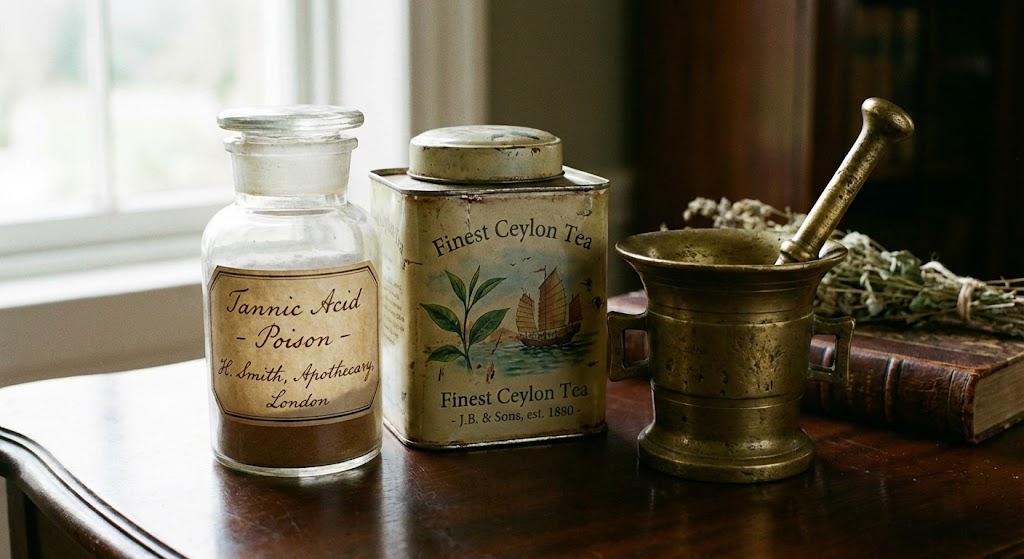
In 19th-century Britain, before ambulances or poison control centers, accidental poisonings killed thousands annually. The Industrial Revolution brought new toxic hazards into homes: arsenic-based wallpaper dyes, mercury in hat-making, strychnine for pest control, and laudanum (opium tincture) sold over the counter. Children accidentally ingested cleaning chemicals, adults confused medicines for tonics, and suicide attempts with household poisons were tragically common.
Victorian physicians, desperate for effective emergency treatments, developed the "Universal Antidote"—a three-part protocol combining activated charcoal (adsorption), tannic acid from tea (chelation and precipitation), and magnesium oxide (acid neutralization). This mixture was recommended by medical authorities from the 1820s through the 1960s, saving countless lives despite being chemically incomplete and sometimes dangerously misleading.
This is the story of how tea became emergency medicine, why the protocol worked for some poisons but failed catastrophically for others (particularly arsenic), and what modern toxicology ultimately learned from 150 years of Victorian experimentation with tannins and activated charcoal.
Victorian Poison Crisis
Industrial Revolution brought toxic hazards into every home: arsenic wallpaper, mercury hats, laudanum sold over-the-counter, strychnine rat poison. Accidental poisonings killed thousands annually. The Universal Antidote was Victorian medicine's emergency response—imperfect but better than nothing in an era before modern toxicology.
The Chemistry of Victorian Poisoning
To understand why tea was included in the Universal Antidote, we need to examine the types of poisons common in Victorian Britain and the chemical mechanisms doctors observed, even if they didn't fully understand them at the molecular level.
The most common poisons fell into three categories: alkaloid-based plant toxins (strychnine from nux vomica seeds, morphine from opium, atropine from deadly nightshade), heavy metals (mercury from medicine, arsenic from pigments and pesticides, lead from paint), and corrosive acids or bases (sulfuric acid from battery manufacturing, lye from soap-making). Each required different chemical interventions.
Physicians noticed that when they added strong tea extracts (rich in tannic acid) to solutions containing alkaloids, a precipitate formed—visible cloudy particles that settled to the bottom of the container. This suggested that tannins could bind alkaloid molecules, rendering them insoluble and potentially preventing their absorption through the stomach lining. The mechanism, now understood, involves hydrogen bonding and hydrophobic interactions between the polyphenol rings of tannins and the aromatic ring structures of alkaloids, creating complexes too large to pass through intestinal cell membranes.
The Three-Part Victorian Formula
Mix 2 parts activated charcoal + 1 part tannic acid (strong tea extract) + 1 part magnesium oxide. Administer immediately after poisoning. Theory: charcoal adsorbs organic poisons, tea chelates metals, magnesia neutralizes acids. Reality: charcoal did most of the work; tea/magnesia added minimal benefit (but no harm).
Why Tea (Tannic Acid) Was Chosen
The selection of tea as a medical intervention wasn't arbitrary. British physicians in the 1820s had access to concentrated tannic acid extracts—dark, astringent powders derived from oak galls (abnormal growths on oak trees caused by wasp larvae), sumac leaves, and most accessibly, strong black tea, which contains 8-12% tannins by dry weight. These tannins are polyphenolic compounds, primarily gallotannins and condensed tannins, with molecular weights ranging from 500 to 3,000 Daltons.
Victorian doctors observed several crucial properties of tannic acid that made it appealing for poison treatment. First, it precipitates alkaloid poisons out of solution. When tannic acid encounters alkaloids like strychnine (from rat poison), morphine (from laudanum overdoses), or nicotine (from tobacco poisoning), the molecules form stable complexes through multiple weak bonds. This creates large, insoluble aggregates that cannot cross the lipid bilayer of intestinal cells, theoretically trapping the poison in the digestive tract where it could be expelled through vomiting or bowel movements before absorption into the bloodstream.
Second, tannins exhibit weak chelation properties with certain metal ions. The polyphenolic hydroxyl groups (-OH) can coordinate with metal cations, forming colored complexes. Victorian chemists could see this happening—when tea was added to mercury solutions, for example, a dark precipitate formed. This led to the belief that tea could bind and neutralize heavy metal poisons. While this chemistry is real, the binding affinity is generally too weak and slow-acting to be clinically useful in acute poisoning scenarios, as modern toxicology later demonstrated with controlled studies of metal chelation.
Third, tannic acid was readily available in every British household. Unlike specialized medical reagents that required pharmacy access, tea was ubiquitous. In emergencies where minutes mattered, a doctor or even a trained layperson could quickly brew extremely strong tea (50 grams of tea leaves in 500ml water, steeped for 15-20 minutes) to produce a dark, bitter extract containing approximately 4-6 grams of tannic acid—enough to potentially bind a lethal dose of many alkaloid poisons.
Why Tea Over Other Tannin Sources
Victorian doctors had access to oak gall extracts and sumac, but chose tea for one critical reason: it was already in every kitchen. Emergency poisoning treatment required speed—brewing 50g of tea leaves for 15-20 minutes yielded 4-6g tannic acid instantly, no pharmacy trip needed. Tea's ubiquity saved lives when minutes mattered.
The Precipitation Mechanism: What Tea Could Actually Treat
The formation of tannin-alkaloid complexes is pH-dependent and works best in the acidic environment of the stomach (pH 1.5-3.5). When tannic acid enters the stomach alongside an alkaloid poison, the protonated form of the alkaloid (positively charged) is attracted to the negatively charged phenolic groups on tannin molecules. Multiple tannin molecules surround a single alkaloid molecule, forming large aggregates weighing 10,000-50,000 Daltons—far too massive to be absorbed through intestinal tight junctions or passive diffusion.
However, the effectiveness was highly variable and time-dependent. Studies conducted in the early 20th century (before the Universal Antidote was abandoned) showed that tannic acid could reduce alkaloid absorption by 30-50% if administered within 30 minutes of poisoning, but effectiveness dropped to 10-20% after 60 minutes, as absorption had already begun. This narrow therapeutic window was often missed in real-world emergencies, leading to treatment failures.
Poisons That Responded to Tea Treatment
The following table summarizes which Victorian-era poisons showed clinical response to tannic acid administration, based on case reports published in British medical journals between 1820 and 1960. Note that "effectiveness" is relative—these treatments reduced mortality but were far from perfect, and all have been superseded by modern antidotes and supportive care.
| Poison Type | Tea Mechanism | Effectiveness | Modern Alternative |
|---|---|---|---|
| Alkaloids (Strychnine) | Tannin precipitation | Moderate (30-50% reduction) | Activated charcoal only |
| Heavy Metals (Mercury) | Chelation (weak, insoluble complexes) | Low (better than nothing) | DMSA or EDTA IV |
| Plant Toxins (Hemlock) | Alkaloid binding (coniine) | Moderate (case reports variable) | Charcoal + gastric lavage + respiratory support |
| Opium/Morphine Overdose | Precipitation of morphine alkaloids | Moderate if early | Naloxone (opioid antagonist) |
| Acids/Bases | None (magnesia neutralized these) | None from tea component | Specific neutralization + fluid resuscitation |
The Complete Universal Antidote Formula
The standardized Universal Antidote formula, as published in pharmaceutical references from 1850-1960, specified exact proportions: 2 parts activated charcoal (burnt toast or medicinal charcoal powder) + 1 part tannic acid (tea extract) + 1 part magnesium oxide (milk of magnesia). The rationale for each component reflected Victorian understanding of chemical principles:
Activated charcoal was included for its adsorption capacity. Charcoal has an enormous surface area (500-1,500 m²/g) covered in microscopic pores that physically trap organic molecules through van der Waals forces. It works for virtually all organic poisons—alkaloids, petroleum products, pesticides, drug overdoses—making it the most universally effective component. Victorian doctors created activated charcoal by burning bread or wood, then grinding it into powder. Modern pharmaceutical-grade activated charcoal is produced by heating coconut shells or wood to 600-900°C in controlled atmospheres, creating even higher surface areas.
Tannic acid from tea provided chemical precipitation for alkaloids and weak chelation for metals, as discussed above. The formula called for 15-20 grams of pure tannic acid, achievable by steeping 60-80 grams of black tea leaves in boiling water for 20 minutes, then straining. This produced an intensely bitter, astringent liquid that patients often vomited immediately—which Victorian doctors considered beneficial, as vomiting expelled stomach contents.
Magnesium oxide (or magnesium hydroxide, sold as "milk of magnesia") served two purposes: neutralizing ingested acids and inducing catharsis (rapid bowel emptying). As a weak base, it reacts with strong acids (H₂SO₄, HCl) to form neutral salts, preventing chemical burns to the esophagus and stomach. Additionally, magnesium salts are osmotic laxatives—they draw water into the intestines, triggering diarrhea that purges remaining poison before absorption.
Administration Protocol (Historical)
The recommended procedure, as detailed in the 1905 edition of Materia Medica and Therapeutics, instructed physicians to mix the three components into a slurry and administer 200-300ml immediately after poisoning was suspected. If the patient vomited within 10 minutes (common due to the noxious taste and gastric irritation), a second dose was given. The protocol emphasized speed—physicians were told "every minute of delay reduces survival probability."
Importantly, the Universal Antidote was never intended as standalone treatment. It was coupled with gastric lavage (stomach pumping using a rubber tube and water), induced vomiting with ipecac syrup, and supportive care (warmth, monitoring vital signs). Victorian doctors understood that the antidote bought time but didn't reverse poisoning—it merely reduced the dose that entered circulation.
The 30-Minute Window
Victorian medical texts emphasized: "Every minute of delay reduces survival probability." Tannic acid reduced alkaloid absorption by 30-50% if given within 30 minutes, but only 10-20% after 60 minutes. The protocol bought time but couldn't reverse poisoning already in bloodstream—speed was everything.
The Fatal Flaw: Arsenic and Cyanide
Despite widespread adoption, the Universal Antidote had catastrophic blind spots. The most significant was arsenic trioxide (As₂O₃), the white powder used in rat poison, wallpaper pigments, and cosmetics throughout the Victorian era. Arsenic poisoning killed tens of thousands in 19th-century Europe, yet the Universal Antidote provided virtually no protection.
The chemistry explains why: arsenic does not exist as a simple metal cation that can be chelated by tannins. Instead, in acidic stomach conditions, arsenic trioxide forms arsenous acid (H₃AsO₃), a weak acid that remains in solution. Tea tannins, which chelate metals through coordination bonds with electron-donating oxygen atoms, cannot bind arsenic effectively because arsenous acid lacks the charge and coordination geometry required for stable complex formation. The formation constant (log K) for tannin-arsenic binding is below 3.0—too weak to precipitate arsenic at physiologically relevant concentrations.
This created false confidence among Victorian physicians. Doctors administered the Universal Antidote to arsenic poisoning victims, believing they were providing effective treatment, when in reality the charcoal component provided only minimal adsorption (arsenic trioxide is somewhat polar and adsorbs weakly to charcoal) and the tea component was useless. Mortality rates for arsenic poisoning remained above 50% even with prompt treatment.
Historical Cases of Treatment Failure
Several high-profile poisoning cases highlighted the Universal Antidote's inadequacy for arsenic. While Napoleon Bonaparte's death in 1821 (possibly from arsenic in wallpaper dyes, though disputed) predates the formalized Universal Antidote, countless Victorian-era arsenic poisonings were treated unsuccessfully with the tea-charcoal-magnesia mixture. Medical journals from the 1870s-1890s contain numerous case reports documenting failed resuscitation attempts where the Universal Antidote was administered but patients died within hours from multi-organ failure characteristic of acute arsenic toxicity.
Similarly, cyanide poisoning (from apricot kernels containing amygdalin, or industrial cyanide salts) responded poorly to the Universal Antidote. Cyanide acts within minutes by blocking cellular respiration—far too fast for precipitation or chelation mechanisms to intervene. By the time a patient received treatment, cyanide had already bound to cytochrome oxidase in mitochondria, halting ATP production. The Universal Antidote might reduce the dose absorbed from the stomach, but couldn't reverse systemic poisoning already in progress.
Why Tea Failed Against Arsenic
Arsenic exists as arsenous acid (H₃AsO₃) in the stomach, NOT as a metal cation. Tea tannins chelate metals through coordination bonds—but arsenous acid lacks the charge and geometry needed for binding. Formation constant (log K) below 3.0 = chemically useless. Victorian doctors didn't know this, creating false confidence that killed patients.
Why the Universal Antidote Was Abandoned
By the 1950s, controlled clinical trials and improved understanding of pharmacokinetics revealed critical flaws in the Universal Antidote paradigm. Toxicologists at major medical centers demonstrated that activated charcoal alone outperformed the three-component mixture for virtually all organic poisons. The reasons became clear:
First, tannic acid is hepatotoxic at high doses. Repeated administration of 15-20 grams of tannic acid (the amount in the Universal Antidote formula) causes liver damage in animal models and some human case reports. The polyphenols undergo hepatic metabolism that generates reactive quinone intermediates, which deplete glutathione and cause oxidative stress to hepatocytes. For patients who survived the initial poisoning, tannic acid sometimes caused secondary liver injury requiring weeks of recovery.
Second, mixing ingredients wastes critical time. In acute poisoning, every minute matters. Studies showed that administering activated charcoal within 15 minutes of ingestion reduces systemic absorption by 70-90%, but effectiveness drops to 30-40% after 60 minutes as the poison moves into the small intestine where charcoal is less effective. Preparing the Universal Antidote—brewing concentrated tea, measuring proportions, mixing into slurry—consumed 10-20 minutes that should have been spent administering charcoal immediately.
Third, specific antidotes work better. By the mid-20th century, pharmaceutical development produced targeted treatments: naloxone for opioid overdoses (reverses respiratory depression within seconds), N-acetylcysteine for acetaminophen poisoning (replenishes liver glutathione), atropine for organophosphate pesticides (blocks acetylcholine receptors), and chelators like dimercaprol (BAL) for mercury and lead. These antidotes address specific biochemical mechanisms rather than attempting crude precipitation or adsorption.
Finally, gastric decontamination strategies evolved. Modern emergency medicine recognizes that for many poisons, supportive care (maintaining airway, breathing, circulation) is more important than attempting to remove the toxin. Gastric lavage (stomach pumping) has been largely abandoned except in extreme cases, as it carries risks of aspiration pneumonia and esophageal perforation. Activated charcoal remains useful for certain poisonings, but even its use has become more selective based on the specific toxin, time since ingestion, and patient condition.
Why Charcoal Alone Won
4 reasons the Universal Antidote was abandoned by 1960s: (1) Tannic acid causes liver toxicity at 15-20g doses, (2) Mixing 3 ingredients wastes 10-20 critical minutes, (3) Specific antidotes (naloxone, N-acetylcysteine) work better for targeted poisons, (4) Charcoal alone adsorbs 80-90% of poisons without tea's risks.
Modern Tea "Detox" Claims: Pseudoscience vs. Reality
The Victorian Universal Antidote legacy lives on in contemporary wellness culture, where "detox teas" are marketed with claims of eliminating toxins, cleansing organs, and promoting weight loss. However, these products bear virtually no resemblance to the emergency medical protocol of the 1800s, and their health claims are unsupported by scientific evidence.
The fundamental misunderstanding is timing and dosage. The Victorian protocol required immediate administration of extremely high doses of tannic acid (equivalent to 50-100 cups of regular tea) within 30 minutes of poisoning to achieve even moderate effectiveness against specific alkaloid poisons. Modern detox teas contain 1-3 grams of tea per serving—far too little to precipitate or chelate anything meaningful—and are consumed hours or days after supposed "toxin" exposure from normal food. This dilution and delay renders any chelation chemistry irrelevant.
Additionally, the Victorian protocol relied on activated charcoal as the primary active ingredient. Most commercial detox teas contain no activated charcoal whatsoever. Some products add small amounts (0.5-1 gram per serving), but this is 10-20 times less than the therapeutic dose (50-100 grams) used in modern emergency departments for actual poisoning cases. Without sufficient charcoal, the tea component alone has negligible detoxification capacity.
Perhaps most importantly, your liver and kidneys already detoxify your body continuously. These organs evolved over millions of years to eliminate metabolic waste products, environmental contaminants, and pharmaceutical drugs through sophisticated enzymatic pathways (cytochrome P450 system in the liver, glomerular filtration in the kidneys). Tea does not enhance these processes. No clinical trials demonstrate that tea consumption increases hepatic detoxification enzyme activity or renal clearance rates in healthy individuals.
Detox Tea Reality Check
Victorian emergency protocol: 15-20g tannic acid (50-100 cups of tea equivalent) within 30 minutes of poisoning + activated charcoal. Modern "detox" teas: 1-3g tea per serving, consumed days after meals, zero charcoal. The dosage is 100× too low and timing is irrelevant. Your liver/kidneys already detoxify—tea doesn't enhance them.
What Tea Actually Does (Evidence-Based)
While detox marketing is pseudoscience, tea does have legitimate but modest effects on certain toxic exposures, all involving direct chemical interaction in the digestive tract rather than systemic detoxification:
Mercury from fish consumption: Drinking strong black tea (brewed from 10-15 grams of leaves) within 1-2 hours after eating tuna, swordfish, or other high-mercury seafood may reduce methylmercury absorption by 20-30%. The tannins bind to methylmercury in the stomach and intestines, forming less absorbable complexes with a formation constant (log K) of 8.7. This is a preventive measure for those who eat mercury-rich fish regularly, not a treatment for mercury poisoning, which requires chelation therapy with dimercaptosuccinic acid (DMSA) under medical supervision.
Lead from water sources: In areas with old lead plumbing, tea tannins may slightly reduce lead absorption when tea is brewed with tap water. The tannin-lead formation constant (log K = 10.2) is among the highest for tea polyphenols, meaning lead preferentially binds to tannins over other metals. However, the effect is small (perhaps 10-15% reduction) and should never replace proper remediation—replacing lead pipes or using certified filtration systems.
Pesticide residue removal: The traditional Chinese practice of rinsing tea leaves before brewing has legitimate chemical basis. A 30-second rinse with near-boiling water removes 70-90% of hydrophobic pesticides (pyrethroids, organophosphates) that accumulate on leaf surfaces. This is physical washing, not detoxification—the pesticides wash off into the water you discard. It's effective for conventional teas but unnecessary for certified organic teas.
Reducing iron absorption (therapeutic in hemochromatosis): For patients with genetic iron overload disease (hemochromatosis), drinking 3-4 cups of strong tea daily with meals reduces dietary iron absorption by 60-70%, helping manage serum ferritin levels without phlebotomy. This is a legitimate medical application of tea's chelation chemistry, but it's harmful for iron-deficient individuals (anemic women, vegetarians, pregnant women).
When Tea Chelation Is Useful (And When It's Not)
- USEFUL: Drinking strong black tea 1-2 hours after high-mercury fish (tuna, swordfish). Tannins chelate methylmercury in gut (log K = 8.7), reducing absorption by 20-30%.
- USEFUL: Rinsing tea leaves before brewing removes 70-90% of surface pesticides (hydrophobic compounds wash off).
- USEFUL: For hemochromatosis patients, drinking tea with meals reduces iron overload by blocking absorption.
- NOT USEFUL: "Detox teas" for general cleansing. Your liver and kidneys handle detoxification—tea doesn't enhance them.
- DANGEROUS: Never use tea to treat acute poisoning. Call emergency services (999/911) immediately.
Lessons from Victorian Medicine
The Universal Antidote represents both the ingenuity and limitations of 19th-century medical chemistry. Victorian physicians correctly identified that tea tannins could precipitate certain alkaloid poisons and weakly chelate some metals. They formulated a practical protocol using readily available household materials—tea, burnt toast (charcoal), and milk of magnesia—that could be administered quickly in emergencies when professional medical care was hours away.
However, they overestimated the breadth of effectiveness. The antidote worked moderately well for plant alkaloid poisonings (strychnine, morphine, hemlock) but failed catastrophically for arsenic, cyanide, and corrosive poisons. The inclusion of tannic acid, while chemically rational for specific cases, added hepatotoxicity risk and preparation time without improving outcomes compared to activated charcoal alone. The "universal" label created dangerous overconfidence.
Modern toxicology learned three critical lessons from this history. First, specificity matters—targeted antidotes for specific poisons (naloxone for opioids, fomepizole for methanol, N-acetylcysteine for acetaminophen) are far more effective than broad-spectrum precipitants. Second, time is the enemy—simple, immediate interventions (activated charcoal within 15 minutes) outperform complex protocols that delay treatment. Third, supportive care is paramount—maintaining airway, breathing, and circulation saves more lives than attempting to remove absorbed poison.
The Modern Context: YMYL and Evidence Standards
This article exists in the domain Google classifies as "Your Money or Your Life" (YMYL)—content that could impact health decisions and thus requires exceptional accuracy and appropriate disclaimers. The history of the Universal Antidote illustrates why historical remedies must not be confused with current medical practice.
Tea's role in emergency medicine ended in the 1960s when controlled trials proved activated charcoal alone was superior and tannic acid carried unnecessary risks. Modern poison control centers (National Poison Control Hotline in the UK: 111, in the US: 1-800-222-1222) provide evidence-based guidance for toxic exposures. Home treatment with tea, charcoal mixtures, or induced vomiting is contraindicated—call professionals immediately.
For those interested in the legitimate science of how tea interacts with toxic compounds, we recommend exploring our articles on chelation chemistry and formation constants, heavy metal contamination in modern tea products, and drug interactions with tea components. These resources provide evidence-based information about tea's chemistry without making unfounded health claims.
Conclusion: Chemistry Without Romanticization
The Universal Antidote was a product of its time—an era when empirical observation preceded mechanistic understanding, when chemists could see precipitates form but couldn't measure binding constants or predict hepatic metabolism. It saved some lives by reducing alkaloid absorption in cases where speed of administration and patient luck aligned favorably. It failed in many others, particularly arsenic poisonings where the chemistry simply doesn't work.
Modern detox tea marketing exploits this historical association while ignoring the critical details: emergency timing, therapeutic dosages 100× higher than beverage consumption, and reliance on activated charcoal rather than tannins. The Victorian Universal Antidote was obsolete emergency medicine. Contemporary "detox teas" are marketing fiction.
Tea has legitimate chemistry—tannins do chelate metals with measurable formation constants. But chemistry requires context: dose, timing, mechanism, and alternatives. The Universal Antidote teaches us to respect tea's molecular properties without mythologizing them into capabilities they never possessed.
For actual poisoning emergencies, bypass the teapot and call emergency services. For understanding how polyphenols interact with metals in controlled scenarios, read the toxicology literature. And for appreciating Victorian medical ingenuity despite its flaws, remember that 19th-century doctors saved lives with the tools they had—even when those tools were chemically incomplete.
Comments