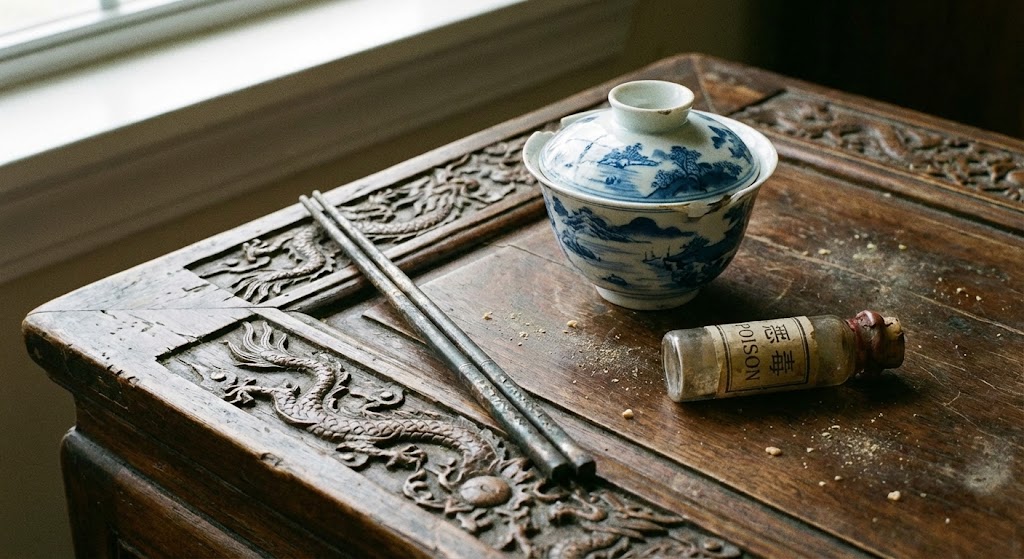
For over 2,000 years, Chinese emperors used silver chopsticks and teacups to detect arsenic in food and drink. The belief: silver tarnishes black when exposed to poison. The reality: silver reacts with sulfur compounds (garlic, eggs), NOT arsenic trioxide. Thousands died trusting this false chemistry, including emperors who drank poisoned tea that passed the silver test.
This is the story of how medieval toxicology failed, why tea's chelation properties couldn't save arsenic victims, and how modern chemistry finally cracked the case.
The Fatal Flaw in Silver Testing
Arsenic trioxide (As₂O₃)—the form used in poisonings—does NOT react with silver. What DOES tarnish silver is hydrogen sulfide (H₂S) from sulfur-rich foods. Emperors who ate garlic or eggs before tea would see tarnished silver and think "poison," but actual arsenic went undetected. Reverse false positives killed the detection method.
The Chemistry That Killed Emperors
Why Silver Fails
The silver-arsenic myth likely originated from arsenic's medieval production method. Crude arsenic ore (arsenopyrite) contains sulfur impurities, which DO tarnish silver:
- Ag (silver) + H₂S (hydrogen sulfide) → Ag₂S (silver sulfide, black tarnish)
- But pure arsenic trioxide: As₂O₃ + Ag → NO REACTION
Once arsenic refinement improved (Tang Dynasty, 618-907°CE), poisoners used pure As₂O₃—invisible, tasteless, and chemically inert with silver. The test became worthless, but the tradition persisted for centuries.
Why Tea Couldn't Chelate Arsenic
Tea's tannins bind heavy metals like mercury (Hg²⁺) and lead (Pb²⁺), but arsenic chemistry is different:
- Arsenic in tea exists as arsenate (AsO₄³⁻), not a simple metal cation
- Tannins chelate +2/+3 metal ions via hydroxyl groups; arsenate is a negatively charged oxyanion
- Formation constant for As-tannin complex is log K < 2 (too weak to prevent absorption)
- Tea provides zero protection against arsenic poisoning
| Detection Method | Chemical Reaction | Arsenic Detection | False Positive Risk |
|---|---|---|---|
| Silver Chopsticks | Ag + H₂S → Ag₂S (black) | NO (pure As₂O₃ inert) | High (garlic, eggs trigger tarnish) |
| Marsh Test (1836) | As + Zn + H₂SO₄ → AsH₃ gas (burns blue) | YES (detects 0.01 mg) | Low (specific to arsenic) |
| Reinsch Test (1841) | As + Cu → gray-black deposit | YES (detects 0.1 mg) | Medium (antimony also reacts) |
| Modern ICP-MS | Inductively Coupled Plasma Mass Spec | YES (detects parts per trillion) | None |
Historical Arsenic Poisonings in Tea
The Guangxu Emperor (1908)
Emperor Guangxu died suddenly at age 37. In 2008, forensic tests on his hair revealed 2,000x normal arsenic levels. The poison was likely administered in tea over several months (chronic low-dose arsenic causes organ failure). His silver tea set detected nothing.
Victorian England's Arsenic Epidemic
1850s Britain: arsenic-laced wallpaper (Scheele's Green dye) released toxic dust. Tea drinkers inhaled it, then drank tea believing it would chelate the poison. It didn't work—arsenic isn't a chelatable metal. Thousands died before the wallpaper was banned.
Why Tea CAN'T Detoxify Arsenic
The Chelation Chemistry Failure
- Tannins chelate metals by donating electron pairs from hydroxyl groups to empty d-orbitals on metal cations (Fe²⁺, Hg²⁺, Pb²⁺). Arsenic exists as arsenate (AsO₄³⁻) or arsenite (AsO₃³⁻) - both are oxyanions with no accessible d-orbitals. The coordination chemistry does not work. Tea is useless against arsenic.
- Iron (Fe²⁺): Tannin-Fe complex has log K = 6.4 (moderate binding)
- Mercury (Hg²⁺): Tannin-Hg complex has log K = 8.7 (strong binding)
- Arsenic (AsO₄³⁻): Tannin-As complex has log K < 2 (negligible binding)
- Clinical Outcome: Tea after tuna chelates mercury (protective), but tea after arsenic does nothing (fatal)
Modern Arsenic Detection in Tea
Today, tea is TESTED for arsenic contamination (from soil/water), not USED to detect it:
- ICP-MS Testing: Detects arsenic down to 0.001 mg/kg (parts per billion)
- Safe Levels: WHO limit is 0.01 mg/L in drinking water; most quality teas are <0.05 mg/kg
- High-Risk Teas: Brick tea from Tibet/China (fluoride AND arsenic from old leaves)
- Lowest-Risk Teas: White tea from young buds (minimal heavy metal accumulation)
Related Deep Dives
- The Science of Chelation — Why tea DOES bind mercury/lead but NOT arsenic
- The Lead & Cadmium Audit — Which teas are contaminated and why
- The Universal Antidote — Victorian poison protocol (burnt toast + tea + magnesium)
- Tea Forensics Hub — Modern authentication and contamination testing
The silver needle test was medieval pseudoscience. Modern tea safety requires mass spectrometry, not superstition.
Comments