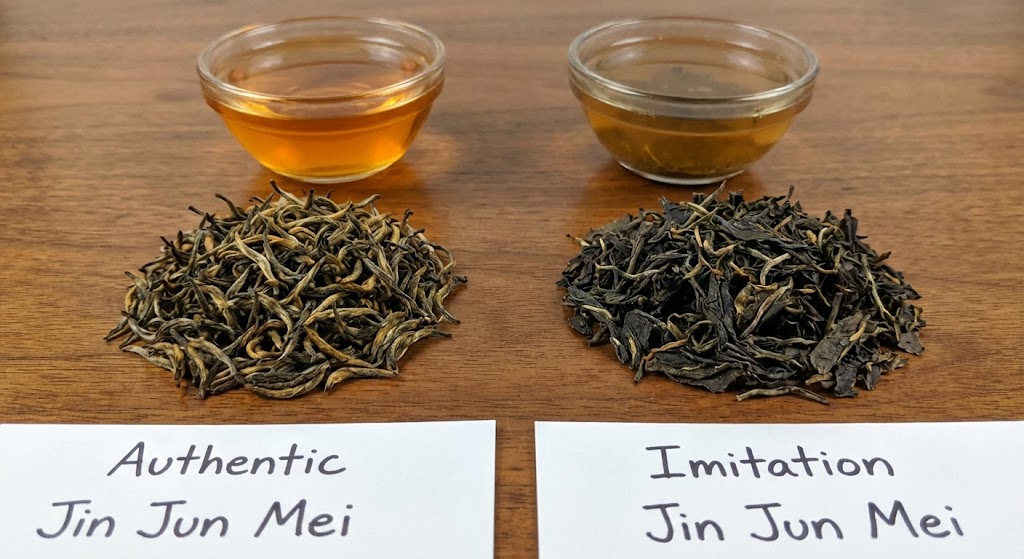
What Is Real Jin Jun Mei?
True Jin Jun Mei (金骏眉, Golden Eyebrow) is all-bud black tea from Wuyi Mountains, Fujian. Created 2005, highly specific production: only spring-picked buds from Wuyi Camellia bohea, hand-processed with careful oxidation, characteristic sweet/fruity flavor. Price: £200-500/kg for authentic. Fake versions: £10-50/kg commodity black tea rolled to look like buds.
The defining feature: all-bud construction. Real JJM is 100% leaf buds—no leaves, no stems (except tiny bud base). Each "thread" is individual bud, tightly rolled. When wet, it should stay bud-shaped. Fake JJM is rolled young leaves cut to resemble buds. When wet, leaves unfurl into recognizable leaf shape.
The Unfurl Test
Steep suspected Jin Jun Mei until leaves fully open (3-5 minutes hot water). Real: stays bud-shaped, small and compact. Fake: unfurls into small leaves with visible leaf blade, serrations, veins. Buds don't have leaf structure—leaves do.
Visual Markers of Authentic JJM
Dry leaf: thin, wiry threads with golden tips (trichomes), mixed black/gold color, uniform tiny size. Wet leaf: stays compact, minimal expansion, no unfurling. Liquor: bright orange-red, clear, sweet aroma. Flavor: honey, fruit, smooth with no astringency. Fake versions: thicker threads (rolled leaves are bigger), less golden tips, unfurl significantly, more astringent.
| Characteristic | Real Jin Jun Mei | Fake (Rolled Leaf) |
|---|---|---|
| Dry appearance | Thin wiry buds, gold tips | Thicker threads, uniform black |
| Wet leaf | Stays bud-shaped, compact | Unfurls into small leaves |
| Leaf structure | No veins/serrations visible | Clear vein pattern, edges |
| Price | £200-500/kg | £10-50/kg |
| Flavor | Sweet, honey, smooth | More astringent, simple |
Why JJM Fraud Is Rampant
Demand vastly exceeds authentic production. Wuyi Mountains produce ~500-1000kg real JJM annually (small area, labor-intensive all-bud picking). Market sells 50,000+ kg annually labeled "Jin Jun Mei." The math: 98-99% of "Jin Jun Mei" in market is fake. Unless buying directly from known Wuyi producer, assume fake until proven otherwise.
Vendors create fake JJM by: taking commodity Yunnan/Fujian black tea, rolling leaves into thin threads, mixing in golden tips (from different tea), packaging as "Jin Jun Mei style" or "Golden Eyebrow." Not illegal if disclosed as "style," but most vendors imply or state authenticity.
Verifying Jin Jun Mei Authenticity
- Unfurl test: Must stay bud-shaped when wet. Leaf unfurling = fake
- Check origin: Real JJM is Wuyi Mountains only. "Yunnan JJM" doesn't exist
- Price reality: <£100/kg is impossible for authentic. Likely fake
- Vendor reputation: Buy from established Wuyi-connected sources only
- Accept "style" teas: "JJM-style" priced honestly is acceptable. Claimed "authentic" at £20/kg is fraud
Why Jin Jun Mei is the Most Counterfeited Tea
Authentic Jin Jun Mei ("Golden Beautiful Eyebrow") from Wuyi Mountain costs $200-800 per 100g—one of the world's most expensive black teas. Made exclusively from wild tea bush tips harvested in early spring, requiring 60,000-80,000 buds per kg. The price creates massive fraud incentive: Fake Jin Jun Mei (made from plantation black tea + dye) costs $3-8/kg to produce, sells for $40-150/100g marketed as "authentic."
The fraud is rampant: Experts estimate 95%+ of "Jin Jun Mei" sold globally is fake. Even in China, 80-90% is counterfeit. The tell: Wet leaf examination reveals plantation material (uniform size, sparse trichomes, no wild characteristics). Real Jin Jun Mei shows golden-tipped buds with dense silvery hairs, irregular sizing, wild genetics markers.
Price Reality Check
Real Jin Jun Mei: $200-800/100g minimum. Fake: $30-150/100g marketed as "authentic." If vendor sells "Jin Jun Mei" under $150/100g, it's 99% likely fake. The math doesn't work—production costs alone exceed budget prices. Avoid the fraud by accepting premium pricing or buying honest alternatives.
Wet Leaf Authentication: Wild vs. Plantation Markers
Real Jin Jun Mei wet leaves show: Dense silver-white trichomes on bud undersides (wild genetics), Irregular bud sizes (wild trees vary genetically), 25-35 serrations per 5cm leaf edge (wild characteristic), Thick buds with visible woody stem structure (old tree signature).
Fake Jin Jun Mei shows: Sparse trichomes (plantation cultivar), Uniform bud sizes (cloned plants), 10-18 serrations per 5cm (cultivated genetics), Thin buds with soft stems (young bushes). The difference is obvious side-by-side—but most buyers never see real Jin Jun Mei for comparison.
Golden Tips: Real vs. Dyed
Real Jin Jun Mei's golden tips come from natural carotenoid oxidation during processing—buds turn golden-amber through controlled oxidation. Fake Jin Jun Mei uses yellow food dye (Tartrazine E102) sprayed on black tea buds to mimic golden color. Detection: Rub dry buds on white paper—dyed version leaves yellow smudge, real version leaves minimal color.
Flavor Profile Differences
Real: Sweet potato, honey, dried longan fruit, smooth with no astringency, complex 8-10 steep evolution. Fake: Generic black tea, slight bitterness, flat one-dimensional flavor, fades after 3-4 steeps. If your "Jin Jun Mei" tastes like standard black tea, it is standard black tea with fake labeling.
Prevention: Buy from Source or Skip Entirely
Unless buying directly from verified Wuyi Mountain estates (with documentation), assume all Jin Jun Mei is fake. Better strategy: Buy honest alternatives like Yunnan Dian Hong golden buds ($20-60/100g) or Keemun Hao Ya ($30-80/100g)—similar profiles, transparent sourcing, fair prices. Save money, avoid fraud, enjoy great tea.
Comments