1. What Is Milk Oolong and Where Does the Name Come From?
Milk oolong is the English market name for Jin Xuan (金萱), a tea cultivar developed by Taiwan's Tea Research and Extension Station and released to growers in 1981. The cultivar's official designation is TRES No. 12, and it was bred by crossing two parent plants—one from an experimental line, the other a wild Taiwanese varietal—to produce a tea naturally high in amino acids and low in astringent polyphenols. The result is a leaf that, when lightly oxidised (typically 15–25 per cent), yields a liquor with an unusually smooth, creamy body and a fragrance reminiscent of steamed milk, butter, or sweet cream. The Mandarin nickname nai xiang (奶香), meaning 'milk fragrance', appeared within a few years of commercial release and stuck; Western importers anglicised it to 'milk oolong' in the early 2000s.
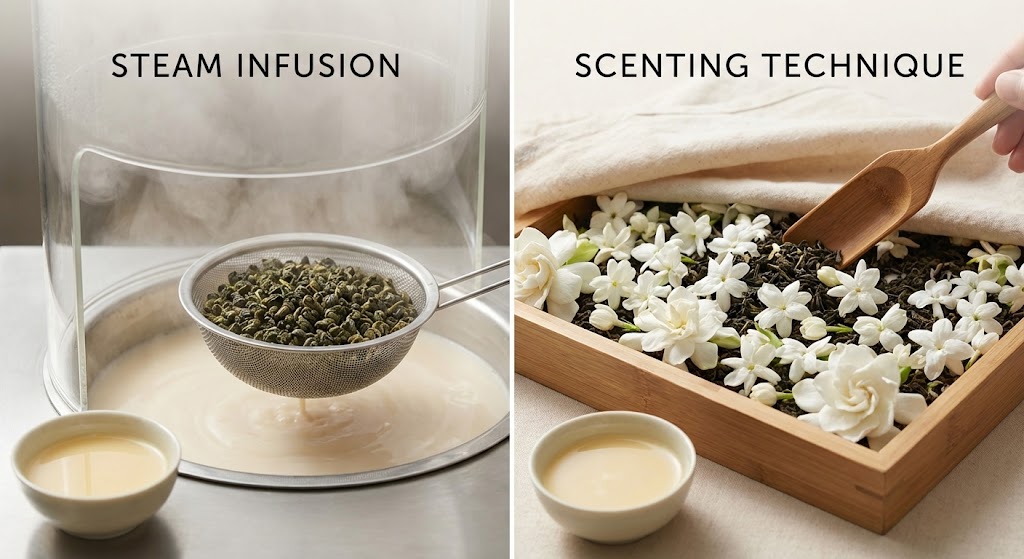
The name does not mean that milk was added during processing—a persistent myth that still circulates online. There is no soaking in milk, no butter rubbed into leaves, and no dairy fat sprayed onto the finished tea. The creamy character is entirely intrinsic to the cultivar's biochemistry. Jin Xuan leaves naturally produce higher concentrations of certain volatile lactones—organic compounds that smell sweet, fatty, and 'milky'—especially when grown at altitude, harvested in cooler seasons, and oxidised gently to preserve rather than transform the leaf's amino-acid profile. For more on the cultivar's development and naming, see how milk oolong got its name.
Because 'milk oolong' is a descriptive market term rather than a protected designation, it has been adopted by vendors to label any oolong with a creamy profile, whether natural or added. This has led to widespread confusion: many teas sold as milk oolong in the UK are not Jin Xuan at all, but standard Taiwanese or Chinese oolongs that have been artificially scented after processing. Both categories exist, both are legally sold, and both use the same English name, so buyers must learn to distinguish them by examining the leaf, the price, and the flavour profile.
Look for 'Jin Xuan' on the Label
If the packet says only 'milk oolong' with no cultivar name, it's often a scented blend. Authentic suppliers will list Jin Xuan, Nai Xiang, or TRES No. 12 somewhere on the packaging or product page.
2. The Jin Xuan Cultivar: Genetics, Growing Regions, and Terroir
Jin Xuan is a relatively young cultivar by tea standards, but it has become Taiwan's most widely planted oolong variety, accounting for a significant portion of the island's mid- and high-mountain production. It thrives at elevations between 600 and 1,600 metres, where cool nights, morning mist, and well-drained volcanic soils slow leaf growth and encourage the accumulation of amino acids—particularly theanine—that contribute to the tea's smooth, sweet character. The cultivar is less demanding than older Taiwanese varieties such as Qing Xin (Soft Stem), and it can produce multiple harvests per year with good cup quality, which has made it attractive to growers across central Taiwan's high-mountain regions, including Alishan, Lishan, and Shanlinxi.
The terroir profoundly affects the expression of Jin Xuan's milky notes. High-altitude Jin Xuan from spring or winter harvests, when temperatures are cool and growth is slow, tends to be more aromatic, with pronounced buttery sweetness and a silky texture. Lower-elevation Jin Xuan, especially summer harvests, can be greener, grassier, and less distinctly 'milky'. The oxidation level during processing also plays a major role: lightly oxidised Jin Xuan (15–20 per cent) emphasises floral and creamy notes, while more heavily oxidised batches (25–35 per cent) can take on caramel, toasted-grain, or honey flavours that overshadow the milk character. For a broader look at how oxidation shapes oolong flavour, see our complete buyer's guide.
Outside Taiwan, Jin Xuan has been planted experimentally in Thailand, Vietnam, and mainland China, particularly in Fujian and Yunnan. These non-Taiwanese versions are often sold as 'milk oolong' in the UK market, sometimes at lower prices. While they share the cultivar genetics, they typically lack the complexity and pronounced creaminess of high-mountain Taiwanese Jin Xuan, because the growing conditions, soil chemistry, and processing expertise differ. If provenance matters to you—and for Jin Xuan, it usually does—check the origin on the label and expect to pay more for Taiwan-grown leaf.
3. The Chemistry of 'Milky' Flavour: Lactones, Amino Acids, and Oxidation
The perception of creaminess in Jin Xuan comes from a combination of volatile aroma compounds and mouthfeel-modifying amino acids. Chief among the aromatics are lactones—cyclic esters that smell sweet, fatty, and often dairy-like. Jin Xuan leaves, when lightly oxidised, retain higher levels of these lactones than most other oolong cultivars. The specific lactones involved have not been exhaustively catalogued in peer-reviewed literature (Jin Xuan is a relatively niche subject outside Taiwan), but sensory analysis and gas chromatography–mass spectrometry (GC-MS) work on Taiwanese oolongs suggests that compounds such as γ-decalactone and δ-decalactone—both of which have peach, coconut, and creamy notes—are present in elevated concentrations. For more on the biochemical pathways, see lactone synthesis in Jin Xuan.
Equally important is the cultivar's high theanine content. Theanine is a non-protein amino acid that contributes sweetness and a smooth, almost viscous mouthfeel, counteracting the astringency of catechins and other polyphenols. Jin Xuan's breeding lineage emphasised low astringency and high amino-acid yield, which means that even when brewed strong, the tea rarely turns bitter. This smoothness reinforces the 'milky' impression, because we associate creamy textures with dairy fats. The interplay between aroma (lactones) and texture (theanine) is what gives authentic Jin Xuan its signature character.
Processing choices—particularly oxidation and roasting—can enhance or diminish these qualities. Light oxidation (15–25 per cent) preserves floral volatiles and lactones; heavier oxidation (30 per cent and above) tends to drive off delicate aromatics and introduce roasted, caramel notes. Similarly, a light or absent roast maintains the tea's fresh, creamy profile, while a heavier roast shifts the flavour toward honey, grain, and nut. Some producers deliberately roast Jin Xuan to appeal to markets that prefer darker oolongs, but this style is less recognisably 'milky'. If you want maximum creaminess, look for lightly oxidised, minimally roasted Jin Xuan from a spring or winter harvest.
Why Cold Brew Brings Out Creaminess
Cold water extracts theanine and lactones efficiently but pulls fewer astringent catechins, so cold-brewed Jin Xuan often tastes more buttery and sweet than a hot infusion of the same leaf.
4. Natural Jin Xuan vs Milk-Scented Oolong: How to Tell Them Apart
The UK market sells two distinct products under the 'milk oolong' umbrella. Natural Jin Xuan derives its creamy character from cultivar, terroir, and processing. Milk-scented oolong (sometimes called flavoured milk oolong or nai xiang pian in Mandarin, though the latter term is ambiguous) is any oolong—often a cheaper cultivar such as Si Ji Chun (Four Seasons) or even a generic Fujian Tie Guan Yin—that has been sprayed, tumbled, or dusted with synthetic milk flavouring after rolling and drying. The flavouring is typically a proprietary blend of vanillin, diacetyl, lactones, and other aroma chemicals designed to mimic dairy or custard. The practice is legal, widely used in China and Taiwan for export markets, and not inherently harmful, but it is a form of flavouring, not a natural characteristic of the tea. For a detailed look at the process, see how milk oolong is flavoured.
Distinguishing the two by appearance alone is difficult, because both are rolled into tight green or jade-coloured balls. However, a few clues can help. Scented oolongs often have a shinier, slightly sticky surface from the flavouring agent; the leaves may clump together or leave a faint residue on your fingers. The dry-leaf aroma is usually very intense—think cream soda, vanilla extract, or sweetened condensed milk—whereas natural Jin Xuan smells more subtle, floral, and complex, with notes of fresh cream, orchid, and sometimes a hint of melon or butter. Once brewed, scented teas deliver a powerful, one-dimensional sweetness that can feel cloying after the first infusion, while genuine Jin Xuan maintains balance, with floral top notes, a creamy mid-palate, and a clean, slightly mineral finish.
Price is another telling factor. Authentic high-mountain Jin Xuan from Taiwan typically retails in the UK for £10–25 per 50 grams or more, depending on altitude, harvest season, and vendor. Milk-scented oolongs are often priced at £4–8 per 50 grams or sold in large tins at suspiciously low prices. If a 'milk oolong' is cheaper than a supermarket Earl Grey, it is almost certainly flavoured. That doesn't make it bad—many drinkers enjoy the bold, sweet profile—but it's not the same product as Jin Xuan, and buyers should know what they're paying for. To compare vetted, authentic options, consult our best milk oolong tea reviews.
The Re-Steep Test
Authentic Jin Xuan holds up for 4–6 infusions with evolving complexity; scented oolongs lose their sweetness rapidly and taste flat or grassy by the third steep, because the flavouring washes off quickly.
5. How to Brew Milk Oolong for Maximum Creaminess
Jin Xuan responds well to gongfu-style brewing—short, repeated infusions in a small vessel—which allows you to explore the tea's evolving profile. Use 5–7 grams of rolled leaf per 100 ml of water. Rinse the leaves with a brief (5–10 second) pour of hot water to open the balls and awaken aromatics, then discard the rinse. The first infusion should steep for 30–45 seconds at 85–90 °C; subsequent infusions can be extended by 10–15 seconds each. Natural Jin Xuan will yield a pale golden liquor with a pronounced buttery aroma and a smooth, almost oily mouthfeel. Oversteeping or using water that's too hot (above 95 °C) can extract unwanted astringency and diminish the creamy sweetness.
For a more relaxed, Western-style brew, use 3 grams per 250 ml and steep for 2–3 minutes at 85–90 °C. This method produces a lighter, more delicate cup, still creamy but less intense. Jin Xuan is also excellent cold-brewed: place 5 grams in 500 ml of room-temperature or refrigerated water and leave for 6–8 hours. The cold extraction emphasises sweetness and silky texture while minimising any bitterness, making it one of the most approachable iced oolongs for UK summer drinking.
Water quality matters, especially in hard-water areas. The high mineral content of London, Birmingham, and Manchester tap water can mute Jin Xuan's delicate floral notes and introduce chalkiness. If possible, use filtered or bottled water with low Total Dissolved Solids (TDS below 100 mg/L). For a regional breakdown and workarounds, see brewing tea in UK hard water areas. If you're stuck with hard water, slightly cooler temperatures (80–85 °C) and shorter steeps can help preserve aroma.
Use a Porcelain or Glass Gaiwan
Yixing clay can absorb and retain flavours, which is wonderful for heavily roasted oolongs but can dull Jin Xuan's delicate lactones. Porcelain or glass vessels keep the profile clean and let the creamy notes shine.
6. Buying Milk Oolong in the UK: What to Look For and What to Avoid
When shopping for milk oolong in the UK, the single most important step is to confirm the cultivar. Look for 'Jin Xuan', 'Nai Xiang', or 'TRES No. 12' on the label or product description. If the listing says only 'milk oolong' or 'milky oolong' without naming the cultivar, ask the vendor directly. Reputable specialists—loose-leaf retailers, importers focused on Taiwanese tea, and curated subscription services—will provide this information freely. If they can't or won't, it's likely a scented blend.
Check the origin and, if possible, the harvest season and altitude. Taiwanese Jin Xuan from elevations above 1,000 metres and from spring (April–May) or winter (December–January) harvests commands higher prices and delivers more pronounced creaminess. Summer and autumn harvests are cheaper and can still be enjoyable, but they lack the depth and aromatic intensity of the peak seasons. Non-Taiwanese Jin Xuan—Thai, Vietnamese, or mainland Chinese—is often sold at half the price of Taiwanese leaf and can be a good entry point, but the flavour profile is usually simpler and less 'milky'.
Be wary of suspiciously low prices. As noted, genuine high-mountain Jin Xuan rarely sells for less than £10 per 50 grams in the UK. If a vendor offers 'milk oolong' at £5 per 100 grams, it is almost certainly either a low-grade Jin Xuan, a different cultivar, or a scented oolong. None of these is necessarily bad, but the labelling should be honest. For vetted recommendations across price points, see our best milk oolong tea reviews. If you're exploring other premium Taiwanese styles, our Apsara oolong reviews cover similarly high-altitude, delicate oolongs with complex aromatics.
Buy a Small Sample First
Even respected vendors occasionally mislabel or receive inconsistent batches. Order 10–20 grams as a taster before committing to a large tin, especially if the price is above £15 per 50 g.
7. Flavour Variations: What to Expect Across Harvests, Altitudes, and Oxidation Levels
Spring Jin Xuan (April–May) is considered the pinnacle: slow growth, cool temperatures, and careful processing yield a tea with intense floral aroma—orchid, lilac, magnolia—balanced by a buttery, almost custardy sweetness. The liquor is pale gold, the body smooth and creamy, the finish long and clean. This is the style most often described as 'milky' in Western marketing. Winter Jin Xuan (December–January) can be equally complex, with slightly more minerality and less overt sweetness, appealing to drinkers who find spring harvests too floral. Both are premium-priced and worth seeking out if you want the full Jin Xuan experience.
Summer and autumn harvests are more variable. Summer Jin Xuan tends to be greener, grassier, and more vegetal, with less of the characteristic creaminess; it can still be pleasant, especially for those who prefer lighter, fresher oolongs, but it won't deliver the 'milk' experience that gives the tea its name. Autumn Jin Xuan often strikes a middle ground: less floral than spring, more balanced than summer, with honey and light roasted-nut notes if the leaves have been given a moderate roast. For a broader understanding of how harvest timing affects oolong character, see our complete oolong guide.
Oxidation and roasting choices introduce further variation. Lightly oxidised, unroasted Jin Xuan (the most common export style) emphasises freshness and aroma. Medium-oxidised Jin Xuan (25–30 per cent) shifts toward caramel and toasted grain, with less pronounced lactones. Heavily roasted Jin Xuan—rare, but occasionally found in specialist Taiwanese shops—takes on dark honey, baked apple, and nutty notes, losing most of the 'milky' character but gaining depth and longevity. If you're exploring milk oolong for the first time, start with a lightly oxidised, unroasted spring or winter harvest from above 1,000 metres. Once you know that baseline, you can experiment with darker, roasted, or off-season batches. For detailed tasting notes and cultivar comparisons, see our milk oolong flavour guide.
8. Common Questions and Misconceptions About Milk Oolong
Does milk oolong contain milk or dairy? No. The name is purely descriptive of the flavour and aroma. The tea is entirely plant-based and suitable for vegans. Is it safe for people with lactose intolerance or dairy allergies? Yes, authentic Jin Xuan contains no dairy proteins, lactose, or milk-derived ingredients. However, milk-scented oolongs sometimes use flavourings that include dairy-derived compounds (though this is rare in the UK market); if in doubt, contact the vendor.
Does milk oolong taste like drinking tea with milk? Not quite. It tastes like tea that has an intrinsic creamy, buttery sweetness—closer to the aroma of steamed milk or condensed milk than the taste of milk added to black tea. The comparison is aromatic and textural, not a literal flavour match. For more on how dairy and tea interact chemically, see the chemistry of adding milk to tea and the science of milk-first brewing.
Can I add milk to milk oolong? You can, but most enthusiasts don't recommend it. The tea's flavour is delicate and designed to be appreciated on its own; adding milk tends to overwhelm the floral and lactonic notes rather than enhance them. If you enjoy milky tea, you'll likely get more satisfaction from a robust Assam CTC or a Hong Kong–style milk tea blend. Does milk oolong have caffeine? Yes, like all true teas, Jin Xuan contains caffeine—typically 20–40 mg per 100 ml infusion, depending on brewing time and temperature. For a detailed comparison, see caffeine in tea vs coffee.
Storage Matters More Than You Think
Jin Xuan's lactones are volatile and sensitive to light and heat. Store in an opaque, airtight tin away from strong smells (coffee, spices) and consume within 6–12 months of opening for peak creaminess. For more, see does tea expire.


Comments