1. Why Water Temperature Accuracy Matters: The Chemistry Beneath the Numbers
Temperature governs the rate at which flavour compounds, amino acids, polyphenols and caffeine dissolve from leaf into water. For green and white teas, catechins and amino acids—particularly L-theanine and arginine—are most soluble at 60–80 °C, delivering sweetness and umami; above 85 °C, tannins and gallocatechins extract more rapidly, tipping the balance toward astringency and bitterness. Black teas and darker oolongs, pre-oxidised and fired at higher temperatures, carry fewer heat-sensitive catechins and benefit from near-boiling water (95–100 °C) to release their full aroma volatiles—aldehydes, ketones and esters locked in cell walls by the firing process.
A 5 °C error may seem trivial, but extraction kinetics are exponential, not linear: raising water from 75 to 80 °C can double the release rate of certain tannins in the first thirty seconds, while dropping from 85 to 80 °C halves the extraction of caffeine and some amino acids. This is why Japanese sencha guidelines specify 70 °C ±2 °C, and why a kettle that delivers 78 °C when set to 70 °C will consistently overbrew. The mineral composition of your water—calcium, magnesium, bicarbonate—interacts with polyphenols in temperature-dependent ways; harder water at high temperature accelerates precipitation of catechins, dulling colour and mouthfeel. Precision is not perfectionism; it is the baseline for reproducibility.
The Five-Degree Window
For most teas, staying within ±3 °C of target gives consistent results; beyond ±5 °C, flavour shifts become obvious to regular drinkers. If your kettle cannot hold that tolerance, manual measurement and adjustment are essential.
2. How Electric Kettle Thermostats Work—and Why They Drift
Most UK electric kettles—whether budget supermarket models or premium brands—rely on a bimetallic thermostat strip or, in variable-temperature designs, a thermistor sensor embedded in the base or spout. A bimetallic strip bends as it heats, mechanically tripping a switch at a set point (typically calibrated to ~100 °C for 'boil' kettles); thermistors change electrical resistance with temperature, feeding data to a microcontroller that cuts power when the target is reached. Both systems are subject to drift: bimetallic strips oxidise and fatigue with repeated flexing, shifting their trip point by 2–5 °C over hundreds of cycles; thermistors, though more stable, can be poorly positioned—too close to the element reads high, too far from the water mass reads low.
In temperature-controlled kettles, the displayed figure reflects the sensor reading, not the average bulk temperature of the water column. If the sensor sits near the heating element, it may register 85 °C while the top layer remains at 78 °C; convection currents take time to equalise. Kettle design—element shape, water volume, insulation—affects how quickly and uniformly heat distributes. A full 1.7-litre kettle heated from cold takes longer to reach thermal equilibrium than a half-full vessel, and the last 200 ml may be several degrees cooler. This is why stirring or swirling the kettle after it switches off, before pouring, can improve accuracy by 2–3 °C.
UK mains voltage (230 V nominal, ±10 % tolerance) and power ratings (typically 2–3 kW for home kettles) mean rapid heating but also rapid thermostat actuation; cheaper models often overshoot by 3–5 °C, then cool back, while the display or dial lags behind. Limescale buildup from hard water—common in London, Birmingham and much of the South-East—insulates the element, slowing heat transfer and throwing off calibration. Regular descaling with citric acid or white vinegar restores not only efficiency but also temperature accuracy.
3. Stovetop and Immersion Thermometers: Accuracy, Response Time and Calibration Drift
Glass alcohol or mercury thermometers (now typically red-dyed ethanol in the UK, following mercury-sales restrictions) remain the gold standard for home calibration because they have no electronic components to drift and are easy to verify against ice-water (0 °C) and boiling-water (~100 °C at sea level) reference points. A quality glass thermometer with 1 °C graduations, stem length 200–300 mm and a clip or weight to suspend it mid-column, will read bulk water temperature accurately within ±0.5 °C if handled correctly. The key limitation is response time: glass thermometers take 15–30 seconds to stabilise, making them unsuitable for fast pour-over workflows but ideal for verifying kettle set points after a minute's rest.
Digital probe thermometers—thermocouple or thermistor-based, often sold for cooking—offer faster response (2–5 seconds for thin-tip models) and easier reading, but calibration drift is common. Cheap probes (under £10) may ship with ±2 °C factory error and drift further after exposure to steam or repeated thermal shock. Premium models with UKAS-traceable certificates (or equivalent European EN standards) cost £30–80 and maintain ±0.3 °C accuracy, provided you verify calibration every few months using the ice-water and boiling-water method. Always immerse the probe tip at least 50 mm into the water column, away from vessel walls and the water surface, to avoid edge effects and evaporative cooling.
Infrared (IR) thermometers—point-and-shoot laser guns—measure the surface radiation of water, not its bulk temperature. Because water has high emissivity (~0.95–0.98) but a cool surface film due to evaporation, IR readings typically fall 2–5 °C below true bulk temperature unless the water is stirred immediately before measurement and the gun is held at the correct distance (usually 15–30 cm, per manufacturer specs). They are useful for rapid screening or comparing multiple vessels, but should not replace immersion thermometers for precision work. For a detailed breakdown of which tools suit which brewing styles, see our thermometer comparison guide.
The Ice-Water Check
Fill a glass with crushed ice and water, stir for 30 seconds, then immerse your thermometer. It should read 0 °C ±0.5 °C. If it reads 2 °C or −1 °C, note the offset and apply it to all subsequent readings—or replace the instrument.
4. Step-by-Step Kettle Accuracy Test Protocol for UK Conditions
Begin by descaling your kettle with a citric-acid solution (15 g per litre, boiled once, left for an hour, rinsed thoroughly) to remove limescale that skews sensor readings. Fill the kettle to its maximum line with fresh filtered or bottled water at room temperature (~18–20 °C in a typical UK home). Select the temperature set point you wish to verify—e.g., 80 °C for green tea—and switch on. Do not open the lid or disturb the kettle during heating; convection currents need time to establish.
Once the kettle signals completion (audible beep, light change or auto-shutoff), wait 30 seconds without opening the lid, then gently swirl the kettle to homogenise the water column. Immediately insert a calibrated glass or digital probe thermometer to mid-depth—avoid touching the element or kettle wall—and wait for the reading to stabilise (15–30 seconds for glass, 3–5 for fast digital probes). Record the reading. Repeat the test three times on different days, at similar room temperatures and fill levels, and calculate the mean; this averages out small environmental variations and gives you the kettle's true offset.
For 'boil' kettles, perform the same protocol but compare the peak reading to the expected boiling point for your location. At UK sea-level sites (London, Birmingham, Manchester), water boils at ~99.5–100 °C; in higher-altitude areas—parts of the Scottish Highlands, the Lake District, Snowdonia—boiling point may be 98–99 °C. You can estimate your local boiling point using the formula Tb ≈ 100 − 0.0034 × (altitude in metres), or simply accept that any reading between 98 and 101 °C at switch-off is normal for a well-calibrated kettle. If your kettle consistently reads below 97 °C or above 102 °C, the thermostat or thermistor has drifted and should be recalibrated (if possible) or replaced.
Fill Level Affects Accuracy
Temperature sensors often sit low in the base; a half-full kettle may read 3–5 °C hotter at switch-off than a full one, because less thermal mass surrounds the sensor. Always test at the volume you typically brew.
5. Temperature Drop During Pouring and Vessel Transfer: Real-World Losses
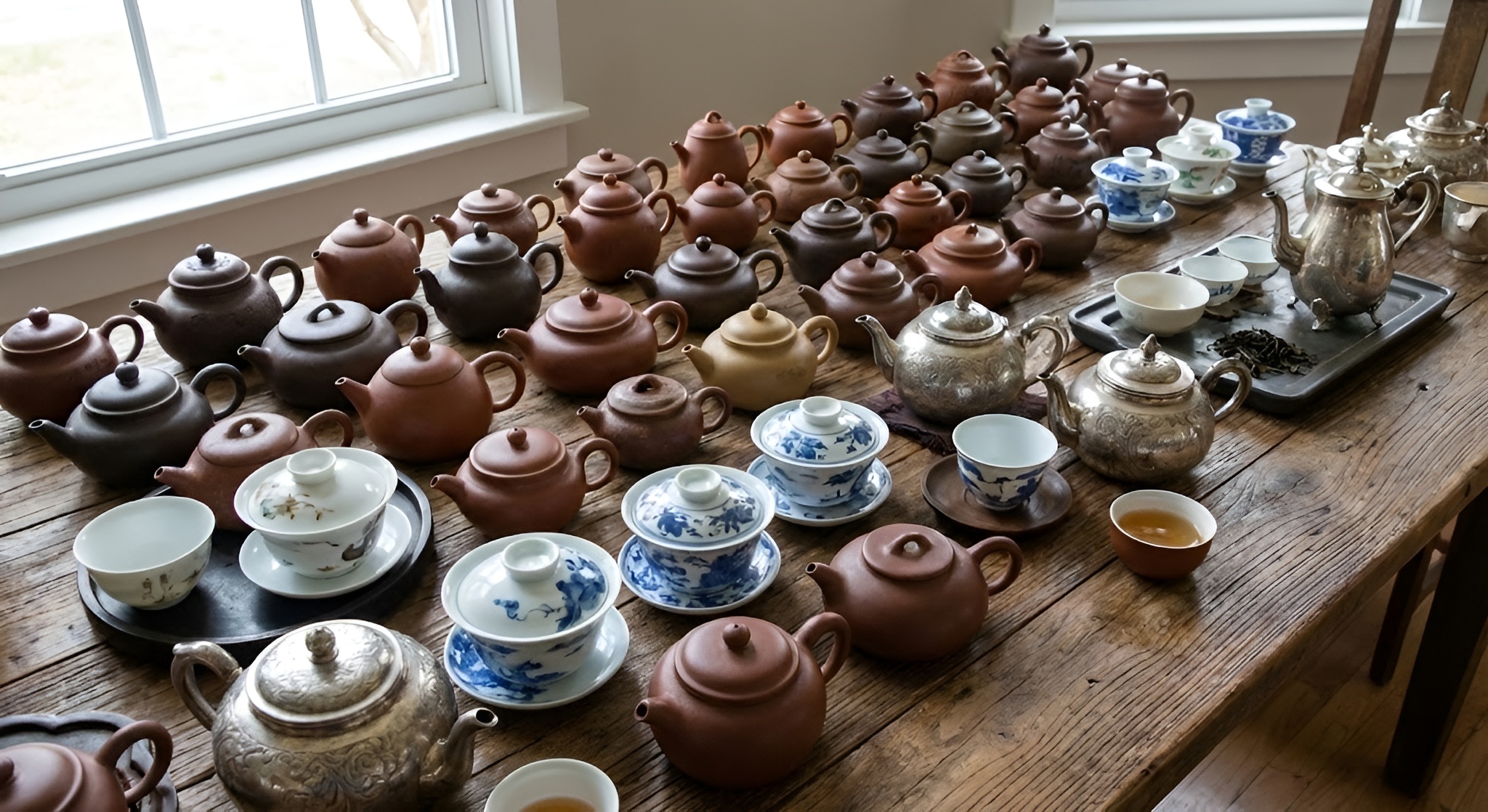
Water loses heat the moment it leaves the kettle. Pouring from a stationary spout into a room-temperature ceramic teapot or gaiwan causes an immediate drop of 2–4 °C through convective and evaporative cooling, even over a pour time of five seconds. The vessel itself—especially thick porcelain, stoneware or cast iron—acts as a heat sink, absorbing energy until it reaches thermal equilibrium with the water; a cold teapot can pull another 3–6 °C from the brew in the first thirty seconds. This is why traditional gongfu practice includes a warming rinse: pouring boiling water into pot and cups, discarding it, then brewing immediately minimises temperature loss.
Ambient conditions amplify these effects. In a draughty kitchen at 15 °C (typical UK autumn or spring), an open teapot loses ~1 °C every 10–15 seconds; in a warm room at 22 °C, the rate halves. Lid-on brewing in an insulated vessel—thick-walled Yixing clay, double-wall glass, or a preheated porcelain gaiwan—can reduce loss to 0.5 °C per minute. For teas requiring precise low-temperature brewing (60–70 °C whites, some gyokuros), these few degrees matter: if your kettle delivers 72 °C and your pot is cold, leaves may contact water at 65 °C, underextracting umami and yielding a thin, grassy liquor.
To measure real leaf-contact temperature, pour from your kettle into your actual brewing vessel (preheated or not, as per your routine), wait the time you normally would before adding leaves, then take a probe reading inside the vessel. The difference between kettle set point and vessel reading is your system's real offset—the number you must compensate for when choosing a temperature. If you consistently find a 6 °C drop, set your variable-temperature kettle 6 °C higher than the recipe specifies, or preheat your pot.
6. UK Product Landscape in 2026: Budget Dial Kettles vs Premium Variable-Temperature Models
The UK market in 2026 spans three tiers. Budget dial kettles (£15–35) from supermarket own-brands and entry-level manufacturers offer mechanical thermostats with coarse set points—typically 'boil' only, sometimes 80, 90 and 100 °C—and accuracy of ±5–8 °C. They are adequate for black teas and everyday drinking but unreliable for greens or oolongs. Mid-range digital kettles (£40–80) from established small-appliance brands feature LED or LCD displays, thermistor sensors and finer graduation (often 5 °C or 1 °C steps); real-world accuracy improves to ±3–5 °C, and many include keep-warm functions that maintain temperature for 20–30 minutes, useful for multiple infusions.
Premium variable-temperature kettles and gooseneck models (£80–180) dominate the specialty-tea and coffee segments. These use calibrated thermistors, PID-style control loops (proportional-integral-derivative logic borrowed from laboratory equipment), gooseneck spouts for pour precision, and hold accuracy to ±1–3 °C across the 40–100 °C range. Build quality—stainless-steel internals, double-wall insulation, STRIX or similar certified thermostat modules—ensures longevity and reduces drift. Models from brands popular with UK tea enthusiasts often ship with calibration certificates or allow user offset adjustment via a hidden menu. For side-by-side testing of leading models, consult our gongfu kettle review.
A separate category—large-capacity hot-water dispensers and electric boilers—suits cafés, offices or households brewing many cups per day. These maintain a reservoir at set temperature (typically 85–98 °C) and dispense on demand, eliminating reboil cycles and the chemical changes associated with reboiling. Accuracy is usually ±3–5 °C, and energy efficiency is higher than repeatedly boiling a kettle. Our hot-water dispenser guide covers UK models in depth.
Gooseneck Geometry and Temperature
A long, narrow gooseneck spout cools water faster during the pour (high surface-area-to-volume ratio). Expect an extra 1–2 °C drop versus a wide, short spout; adjust your set point accordingly if switching kettle styles.
7. When Precision Matters—and When It Doesn't: Matching Gear to Tea Style
Not every tea demands laboratory precision. Robust black teas—Assam, Ceylon, everyday English Breakfast blends—tolerate 95–100 °C with little perceptible difference; a ±5 °C kettle is perfectly adequate. Similarly, darker oolongs (charcoal-roasted Tieguanyin, aged Wuyi rock teas) and ripe pu-erh benefit from high heat to unlock roasted notes and break down fermented compounds, and a simple boil-only kettle suffices. [[Tea-and-water-why-your-kettle-matters|Water quality]]—mineral balance, chlorine removal—will affect these teas far more than a few degrees of temperature variance.
Precision becomes critical for delicate greens, whites and high-mountain oolongs. Japanese senchas, gyokuros and kabusechas are engineered—through shading, cultivar selection and steaming—to maximise amino acids and minimise tannins; even 3 °C over target can tip the balance toward astringency. Chinese greens (Longjing, Biluochun) and white buds (Silver Needle, Bai Mudan) likewise reward careful temperature control with sweetness, floral lift and clarity. High-altitude Taiwanese oolongs—Alishan, Lishan, Shanlinxi—carry complex aromatics that volatilise rapidly above 85 °C and mute below 75 °C; a ±2 °C window is ideal. If these styles form the core of your drinking, investing in a calibrated variable-temperature kettle and a reliable probe thermometer pays dividends in consistency and flavour clarity.
For those who brew multiple styles daily—gongfu sessions in the morning, builder's tea at lunch, cold-brew experiments in summer—a kettle with wide temperature range, fine control and keep-warm function reduces the friction of constant adjustment. Conversely, if you drink one type of tea and always preheat your pot, a simple offset chart (kettle set point + vessel drop = target temperature) taped to the cupboard delivers repeatable results without premium gear. Precision is a tool, not an end; match it to your palate, your routine and the teas you actually drink.
The Repeatability Test
Brew the same tea three times—once at your usual temperature, once 5 °C higher, once 5 °C lower. If you cannot taste a difference, your current kettle is good enough; spend money on better leaves, not tighter thermostats.
8. Ongoing Calibration and Maintenance: Keeping Your System Accurate Over Time
No kettle or thermometer remains perfectly calibrated forever. Quarterly ice-water and boiling-water checks—the two-point calibration described in section 3—catch drift before it compounds. For thermometers, record the readings in a notebook or spreadsheet; if the offset grows beyond ±1 °C for premium digital probes or ±2 °C for budget models, replace or recalibrate. Some digital thermometers include a calibration-offset feature in their firmware, accessible via a button sequence; consult the manual. Glass thermometers rarely drift unless cracked, but check for air gaps in the liquid column (a sign of breakage) and verify the zero point annually.
Kettle maintenance centres on descaling. In hard-water areas—much of England south and east of a line from the Severn to the Humber—limescale accumulates within weeks, insulating the element and skewing sensor readings. Descale every 4–6 weeks with citric acid (cheaper and food-safe) or a proprietary descaler, following the manufacturer's protocol. After descaling, run a full boil-and-discard cycle to flush residues, then re-verify your temperature offsets; removing scale can shift readings by 2–3 °C as the sensor regains direct thermal contact with water. In very soft water areas—western Scotland, parts of Wales, the Lake District—descaling is rarely needed, but annual verification remains good practice.
For variable-temperature kettles with digital displays, firmware updates (if offered by the manufacturer) can improve control algorithms or fix calibration bugs; check the support website annually. If a premium kettle drifts beyond specification within warranty (typically two years for electrical goods in the UK, extended to five years by some brands), contact the manufacturer—many will recalibrate or replace the thermistor module free of charge. Finally, store your reference thermometer in a protective case, away from impacts and extreme temperatures; a broken calibration standard leaves you blind to kettle errors. Precision is a habit, not a purchase: regular checks, simple records and timely maintenance keep your brewing system accurate for years.
Comments