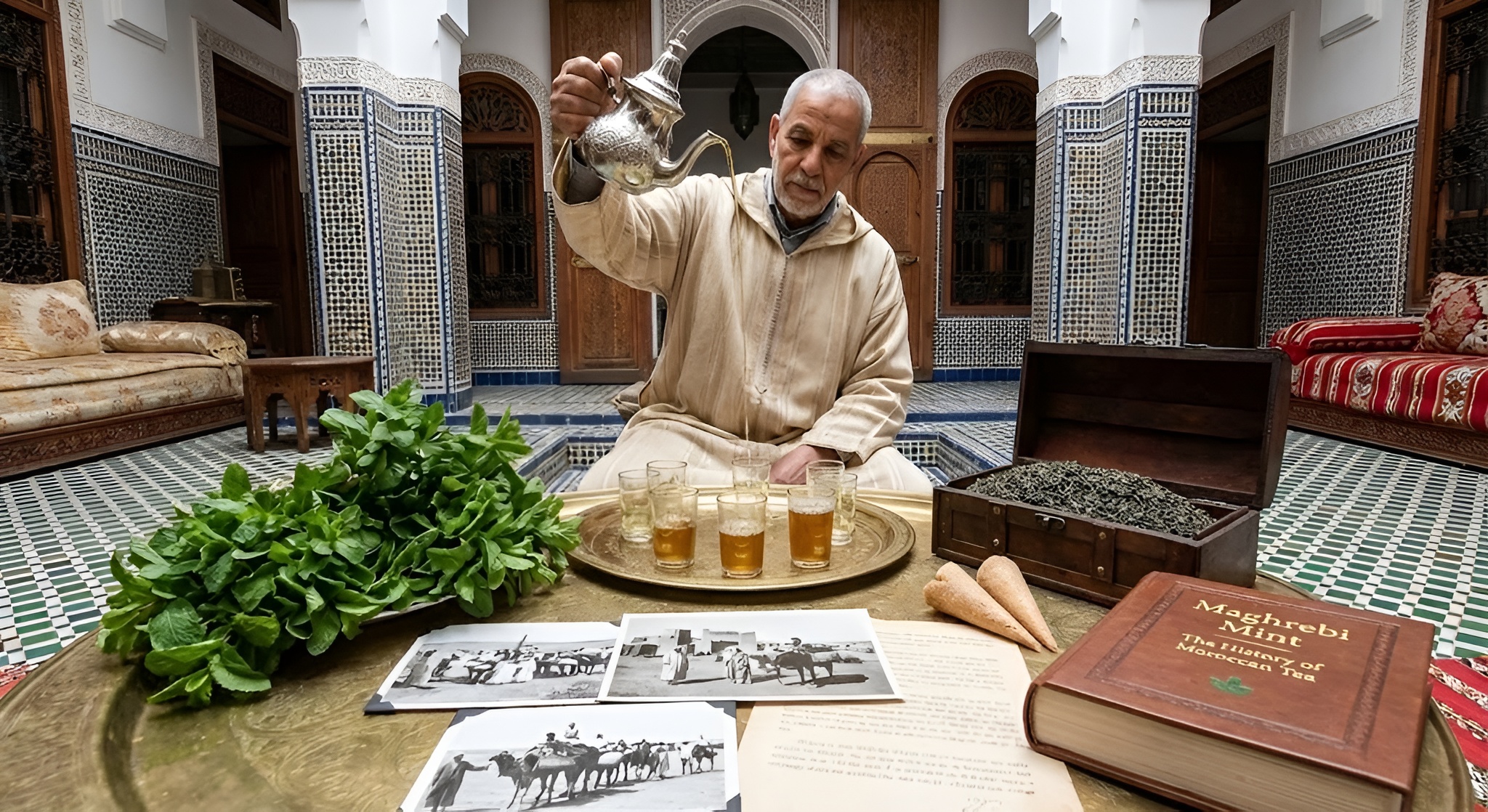
The Crimean War and the "Surplus" Tea
Before the mid-19th century, Moroccans drank infusions of mint and wormwood, but tea was a rare luxury for the Sultan's court. The shift to a national habit happened due to a geopolitical blockade.
In 1854, the Crimean War broke out, closing the Baltic ports to British merchant ships. The East India Company found itself with warehouses full of Chinese Gunpowder Green Tea intended for the Slavic market but with nowhere to send it. Desperate to offload the inventory, British merchants sailed south to the Moroccan ports of Tangier and Mogador (Essaouira).
They sold the tea at dumping prices. The locals, already fond of herbal infusions, found that the strong, smoky flavor of the rolled Gunpowder leaves blended perfectly with their native spearmint (Mentha spicata). The addition of sugar—another imported luxury that was becoming cheaper—created a high-calorie energy drink perfect for the harsh desert climate.
Expert Tip: Why "Gunpowder"?
Gunpowder tea gets its name from the appearance of the leaves—tightly rolled into small, hard pellets that resemble 18th-century gunpowder shot. This rolling preserves the leaves during long sea voyages, keeping them fresh. In Morocco, this strength is essential to stand up to the mint and sugar. Learn more about Gunpowder Tea processing here.
The Ingredients of Atay
Authentic Maghrebi tea is simple but strict in its composition. You cannot substitute delicate Japanese Sencha or Indian Darjeeling here. The ingredients must be:
- Chinese Gunpowder Tea: Specifically, the "Temple of Heaven" grade is prized for its bitterness and smokiness.
- Fresh Nana Mint: This is a specific cultivar of spearmint (Mentha spicata 'Nana') that is sweeter and more pungent than common peppermint. It grows aggressively in the Moroccan climate.
- Sugar Loaf (Pain de Sucre): Traditionally, sugar comes in large, solid cones (loaves) that are hacked into chunks with a brass hammer. The quantity is significant—Atay is a sweet drink.
Expert Tip: The "Sheeba" Season
In winter, when mint is scarce or dormant, Moroccans often substitute it with Sheeba (Wormwood/Absinthe). It has a bitter, medicinal flavor that is deeply warming. If you visit Morocco in January, don't be surprised if your tea tastes very different!
The Ritual: Washing the Tea
Making Atay is a performance, often done in front of guests. It involves a specific cleaning process that confuses many Westerners.
First, boiling water is added to the tea leaves and swirled. This first liquid—the "spirit" or "soul" of the tea—is poured into a glass and set aside. It contains the essential oils. Then, more water is added to the pot and swirled vigorously. This second liquid is cloudy and dirty; it is discarded. This step "washes" the dust off the Gunpowder pellets. Finally, the "spirit" is returned to the pot along with fresh water, mint, and sugar to boil.
The Three Cups Proverb
Moroccan tea is never served as a single cup. It is served in three rounds, with the flavor evolving as the leaves steep longer in the pot. There is a famous Maghrebi proverb that describes this progression:
"The first glass is as gentle as life,
The second is as strong as love,
The third is as bitter as death."
This reflects the extraction process: the first cup is sweet and minty, the second has more tannin from the tea, and the third is fully extracted and astringent.
The High Pour: Aeration and Foam
The most iconic image of Moroccan tea is the server lifting the teapot high above the glass, creating a long, precise stream of amber liquid. This is not just showing off. The high pour serves two scientific purposes:
- Cooling: It cools the boiling tea slightly before it hits the glass, preventing the thin glass from shattering.
- Aeration: It mixes air into the tea, creating a foam head called the "turban" or "crown." This foam traps the mint aroma and prevents the tea from oxidizing too quickly in the glass. It is said that tea without foam is like a man without a turban—lacking dignity.
Expert Tip: Get the Gear
To do this correctly, you need a Barrad (a Moroccan teapot with a long, curved spout) and heat-resistant glasses. We've reviewed the best authentic teapots and tea brands available online. See our Review: Best Moroccan Tea & Gear.
Social Significance and Gender Roles
In Moroccan culture, food preparation is traditionally the domain of women. However, tea preparation—specifically for guests—is often the domain of the male head of the household. It is a gesture of welcome and respect. To be invited to drink tea is to be welcomed into the family's protection.
Today, Atay is ubiquitous. From the Sahara to the Atlas Mountains, it is the fuel of negotiation in the rug shops and the comfort of the home. It stands as a testament to how a foreign ingredient can be adopted, adapted, and transformed into a symbol of national identity.
Comments