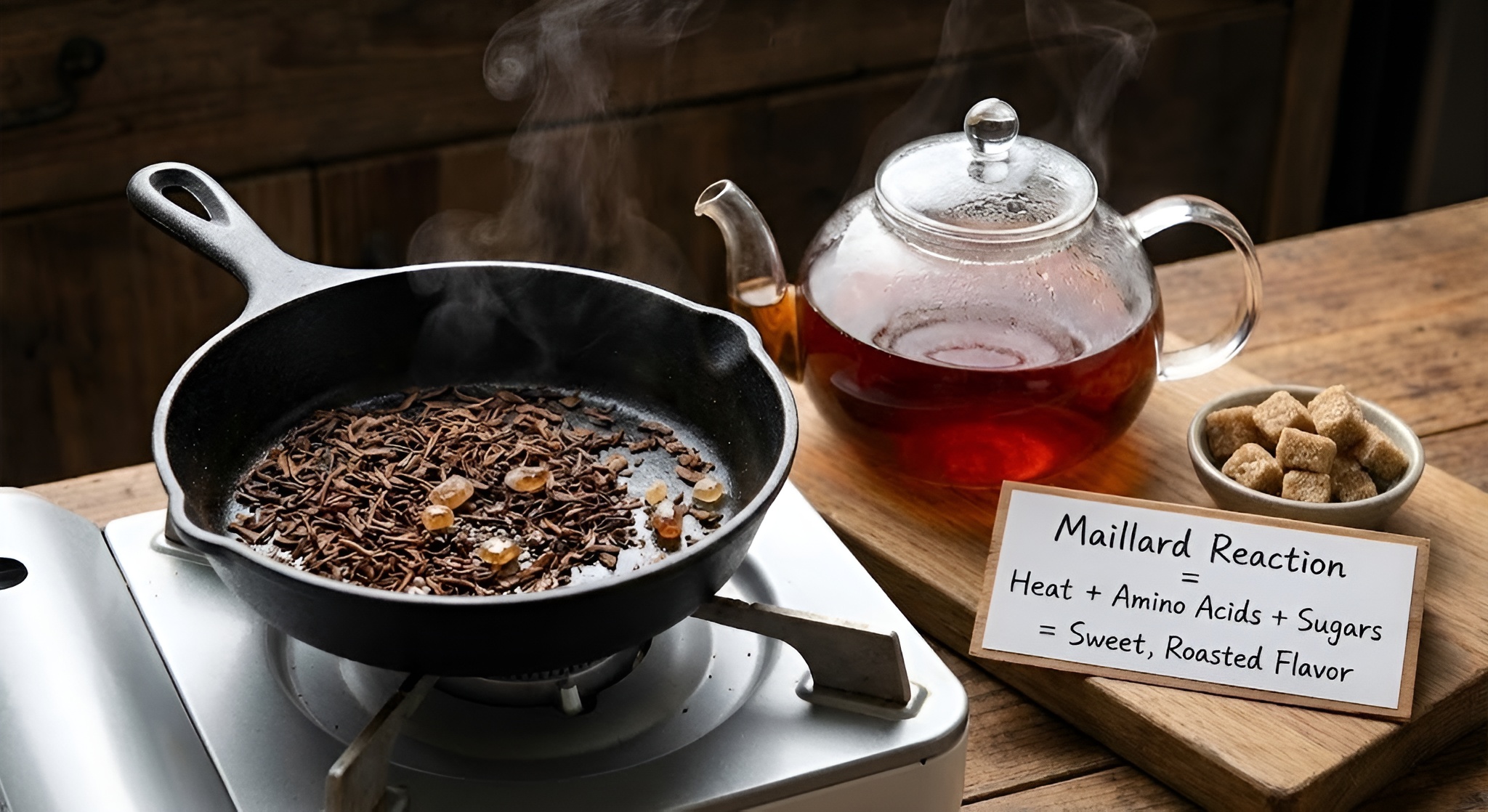
What is the Maillard Reaction?
Discovered by French chemist Louis-Camille Maillard in 1912, the Maillard reaction is a form of non-enzymatic browning. Unlike the oxidation that turns a sliced apple brown (which uses enzymes), the Maillard reaction requires heat.
At a molecular level, it is a chemical dance between two partners:
- The Amino Group: Found in proteins and amino acids (like L-Theanine in tea).
- The Carbonyl Group: Found in reducing sugars (like glucose and fructose in the tea leaf).
When heated together, these molecules fuse to form an unstable intermediate called a glycosylamine. This undergoes a rearrangement (the Amadori rearrangement) and then breaks down into hundreds of complex flavor compounds. Eventually, it forms Melanoidins—large, brown, nitrogen-containing polymers that give roasted foods their dark color.
The Distinction: Maillard vs. Caramelization
These two are often confused, but they are chemically distinct:
- Caramelization is the pyrolysis of sugar. It happens when you heat sugar alone (above 160°C). It creates nutty, buttery flavors.
- Maillard Reaction requires both protein and sugar. It creates savory, meaty, earthy, and roasted flavors.
In tea roasting, both happen simultaneously. The sugars in the leaf caramelize, while the amino acids react with sugars to produce Maillard compounds. This dual-action is what gives roasted tea its complexity.
The Chemistry of Tea Roasting
Green tea leaves are chemically complex. They are rich in amino acids (specifically Theanine, Glutamic Acid, and Arginine) and carbohydrates (pectin, sugars, cellulose). When a tea master applies heat—whether via a charcoal fire, an electric oven, or a rotating drum—they are essentially cooking these ingredients.
1. The Creation of Pyrazines (The "Nutty" Note)
The most important outcome of the Maillard reaction in tea is the formation of Pyrazines. These are heterocyclic organic compounds responsible for roasted, nutty, and bready aromas.
- 2,5-dimethylpyrazine: Smells like roasted nuts or cocoa.
- 2-ethyl-3,5-dimethylpyrazine: Smells like baked bread or coffee.
In unroasted green tea (like Sencha), these compounds are virtually non-existent. In Hojicha, they are the dominant volatiles. This is why Hojicha smells more like coffee than like grass.
2. The Creation of Furans (The "Sweet" Note)
Simultaneously, the thermal degradation of sugars produces Furans and Furanones. These compounds have sweet, caramel-like, or burnt-sugar aromas. Even though no sugar is added to the tea, the nose detects these "sweet" molecules, and the brain interprets the tea as tasting sweet. This is a phenomenon known as odor-taste interaction.
Why Stems Matter
In Japanese tea making, stems (Kukicha) are often roasted to make Hojicha. Stems contain less caffeine and protein than leaves, but they are higher in sugars and amino acids relative to their weight. This makes them the perfect substrate for the Maillard reaction, often resulting in a sweeter, more aromatic roast than leaves alone.
The Reduction of Bitterness
Roasting doesn't just add flavor; it subtracts it. Green tea is naturally bitter and astringent due to Catechins (like EGCG). While healthy, these tannins can be harsh on the palate.
High heat causes catechins to polymerize (join together) or degrade. This process significantly reduces astringency. It transforms the "sharp" mouthfeel of raw green tea into the "smooth" mouthfeel of roasted tea. This is why Hojicha is often served to children or the elderly in Japan—it is gentle on the stomach and the palate.
Types of Roasted Tea: From Japan to China
The Maillard reaction is utilized differently across tea cultures.
Hojicha (Japan)
Hojicha is roasted green tea. The leaves (usually Bancha or Sencha) are steamed first to stop oxidation (preserving the green color initially), but then roasted at high heat (approx 200°C) in a porcelain pot or rotating drum. The result is a complete transformation: the color turns reddish-brown, the grassy notes vanish, and the pyrazines take over. Try this flavor in our Hojicha Pudding recipe.
Wuyi Rock Oolong (China)
In the Wuyi mountains, roasting (Hong Bei) is an art form. Unlike Hojicha, which is a "kill-green" roast, Wuyi Oolongs are roasted over charcoal ash for hours, sometimes days, at lower temperatures. This slow roast (baking) aims to drive moisture out and deepen the flavor without burning the leaf. This technique, called "Gai Wei" (covering the flavor), can smooth out rough edges in the tea and create a long-lasting floral/mineral finish known as "Yan Yun" (Rock Rhyme). Learn more about Oolong processing here.
Kamairicha (Japan)
A rare style of Japanese tea that is pan-fired (like Chinese tea) rather than steamed. This direct contact with the hot metal pan initiates a mild Maillard reaction, giving Kamairicha a subtle "baked" flavor distinct from the vegetal taste of steamed Sencha.
Does Roasting Lower Caffeine?
There is a persistent myth that Hojicha is caffeine-free. This is scientifically incorrect, but there is nuance. Caffeine is a stable molecule with a sublimation point of 178°C (352°F).
Since tea roasting often exceeds this temperature (reaching 200°C+), some caffeine does sublimate (turn from solid to gas) and leave the leaf. However, the reduction is usually minor (10-20%). The reason roasted teas feel less stimulating is largely due to the tea material used (often mature leaves or stems, which naturally have less caffeine than buds) and the presence of pyrazines, which have been shown in studies to have a sedating, relaxing effect on the nervous system.
Health Benefits: The Trade-Off
Roasting tea is a trade-off. You lose some heat-sensitive nutrients, but gain others.
- Loss: Vitamin C and EGCG are heat-sensitive. Heavily roasted teas have significantly lower levels of these antioxidants compared to fresh green tea.
- Gain: The Maillard reaction produces Melanoidins, which have their own antioxidant and anti-inflammatory properties.
- Gain: Pyrazines (the aroma compounds) have been shown to improve blood circulation and induce relaxation. This is why roasted tea feels "warming."
A Note on Acrylamide
Whenever starchy foods are roasted (like potatoes or coffee), there is a risk of forming Acrylamide, a potential carcinogen. Studies on roasted tea have found trace amounts, but generally far lower than coffee or toast. The high levels of polyphenols in tea also help counteract potential negative effects. It is generally considered safe, but moderation is key.
Brewing Science: Extracting the Roast
To fully enjoy the fruits of the Maillard reaction, you must brew differently than you would for green tea.
Because the tannins have been degraded by heat, roasted teas are less prone to bitterness. This means you can use boiling water (100°C) without fear. High heat is actually necessary to extract the heavy, aromatic pyrazines and the savory melanoidins.
The Recipe for Roast:
- Water: 100°C (Boiling).
- Leaf: Use more leaf than usual (approx 8g for a small pot) as roasted leaves are light and fluffy.
- Time: 30 seconds to 1 minute. You want a "flash brew" to get the aroma without the heavy, charcoal taste.
Comments