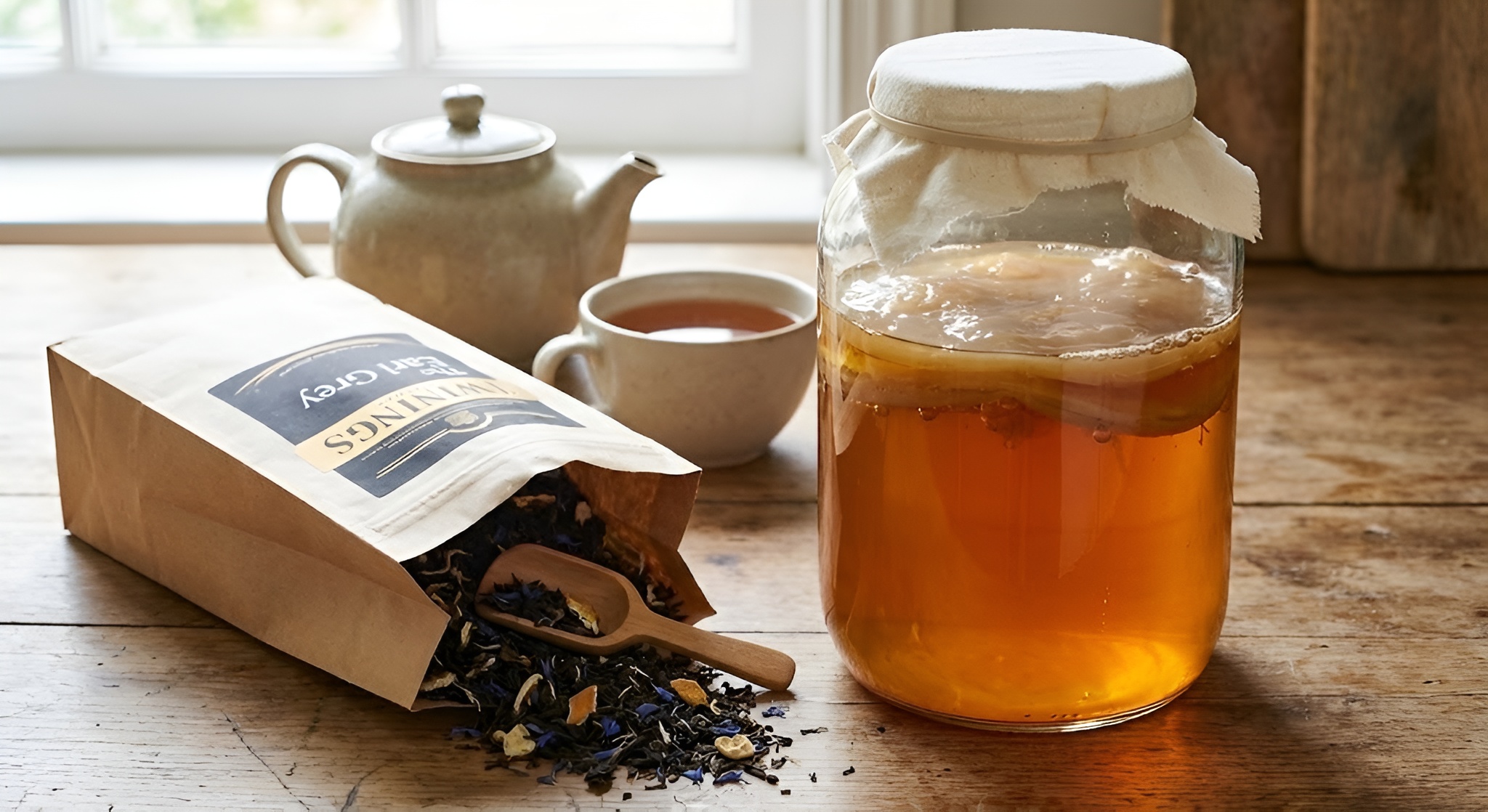
1. The Earl Grey Debate: Why Essential Oils are "Anti-Life"
To understand why you shouldn't use Earl Grey, you have to understand what a SCOBY is. As we discussed in our Master Brewing Guide, the SCOBY is a symbiosis of Yeast and Bacteria. The bacteria are responsible for creating the cellulose mat (the "pancake") and the acetic acid that keeps the drink safe from mold.
The Bergamot Mechanism: Earl Grey is flavored with the essential oil extracted from the rind of the Bergamot orange. In nature, plants produce essential oils specifically to protect their fruit from rot—i.e., from bacteria and fungi. Bergamot oil contains compounds like Linalool and Linalyl acetate which are potent antimicrobials. When you introduce these into your brewing vessel, they attack the cell membranes of your SCOBY's bacteria.
It usually won't kill the culture instantly. You might get one or two good batches. But the damage is cumulative. The bacterial colony weakens, the acid production slows down, and the pH fails to drop fast enough. This creates a window of opportunity for invasive mold spores to take hold. Eventually, your SCOBY turns black or gets fuzzy, and the batch is ruined.
Expert Tip #1: The "Sacrificial SCOBY" Strategy
If you absolutely love the taste of Earl Grey Kombucha, here is how to do it safely. Do not use your main SCOBY. Instead, peel off a layer (a "baby") from your main culture and put it in a separate jar designated for Earl Grey. Brew with it until the culture eventually weakens and dies, then discard it. Never put an Earl Grey-tainted SCOBY back into your main hotel, or you risk contaminating the healthy colony with oil residues.
2. The Nitrogen Hypothesis: Why Herbal Tea "Starves" the Culture
Another common question is: "Can I use Hibiscus or Mint tea instead?" The short answer is no, not for the primary ferment.
While sugar provides carbon (energy), the SCOBY requires Nitrogen to build proteins, enzymes, and new cellular tissue. The yeast also requires specific minerals (magnesium, potassium) and purines (caffeine and theobromine) to reproduce efficiently. The tea plant, Camellia sinensis, is uniquely rich in these specific nitrogenous compounds.
Herbal infusions (tisanes) like peppermint, chamomile, or rooibos are not tea. They lack the caffeine and the specific nitrogen profile the yeast evolved to consume. If you use 100% herbal tea, the SCOBY will slowly starve. The layers will become thin and papery, carbonation will stop, and the brew will taste flat.
The Blending Solution
If you want the flavor of hibiscus but the health of black tea, use a blend. We recommend a ratio of 70% Pure Tea to 30% Herbal. This ensures there is enough nitrogen to feed the yeast while still imparting the herbal flavor profile you want.
3. The Tea Hierarchy: Choosing Your Cultivar
Even within "Pure Tea," some leaves are better than others. We have ranked them based on nutrient density and fermentation performance.
| Tea Variety | Nutrient Density | Fermentation Speed | Flavor Result |
|---|---|---|---|
| Assam (Black) | Very High | Fast | Rich, cider-like, apple notes. Produces the thickest SCOBYs. |
| Ceylon (Black) | High | Moderate | Crisp, citrusy, lighter amber color. |
| Gunpowder (Green) | Medium | Fast | Tart, grassy, refreshing. Higher lactic acid notes. |
| Oolong | High | Slow | Complex, fruity, apricot notes. Best for connoisseurs. |
| White (Silver Needle) | Low | Very Slow | Delicate, floral. Risk of mold due to slow acidification. |
Expert Tip #2: The Scoby Hotel Base
For your "Scoby Hotel" (the jar where you store spare cultures), always use 100% Black Tea (specifically Assam if possible). It is the most nutrient-dense fuel. This ensures your backup cultures stay strong, thick, and healthy for months, ready to be used if your main batch fails.
4. The "No-Go" List: Oils and Smokes
Beyond Earl Grey, there are other teas you should avoid in primary fermentation due to their volatile oil content.
- Lapsang Souchong: This tea is smoked over pine fires. The tar and smoke oils can coat the surface of the SCOBY, inhibiting oxygen exchange. Furthermore, the smoke flavor intensifies during fermentation, often resulting in a brew that tastes like liquid ashtray.
- Chai Mixes: Traditional Masala Chai contains cloves, cinnamon, and cardamom. Clove oil contains eugenol, an extremely potent antibacterial agent (used in dentistry to kill bacteria). Cinnamon is also antimicrobial. Brewing with a pre-mixed Chai blend is essentially sanitizing your culture.
- Flavored Teas (Vanilla, Caramel, etc.): These usually contain artificial chemical flavorings or essential oils. Both can disrupt the microbiome.
Expert Tip #3: Flavor in the Second Ferment (F2)
If you want Earl Grey, Chai, or Peppermint kombucha, add the flavoring after you remove the SCOBY. Once you bottle the liquid for carbonation, the SCOBY is safe in its hotel. You can add oils, fruit, or spices to the bottle without risking the health of the mother culture.
5. The Green Tea Exception: Jun
There is one exception to the "Black Tea is Best" rule. If you prefer Green Tea and want to use Honey instead of sugar, you should not try to force your Kombucha SCOBY to adapt. Instead, acquire a Jun SCOBY.
Jun is a distinct cousin of Kombucha that has evolved to feed on the specific fructose/glucose ratio of raw honey and the nutrients in green tea. It ferments faster and at cooler temperatures. Read our full guide on Jun Tea here.
Get the Right Gear
Now you know which tea to use, make sure your equipment isn't leaching metals into your brew. We tested the best jars for fermentation.
Review: Best Safe Brewing Jars
Comments