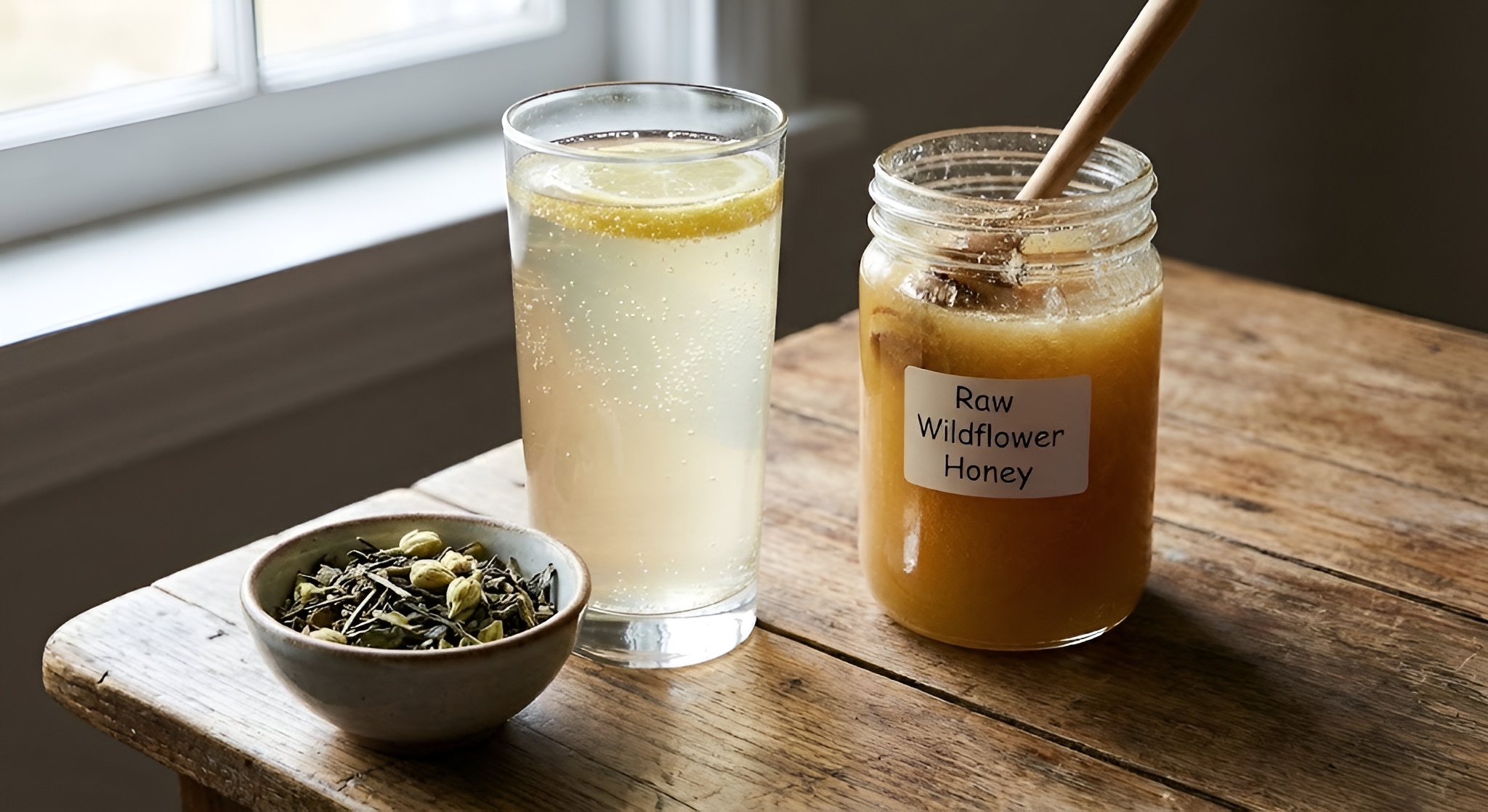
1. Jun vs. Kombucha: The Ecological Differences
While they look similar in the jar—a gelatinous pellicle floating on tea—Jun and Kombucha are ecologically distinct cultures. They share the same bacterial family (Acetobacter), but the yeast strains involved are adapted to completely different food sources.
Kombucha yeasts are bred to break down Sucrose (table sugar), which is a disaccharide (complex sugar). They work hard to split this into glucose and fructose before fermentation can really begin. Jun yeasts, however, are adapted to Raw Honey, which is already primarily glucose and fructose (simple sugars). Because the fuel is pre-digested by bees, the Jun yeast can start fermentation immediately and explosively. This metabolic difference is why you cannot simply swap sugar for honey without consequences.
| Feature | Kombucha | Jun Tea |
|---|---|---|
| Food Source | Cane Sugar (Sucrose) | Raw Honey (Fructose/Glucose) |
| Base Tea | Black Tea (Preferred) | Green Tea (Mandatory) |
| Fermentation Time | 7-14 Days | 3-5 Days (Rapid) |
| Temperature | Warm (24°C - 27°C) | Cool (18°C - 22°C) |
| Flavor Profile | Cidery, Earthy, Sour | Floral, Crisp, Dry |
Expert Tip #1: Can I "Train" a Kombucha SCOBY?
Technically, yes, but it is risky. You can slowly introduce honey to a Kombucha culture over 5-6 generations (start with 20% honey/80% sugar, then 40%, etc.). However, many cultures stall or develop mold during this transition because they cannot process the antimicrobial enzymes in raw honey fast enough. We strongly recommend buying an authentic Heirloom Jun Culture to save yourself months of frustration.
2. The Science of Honey Fermentation
The most fascinating aspect of Jun is its symbiotic relationship with honey. Raw honey is naturally antimicrobial. It contains enzymes (like glucose oxidase) that produce small amounts of hydrogen peroxide when diluted with water. This peroxide kills most wild bacteria, which is why honey never spoils in the cupboard.
A standard Kombucha SCOBY, adapted to the sterile environment of boiled sugar water, has no defense against these enzymes. If you dump a Kombucha SCOBY into raw honey, the honey actually fights back, inhibiting the culture's growth. A true Jun SCOBY, however, has co-evolved with these enzymes. It thrives in the antimicrobial environment, metabolizing the sugars so quickly that it outpaces any inhibition.
Raw vs. Pasteurized Honey
Pasteurized Honey? No. Using pasteurized honey kills the natural enzymes and wild yeasts that give Jun its complexity. It turns Jun into just "Green Tea Kombucha." To get the true "Champagne" flavor, you must use raw, biological honey. The wild yeasts in the honey interact with the cultivated yeasts in the SCOBY to create a unique, ever-changing flavor profile that reflects the season of the honey (e.g., Spring Blossom vs. Late Summer Heather honey).
3. Why Green Tea? The Nitrogen Balance
Why is Jun always paired with Green Tea? It comes down to chemical balance. Honey has a delicate, floral flavor profile. The heavy, malty tannins of Assam Black Tea would completely overpower the honey notes, resulting in a muddy flavor.
From a biological standpoint, Green tea (specifically Sencha or Gunpowder) provides the necessary nitrogen for the SCOBY but has a lighter catechin structure. This allows the finished brew to remain pale, crisp, and refreshing—closer to a Sauvignon Blanc than a cider. Read our full guide on tea selection here.
Expert Tip #2: Temperature Sensitivity
Jun prefers cooler temperatures than Kombucha (18°C - 22°C). This makes it an excellent choice for UK kitchens that might be too drafty for a standard Kombucha brew. However, be warned: because it relies on honey (simple sugar), it ferments significantly faster. In summer, a batch of Jun can go from "perfectly sweet" to "straight vinegar" in 48 hours. Taste it daily.
4. The "Bottle Bomb" Danger: Carbonation Science
Jun is famous for its bubbles. The yeast strains in Jun are voracious and produce CO2 rapidly. Even during the primary ferment (in the jar with the cloth on), you will often see bubbles rising from the SCOBY. When you bottle it for the second ferment (sealing the lid), the pressure builds up much faster than with Kombucha.
This creates a fine, dry carbonation that mimics sparkling wine. However, it also creates a significant safety risk. Jun bottles are notorious for exploding if left too long at room temperature. We recommend using high-quality, pressure-rated swing-top bottles (like Grolsch style) and "burping" them (opening briefly to release gas) daily if you are new to Jun brewing.
5. Equipment: Glass Only
Because Jun is a premium ferment using expensive ingredients (raw honey is not cheap!), you should treat it with respect. Never ferment Jun in plastic. Plastic scratches easily, harboring bacteria that can spoil the delicate honey flavor. Worse, the acidity can leach plasticizers into your expensive brew.
Use a glass vessel. If you are doing continuous brew, ensure the spigot is 304 Stainless Steel. Cheap plastic spigots painted to look like metal will dissolve in the acetic acid over time, ruining your batch with metallic flavors. Read our review of safe brewing jars here.
Expert Tip #3: The Alcohol Question
Does Jun have more alcohol than Kombucha? Often, yes. Honey is a potent fuel for yeast. If you bottle Jun with additional fruit juice (like grape or apple) and let it sit for a week, the alcohol content can creep up to 2-3% (hard cider territory). If you want to keep it non-alcoholic, keep the fermentation times short and refrigerate immediately once carbonated.
Comments