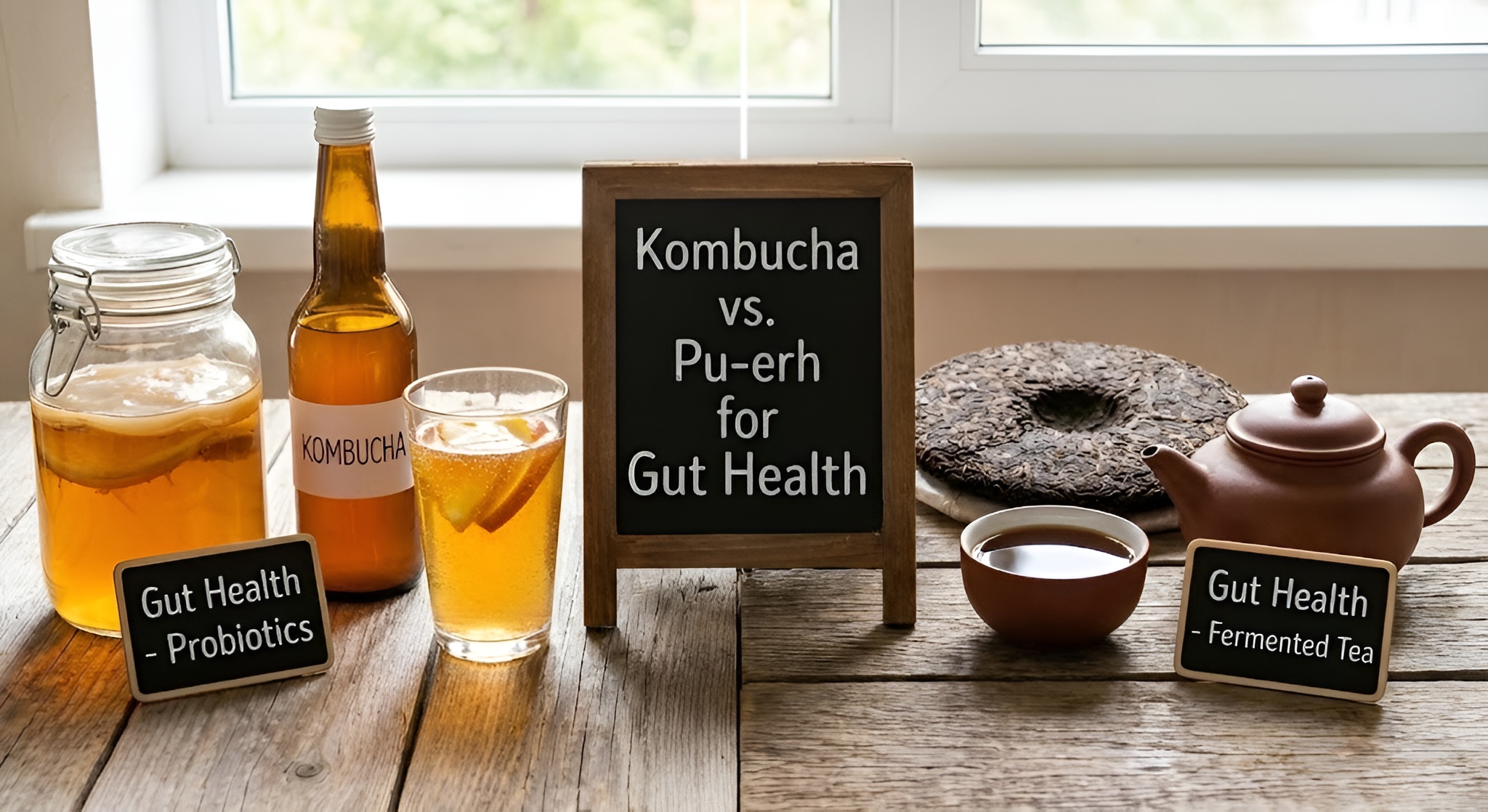
1. Biological Engineering: How They Are Made
To understand the health benefits, you must first understand the engineering. Both are "fermented," but they use completely different biological engines.
Kombucha: The "Aerobic" Reactor
Kombucha is a product of Liquid State fermentation. A SCOBY (Symbiotic Culture Of Bacteria and Yeast) is added to sweetened tea. It requires oxygen (aerobic) to work.
[Image of Kombucha fermentation jar with SCOBY]- Step 1 (The Yeast): Yeasts consume the sucrose (sugar) and convert it into Ethanol (alcohol) and Carbon Dioxide (fizz).
- Step 2 (The Bacteria): Acetobacter bacteria consume the ethanol and convert it into Acetic Acid (vinegar) and Gluconic Acid.
The result is a cocktail of live yeast, bacteria, acids, and residual sugar. It is essentially a "living soda."
Pu-erh: The "Solid State" Reactor
Ripe Pu-erh is a product of Solid State Fermentation (Wo Dui). Tea leaves are piled on a factory floor, moistened, and covered with thermal blankets. The heat is generated by the microbial activity itself, reaching 60°C+.
The dominant microbe here is a mold called Aspergillus niger. This mold secretes enzymes that break down the tea's polyphenols into new compounds called theabrownins. Unlike Kombucha, this process does not produce alcohol or CO2. It produces deep, complex, earth-like compounds that are shelf-stable for decades.
2. The Sugar Paradox: Fuel vs. Zero Calorie
This is the single most important factor for anyone on a diet or fasting protocol.
Kombucha Needs Sugar
You cannot make Kombucha without sugar. It is the food source for the SCOBY. While the yeast eats most of it, a significant amount remains to balance the intense sourness of the vinegar. A typical bottle of commercial Kombucha contains 10g to 16g of sugar. If they didn't add sugar or fruit juice, it would taste like straight salad dressing.
Pu-erh is Zero Calorie
Pu-erh fermentation does not require added sugar. The mold feeds on the natural compounds within the leaf structure itself. The final tea has 0 calories and 0g sugar. This makes it the only "fermented" gut health drink that is safe for:
- Ketogenic Diets
- Intermittent Fasting (Autophagy)
- Diabetics (No insulin spike)
Does Pu-erh Break a Fast?
No. Unlike Kombucha, which will break your fast due to the sugar content, Pu-erh keeps you in a fasted state while suppressing hunger hormones (Ghrelin). Read our full guide: Does Tea Break a Fast? →
3. The Microbiome Mechanism: Seeds vs. Fertilizer
Both teas improve gut health, but they act on your microbiome in fundamentally different ways.
Kombucha: The Seeder (Probiotic)
Kombucha delivers live bacteria (mainly Lactobacillus and Acetobacter) directly to your system. This is useful if your gut flora has been wiped out (e.g., after antibiotics). You are literally drinking the colony.
The Drawback: Many of these bacteria are killed by your stomach acid before they reach the intestines. Additionally, commercial Kombucha is often pasteurized to stop bottles from exploding, which kills the probiotics entirely.
Pu-erh: The Fertilizer (Prebiotic)
When you brew Pu-erh with boiling water, you kill the live mold. However, the benefit remains. Pu-erh is rich in Tea Polysaccharides (TPS) and Theabrownins. These compounds act as a high-grade fertilizer for the good bacteria already in your gut.
The Akkermansia Effect: Studies show that Ripe Pu-erh specifically boosts the population of Akkermansia muciniphila. This is the "Holy Grail" bacterium linked to:
- Thicker gut lining (preventing Leaky Gut).
- Lower systemic inflammation.
- Reduced obesity and insulin resistance.
Essentially, Kombucha plants seeds; Pu-erh makes your garden grow.
4. Safety Profile: Acid vs. caffeine
Neither drink is perfect. Here are the risks you need to know.
Kombucha Risks:
- Acid Erosion: The low pH (vinegar) attacks tooth enamel. Dentists recommend drinking it with a straw.
- Alcohol: Home-brewed Kombucha can accidentally reach 1-3% ABV.
- Bloating: The carbonation (gas) combined with sugar alcohols can cause severe bloating in people with IBS.
Pu-erh Risks:
- Caffeine: Ripe Pu-erh contains caffeine (approx 30-40mg). It shouldn't be drunk right before bed.
- Quality Control: Cheap, poorly fermented Pu-erh can smell like fish or compost ("Wet storage"). It is critical to buy from reputable sources.
Avoid the "Fishy" Smell
If your Pu-erh smells like a fish market, it's bad quality. Good Ripe Pu-erh should smell like earth, wood, or dates. Learn how to spot the difference: Why Does My Tea Smell Fishy? →
5. Economic Reality: The Cost Per Serving
If you drink a probiotic daily, the cost adds up.
Kombucha: £3.50 - £4.50 per bottle.
Monthly Cost: ~£120.00
Ripe Pu-erh Cake (357g): £25.00 - £40.00.
Servings: A single cake provides approx. 50-70 sessions (and each session can be re-steeped 5+ times).
Monthly Cost: ~£5.00
Switching to Pu-erh is essentially a 95% savings on your gut health budget.
6. The Transition Protocol: How to Switch
If you are addicted to the sugar/fizz of Kombucha, Pu-erh can taste "flat" at first. Here is how to adjust your palate:
- Start with "Nuo Mi Xiang": This is Ripe Pu-erh scented with a "Sticky Rice" herb. It has a sweet, popcorn-like aroma that is very beginner-friendly. (See our Top 6 Review).
- Brew it Strong: Use boiling water and a 5-minute steep. You want a thick, soup-like texture to replace the mouthfeel of soda.
- Drink it With Food: Pu-erh is best drunk after a heavy meal to aid digestion ("The Grease Cutter").
Comments