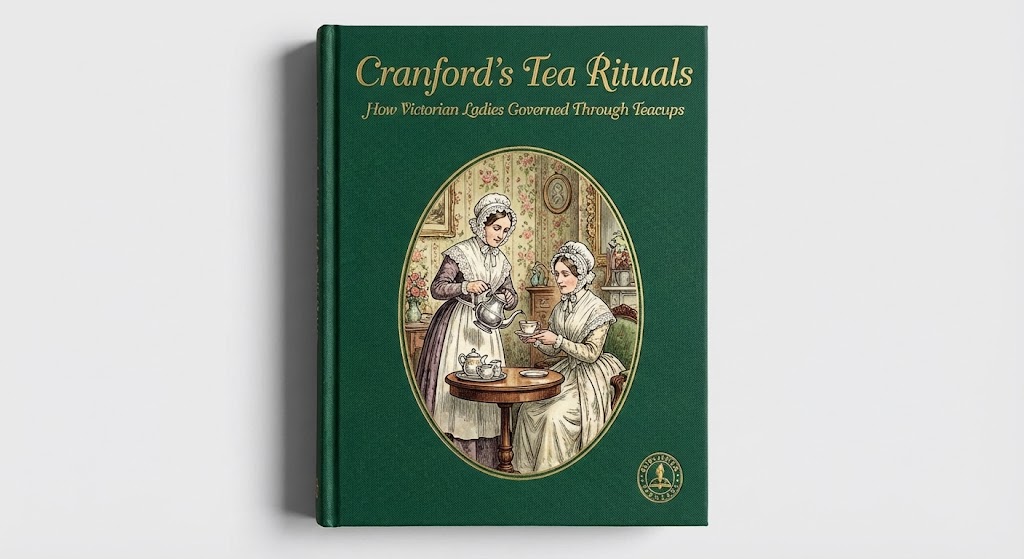
Cranford's Strict Tea Hierarchy
Green tea (£2 shillings/oz) for elite gatherings, black Congou (8 pence/oz) for regular visiting, and "common Bohea" (4 pence/oz) for servants. Miss Matty serves green tea despite poverty to maintain social status—each pot costs a day's food budget. Gaskell shows how tea expense enforces class performance even when unsustainable.
1. Elizabeth Gaskell's Cranford: Tea as Female Governance
Elizabeth Gaskell's Cranford (1851) depicts a village run entirely by women where tea ritual functions as unofficial government. The male population has died, moved away, or been socially exiled, leaving the "Amazons" of Cranford to govern through tea table diplomacy. Every decision—who is socially acceptable, what behaviors are permissible, how money should be spent—is negotiated over tea service.
This isn't metaphorical—Gaskell literally shows legislation happening through tea. When a crisis occurs (Miss Matty's financial ruin, Captain Brown's vulgarity, the panic about potential burglars), the ladies convene for tea to decide collective response. The tea ceremony provides structure for debate: the hostess chairs meeting, passing tea means granting speaking rights, accepting tea means agreeing to majority opinion. Victorian tea service becomes parliamentary procedure.
Gaskell's radical insight: domestic ritual can be political infrastructure. Excluded from formal politics (women couldn't vote, own property, or hold office), Cranford's women create parallel governance system using tools available to them—primarily tea service. The tea table isn't apolitical domestic space; it's where Cranford's actual power operates. Men might legally own property, but women decide community values over Congou and biscuits.
Cranford's Tea Rules (Unwritten Constitution)
- Rule 1: Never serve tea before 4 PM (signals vulgar haste)
- Rule 2: Always offer at least two tea varieties (demonstrates taste and wealth)
- Rule 3: China tea for formal calls, black tea for intimates
- Rule 4: Refuse first offer of tea (politeness), accept second offer
- Rule 5: Discuss only "elegant" topics (no money, illness, or scandal—at least openly)
2. Miss Matty's Green Tea Martyrdom: Class Performance at Poverty Level
The novel's tragic center is Miss Matty Jenkyns, who maintains expensive tea standards despite bankruptcy. She serves green tea (Hyson, £2 shillings per ounce) to visitors when she's living on £13 annual income—less than the cost of keeping up tea appearances. Each pot of green tea represents a day without proper meals. Gaskell uses this to show how class performance becomes financial suicide.
Miss Matty can't serve cheap tea because tea quality is social status. Her identity depends on being "genteel"—a lady of reduced circumstances but still a lady. If she serves common Bohea, she admits she's no longer genteel. She'd rather starve than serve working-class tea. Gaskell doesn't mock this—she shows it as tragedy. The class system requires Miss Matty to perform wealth she doesn't have, and tea is the most visible, most frequent, most expensive performance required.
The community eventually saves Miss Matty by helping her open a tea shop—selling tea rather than serving it. This is brilliant irony: her expertise (knowing tea grades, brewing techniques, service etiquette) becomes income source rather than expense. But it also marks social demotion—shopkeepers aren't genteel. Gaskell shows how tea culture simultaneously imprisons women in class performance and provides their only escape route through commerce.
3. The Great Tea Controversy: Green vs. Black as Philosophical Divide
Cranford's ladies wage aesthetic civil war over tea preference. Miss Jenkyns (Miss Matty's sister, now deceased) insisted on green tea exclusively—she considered black tea "common" and drinking it a moral failing. Her rival, Mrs. Jamieson, served strong black Assam as deliberate challenge to Miss Jenkyns's pretensions. These weren't beverage preferences—they were ideological positions.
Gaskell uses tea preference to encode personality: Green tea drinkers are refined, delicate, old-fashioned, possibly pompous. Black tea drinkers are robust, modern, practical, possibly vulgar. The tea you serve announces your values. Miss Jenkyns's green tea represents her commitment to 18th-century aristocratic standards (when green tea dominated). Mrs. Jamieson's black tea represents Industrial Revolution pragmatism (black tea from India was cheaper, stronger, more available).
The conflict peaks when Miss Matty, after her sister's death, must choose which tea to serve. She compromises by offering both—green for formal visits, black for intimate friends. This is character growth disguised as tea inventory management. Miss Matty escapes her sister's rigid ideology while maintaining enough tradition to preserve identity. Tea choice becomes visible marker of internal transformation.
Why Green Tea Cost More
1850s Britain paid premium for Chinese green tea (12-2£4 shillings/lb) vs. British Indian black tea (4-£8 shillings/lb). Green tea required delicate processing, didn't survive shipping as well, and carried cultural cachet of being "original" tea. Miss Jenkyns's green tea snobbery was financially ruinous—she spent 3x more than necessary purely for status signaling.
4. Tea and Femininity: The Invisible Labor of Ritual
Gaskell meticulously describes the work required for proper tea service: warming the pot, measuring leaves precisely, timing the steep, ensuring water temperature, managing refills, coordinating food service, maintaining conversation flow. This is skilled labor performed while appearing effortless. The hostess must execute complex choreography while looking graciously relaxed. Gaskell exposes Victorian tea culture's hidden gender tax.
Men in Gaskell's world are comically incompetent at tea. When Captain Brown attempts to serve tea, he pours it wrong temperature, uses wrong leaves, forgets sugar, and creates chaos. This isn't because men are inherently bad at tea—it's because they've never learned. Tea ritual is female knowledge, passed mother to daughter, practiced daily, perfected through repetition. Men benefit from tea culture without learning its skills.
The tragedy: women's tea expertise is unpaid, unrecognized, socially mandatory labor. Miss Matty is expert tea-maker but this expertise only has value when she's forced to monetize it through tea shop. Before that, her skill is invisible—just "what ladies do." Gaskell uses tea to illustrate how Victorian society demanded enormous female labor while treating it as natural, effortless, valueless.
5. The Tea Spy Network: Gossip as Intelligence
Cranford's tea gatherings function as information exchange. Every visit involves tea service and gossip. The ladies learn who's financially struggling (cheaper tea served), who's courting (extra care with appearance at tea), who's social climbing (pretentious tea choices), and who's falling from grace (declining tea invitations). Tea ritual generates surveillance data that community uses to enforce social norms.
Gaskell shows how this creates both community care and oppressive monitoring. When Miss Matty faces bankruptcy, the tea network discovers it (she stops hosting tea) and organizes financial rescue. But the same network also polices behavior—any deviation from tea norms triggers investigation and potential social exile. Tea culture creates visibility that can save or destroy you, depending on community judgment.
The narrator, Mary Smith, is explicit about tea's intelligence function: "We drank tea together, and then we told each other all we knew." This isn't casual chatting—it's systematic information gathering. The tea table is where Cranford's women learn everything relevant to community governance. Knowledge flows through tea service like water through plumbing. Cut someone off from tea invitations and they become informationally blind—and therefore powerless.
Tea Calls and Social Time
Cranford ladies made "tea calls" between 4-6 PM, lasting exactly 15-20 minutes. Staying longer implied intimacy or presumption. Leaving earlier suggested offense or superiority. The rigid timing allowed multiple visits per afternoon—a lady might make 4-5 tea calls, gathering intelligence across community. This created distributed surveillance network impossible for any individual to escape.
6. Economic Precarity Behind the Teacups
Every Cranford lady is financially insecure. They're widows, spinsters, daughters of deceased clergymen—women with tiny fixed incomes (—50-150/year) trying to maintain middle-class respectability. Tea service is their most expensive social obligation, consuming 5-10% of annual income. Gaskell shows the arithmetic: Miss Matty on —13/year spends —1-2 annually on tea alone, while also needing rent, food, clothing, coal.
This creates permanent anxiety. The ladies must serve expensive tea to maintain social position, but serving expensive tea bankrupts them, threatening social position through poverty. It's unsolvable paradox. Gaskell exposes how class performance extracts resources from those least able to afford it. Rich people can easily maintain tea standards. Poor-but-genteel women destroy themselves maintaining standards they can't afford.
The novel's solution—Miss Matty's tea shop—is both practical and pathetic. Practical: it monetizes her expertise. Pathetic: it requires abandoning claims to gentility (shopkeepers aren't ladies). Gaskell shows there's no way to win: maintain tea standards and starve, or abandon tea standards and lose identity. Victorian tea culture creates this trap, particularly for women without male financial support.
7. Conclusion: Tea as Alternative Government
Cranford demonstrates that tea ritual can function as parallel political system for those excluded from formal power. Women in 1850s Britain couldn't vote, hold office, or own property independently. But they could control tea service—and through tea service, control community norms, social hierarchies, and collective decisions. The tea table becomes parliament, the hostess becomes legislator, and tea quality becomes voting currency.
Gaskell's portrayal is both admiring and critical. Admiring: these women create functional governance using available tools. Critical: the system requires expensive performance (tea service) that financially ruins its participants. Cranford works as community but fails economically. The tea culture that empowers women also bankrupts them. Perfect ritual, impossible sustainability.
The novel's lasting insight: domestic rituals are political. Dismissing tea service as trivial women's work misses how it functions as infrastructure for decision-making, information exchange, and social governance. Cranford shows that wherever formal power excludes groups, those groups build alternative power structures using available resources. For Victorian women, that resource was tea—and they built an entire shadow government inside their teacups.
Related Reading in Literature & Film
- Emma: Tea as Social Currency in Regency England
- The Remains of the Day: Butler's Tea Service as Emotional Repression
- Brideshead Revisited: Tea, Class, and Aristocratic England
- Sense and Sensibility: Tea as Social Survival Exam
- Downton Abbey Tea Culture
- Pride and Prejudice Tea Etiquette
- Sherlock Holmes Tea Habits
- Agatha Christie's Tea Murders: Poison and Afternoon Tea
Comments