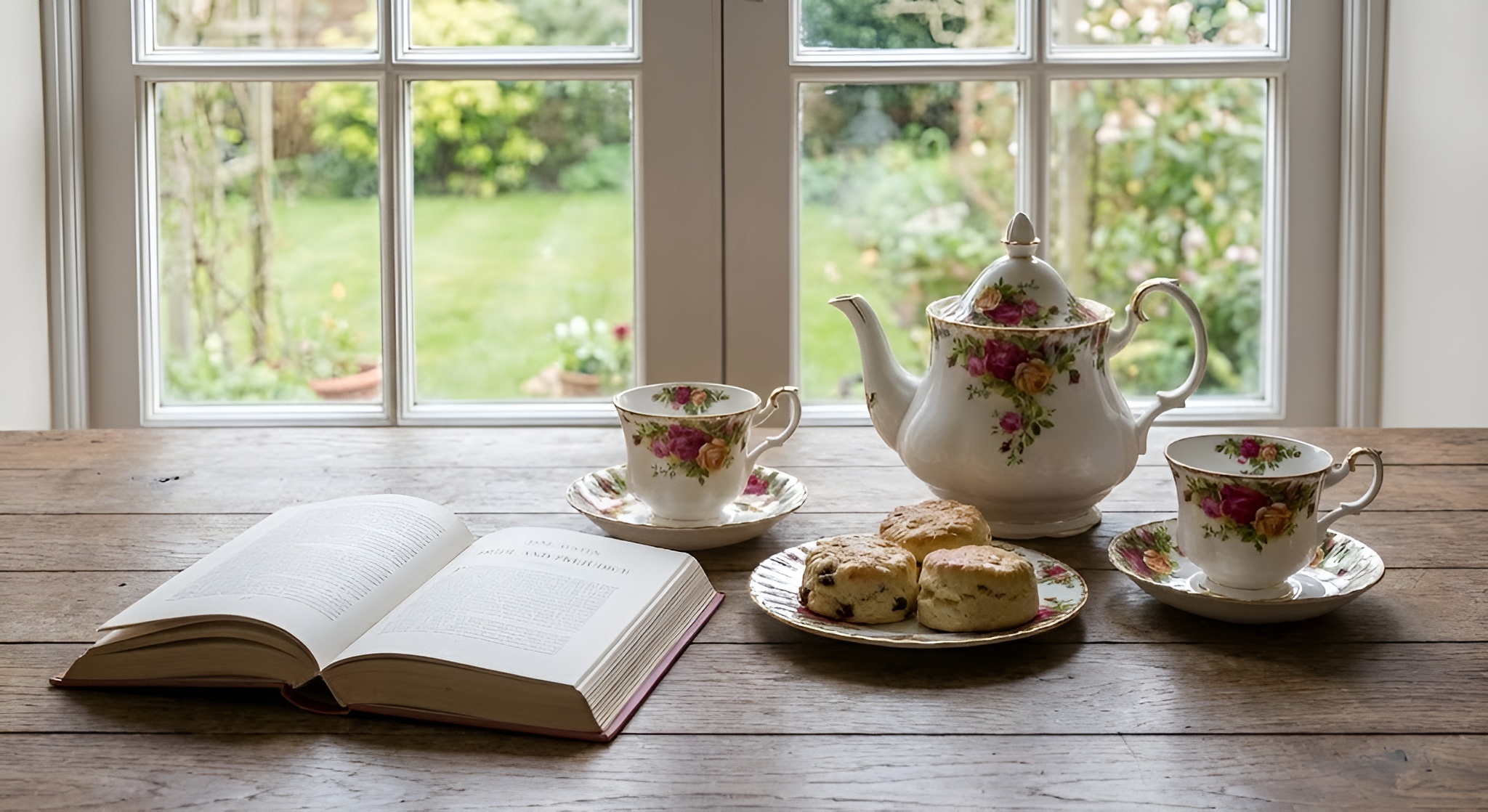
1. Tea as the Marriage Examination
In *Pride and Prejudice*, tea service was a live audition for wifehood. When Elizabeth Bennet pours tea at Netherfield, she is being silently assessed by Caroline Bingley and Louisa Hurst. The metrics: hand steadiness, pour angle, timing, and—crucially—whether she knows when to add milk without being told.
The Netherfield Tea Table
When Jane falls ill at Netherfield, Elizabeth stays to nurse her. During these visits, she is repeatedly placed at the tea table—a test of her suitability for high society. Caroline Bingley watches for errors:
- Overfilling the cup: Indicates lack of control or nerves.
- Spilling: Social death. A lady's hand must never shake.
- Incorrect milk timing: Adding milk before assessing the tea's strength suggests ignorance of quality brewing.
- Failure to offer sugar: Sugar was expensive (6 pence per pound). Offering it demonstrated both manners and wealth.
Elizabeth passes these tests flawlessly, much to Caroline's irritation. Her competence signals she has been trained by a mother who understands that marriage depends on tea table performance.
Rosings: Lady Catherine's Interrogation
At Rosings, Lady Catherine uses tea service as a weapon. She does not allow guests to pour—she pours herself, controlling the social dynamic. When she does permit Elizabeth to pour (Chapter 31), it is a calculated test of obedience. Elizabeth's calm, confident pouring (despite the intimidation) is what earns Darcy's respect. He recognizes that she cannot be bullied, even by his aunt.
2. The Regency Tea Table Rules
The Regency era (1811-1820) had strict, unspoken rules that Austen's characters would have followed religiously.
The Three-Finger Hold (Not the Pinky Out Myth)
Contrary to modern parody, Regency ladies did not extend their pinky fingers. That is a Victorian affectation that developed decades later. Instead, they held the cup with thumb and two fingers (index and middle) gently gripping the handle. The pinky and ring finger curled naturally inward. Extending the pinky was considered pretentious—exactly the sort of thing Lydia Bennet might do to appear sophisticated.
Milk-In-Last as a Class Marker
In the Regency period, milk went in last—but not for the reason Victorians would later claim. The real reason: quality assessment. A lady poured the tea first to judge its color and strength. Only after visual inspection did she add milk to taste. This required fine bone china that could withstand boiling water without cracking. Cheaper earthenware (used by the working class) required milk-in-first to prevent thermal shock. Thus, milk-in-last became a class signifier—a way to demonstrate wealth without saying a word.
Sugar as Wealth Display
Sugar was extraordinarily expensive in 1813. A pound of sugar cost 6-8 pence (roughly £5-7 today per pound). The Bennets, with their modest income, would have used sugar sparingly. When Mrs. Bennet offers tea to guests, the number of sugar cubes offered is a silent statement of the family's financial health. Darcy, at Pemberley, would have had unlimited sugar—he could afford to sweeten tea to oblivion. His preference for unsweetened tea (implied by his austere character) is a deliberate rejection of excess—a sign of self-discipline, not poverty.
3. What Did They Actually Drink?
Forget Earl Grey. That blend wasn't created until the 1830s—20 years after *Pride and Prejudice* is set. Here's what the Bennets and Darcys actually drank:
Bohea: The Working Class Standard
Bohea (pronounced "Boo-hee") was a cheap Chinese black tea from the Wuyi mountains. By the 1810s, it had become synonymous with low-grade tea. The Bennets likely drank Bohea as their daily tea—affordable enough for a family of seven, but not prestigious. Mrs. Bennet would have reserved better tea for guests like Mr. Bingley.
Congou & Hyson: The Genteel Choice
Congou (a Chinese black tea) and Hyson (a Chinese green tea) were the premium options for the gentry. Hyson, in particular, was the most expensive tea available—up to £5 per pound (£400 today). It was delicate, grassy, and required careful brewing at lower temperatures (around 160-180°F / 70-80°C). Serving Hyson signaled serious wealth. Lady Catherine de Bourgh would have served Hyson exclusively. Elizabeth's mother, trying to impress Bingley, might have splurged on a small tin of Congou for special occasions.
Smuggled Tea: The Hidden Reality
Due to massive import taxes (up to 119% in the 1780s), an estimated 50-70% of tea in Britain was smuggled. The Bennets, living in Hertfordshire (near the coast), almost certainly bought smuggled tea at some point. This wasn't seen as immoral—it was economic survival. Even respectable families bought from "free traders" (smugglers). Darcy, with his vast wealth, could afford legally imported tea, but even he might have overlooked the provenance of the tea served at inns during his travels.
Expert Tip: The Regency Brewing Method
Regency households used the "two-pot method." Tea was brewed in a small ceramic teapot (warmed with hot water first), then poured into a larger silver or ceramic pot for serving. This prevented over-brewing while keeping the tea hot. The silver pot would be placed on a spirit lamp or hot water bath to maintain temperature during the serving period (which could last 1-2 hours in grand houses like Pemberley).
4. The Economics of Tea: Why It Mattered
To understand tea in *Pride and Prejudice*, you must understand the economics. Tea was not a casual beverage—it was a financial statement.
The Bennet Budget
The Bennet family had an income of £2,000 per year (roughly £140,000 today). Feeding a household of seven plus servants, maintaining Longbourn, and providing dowries for five daughters left little for luxuries. If the Bennets spent £10-15 per year on tea (roughly £700-1,000 today), it represented 0.5-0.75% of their total income. That's roughly equivalent to a modern middle-class family spending £500-700 annually on coffee—a noticeable expense, but not ruinous.
The Darcy Difference
Darcy, with £10,000 per year (£700,000 today), could afford the finest Hyson without blinking. His tea budget might be £50-100 per year (£3,500-7,000 today)—but that's only 0.5-1% of his income. The difference: Darcy could serve Hyson to every guest, every day. The Bennets had to ration it.
Why Tea Caused Smuggling Wars
British import taxes on tea were so high (up to 119%) that smuggling became a massive industry. The government lost millions in tax revenue. In 1784, Prime Minister William Pitt slashed the tea tax from 119% to 12.5%, instantly making smuggling unprofitable and flooding Britain with legal, affordable tea. By the time *Pride and Prejudice* is set (1813), tea was more accessible—but still expensive enough to signal class. The Bennets could afford tea, but not carelessly. Darcy could afford carelessness.
5. Tea Scenes as Plot Devices in Austen
Austen uses tea scenes to reveal character and advance the plot. Here are the key tea moments in *Pride and Prejudice*:
The Longbourn Tea Table: Mrs. Bennet's Desperation
When Mr. Bingley visits Longbourn, Mrs. Bennet insists on serving tea, even at odd hours. She is using tea as a social trap—once you accept tea, you must stay at least 20-30 minutes (the time required to consume it politely). This gives her daughters time to charm the eligible bachelor. Tea becomes a weapon of marriage ambition.
Netherfield: Elizabeth vs. Caroline
Caroline Bingley's constant attempts to belittle Elizabeth during tea service backfire. When Elizabeth confidently pours and serves without flinching, Darcy notices. He sees a woman who is unshaken by social pressure—a stark contrast to Caroline's desperate attempts to impress him. The tea table becomes the arena where Elizabeth proves her worth.
Rosings: Darcy Watches Elizabeth Defy His Aunt
When Elizabeth refuses to be intimidated by Lady Catherine at tea, Darcy is captivated. Her calm pouring, despite the interrogation, shows a strength of character he has never seen in other women. This is the moment he begins to fall in love—not during a dance or a conversation, but while watching her handle a teapot under psychological warfare.
Pemberley: The Turning Point
When Elizabeth visits Pemberley and is served tea by Darcy's housekeeper (Mrs. Reynolds), the quality of the tea, the china, and the service tells her everything about Darcy's real character. The servants are treated well (evidenced by the quality of the tea they are allowed to serve guests). The tea is expensive but not ostentatious. Darcy's wealth is real, but not performative. This tea service—without Darcy even present—begins Elizabeth's reassessment of him.
6. How to Host an Austen-Style Tea
Want to serve tea like Elizabeth Bennet? Follow these Regency rules:
- The Tea: Use loose-leaf Chinese black tea (Keemun or Lapsang Souchong as a Congou substitute) or a Chinese green tea (Gunpowder as a modern Hyson substitute). Brew at the correct temperature (190-200°F / 88-93°C for black, 160-180°F / 70-80°C for green).
- The Pot: Use a ceramic or silver teapot. Warm the pot with hot water first, discard, then add tea. Brew for 3-5 minutes. Serve from a second pot to prevent over-brewing.
- The Milk: Offer milk in a small jug. Let the guest pour their own tea first, then decide if they want milk. Never add milk to green tea (a Regency faux pas).
- The Sugar: Offer sugar cubes (not granulated) with small silver tongs. Let the guest add their own—do not presume to know their preference.
- The Food: Serve simple, unbuttered bread (crusts on!), plain cake (pound cake or seed cake), and perhaps biscuits. The elaborate sandwiches and scones came later in the Victorian era. Regency tea was about the beverage, not the food.
- The Timing: Serve tea in the late afternoon (4-6 PM) or after dinner (around 9-10 PM). Morning tea was for invalids or the very wealthy.
Expert Tip: The Regency "Tea Test"
In Regency England, a man would sometimes judge a potential wife's tea-making ability as a proxy for household management skills. A woman who brewed weak tea was seen as wasteful (using too little tea). A woman who brewed bitter tea was seen as careless (over-steeping). The "perfect" cup—strong but not bitter, hot but not scalding—signaled competence, economy, and attention to detail. This is why tea service was such a high-stakes performance for women like Elizabeth.
7. Darcy's Tea Preferences: A Character Study
Though Austen never explicitly describes Darcy drinking tea, we can infer his preferences from his character:
- Unsweetened: Darcy is disciplined, controlled, and dislikes excess. He would drink his tea plain or with minimal milk—never heavily sweetened.
- Hyson or Fine Congou: As one of the wealthiest men in England, he could afford the best. But his preference for substance over show suggests he would choose a high-quality black tea over the flashier green Hyson.
- Served in Silence: Darcy dislikes small talk. His ideal tea service would be quiet, efficient, and solitary—a stark contrast to the chaotic Bennet household tea table.
- No Smuggled Tea: Darcy is honorable and wealthy enough to buy legally imported tea exclusively. He would view smuggling as beneath him—both morally and financially.
When Elizabeth finally marries Darcy, she inherits a tea budget 5-10 times larger than her mother's. The symbolic weight of this cannot be overstated: Elizabeth goes from rationing tea to having unlimited access. It is one of the most concrete markers of her social elevation.
Conclusion: The Marriage Market in a Teacup
In *Pride and Prejudice*, tea is never just tea. It is a battlefield for social standing, a test of feminine competence, and a silent economic statement. How you poured tea revealed your class, your wealth, and your suitability for marriage. Elizabeth Bennet passes every tea test thrown at her—not through inherited privilege, but through intelligence, composure, and refusal to be intimidated.
When you re-read the novel, watch the tea scenes carefully. Every cup poured is a small act of negotiation in the marriage market. And every refusal to be flustered—whether by Caroline Bingley or Lady Catherine—is Elizabeth proving she deserves Pemberley's tea table.
Get the Regency Look
Want to serve tea like Elizabeth Bennet? We reviewed authentic Regency-style tea sets and Chinese tea suppliers.
Review: Regency Tea Sets & Authentic TeasRelated Reading in Literature & Film
- Emma: Tea as Social Currency in Regency England
- Sense and Sensibility: Tea as Social Survival Exam
- The Remains of the Day: Butler's Tea Service as Emotional Repression
- Brideshead Revisited: Tea, Class, and Aristocratic England
- Cranford: Victorian Ladies Governing Through Tea
- Room with a View: Tea as Edwardian Sexual Prison
- Downton Abbey Tea Culture: Afternoon Tea Rules
- Agatha Christie's Tea Murders: Poison and Afternoon Tea
Comments