1. Introduction: The High-Stakes World of Compressed Tea
This capacity for aging has transformed the humble compressed cakes of Yunnan province into a formidable asset class, akin to vintage Bordeaux or investment-grade art. However, this financialization has birthed a shadow economy of sophisticated counterfeiting, rendering the marketplace a minefield for the uninitiated.
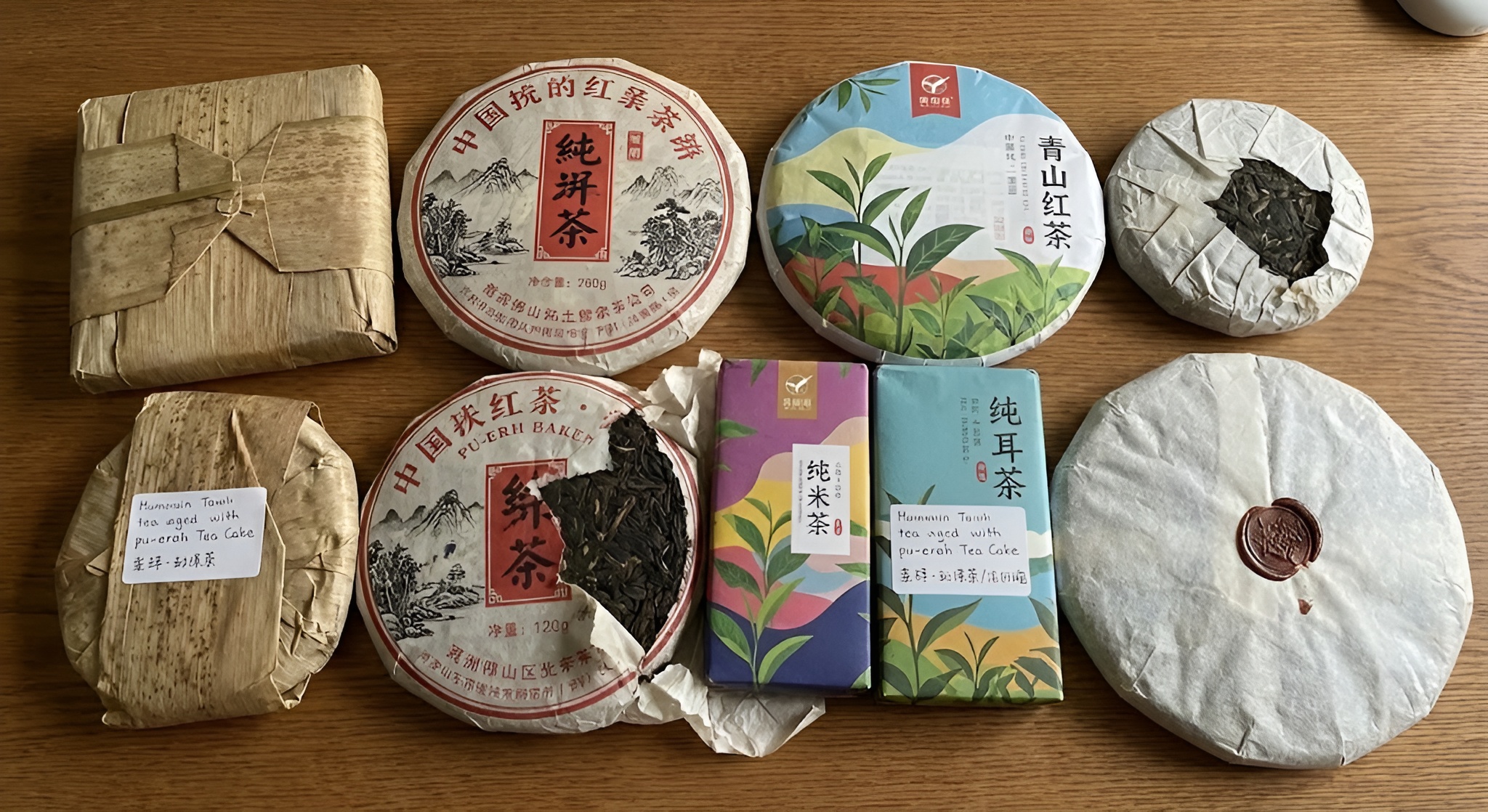
For the serious collector, investor, or connoisseur, the tea wrapper is not merely a protective covering; it is a primary document of forensic evidence. It is the first line of defense against fraud and the primary key to unlocking the history of the tea within. The study of Pu-erh packaging—its typography, paper composition, regulatory marks, and numeric codes—is a discipline that merges history, material science, and regulatory archaeology.
This report provides an exhaustive analysis of these forensic markers. We will deconstruct the numeric recipe systems of the state-owned factory era, trace the evolution of Chinese food safety regulations from the "QS" mark to the modern "SC" code, and analyze the material properties of authentic vintage wrappers. By synthesizing historical production data with visual authentication protocols, this document aims to equip stakeholders with the methodologies necessary to distinguish authentic premium productions from the vast array of market fabrications.
2. The Architecture of Provenance: The Numeric Recipe System
To navigate the Pu-erh market, one must first master the language of the "Recipe" (配方). During the era of the planned economy, specifically from the mid-1970s until the privatization waves of the mid-2000s, Pu-erh production was dominated by state-owned factories operating under the aegis of the China National Native Produce & Animal By-products Import & Export Corporation (CNNP).1
In this centralized system, brand identity was secondary to standardized production. Factories did not produce "artisan" batches; they produced numbered formulas designed to deliver a consistent flavor profile year after year. Understanding this code is the foundational skill of Pu-erh identification.
2.1 The Four-Digit Code: A Formulation Standard
The ubiquitous four-digit code found on the wrapper of factory Pu-erh (e.g., 7542, 8582, 7581) is frequently misunderstood by novices as a date of production or a simple serial number. It is neither. It is a formulaic identifier that encodes the history, composition, and origin of the blend.2
2.1.1 The Chronological Marker (Digits 1 & 2)
The first two digits of the recipe code denote the year the specific blend formula was first developed, standardized, or released. For example, in the quintessential raw Pu-erh recipe 7542, the number 75 indicates that this specific blending pattern was formalized in 1975.2
Critical Insight: It is a profound error to assume these digits represent the vintage of the physical cake. A tea cake pressed in 2012 or 2024 can—and often does—bear the recipe code 7542.1 The number refers to the intellectual property of the recipe, not the agricultural harvest date. A "7542" is a tea made in the style of the 1975 standard, regardless of when it was actually pressed. Consequently, seeing "75" on a wrapper does not guarantee the tea is forty years old; it merely identifies the style of the blend.
2.1.2 The Grade Designator (Digit 3)
The third digit represents the average leaf grade (Maocha grade) utilized in the blend, measured on a scale from 0 to 9.2
- Grade 0-2 (Small/Tender): These are the smallest, most tender buds and young leaves. They are high in amino acids and aromatics, producing a tea that is fragrant and delicate in its youth.
- Grade 3-6 (Medium): The standard range for balanced cakes, offering a mix of aromatics and structural substance.
- Grade 7-9 (Large/Coarse): These are larger, more mature leaves and stems. While less aromatically intense initially, these leaves are richer in polysaccharides and structural compounds that facilitate long-term aging.4
The Economic Implication of Leaf Grade: Newcomers often mistakenly equate "grade" with "quality," assuming a Grade 1 leaf is superior to a Grade 8. In the context of Pu-erh, this is false.1 The grade refers strictly to leaf size, not quality. A recipe like the 8582 (Grade 8 leaf) is prized specifically because the larger leaves allow for a sweeter, smoother transformation over decades of aging, compared to the punchier, more aggressive profile of the 7542 (Grade 4 leaf).3 The choice of recipe depends on the collector's intent: immediate consumption versus long-term storage.
2.1.3 The Factory Identity (Digit 4)
The final digit serves as the identifier for the manufacturing facility. In the pre-privatization era, this was a strict designation assigned by the provincial authority.2
| Code | Factory Name | Location | Historical Significance & Market Profile |
|---|---|---|---|
| 1 | Kunming Tea Factory | Kunming | The original "Number One." Historically significant for pioneering humid storage research. Productions are less common in the mid-era but highly collectible. Known for the "7581" ripe brick.3 |
| 2 | Menghai Tea Factory | Xishuangbanna | The undisputed giant of the industry. Producer of the "Dayi" (Great Benefit) brand. Its recipes (7542, 7572) are the market benchmarks against which all other standard Pu-erh is judged.2 |
| 3 | Xiaguan Tea Factory | Dali | Famous for tight compression "Iron Cakes" (Tie Bing) and bowl-shaped Tuochas. Xiaguan teas often possess a distinct smoky profile due to local processing variations.1 |
| 4 | Fengqing / Lancang | Lincang | Fengqing is renowned for its Dianhong black tea, but its Pu-erh productions (often labeled under various names) utilize Lincang material, which is distinctively robust and bitter.1 |
| 5 | Pu-erh Tea Factory | Pu-erh City | Originally the local state factory for Pu-erh city (formerly Simao). Now operates as the Pu-erh Tea Group Co. Ltd.1 |
| 6 | Six Famous Tea Mountains | Menghai | A post-privatization entity founded by former Menghai Factory professionals. Known for blending expertise.1 |
| 8 | Haiwan Tea Factory | Menghai | Founded by Mr. Zou Bing Liang, the legendary master blender and former manager of Menghai Tea Factory. The "8" code reflects this lineage of expertise.1 |
Notable Anomaly: While this system is robust, there are exceptions. The Xiaguan Tea Factory (Factory 3), for instance, has been known to utilize the third digit as a product identifier rather than a strict leaf grade. In their system, an 8653 represents a raw (Sheng) tea, while an 8663 represents a ripe (Shou) tea, deviating from the pure leaf-grade logic of Menghai.1
2.2 The Batch Number: Temporal Specificity
While the recipe number establishes the "what" and "where," it does not answer the "when." For this, one must locate the Batch Number (批次), typically a three-digit code found on the Neipiao (the flyer inside the wrapper) or stamped on the outer packaging in later eras.2
The standard format is XYZ: X (Year Digit): The last digit of the production year. YZ (Batch Sequence): The sequential order of production within that year.
Case Study: Decoding a "901" Batch If a Menghai 7542 cake bears the batch code 901, the forensic analysis proceeds as follows: * Recipe 7542: 1975 recipe, Grade 4 leaf, Menghai Factory. * Batch 9: Indicates a year ending in 9. Given the context of modern batch codes, this is most likely 2009 (or potentially 1999, though 3-digit batch codes were less standardized then). * Batch 01: This was the first batch produced in that year.3
Expert Tip: The Economic Premium of the "01" Batch
In the Pu-erh market, not all batches are created equal. The first batch of the year (x01) often commands a significant price premium—sometimes double the price of later batches.3 This valuation is driven by the perception that the first batch utilizes the highly coveted "Spring Tea" (Ming Qian or Yu Qian harvest), which is widely considered to have superior nutrients, complexity, and aging potential compared to the "Gu Hua" (grain flower) or autumn harvests used in later batches (e.g., x02, x03).3 Authenticating the specific batch number is therefore as financially critical as authenticating the factory itself.
3. Regulatory Archaeology: Dating via Safety Marks
One of the most powerful, yet underutilized, methods for authentication is "regulatory archaeology"—the practice of dating a tea cake based on the government-mandated food safety marks present on the wrapper. As the Chinese state has modernized its food safety laws, the required labeling has shifted, leaving distinct visual footprints that counterfeiters often fail to synchronize with the alleged vintage of their fake products.8
3.1 The QS Mark Era (c. 2005–2018)
In the mid-2000s, amidst a broader push for food safety, the Chinese government implemented the QS (Quality Safety / Qiangzhi) system. The symbol is a distinctive blue mark, often described as a "Q" intersected by an "S" inside a balloon-like outline.8 Implementation Timeline: The QS mark began appearing on tea packaging around 2005/2006 and became mandatory shortly thereafter.9 Forensic Application: This mark serves as a definitive "terminus post quem." If a tea wrapper displays a QS mark, the tea cannot be older than 2005. Scenario: A vendor offers a cake labeled as "1998 Aged Wild Tree Pu-erh." Inspection reveals a small blue QS logo on the back label. Verdict: The tea is a forgery or gross misrepresentation. A 1998 cake predates the QS system by seven years. The presence of the mark proves the wrapper (and likely the tea) was produced after 2005.9
3.2 The SC Mark Transition (2015–Present)
In October 2015, the People's Republic of China enacted a new Food Safety Law, transitioning from the QS system to the SC (Shengchan - Production) coding system.9 Visual Change: The blue QS logo was eliminated. It was replaced by a code string beginning with the letters "SC" followed by 14 digits.9 The Transition Period: The government allowed a grace period for manufacturers to use up existing packaging stock. This period lasted approximately three years, ending around October 2018.9
| Mark Type | Visual Identifier | Valid Date Range | Forensic Implication |
|---|---|---|---|
| Pre-Standard | No Safety Codes | Pre-2004/2005 | Absence of code is consistent with vintage claims, but heavily counterfeited. |
| QS Mark | Blue "QS" Logo + 12 Digits | ~2005 – 2018 | CANNOT be on a cake older than 2005. |
| SC Mark | "SC" + 14 Digits | Oct 2015 – Present | CANNOT be on a cake older than late 2015. |
4. The Privatization Watershed: Menghai and the "Dayi" Era
The year 2004 represents a seismic shift in the Pu-erh landscape: the privatization of the Menghai Tea Factory.6 This event divides the market into two distinct eras—the "CNNP/State Era" and the "Dayi/Private Era"—each with its own packaging aesthetics and security protocols.
4.1 The Pre-2004 "CNNP" Aesthetic
Before 2004, Menghai was a state asset. Its wrappers were utilitarian, often utilizing the generic "Eight Zhong" (八中) logo—the character Zhong (middle) surrounded by eight Zhong characters in a circle. Consistency Issues: During this period, "branding" was loose. Wrappers were made of thin, often handmade paper. Inks were duller, and printing was done via letterpress or simple offset, leading to variations that modern collectors study obsessively.6 The "Red Mark" & "Blue Mark" Legacy: The most legendary cakes from the 1950s-1970s, such as the "Red Mark" (Hong Yin), are defined by the color of the central "Tea" character in the logo. Authentic examples are astronomically expensive and virtually non-existent in general retail; any "Red Mark" found in a casual tea shop is a commemorative reprint or a fake.6
4.2 The Post-2004 "Dayi" Revolution
Following privatization, Menghai rebranded aggressively under the Dayi (Taetea) trademark. This era introduced sophisticated anti-counterfeiting measures to protect the brand's integrity. Holographic Security: Starting around 2006, Dayi introduced holographic stickers on their cakes. These are not simple stickers; they contain micro-text and specific light-refracting properties.12 The Security Thread: Later wrappers included a safety wire or thread embedded in the paper, similar to banknotes. The Forensic Trap: A common error in counterfeiting is the anachronistic application of these technologies. A fake cake labeled "2001 Menghai" that features a 2006-style holographic sticker is an obvious fabrication, as the technology was not yet in use by the factory.14 Typography: Post-2004 wrappers feature crisp, computer-aided design and consistent fonts. In contrast, fakes often struggle to match the exact font weight. Paradoxically, some fakes use better paper and darker ink than the genuine factory products, which were mass-produced on a budget. A wrapper that feels "too premium" for a standard recipe cake should arouse suspicion.12
5. Material Forensics: The Science of Paper and Ink
Beyond the printed information, the physical medium of the wrapper—the paper itself—tells a story that is difficult to forge. The evolution of paper manufacturing in Yunnan provides a timeline of material evidence.
5.1 The "Ma San" and "Thai" Paper Tradition
Traditional Pu-erh wrappers are often made from the bark of the Ma San (马三) plant, a fibrous shrub native to Xishuangbanna.15 Material Properties: This paper is prized for its "breathability." Pu-erh requires gas exchange (oxygen in, CO2/byproducts out) to ferment and age properly. Plastic or non-porous paper chokes the tea, leading to "sour" fermentation. Ma San paper is pliable, tough, and has a distinct fibrous texture often containing small plant inclusions.15 "Thai" Paper (Dai Paper): Historically, and in some premium modern productions, a specific handmade paper known as "Thai paper" (referring to the Dai ethnic minority, related to Thai people) is used. This paper typically has a rougher, more organic texture compared to machine-made cotton paper. It is often associated with higher-quality or traditional storage cakes.17
5.2 The "88 Qing Bing" Anomaly: Thin vs. Thick
The famous 88 Qing Bing (7542 cakes produced between roughly 1989 and 1992) serves as a prime case study in paper forensics. Authentic examples from this specific batch run are wrapped in a distinctively thin paper.18 The Counterfeit Tell: Fakes attempting to replicate this legendary cake often mistakenly use the thicker, cotton-like paper that became standard in later years. A "thick paper" 88 Qing Bing is a contradiction in terms and a likely fake.18 However, one must note that later re-issues (e.g., a 2003 commemorative cake) might legitimately use thick paper, but these should not be sold as the original 1989 vintage.19
Expert Tip: Bio-Indicators
Aged tea wrappers often bear the scars of their history in the form of insect damage, specifically from "silverfish" (paper-eating insects).
Authentic Damage: Genuine "bug biting" appears as small, irregular clusters of holes. Under magnification, the edges show "micro-fraying."
Forged Damage: Counterfeiters will manually puncture wrappers. These fake holes often look too clean, too uniform, or are placed in patterns that lack the randomness of nature.20
6. Storage Forensics: Gan Cang vs. Shi Cang
The wrapper is also a litmus test for the tea's storage history. In the Pu-erh world, "storage is the second production." The conditions in which the tea was kept dictate its value and flavor profile. (See Pumidor Guide).
6.1 Shi Cang (Wet Storage)
Traditionally associated with Hong Kong and Guangzhou, "Wet Storage" involves aging tea in high-humidity environments (often 80%+ RH) to accelerate fermentation and smooth out bitterness.21 Wrapper Evidence: Wrappers from wet storage often show water stains, "tide lines" (discoloration rings from moisture evaporation), or a general browning of the paper. Sensory Signs: The tea will have a distinct earthy, camphor, or damp wood aroma. The mold Warning: While some microbial activity is desired, distinct patches of fluffy white or green mold on the tea surface are defects. "Golden Flowers" (Eurotium cristatum) are rare in Pu-erh (common in Hei Cha) and claims of their presence should be verified carefully, as they are often confused with toxic molds by unscrupulous sellers.23
6.2 Gan Cang (Dry Storage)
"Dry Storage" refers to aging in natural humidity (typically 50-70% RH), common in Kunming or specialized "dry" warehouses.21 Wrapper Evidence: The paper remains relatively clean and crisp, though it may yellow or oxidize naturally with time (turning a "ginger" color). It should not have heavy water staining. Value Proposition: Dry-stored teas age slower but preserve the "terroir" and varietal character of the leaf better than wet-stored teas. They are often more expensive due to the longer time required to reach maturity.21
7. Botanical Provenance and Labeling Fraud
As the market moved away from factory blends toward "single origin" teas in the 2000s, a new vocabulary of fraud emerged, centered on botanical claims.
7.1 The "Gu Shu" (Ancient Tree) Deception
The term Gu Shu (古树) implies tea harvested from ancient trees (often 100-300+ years old). These trees have deep root systems, producing tea with profound minerality and lack of astringency.7 (See Gushu Guide). The "Guan Mu" Reality: The vast majority of tea is Guan Mu (灌木) or Tai Di (plantation bush) tea—small shrubs planted in dense rows for high yield. Labeling Loophole: Until recently, the term "Gu Shu" was unregulated. A wrapper saying "Ancient Tree" is statistically likely to be lying. True ancient tree material is scarce and extremely expensive. If a "Gu Shu" cake is cheap, it is fake. "Qiao Mu" (Arbor): This term refers to trees that are allowed to grow tall, but they may not be ancient. It is a slightly more reliable, though still abused, descriptor.7
Expert Tip: The "Smart Cake" Fraud
A sophisticated form of botanical fraud involves the "Smart Cake." Producers use high-quality, large-bud material from a cheaper region (like Jinggu) to visually mimic the prestigious "Lao Ban Zhang" tea. The wrapper says "Ban Zhang," the leaves look huge and impressive (like Ban Zhang), but the taste is merely sweet and lacks the crushing bitterness and "Cha Qi" of the genuine article.28 This is a "visual fake" designed to fool the eye, solvable only by the palate.
7.2 "Chun Liao" (Pure Material)
This term indicates a tea made from a single harvest of a single region, unblended.26 This is the antithesis of the factory recipe (e.g., 7542) which is inherently a blend.
8. Inner Authenticity: Neifei and Neipiao
Finally, we must look inside the cake. Authentic productions typically include two distinct paper tickets. The Neipiao (Inner Ticket): A larger flyer consisting of the factory history and brewing instructions, placed loosely between the wrapper and the cake. In fakes, this is often missing, generic, or printed on the wrong paper type.29 The Neifei (Inner Fly): A small square ticket embedded into the tea cake during the pressing process. Forensic Value: The Neifei is the most secure identifier because it cannot be easily swapped without destroying the cake. A counterfeiter can put a real wrapper on a fake cake, but they cannot easily embed a real Neifei into a fake cake after it has been pressed. Check: Does the Neifei text match the wrapper? Does the factory logo on the Neifei align with the era? A "Red Mark" cake with a modern Dayi logo Neifei is an immediate contradiction.2
9. Technological Frontiers: AI and Traceability
The future of Pu-erh authentication is moving beyond the analog. Recent research has introduced systems like TeaFaceNet, an AI-driven approach that uses deep learning to map the unique "face" (surface texture) of a tea cake. Just as fingerprints are unique, the chaotic arrangement of leaves on a tea cake surface is essentially non-replicable. By photographing and cataloging these patterns at the point of production, stakeholders hope to create an immutable digital ledger of provenance, potentially rendering the paper wrapper—and its vulnerabilities—obsolete in the years to come.31
10. Conclusion
The authentication of Pu-erh tea is not a single act of checking a number; it is a holistic process of triangulation. The expert buyer must synthesize Chronological Data (Does the recipe year align with the factory code?), Regulatory Evidence (Does the QS/SC mark fit the claimed vintage?), Material Reality (Does the paper, leaf grade, and wear pattern match the alleged history?), and Sensory Experience (Does the liquor confirm the storage and botanical claims?). In a marketplace where "1980s" cakes are sold with 2006 regulatory stamps, and where plantation bushes are dressed in the robes of ancient trees, the wrapper serves as the first witness. By learning to cross-examine this witness with the forensic rigor detailed above, the connoisseur can navigate the shadows of the Pu-erh market and find the true "living tea" hidden within.
Works Cited
- Understanding the Numbers on Factory Puerh Wrappers, accessed November 18, 2025, https://www.teaformeplease.com/numbers-factory-puerh-wrappers/
- What Are The Numbers On Pu-erh Wrappers?, accessed November 18, 2025, https://pathofcha.com/blogs/all-about-tea/pu-erh-recipes-what-the-4-numbers-on-pu-erh-wrappers-stand-fo
- Reading & Drinking Numbers, Numbered Recipes in Pu'erh, accessed November 18, 2025, https://teadb.org/reading-drinking-numbers/
- Codes of Pu erh Tea - Luna Cha, accessed November 18, 2025, https://www.lunacha.com/blogs/news/code-of-pu-erh-tea
- What the 4-digit numbers on Puerh mean - Reddit, accessed November 18, 2025, https://www.reddit.com/r/tea/comments/1oxede/what_the_4digit_numbers_on_puerh_mean/
- A Brief History - 7542 "Chi Tse Beeng Cha", accessed November 18, 2025, https://yeeonteaco.com/blogs/news/manghai-tea-factory-7542-series-chi-tse-beeng-cha-collection-brief-introduction
- Glossary | Down the Rabbit Hole, accessed November 18, 2025, https://puerist.co/yunnanpuertea/puer-tea-glossary/
- Pu-Erh Packaging Blue S symbol and numbers?, accessed November 18, 2025, https://www.teachat.com/viewtopic.php?t=24467
- Tips for dating modern pu'er - TeaForum.org, accessed November 18, 2025, https://www.teaforum.org/viewtopic.php?t=1337
- China - Labeling/Marking Requirements, accessed November 18, 2025, https://www.trade.gov/knowledge-product/china-labelingmarking-requirements
- China Food Labelling Regulation Sets New Compliance Measures for 2027, accessed November 18, 2025, https://cisema.com/en/china-food-labelling-regulation-2027/
- Distinguishing between fake and real 2009 Menghai 7572 901, accessed November 18, 2025, https://www.teachat.com/viewtopic.php?t=12141
- To get Red Mark, Green Mark, Yellow Mark..., accessed November 18, 2025, http://www.puerh.fr/en/article/to_get_red_mark_green_mark_yellow_mark_and_other_colored_mark_over_with.htm
- Real puer - how to identify a fake?, accessed November 18, 2025, https://i-tea.club/en/articles-about-tea/real-puer-how-to-identify-a-fake
- How To Make The Packing Paper of Pu-Erh Cakes, accessed November 18, 2025, https://www.teavivre.com/info/how-to-make-the-packing-paper-of-pu-erh-cakes.html
- Dai Handmade Paper for Packing Puerh Tea, accessed November 18, 2025, https://www.chawangshop.com/tea-hardware/packaging-needs/hand-made-paper-for-packing-pressed-puerh-tea.html
- The Manufacturing of Traditional Thai Paper for Wrapping of Pu-erh Tea, accessed November 18, 2025, https://www.wufeng-tea.com/the-manufacturing-of-traditional-thai-paper-for-wrapping-of-pu-erh-tea/
- The History & Story of Eighty-eight Raw Tea Cake 7542, accessed November 18, 2025, http://www.cloudsteacollection.com/html/webart/webart008_e.html
- 2003 Thick Paper Qing Bing - Reddit, accessed November 18, 2025, https://www.reddit.com/r/tea/comments/1biq7s3/2003_thick_paper_qing_bing/
- How to id counterfeit puerh? - Reddit, accessed November 18, 2025, https://www.reddit.com/r/tea/comments/18woku3/how_to_id_counterfeit_puerh/
- Wet vs Dry Storage Puerh: Mastering Aging, accessed November 18, 2025, https://orientaleaf.com/blogs/tea-101/puerh-wet-vs-dry-storage-guide
- Chinese Tea Vocabulary - Yunnan Craft, accessed November 18, 2025, https://www.yunnancraft.com/en/tea-vocabulary
- Spotting Authentic Pu-Erh - The Key Characteristics, accessed November 18, 2025, https://arteamony.com/blogs/articles/how-to-spot-authentic-pu-erh-tea
- Aging Pu-erh Tea: Wet Storage vs. Dry Storage (Part I), accessed November 18, 2025, https://pathofcha.com/blogs/all-about-tea/storing-and-aging-pu-erh-tea-wet-vs-dry-storage-part-1
- 2022 Fengqing Gushu Chunliao Raw Puerh - Adhara Tea, accessed November 18, 2025, https://www.adharatea.com/Store/2022-Fengqing-Gushu-Chunliao-Raw-Puerh-Mountain-Elder-p546740269
- Accessible LBZ - TeaChat, accessed November 18, 2025, https://www.teachat.com/viewtopic.php?t=17451&start=15
- Fake Pu-erh - Page of Tea, accessed November 18, 2025, https://www.pageoftea.com/fake-puer
- How to Identify Authentic Pu Erh Tea - Cspuerh, accessed November 18, 2025, https://cspuerh.com/blogs/news/how-to-identify-authentic-pu-erh-tea-a-buyer-s-guide
- How Pu-erh Tea is Made - Part 2 – KUURACORP, accessed November 18, 2025, https://kuura.co/en-us/blogs/education/how-pu-erh-tea-is-made-part-2
- A novel method for Pu-erh tea face traceability identification - NIH, accessed November 18, 2025, https://pmc.ncbi.nlm.nih.gov/articles/PMC10147721/
Comments