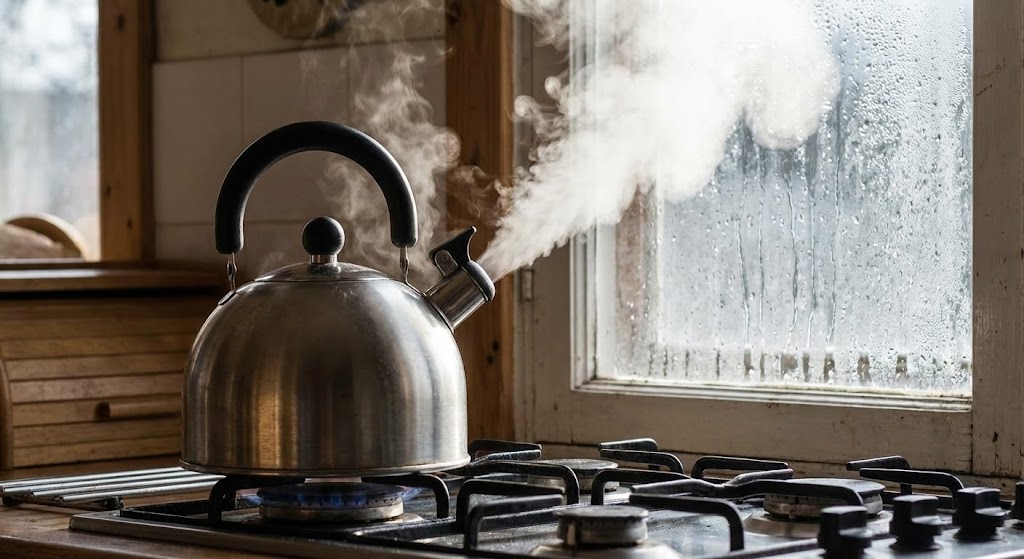
1. The Safety Myth: Does it Concentrate Toxins?
The theory is that when water evaporates during boiling, anything left behind (like fluoride, nitrates, or arsenic) becomes more concentrated. While mathematically true, the amount of evaporation in a household kettle is minimal.
You would need to boil the kettle dry multiple times to see any significant rise in toxicity. If your tap water is safe to drink once, it is safe to drink twice. The bigger issue with re-boiling is Limescale (Calcium Carbonate), which precipitates out of the water and coats your kettle.
Expert Tip: The Scum Layer
If you see a film on your tea (Tea Scum), it's caused by calcium reacting with tea polyphenols. Re-boiling hard water forces more calcium to precipitate, making this scum worse. Use a water filter to fix this.
2. The Flavor Science: Dissolved Oxygen
This is where the real damage happens. Water naturally contains dissolved gases, including oxygen. When you heat water, the solubility of gases decreases (Henry's Law), and they escape as bubbles.
Why does tea need oxygen? Oxygen helps extract flavor compounds and, more importantly, it affects how we perceive flavor. Aerated water feels "crisp" and "bright" on the palate. De-oxygenated (boiled flat) water tastes heavy and dull.
- First Boil: Reduces oxygen, but enough remains for a good brew.
- Re-Boil: Strips the remaining oxygen, leading to a flat cup.
Expert Tip: The "Cooling" Trick
Often, we re-boil because the water got cold. Instead of boiling it again to 100°C, get a Variable Temperature Kettle. You can simply heat the water back up to 80°C or 90°C without reaching a rolling boil, preserving the oxygen levels.
3. Which Teas are Affected Most?
Not all teas suffer equally.
High Impact: Delicate teas like Silver Needle, First Flush Darjeeling, and high-end Green Teas rely on subtle top notes that vanish in flat water.
Low Impact: Strong, robust teas like Assam, Chai, or dark Pu-erh are powerful enough to mask the flat taste of re-boiled water.
Need a better kettle?
If you find yourself constantly re-boiling water, it might be time for a variable temperature kettle that can hold heat or reheat gently. See our Top 5 Electric Kettles of 2025 →
Comments