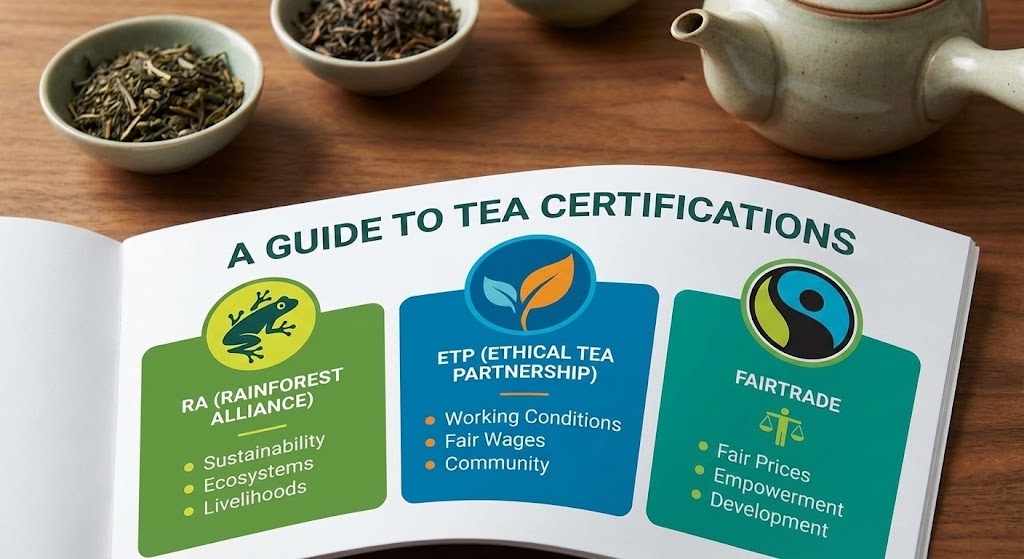
1. Fairtrade International: The Economic Shield
The Core Promise: Poverty Alleviation via Price Regulation.
Fairtrade is the only certification that meddles directly with the market price. It guarantees a Minimum Price Floor. If the global commodity price for tea crashes (as it often does in Kenya or Malawi), Fairtrade buyers must pay the minimum to cover the cost of sustainable production.
The "Social Premium": On top of the price, buyers pay an extra sum (the Premium) into a communal fund. The workers or cooperative members vote democratically on how to spend this—building schools, clinics, or buying trucks. The plantation owner cannot touch this money.
The Limitation: It works best for smallholder cooperatives. On large plantations, the "Minimum Price" goes to the estate owner, not the individual picker. While the Premium helps the community, it doesn't always translate to higher daily wages for migrant workers.
Expert Tip: Fair Trade vs. Direct Trade
Fair Trade sets a "Minimum" price. Direct Trade often pays significantly more than Fair Trade because it pays for Quality, not just charity. Think of Fair Trade as the minimum wage, and Direct Trade as a performance bonus.
2. Rainforest Alliance (The Frog): The Eco-Standard
The Core Promise: Biodiversity and Sustainable Agriculture.
When you see the green frog, it means the farm has passed strict environmental audits. They cannot clear-cut forests to plant tea. They must maintain shade trees, protect local waterways, and limit pesticide use. It merged with UTZ in 2018 to become the world's largest certification program.
The Limitation: While Rainforest Alliance has robust criteria for preventing child labor and forced labor, it does not mandate a fixed minimum price like Fairtrade. A farm can be Rainforest Alliance certified and still pay its workers the legal minimum wage, which in many tea regions (like Assam) is below a living wage.
3. Organic: The Soil Standard
The Core Promise: No Synthetic Chemicals.
Organic certification (Soil Association, USDA) is strictly about inputs. It guarantees no synthetic fertilizers, pesticides, or herbicides were used. This is vital for soil health and prevents chemical runoff into rivers.
The Limitation: Organic is not a social certification. You can have a 100% Organic farm that treats its workers poorly. Conversely, many small farmers practice "organic by default" (because they can't afford chemicals) but cannot afford the expensive certification paperwork. This is why many Single Origin teas are organic in practice but not on the label.
Expert Tip: The "Mass Balance" Loophole
The dark secret of the industry is "Mass Balance." For some certifications (like Rainforest Alliance or Fairtrade in certain contexts), companies can buy 50% certified tea and 50% non-certified tea, mix them together in the factory, and still sell the box with the logo (as long as they purchased the credits). It essentially treats ethics like carbon offsets.
4. The Ethical Tea Partnership (ETP)
The Core Promise: Industry Self-Regulation.
The ETP is not a consumer label; you won't usually see it on a box. It is a non-profit membership organization formed by the big packers (Tetley, Twinings, etc.) to monitor their own supply chains. They work on the ground to improve health and safety, housing, and gender equality on plantations.
The Limitation: Critics argue it is "marking your own homework." However, the ETP has arguably done more practical work in improving housing conditions in Sri Lanka and Kenya than many consumer labels because they have the direct ear of the massive corporations.
Summary: The Label Comparison
| Label | Primary Focus | Price Guarantee? | Audited By? |
|---|---|---|---|
| Fairtrade | Farmer Income & Community | Yes (Minimum Floor) | FLOCERT |
| Rainforest Alliance | Biodiversity & Environment | No (Market Price) | Authorized Auditors |
| Organic | Chemical-Free Soil | No | Soil Association / USDA |
| Direct Trade | Quality & Relationship | Negotiated (High) | Trust / Transparency |
See the Brands That Pass the Test
We've vetted the market to find the tea companies that go beyond the minimum requirements of these labels. Discover who is truly ethical.
See Ethical Brand Reviews
Comments