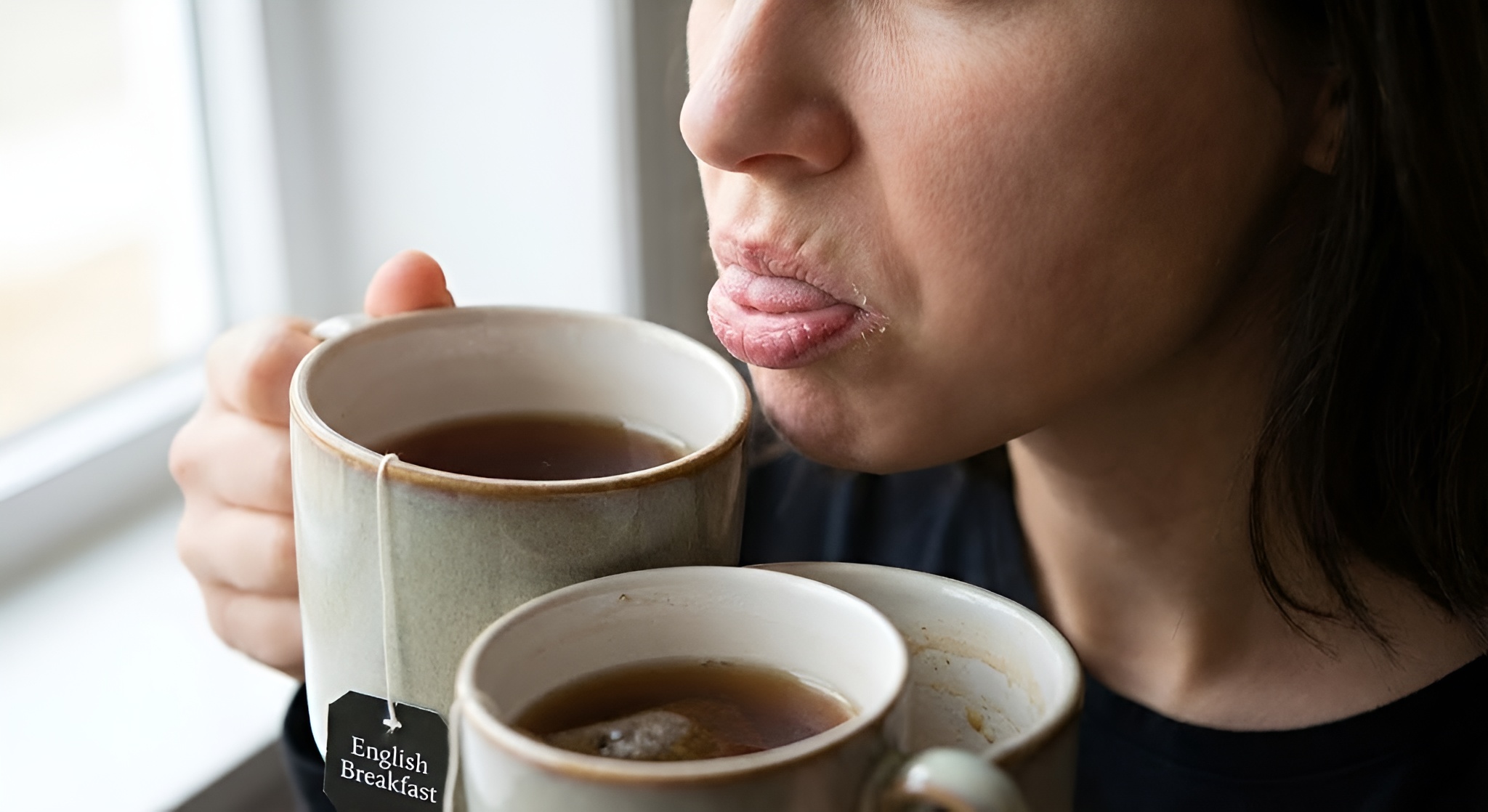
1. The Biology: Why Your Mouth Feels "Rough"
To understand astringency, you have to understand spit. Your saliva contains specific proteins called Proline-Rich Proteins (PRPs). These proteins act as a lubricant. They create a smooth, slippery film over your teeth, gums, and tongue, allowing them to glide against each other effortlessly. This is why the inside of your mouth usually feels slick.
The "Crash" (Precipitation): Tea contains polyphenols (specifically tannins and catechins). When these tannins enter your mouth, they chemically bond with the Proline-Rich Proteins in your saliva. This reaction causes the proteins to Precipitate—meaning they stop being dissolved and clump together into microscopic solids.
The Friction: Because the lubricating proteins have been stripped away and clumped together, your mouth loses its natural lubrication. Your tongue and cheeks suddenly experience high friction when they rub together. That "sandpaper" feeling is literally the sensation of un-lubricated tissue rubbing against tissue. It is a physical change in the viscosity of your saliva.
Taste vs. Touch
It is crucial to distinguish Astringency from Bitterness. Bitterness is a taste detected by receptors on the back of the tongue (Taste). Astringency is a physical sensation of dryness and puckering detected by the mechanoreceptors of the Trigeminal Nerve (Touch). You can have a tea that is astringent but sweet (like a First Flush Darjeeling), or a tea that is bitter but smooth (like a heavy Matcha). Learn more about Sensory Analysis here.
2. The Chemistry: The Culprits (Tannins)
The compounds responsible for this reaction are generally referred to as Tannins. In tea science, these fall under the umbrella of Polyphenols. Different teas have different types of astringency based on their chemical makeup.
Green Tea (Catechins)
In Green Tea, the primary astringents are Catechins (like EGCG). These provide a sharp, grippy astringency that hits the front of the mouth and tongue. It feels "green" and "raw." If brewed too hot, this can become aggressively drying. Read more about Green Tea chemistry.
Black Tea (Theaflavins)
In Black Tea, the catechins have oxidized into Theaflavins and Thearubigins. These larger molecules create a different kind of astringency—often described as "Briskness." It feels thicker, coating the back of the throat and gums. This is the characteristic "bite" of a good English Breakfast or Assam. Deep dive into Polyphenols here.
3. The Good vs. The Bad: Why We Want Astringency
If astringency is the loss of lubrication, why do we drink it? Why isn't all tea made to be smooth like water?
Structure and Body: Astringency gives tea "structure." Without it, tea tastes flat, flabby, and watery. That drying sensation provides a "finish" to the sip, clearing the palate and making the mouth water in response (a reflex to restore lubrication).
The "Brisk" Quality: In the tea industry, "Brisk" is a positive tasting note. It implies a lively, energizing astringency that wakes up the mouth. It is highly prized in breakfast teas because it cuts through the morning fog (and the milk).
Palate Cleansing: This is the superpower of astringency. Because tannins bind to proteins and fats, they are excellent at scrubbing the tongue clean after a bite of rich food. This is why astringent tea pairs perfectly with fatty foods like cheese, cream scones, or greasy dim sum. Read our Tea & Cheese Pairing Guide.
4. Factors That Increase Dryness (and How to Control Them)
If your tea is too dry—painfully so—it is usually due to one of three factors: Temperature, Time, or Water.
1. Water Temperature
Tannins and Catechins are highly soluble at high temperatures.
The Fix: If your Green Tea is too drying, drop the water temperature to 70°C-80°C. This extracts the sweet Amino Acids (L-Theanine) but leaves many of the harsh tannins in the leaf. For Black Tea, you generally need boiling water to get the flavor, but you can reduce steep time. Guide to fixing bitter/dry Green Tea.
2. Steep Time
Tannins release slower than caffeine. The longer the leaf sits in the water, the more tannins are extracted.
The Fix: Shorten your steep. A 3-minute brew will be significantly smoother than a 5-minute brew. In Gongfu Brewing, steeps are often only 10-20 seconds to avoid this buildup. Learn Gongfu Brewing here.
3. Water Hardness (The Chalk Effect)
This is a hidden factor. Hard water contains Calcium and Magnesium. These minerals can bind with tea compounds to form a scum or precipitate that enhances the sensation of roughness and chalkiness.
The Fix: Use filtered or softer water. However, water that is too soft (distilled) can make tea taste sour and flat. You want a middle ground. Read our Water Quality Guide.
5. The Milk Solution: Chemistry in Action
Why do the British add milk to strong tea? It isn't just for flavor; it's to kill the astringency.
Milk contains a protein called Casein. When you pour milk into high-tannin tea (like Assam), the tannins immediately bind to the Casein proteins in the cup instead of the Proline-Rich Proteins in your saliva. The reaction happens before the tea even touches your tongue. This neutralizes the astringency, turning a harsh, mouth-drying brew into a smooth, creamy beverage. This is why "Builder's Tea" works—it uses milk to tame the massive tannin load of strong CTC tea.
The Cold Brew Hack
Tannins and Catechins are stubborn in cold water. If you brew tea with cold water over 8-12 hours (Cold Brew), you extract almost all the flavor and sweetness but only a fraction of the astringency and caffeine. The result is a tea that is silky smooth and never dries out your mouth. Read our Cold Brew Science guide.
Troubleshooting Table
| Sensation | Likely Cause | The Fix |
|---|---|---|
| Sandpaper Tongue (Green Tea) | Water too hot / Steeping too long | Cool water to 75°C. Steep for 2 mins max. |
| Chalky / Dusty Film | Hard Water | Switch to filtered or bottled spring water. |
| Intense Gum Puckering | High Tannin Content (Young Raw Pu-erh) | Do a quick "Rinse" (discard first brew) or age the tea longer. |
| Dry Throat (Locking) | Agrochemicals or Poor Quality | This is often a sign of bad tea ("Suo Hou"). Switch brands. |