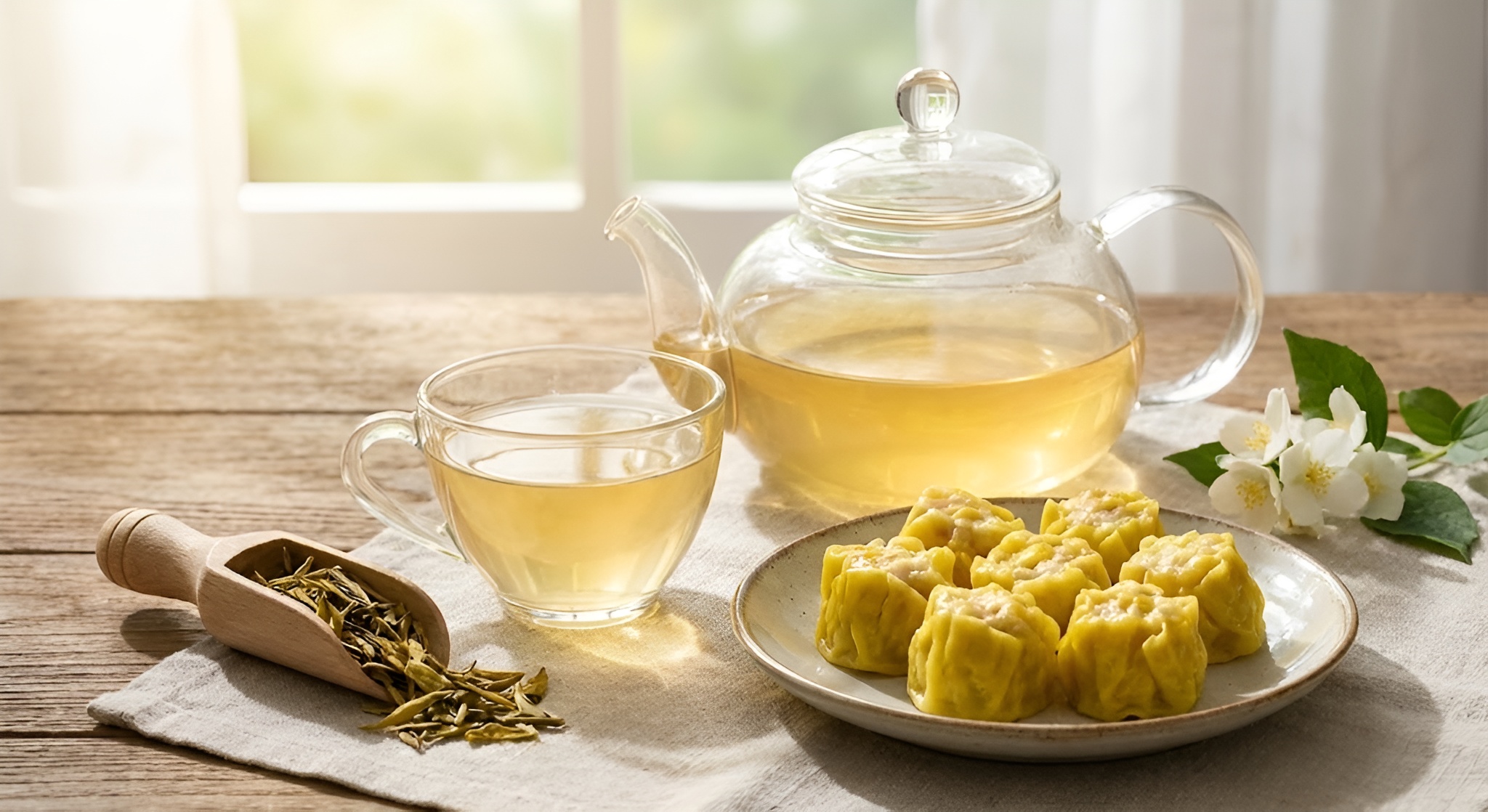
1. What is Yellow Tea? (The Magic of "Smothering")
To understand Yellow Tea, you must first understand Green Tea. Green tea is "fixed" (heated) quickly to stop oxidation, keeping it bright green and grassy. Yellow Tea starts the same way—it is harvested and fixed—but then the Tea Master does something strange. He deviates into a unique, labor-intensive step called Men Huang (闷黄), or "Sealing Yellow."
The "Sweating" Process
While the damp leaves are still hot from the kill-green step, they are wrapped in special paper or cloth and placed in wooden boxes or piled in heaps. They are left to "smother" or "swelter" in their own residual heat and moisture for hours, or even days. The master must constantly check the temperature. If it gets too hot, the leaves rot. If it gets too cool, the magic stops. It is a high-stakes game of thermal management.
Expert Tip #1: The "Baked Apple" Effect
Think of Green Tea like a crisp, raw apple—acidic and sharp. Think of Yellow Tea like a baked apple—soft, sweet, and comforting. The Men Huang process caramelizes the flavors, removing the astringency that makes some people gag when drinking strong Green Tea. If you want antioxidants but have a sensitive stomach, Yellow Tea is your answer.
The Chemistry: This warm, humid environment encourages a non-enzymatic oxidation (auto-oxidation). The chlorophyll breaks down, turning the leaves from bright green to a yellowish-brown. More importantly, the bitter catechins and grassy volatile compounds oxidize into sweeter, mellower substances. It is essentially "slow-cooking" the harshness out of the tea.
Where to Buy True Yellow Tea?
Because it is so rare, most "Yellow Tea" on Amazon is fake. We hunted down the few reputable vendors selling authentic Jun Shan Yin Zhen and Huo Shan Huang Ya.
See the Top 4 Authentic Brands2. A History of Emperors and Extinction
Yellow Tea isn't just rare; it has a prestigious lineage. In Imperial China, the color yellow was the exclusive property of the Emperor. As such, Yellow Tea was developed as a "Tribute Tea" (Gong Cha)—tea made specifically to be paid as tax to the Imperial Court. For centuries, commoners were forbidden from drinking it. It was the drink of the elite, designed to be smooth, sophisticated, and rare.
The Near Extinction: The "Sealing Yellow" process is incredibly risky. In the modern era, market economics threatened to kill Yellow Tea. Farmers realized they could make Green Tea in 1 day and sell it immediately. Why spend 4 days making Yellow Tea for the same price? By the late 20th century, the art of making true Yellow Tea was nearly lost, with only a few masters in Hunan and Sichuan keeping the flame alive. Today, we are seeing a small renaissance, but it remains the rarest category on Earth.
Expert Tip #2: The Fake Tea Warning
Buyer Beware: Because true Yellow Tea is so labor-intensive, the market is flooded with fakes. Unscrupulous vendors will sell stale, old Green Tea (which has turned yellow naturally from age/oxidation) as "Yellow Tea."
The Test: True Yellow Tea should taste fresh, sweet, and lively—not dusty or stale. It should have a vibrant "golden ring" inside the cup rim, not a dull brown one.
3. The Famous Varieties: The "Big Three"
Because the processing is so specific to local traditions, there are only a handful of famous Yellow Teas remaining in existence. If you are hunting for Yellow Tea, look for these names:
A. Jun Shan Yin Zhen (Silver Needle)
The most famous and expensive. Produced on Jun Shan Island in Dongting Lake (Hunan Province). It uses only fat, single buds. It is often confused with White Tea Silver Needle, but the flavor is vastly different.
Flavor: Sugarcane, sweet corn, subtle floral notes.
B. Meng Ding Huang Ya (Mt. Meng Ding Yellow Buds)
From Sichuan Province, this was a tribute tea as far back as the Tang Dynasty.
Flavor: Nutty, chestnutty, with a long sweet finish. More savory than Jun Shan.
C. Huo Shan Huang Ya
From Anhui Province. This tea was "lost" for decades and revived in the 1970s.
Flavor: Peas, toasted nuts, and a high floral aroma. It is often the most accessible (and affordable) Yellow Tea for beginners.
Expert Tip #3: The Glass Brewing Method
Yellow Tea (especially the bud-only varieties like Jun Shan Yin Zhen) should always be brewed in a tall clear glass. Why? To watch the "Dance of the Three Ups and Three Downs." The buds will float vertically, then slowly sink, then rise again as they release air bubbles. It is a visual meditation that was beloved by Emperors.
4. Flavor Profile: The Anti-Green Tea
Why should you drink it? Because it occupies a flavor space that no other tea does. It sits precisely between the fresh vegetal notes of Green Tea and the floral/creamy notes of a very light Oolong.
The "Returned Sweetness" (Hui Gan): Yellow Tea is famous for its Hui Gan. After you swallow, a distinct sweetness rises back up the throat. It lacks the "grassy" punch of Sencha or the "astringency" of Gunpowder. It is soft, round, and full-bodied—a gentle hug for your palate.
| Feature | Green Tea | Yellow Tea | White Tea |
|---|---|---|---|
| Processing | Kill-Green -> Dry | Kill-Green -> Smother -> Dry | Wither -> Dry |
| Oxidation | 0% (Non-oxidized) | 5-10% (Post-oxidized) | 5-10% (Natural) |
| Flavor | Grass, Seaweed, Vegetal | Corn, Sweet, Toasted | Hay, Honey, Melon |
| Stomach Feel | Can be irritating (Cold) | Gentle / Soothing (Warm) | Cooling |
5. Health Benefits: The Digestive Aid
In China, Yellow Tea is often marketed as a "digestive tea." The micro-fermentation process stimulates the production of digestive enzymes and yeasts (similar to a very young Pu-erh), which can help metabolize fats and settle the stomach after a greasy meal.
Furthermore, studies suggest that the Sealing Yellow process retains close to 85% of the EGCG found in green tea, but converts the remainder into unique derivatives that are more bioavailable and less astringent. You get the cancer-fighting properties of green tea without the gastric distress. It's a win-win for your health and your taste buds.
Expert Tip #4: storage Matters
Unlike Green Tea, which must be consumed fresh (within 1 year), Yellow Tea ages gracefully. The slight fermentation means it is chemically more stable. A 2-year-old Yellow Tea can develop deeper, honey-like notes, whereas a 2-year-old Green Tea just tastes like cardboard. Don't be afraid to keep it.
Expert Tip #5: Brewing Temperature
Treat Yellow Tea like a delicate Green Tea. Use water at 80°C - 85°C (175°F - 185°F). Boiling water will cook the leaves and ruin the subtle "sealing yellow" sweetness. Steep for 2-3 minutes for a perfect golden cup.
Conclusion: The Worthy Hunt
Finding authentic Yellow Tea is not easy. You won't find it in the supermarket next to the Earl Grey. You likely won't even find it at your local hip coffee shop. It requires hunting down specialized tea vendors who have relationships with heritage farmers in Hunan or Sichuan.
But the hunt is worth it. To drink Yellow Tea is to taste history—to experience a flavor profile that was once deemed too good for anyone but the Son of Heaven. It is the perfect bridge for the tea drinker who wants the elegance of White Tea, the body of Oolong, and the health of Green, all without the bitterness. It is the lost art of the leaf, waiting to be rediscovered in your cup.
Expert Tip #6: The Price of Gold
Be prepared to pay for quality. True Yellow Tea is hand-made in small batches. If you see "Yellow Tea" for $5 a bag, it is almost certainly a fake or a low-grade green tea. Expect to pay premium prices for the authentic experience—it's cheaper than a flight to China.
Comments