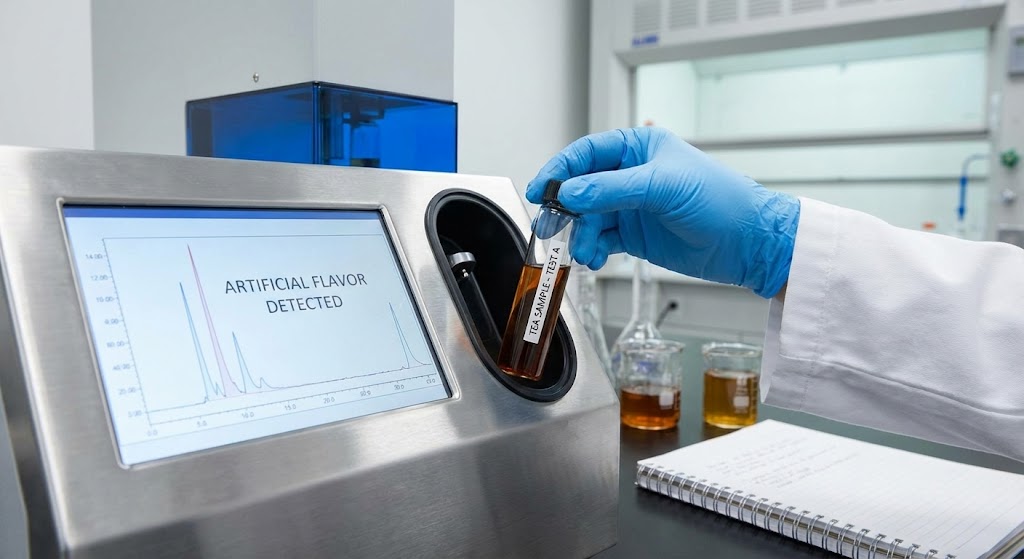
Natural vs. Artificial Oils: The Surface Test
Natural tea oils (from leaf cells) integrate into water—they're released gradually through steeping, creating emulsified suspension. Artificial essential oils (added flavoring) sit on water surface—they don't integrate, forming visible oil slick. This is chemistry, not subjective: natural lipids are hydrophilic (water-loving), synthetic oils are hydrophobic (water-fearing).
The test: brew tea in clear glass. Natural tea shows slight cloudiness (emulsified oils distributed throughout). Flavored tea shows oil slick on surface (concentrated layer of hydrophobic compounds floating). Swirl the cup—natural oils stay suspended, artificial oils re-form surface film.
The 30-Second Oil Slick Test
Brew suspected tea in clear glass. Look at surface under direct light. Natural: slight even cloudiness, no distinct layer. Artificial: visible oil film, rainbow sheen, separates from water.
How to Spot Fake "Milk Oolong"
True Jin Xuan (Milk Oolong) cultivar has natural buttery aroma from specific lactone compounds. Fake "milk oolong" is any oolong sprayed with milk flavoring or butter essence. The oil slick test catches fakes immediately—true Jin Xuan has no surface oil, fake milk oolong has obvious slick.
Vendor claims to check: "natural milk flavor" (chemical name dodecalactone—naturally occurring), "authentic Jin Xuan cultivar" (specific plant variety), "no added flavoring" (verifiable via oil test). Suspicious claims: "traditional milk process" (doesn't exist), "milk infused" (means artificially flavored), "creamy natural essence" (marketing speak for added oil).
Other Flavored Teas to Test
Common artificial flavorings: jasmine (real uses scenting, fake uses jasmine oil), rose (real uses petals, fake uses rose essence), osmanthus (real uses flowers, fake uses flavoring), lychee (always artificial—no natural lychee-flavored tea exists), vanilla (always added), coconut (always added). Oil test reveals all artificial additions.
| Tea Type | Natural Process | Artificial Version | Oil Test Result |
|---|---|---|---|
| Milk Oolong | Jin Xuan cultivar genetics | Sprayed milk flavor/butter oil | Natural: no slick. Fake: obvious oil |
| Jasmine Tea | Flower scenting (petals) | Jasmine essential oil spray | Natural: no slick. Fake: floral oil film |
| Rose Tea | Real rose petals mixed | Rose oil/essence coating | Natural: no slick. Fake: rose oil sheen |
| Lychee Black | N/A—always artificial | Lychee flavoring spray | Always shows oil slick |
Why Artificial Flavoring Matters
Health: artificial flavorings are generally safe but unregulated in tea. Some contain allergens, propylene glycol (antifreeze component), or undisclosed chemical carriers. Transparency: paying premium for "natural tea" but getting chemical-sprayed commodity is fraud. Quality: flavoring masks poor-quality base tea—vendors use it to make undrinkable tea saleable.
Detecting Artificial Flavoring
- Oil slick test: Clear glass, bright light, look for surface film
- Smell dry leaf: Overpowering = likely artificial (natural is subtle)
- Flavor persistence: Artificial flavor fades after 1-2 steeps. Natural persists
- Wet leaf smell: Should smell like tea, not candy/perfume
- Sticky residue: Artificial oils leave film on cup/lips
Why Artificial Flavoring is Rampant in Tea Industry
Unlike coffee, tea has no standardized grading enforced globally—making it trivial for unscrupulous vendors to sell low-grade tea with artificial flavoring at premium prices. The economic incentive is enormous: commodity tea costs $3-8/kg, artificial flavoring costs $0.50-2/kg, final product sells for $40-100/kg marketed as "premium artisan tea." The wet leaf reveals the fraud immediately.
Common artificially flavored teas: "Earl Grey" using synthetic bergamot oil ($2/L) instead of natural ($50/L), "jasmine tea" using synthetic indole/benzyl acetate instead of real jasmine scenting, "milk oolong" sprayed with vanilla/coconut flavoring instead of natural Jin Xuan varietal character. The base tea quality is often terrible—CTC fannings, broken leaves, even non-tea plant material.
Professional tea buyers use the "oil slick test" as first-line screening: Brew tea in glass cup. Look at surface under bright light. Natural tea oils form thin, rainbow-sheen film (lipid compounds from leaf). Artificial flavoring forms thick, globular oil slicks that don't disperse (propylene glycol, glycerin carriers). If you see chunky oil pools floating, it's artificially flavored.
The Glass Cup Oil Slick Test
Brew 3g tea in clear glass. After 2 minutes, examine surface under direct light (sunlight or LED). Natural tea: thin rainbow sheen, barely visible. Artificial flavoring: thick oil droplets, visible chunky slicks. Takes 30 seconds, catches most fakes. Always test in glass—porcelain hides the oil.
The Wet Leaf Smell Test: Natural vs. Synthetic
After brewing, remove wet leaves and smell immediately while still hot. Natural tea aromatics smell complex—layers of different notes (floral + fruity + grassy + woody) that evolve as leaves cool. Synthetic flavoring smells one-dimensional—single dominant note (fake vanilla, fake coconut, fake bergamot) that stays constant and doesn't evolve.
The chemical reason: Natural plant aromatics contain 50-200+ volatile compounds in specific ratios (creating complexity). Synthetic flavoring uses 1-5 compounds trying to mimic the dominant notes (creating simplicity). Your nose detects this difference—natural smells "alive," synthetic smells "flat" or "perfume-like."
Specific tells: Fake jasmine smells like bathroom air freshener (pure indole + benzyl acetate = one-note). Real jasmine scenting smells like fresh flowers with green undertones. Fake vanilla smells like extract (vanillin only). Natural vanilla notes (in some oolongs) smell creamy with woody background. Fake bergamot smells like cleaning products. Natural bergamot oil smells citrus-floral-complex.
The Wet Leaf Visual Inspection
Artificially flavored tea often shows visible residue on wet leaves: oily sheen coating the leaf surface (flavoring carrier oils), whitish powder in crevices (spray-dried flavoring that didn't dissolve), or unnaturally uniform color (dye added with flavoring). Dyed tea and flavored tea frequently go together—covering low-grade base material.
Compare wet leaves to natural tea under magnification (10-30x USB microscope). Natural tea leaves show intact cellular structure, trichomes, vein patterns. Heavily processed/flavored tea shows broken cell walls, residue deposits, sometimes visible crystals (flavor compounds precipitated out of solution).
The Fade Test: Brew Multiple Infusions
Natural tea aromatics evolve across multiple steepings: First steep = light/floral notes dominant. Second steep = deeper/roasted notes emerge. Third steep = subtle/sweet notes appear. Synthetic flavoring stays constant or fades uniformly: First steep = strong fake vanilla. Second steep = weaker fake vanilla. Third steep = barely detectable fake vanilla.
The test protocol: Brew same 5g sample three times (3 min each steep). Smell and taste each infusion separately. Natural oolong or Puerh shows distinct character shift across steeps. Artificially flavored tea just gets weaker—no character evolution. The synthetic compounds wash out mechanically (no chemical changes happening in the leaf).
The Three-Steep Character Test
Steep 1: Strong aroma. Steep 2: Different aroma OR same but weaker? If different = natural. If just weaker (same smell, less intensity) = likely artificial. Steep 3: Should show tertiary notes in natural tea. If totally flavorless = flavoring washed out (synthetic).
Specific Fraud Cases and How to Detect
Fake "Milk Oolong" (Jin Xuan fraud): Real Jin Xuan has subtle natural milk-cream aroma from specific lactone compounds in the cultivar genetics. Fake uses spray coating of butter/vanilla/coconut flavoring. Test: Wet leaf should smell like fresh cream, not vanilla extract. Oil slick test shows thick slicks = fake. Real Jin Xuan shows minimal oil, delicate aroma.
Fake "Osmanthus Oolong" (flavored scam): Real osmanthus scenting uses dried osmanthus flowers mixed with tea (visible in dry leaf). Fake uses synthetic osmanthus flavoring (coumarin + linalool compounds). Test: Search dry leaf for actual flower pieces. If none visible but strong floral smell = synthetic. Real osmanthus oolong shows actual flower fragments, subtle scent.
Fake "Lychee Black Tea" (spray fraud): Real lychee scenting (rare, expensive) uses fresh lychee fruit during withering. Fake sprays synthetic lychee flavor (rose oxide + various esters). Test: Smell wet leaves—real lychee scenting smells like fresh fruit with green notes. Fake smells like lychee candy (one-dimensional, too sweet).
| Test Method | Natural Tea | Artificially Flavored | Detection Speed |
|---|---|---|---|
| Oil Slick Test | Thin rainbow sheen, barely visible | Thick oil droplets, chunky slicks | 30 seconds |
| Wet Leaf Smell | Complex, evolves as it cools | One-note, perfume-like, constant | 2 minutes |
| Multiple Steeps | Character shifts across 3 brews | Same flavor, just weaker | 20 minutes (3 steeps) |
| Residue Check | Clean leaf surface, no coating | Oily sheen, white powder deposits | 2 minutes |
| Fade Pattern | Gradual fade with note evolution | Linear fade, no evolution | 20 minutes |
Health Concerns: Are Flavor Chemicals Dangerous?
Most artificial tea flavorings use food-grade compounds approved by FDA/EFSA—same chemicals in flavored drinks, candy, etc. They're not acutely toxic. But tea vendors rarely disclose what specific compounds they use, and some cheap imports use industrial-grade flavoring not tested for oral consumption.
Concerns: (1) Propylene glycol (carrier) can cause digestive upset in high doses, (2) Some synthetic aromatics trigger allergic reactions (skin rash, respiratory issues), (3) Heavy consumption might have unknown long-term effects (these compounds aren't naturally occurring in diet). If tea gives you headaches, nausea, or skin reactions, artificial flavoring is a likely culprit.
Why Vendors Don't Disclose Flavoring
Legally, most regions require disclosure ("natural flavoring" or "artificial flavoring" on label). But tea often sells loose without labels, or vendors claim "trade secret blend" to avoid disclosure. Online marketplaces frequently allow misleading descriptions ("natural jasmine scent" when it's synthetic).
The disclosure game: Vendor lists "jasmine tea" without specifying natural vs. artificial. Consumer assumes natural (why would they add fake jasmine?). Vendor profits from confusion. When questioned, they claim "we never said it was naturally scented." Technically true, ethically fraudulent. Buy only from vendors who explicitly state "naturally scented with real flowers" or similar.
Economic Reality: Natural vs. Artificial Costs
Natural jasmine scenting: 4-7 nights of flower layering, 10-20kg fresh flowers per kg tea, labor intensive. Cost: $30-80/kg wholesale. Artificial jasmine flavoring: Spray 50-100ml synthetic oil per kg tea, 5 minutes. Cost: $4-8/kg wholesale. The price difference explains why 90% of "jasmine tea" in Western markets is artificially flavored.
Similar economics for Earl Grey (natural bergamot oil $50/L vs. synthetic $2/L), vanilla-flavored teas (natural vanilla extract $80/L vs. vanillin $3/kg), rose-scented teas (real rose petals $60/kg vs. synthetic rose oil $8/L). If price seems too good to be true, it's probably artificially flavored commodity tea.
Prevention When Buying
Ask vendors directly: "Is this naturally scented or flavored?" If they dodge the question, assume artificial. Request ingredient disclosure—legitimate vendors list "tea + natural bergamot oil" or "tea + jasmine flowers." Sketchy vendors list just "tea" or "proprietary blend" (hiding artificial additives).
Sample before bulk purchase. Run oil slick test, smell test, multiple-steep test. If any test shows artificial characteristics, reject the batch—even if vendor claimed "natural." Your forensic examination beats their marketing claims. Trust the evidence, not the story.
Comments