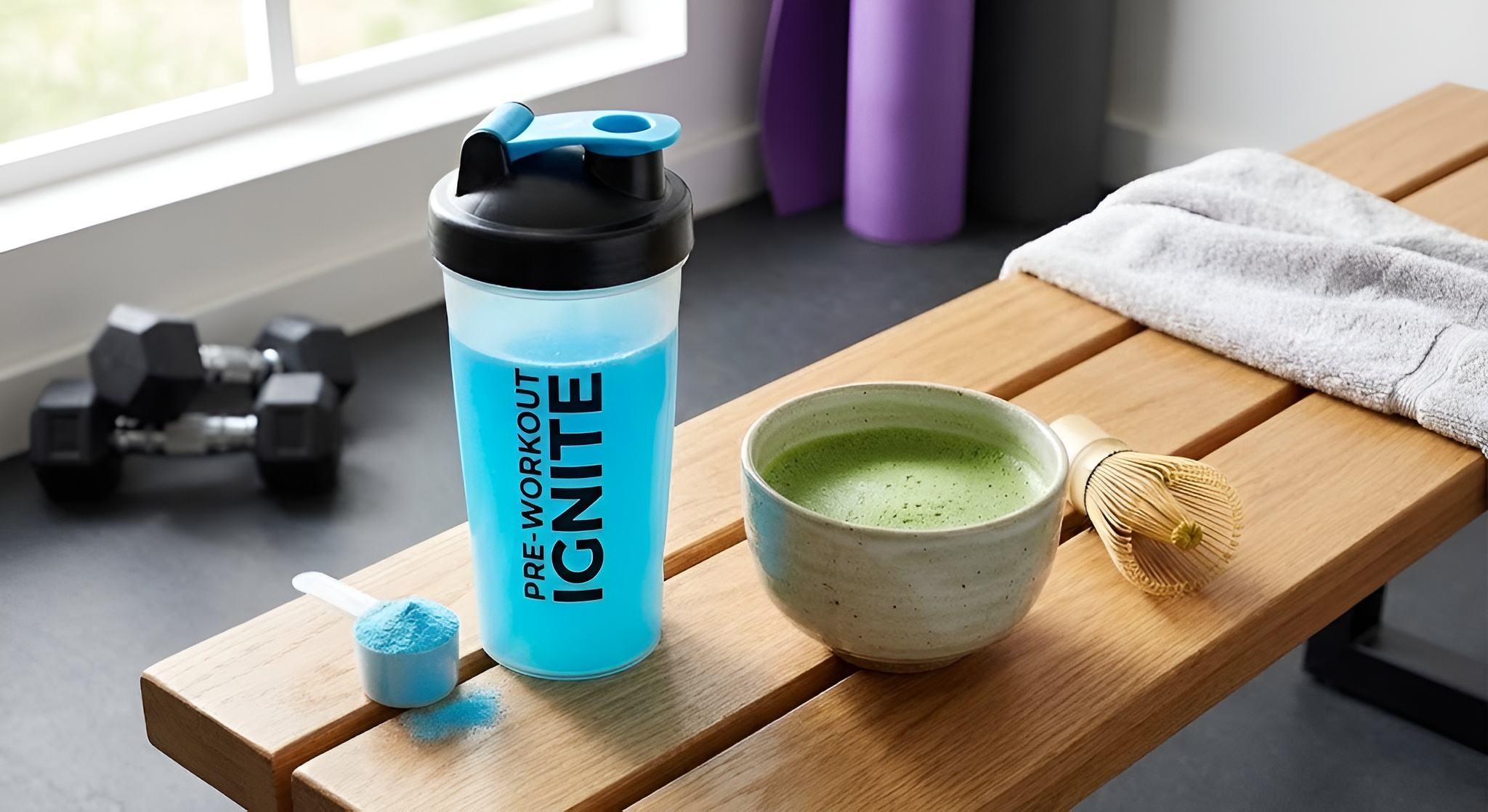
The Science of the Spike: Why Pre-Workouts Crash
Most commercial pre-workouts rely on Caffeine Anhydrous—a highly concentrated, lab-made caffeine powder derived from pharmaceutical processing. Because it has been stripped of all plant matter, your body absorbs it almost instantly. This hits your central nervous system like a sledgehammer.
Within 15-30 minutes, your cortisol and adrenaline levels spike. While this feels like "energy," it is physiologically indistinguishable from acute stress. This spike is often followed by a rapid crash as your adenosine receptors (which signal tiredness) are suddenly flooded once the caffeine wears off. This is why you might feel exhausted and irritable an hour after your workout.
Furthermore, many powders contain artificial sweeteners like Sucralose or Acesulfame K, which can cause bloating and gut distress mid-set. If you've ever felt nauseous during a heavy squat session, your "Blue Raspberry" drink might be to blame.
The Matcha Matrix: Why It's Different
Matcha is fundamentally different. As we explain in our Matcha 101 Guide, you are consuming the whole leaf, not just an infusion. This means you ingest all the phytonutrients, fiber, and tannins.
Crucially, the caffeine in Matcha binds to these larger plant molecules called tannins (catechins). It takes your digestive system longer to break these bonds. The result is a slow, steady drip-feed of caffeine into your system over 4 to 6 hours. You don't get the spike, but you also don't get the crash. You just feel... awake. This sustained release is ideal for long sessions, endurance running, or CrossFit, where you need energy to last beyond the first 45 minutes.
Neurology: L-Theanine and "Flow State"
The real superpower of tea is L-Theanine. This rare amino acid is found almost exclusively in the tea plant (Camellia Sinensis) and some mushrooms. It crosses the blood-brain barrier and increases alpha brain wave activity, which induces a state of "relaxed alertness."
In the context of lifting weights, this is profound. High doses of synthetic caffeine can cause "scattered" energy—you feel like you need to move, but you can't focus on the muscle connection. L-Theanine smooths out the rough edges of caffeine. It prevents the jitters, the anxiety, and the elevated heart rate.
This combination creates what athletes call "Flow State" or "The Zone"—a calm, deliberate connection to the movement. You are energized, but your mind is quiet. Read our Deep Dive on L-Theanine here.
Head-to-Head: Matcha vs. The Powder
Let's look at the stats. Here is how a standard serving of Ceremonial Matcha compares to a typical scoop of pre-workout.
| Feature | Matcha (2g / 1 tsp) | Typical Pre-Workout (1 Scoop) |
|---|---|---|
| Caffeine | ~70mg (Release: 4-6 hours) | 150-300mg (Release: 30-60 mins) |
| L-Theanine | High (20-40mg) | Usually None (or trace amounts) |
| Beta-Alanine | None (No itch) | High (Causes tingling/itch) |
| Antioxidants | Extremely High (EGCG) | None |
| Ingredients | 1 (Green Tea Leaves) | 10-20 (Artificial Flavors, Dyes, Sweeteners) |
| Side Effects | Calm Focus | Jitters, Anxiety, Crash, Bloating |
Dosage Matters
If you are a heavy caffeine user (3+ coffees a day), 1 tsp of Matcha might feel weak. You can safely double the dose to 2 tsp (4g) of Matcha before a workout. This gives you approx 140mg of caffeine—comparable to a standard pre-workout but with all the stabilizing benefits of L-Theanine. Check our Caffeine Guide for more details.
Metabolic Boost: EGCG and Fat oxidation
If your goal is body composition or fat loss, Matcha has a significant edge over synthetic caffeine. It is packed with EGCG (Epigallocatechin Gallate), a potent catechin antioxidant.
Clinical studies suggest that consuming green tea extract (like Matcha) before exercise can increase fat oxidation (the rate at which your body burns stored fat for fuel) by up to 17% during moderate-intensity cardio. This makes Matcha the ultimate companion for "Zone 2" cardio or metabolic conditioning circuits. It helps your body access fat stores more efficiently than caffeine alone. Learn more about this mechanism in our Tea & Weight Loss Article.
Gut Health: The Hidden Factor
Your performance in the gym is linked to your digestion. Many pre-workouts use Sucralose or other artificial sweeteners because they are cheap and calorie-free. However, these can disrupt the gut microbiome and cause bloating, gas, or water retention—the last thing you want when trying to brace your core for a heavy lift.
Matcha, on the other hand, acts as a prebiotic. The unique carbohydrates and fibers in the tea leaf feed beneficial gut bacteria. It supports digestion rather than disrupting it. For sensitive stomachs, switching to Matcha can eliminate "gym belly."
The "Pump" Question: Vasodilation
Many pre-workouts contain Citrulline or Arginine to boost Nitric Oxide (NO) and create a "pump" (vasodilation). Matcha does not contain these amino acids.
However, the polyphenols in green tea have been shown to improve endothelial function (the health of blood vessel linings), which supports healthy blood flow. While it won't give you the immediate, skin-splitting pump of 6g of Citrulline, it supports genuine cardiovascular health and blood pressure regulation rather than just a temporary cosmetic effect. Read more on Tea & Blood Pressure.
Sourcing Matters: Why Grade is Critical
Not all Matcha is created equal. If you are drinking it straight with water before a workout, you must use Ceremonial Grade Matcha. Culinary grade is bitter, sandy, and designed for baking. It will be unpleasant to drink in the quantity needed for a workout.
Furthermore, cheap matcha can be high in lead or pesticides, as the tea leaf absorbs everything from the soil. Since you are eating the whole leaf, purity is non-negotiable. Look for matcha from Uji or Nishio, Japan, which have stricter soil testing standards than other regions.
How to Build the Ultimate Natural Pre-Workout Stack
If you want the benefits of Matcha but miss the specific performance boosters of synthetic powders, you can build your own natural stack:
- The Base: 2 tsp Ceremonial Matcha (Energy + Focus)
- The Pump: Add Beetroot Powder (Natural Nitric Oxide)
- The Endurance: Add Cordyceps Mushroom Powder (ATP production - Read about Mushroom Tea here)
- The Electrolytes: Add a pinch of Pink Himalayan Salt (Hydration - Why Salt in Tea works)
Mix this with coconut water or oat milk for a drink that outperforms any lab-made powder, with zero crash.
When To Stick With Powder
We are biased towards tea, but we are also honest. If you are a competitive powerlifter attempting a 1-rep max and you need that aggressive, face-slapping adrenaline rush to lift a car, Matcha might be too subtle. Matcha is for sustained performance—CrossFit, bodybuilding, running, or long gym sessions. It is "flow state" energy, not "rage" energy.
Comments