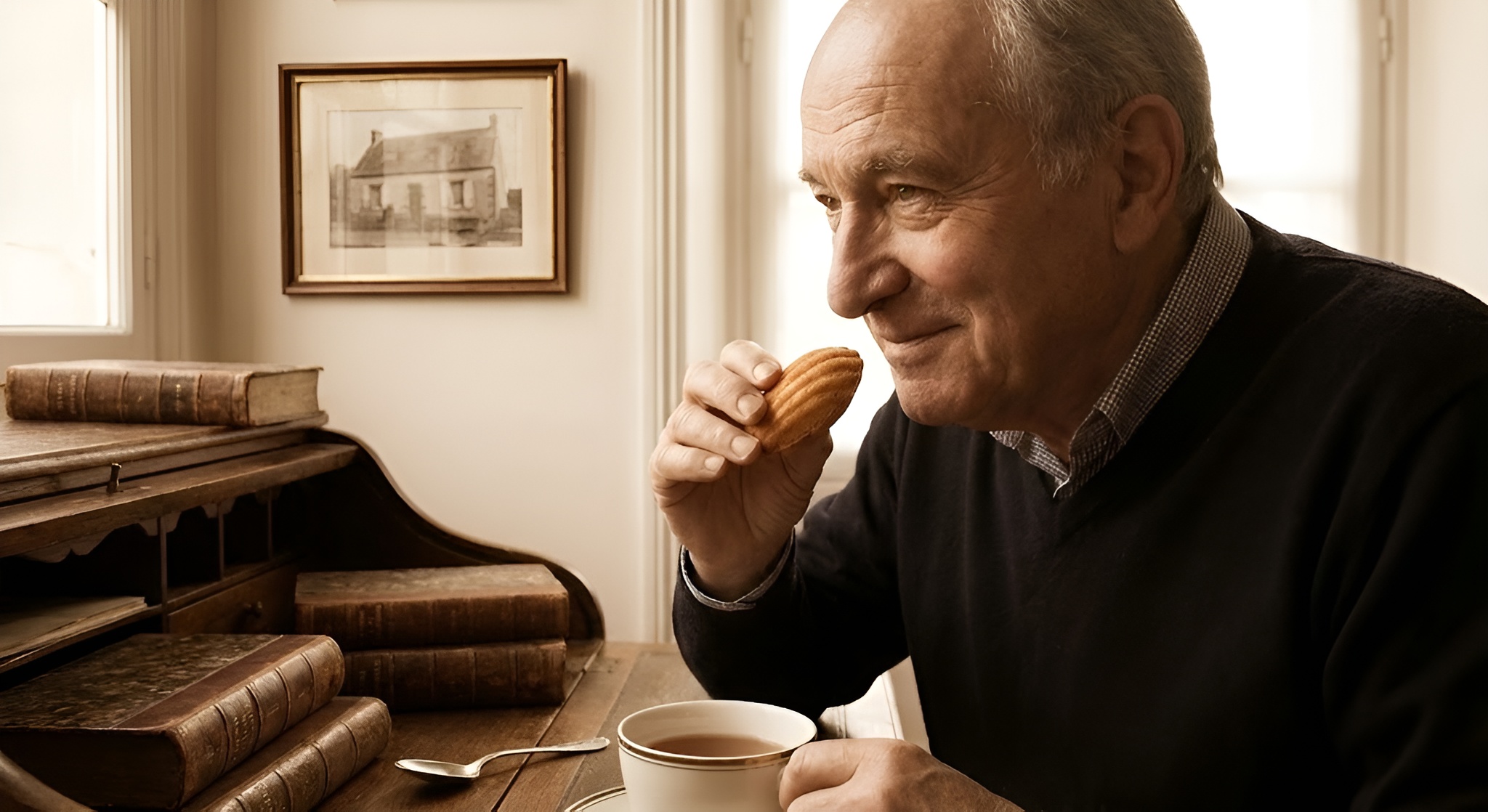
1. What Was in Proust's Cup? (The Case of the Missing Earl Grey)
Popular culture often imagines Proust drinking a refined cup of Earl Grey or perhaps a sturdy English Breakfast. It fits the image of a sophisticated writer in a Paris salon. However, the text is explicit, and the reality is far more domestic and grandmotherly. He describes the drink as "thé" (tea) but later clarifies it is an infusion of lime-blossom (tilleul).
What is Lime Blossom? It has nothing to do with the green citrus fruit (lime). It comes from the flowers of the Linden tree (Tilia). In French culture, Tilleul is the quintessential "Grandmother's Tea." It is a mild, honey-sweet, floral infusion traditionally drunk in the evening to aid sleep or calm digestion. It is the flavor of the nursery, of being cared for, of illness recovery, and of safety.
By choosing this specific herb, Proust anchors the memory not in the intellectual world of adults, but in the visceral, sensory world of childhood. It is the smell of his Aunt Léonie's bedroom—a space of comfort and stillness. If he had been drinking coffee or wine, the memory would likely not have triggered, as those are "adult" flavors acquired later in life. Tilleul is primal.
Expert Tip: Tilleul vs. Verveine
In France, the two classic evening herbal teas are Tilleul (Linden) and Verveine (Lemon Verbena). While Verbena is bright, citrusy, and refreshing, Linden is thick, viscous, and deeply floral with notes of hay and honey. It is this "sticky" sweetness that pairs so perfectly with the buttery sponge of the madeleine. Read our Review of Best Herbal Teas.
2. The Neuroscience: The Brain's VIP Entrance
Why did a taste trigger a memory so vivid it took seven volumes to write down? Why didn't looking at a picture of his aunt do the same thing? The answer lies in the unique wiring of the human brain. This is known in psychology as Involuntary Autobiographical Memory.
The Thalamus Bypass: Most of our senses (sight, sound, touch) are routed through the Thalamus. Think of the Thalamus as the brain's "receptionist." It takes the data, processes it, analyzes it, and then sends it to the relevant department (memory, logic, language). It is a filtered path. We see a flower, we name it, we categorize it, and *then* we might feel something about it.
The Olfactory Superhighway: Smell is different. The olfactory bulb has a VIP pass. It is directly wired to the Amygdala (the center of emotion) and the Hippocampus (the center of memory). It skips the receptionist entirely. When you smell tea (or cut grass, or old books), the emotional reaction happens before your conscious brain even identifies the scent.
This is why aroma feels "visceral." Proust didn't just remember his childhood; he felt it physically because the scent unlocked the emotional center of his brain instantly. In Tea Tasting, we call this "Retro-Nasal Olfaction"—the vapors rising from the back of the mouth to the nose while you eat or drink.
3. The Ritual: The Physics of the "Sodden Crumb"
Proust specifies that the dry cake alone meant nothing. The tea alone meant nothing. It was the interaction—the "crumbs" mixed with the warm liquid—that unleashed the memory.
Scientifically, heat and moisture are the keys to unlocking flavor. Dry food holds its volatile compounds tightly. But when the buttery fats of the madeleine were warmed by the hot tisane, they melted, releasing locked-in aromas of vanilla, egg, and browned flour. Simultaneously, the heat of the tea vaporized the floral notes of the Linden flowers.
This creates a unique chemical signature. It wasn't just "cake" and "tea." It was a specific slurry of starch, fat, sugar, and floral terpenes at a specific temperature (likely around 50°C). This exact chemical profile existed only in that specific house, at that specific time in his life. By recreating the physics of the mixture, he recreated the chemical key that unlocked the dormant neural pathway.
Expert Tip: How to Dip Like Proust
Don't dunk for too long! The madeleine is a delicate sponge cake (genoise batter). A quick dip (1-2 seconds) allows the tea to permeate the outer layer without disintegrating the structural integrity. You want the contrast between the warm, soaked exterior and the buttery, firm interior. Learn more about Tea & Pastry Pairing here.
4. Voluntary vs. Involuntary Memory: The Hunt vs. The Flash
Proust draws a sharp distinction between "Voluntary Memory" (Memoire Volontaire) and "Involuntary Memory" (Memoire Involontaire). This is the philosophical core of the book.
- Voluntary Memory: This is when you try to remember something. "What did I do last Tuesday?" It is an intellectual effort. The result is often dry, factual, and devoid of color. It is like looking at a black-and-white photograph.
- Involuntary Memory: This cannot be summoned. It strikes you out of nowhere, usually triggered by a sensory experience (taste, smell, sound). It brings back not just the facts, but the *atmosphere*—the feelings, the light, the mood. It is a full-color, 3D immersion.
Tea is the ultimate trigger for Involuntary Memory because it is so chemically complex. A single cup of tea contains hundreds of volatile compounds. It creates a sensory fingerprint that is far more specific than a visual image. You might see a thousand red cars in your life, but you will only smell that specific blend of rainy pavement and Earl Grey in London.
5. Hacking Your Brain: Building Your Own "Memory Palace"
We can use the "Proustian Effect" to our advantage. We can hack our own biology to anchor new memories or create safe spaces for relaxation. Here is how to build a Memory Palace using tea:
- The Study Tea: Choose a specific, distinct tea (like Jasmine Pearls or a smoky Lapsang) and drink it only when studying or working deep. Over time, your brain will associate that specific scent with "focus mode." Eventually, brewing the tea will trigger concentration before you even take a sip.
- The Vacation Tea: If you travel, buy a local tea you've never had before. Drink it every morning of the trip. Do not drink it when you get home. Save it. Years later, brewing that tea will instantly transport you back to that holiday, bringing back the mood and the light of that place.
- The Comfort Tea: Establish a ritual tea for stressful times (like Proust's Linden). Over time, the smell alone will lower your cortisol levels via Pavlovian conditioning.
The Japanese Connection: Chanoyu
The Japanese Tea Ceremony (Chanoyu) is the "Anti-Proust." While Proust was shocked by a random memory, Chanoyu is a deliberate, highly structured ritual designed to create a specific state of mind *in the present*. The tea room, the incense, and the matcha are curated to force the guest into the "Here and Now" (Ichigo Ichie), rather than dragging them into the past. Both use tea to manipulate time perception, but in opposite directions. Read our guide to Chanoyu here.
6. Conclusion: The Time Machine in Your Cup
Marcel Proust showed us that we are not just what we eat, but what we remember eating. In a world of digital clouds and smartphone photos, our memories are often outsourced to screens. But true memory—emotional, visceral memory—lives in the senses.
Tea is unique among beverages because of its aromatic complexity. It is a time machine. A single whiff of mint tea can take you to a bazaar in Morocco; a sip of Masala Chai can drop you onto a rainy street in Mumbai; and for Proust, a cup of Linden tea took him home to Aunt Léonie.
So, the next time you brew a cup, pause. Close your eyes. Smell the steam. What does it remind you of? You might just find your own lost time swirling in the pot.
Find Your Memory Anchor
Looking for a tea distinctive enough to build a memory around? We reviewed the most aromatic and unique blends on the market.
Review: Best Aromatic Teas
Comments