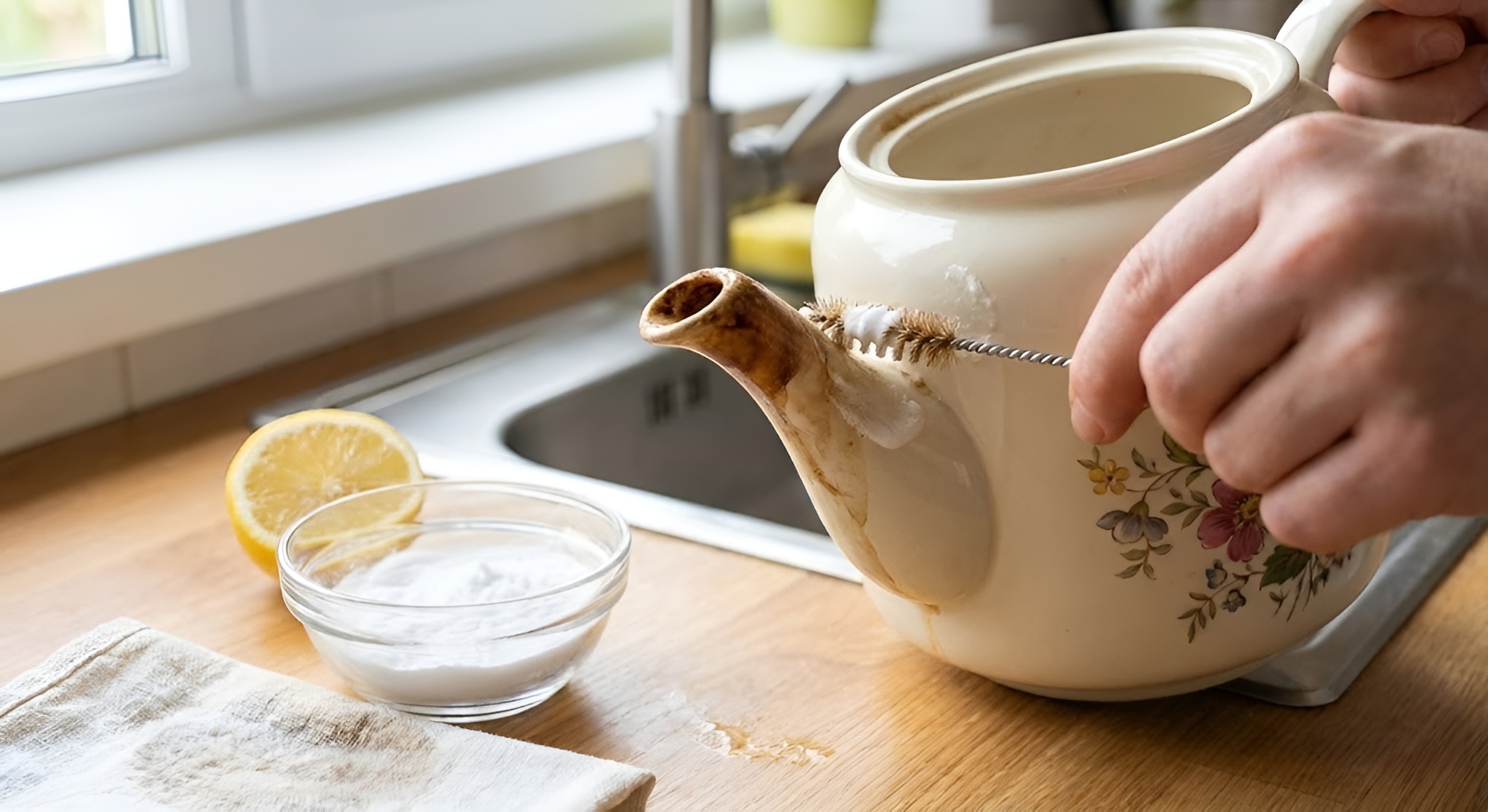
The Anatomy of a Clog: What is inside?
The brown gunk inside your spout isn't just "stain." It is a complex chemical lattice.
1. The Tannin Polymer: polyphenols-glossary.html" class="internal-link">Polyphenols (Thearubigins) in black tea oxidize and polymerize, forming sticky, dark chains that adhere to ceramic surfaces.
2. The Limescale Matrix: If you live in a hard water area, Calcium Carbonate precipitates out of the water as it cools. This scale acts like a microscopic concrete, trapping the sticky tannins in layers. This combination is often called "Tea Stone" (Tea Scale). Read more about Tea Scum here.
3. The Biofilm Risk: Because the spout stays damp and warm, and contains organic nutrients (tea sugars/oils), it is a prime breeding ground for mold and bacteria if not dried properly. A sour smell from a dry teapot usually comes from the spout.
Essential Tool Kit
You cannot clean a spout with a sponge. You need mechanical reach.
- Spout Brushes: These look like tiny bottle brushes. Look for nylon bristles for glass/porcelain (scratch-free) and stiffer natural bristles for cast iron.
- Pipe Cleaners: For very narrow or curved spouts (like a Gooseneck kettle), standard brushes won't fit. Chenille craft pipe cleaners are flexible and effective.
- Cotton Swabs (Q-Tips): Perfect for cleaning the very tip (lip) of the spout where dribbles dry and crust.
- Sodium Percarbonate: The active ingredient in OxiClean. It releases hydrogen peroxide and soda ash, dissolving organics without the toxicity of chlorine.
Need the Right Gear?
We reviewed the best teaware cleaning tools, including the perfect sized spout brushes and safe cleaning powders.
Review: Best Teaware Maintenance KitsMethod 1: The Chemical Soak (For Porcelain & Glass)
This is the "Hands-Off" method for removing heavy buildup in robust materials.
The Solution: Dissolve 1 tablespoon of Sodium Percarbonate (or a denture cleaning tablet) in a bowl of boiling water.
The Submerge: Place the teapot in the bowl so the spout is fully submerged. If the pot floats, fill it with water first to weigh it down.
The Wait: Let it soak for 30 minutes. You will see vigorous bubbling. This oxygen reaction lifts the tannin polymer from the ceramic surface.
The Flush: Rinse thoroughly with hot water. The brown scale should flake off in chunks. Use a brush to remove any remaining residue.
The Spout Plug Trick
If you don't have a large enough bowl to submerge the whole pot, plug the end of the spout with a small cork, a piece of rolled-up paper towel, or even a wad of blu-tack. Then, fill the teapot with the cleaning solution until it flows into the spout. Let it sit. This concentrates the chemical action exactly where you need it.
Method 2: The Acid Ream (For Limescale)
If the blockage is white and crusty (limescale), oxygen bleach won't work well. You need acid.
The Acid: Use hot White Vinegar or a solution of Citric Acid powder.
The Application: Soak a pipe cleaner in the vinegar. Insert it into the spout and scrub back and forth ("reaming"). The acid dissolves the calcium carbonate matrix instantly.
The Rinse: Rinse with fresh water to remove the vinegar smell. If the smell persists, brew a "dummy" pot of cheap tea and discard it.
Method 3: Cast Iron (Tetsubin) Protocol
CRITICAL WARNING: Never use soap, vinegar, or abrasive scrubbers on the inside of a traditional cast iron Tetsubin. You will strip the mineral layer that protects against rust.
The Fix: For cast iron spouts, rely on heat. Fill the pot with water and bring it to a boil (if safe for stovetop) or fill with boiling water. Let it stand for 10 minutes to soften the residue. Use a soft natural fiber brush to gently dislodge the buildup. If rust appears, simply boil green tea leaves in the pot; the tannins will react with the rust to form a protective black seal (Ferric Tannate). Read more about Tetsubin care.
Method 4: The Yixing Challenge (Unglazed Clay)
Yixing clay is porous. It absorbs everything. DO NOT use vinegar, soap, bleach, or sodium percarbonate. These chemicals will soak into the clay and ruin the flavor of every future brew.
The Physical Only Method:
1. Boil: Submerge the entire teapot in a pot of clean boiling water for 30 minutes. This helps loosen oils and kill bacteria.
2. Physical Scrub: Use a dedicated brush (used only for tea) to scrub the spout.
3. Flow Check: Pour water through the spout. If flow is still restricted, use a specialized Teapot Needle (often included in Gongfu tea sets) to gently clear the filter holes at the base of the spout. Be extremely gentle; Yixing clay is brittle. Deep dive into Yixing maintenance here.
Fixing the "Dribble"
Why do dirty spouts dribble? It's physics. Liquid relies on Surface Tension to cling to the lip of the spout. A clean, smooth ceramic surface allows water to break cleanly and pour in a laminar arc. A spout rough with limescale increases adhesion, causing the water to cling to the underside and run down the pot. Often, simply descaling the very tip of the spout fixes a dribbling pot completely.
Preventative Maintenance: The Daily Rinse
The best way to clean a spout is to never let it get dirty.
- Immediate Rinse: Rinse the pot with hot water immediately after use. Do not let tea leaves or liquid sit in the pot overnight.
- Dry the Spout: After rinsing, insert a rolled-up corner of a paper towel into the spout to wick away moisture. This prevents biofilm growth.
- Soft Water: Using filtered water prevents the limescale matrix from forming, which means tannins have nothing to cling to. Learn about water filtration here.
Comments