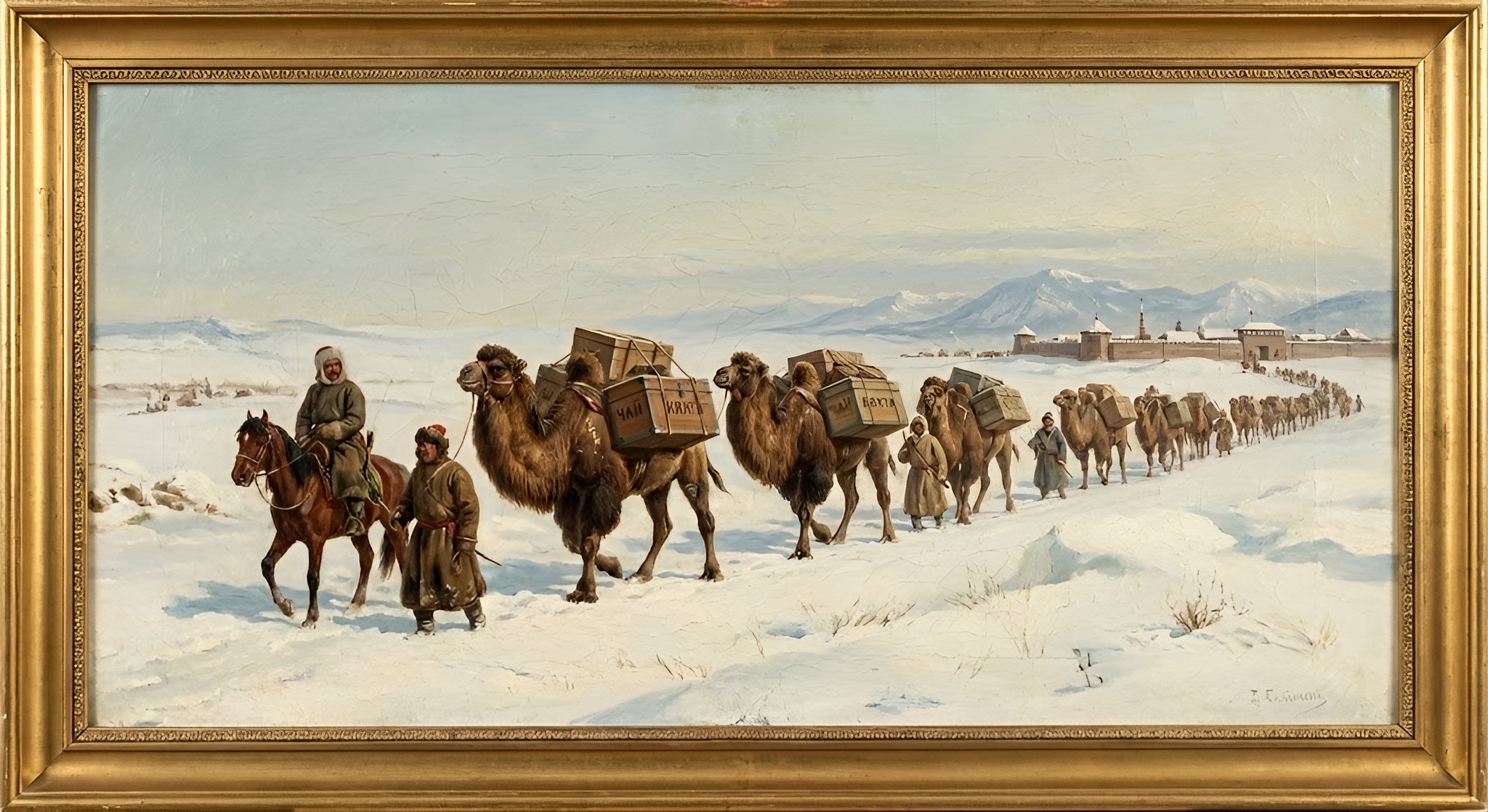
The First Cup: A Gift to the Tsar
While the British and Dutch were discovering tea via maritime trade routes in the 17th century, the Russians discovered it overland. The story begins in 1638, when the Russian ambassador Vasily Starkov was sent on a diplomatic mission to the Mongol Altan Khan.
At the end of his visit, the Khan offered Starkov a parting gift: 64 kilograms (about 200 tea bricks) of dried leaves. Starkov was insulted. He had no use for "dead leaves" and famously tried to refuse, asking for sable furs instead. The Khan insisted, and Starkov reluctantly hauled the load back to Moscow to present to Tsar Michael I.
To everyone's surprise, the Tsar and his court loved the beverage. It was initially used as a medicine to cure stomach ailments, but its stimulating effects soon made it a favorite of the aristocracy. However, unlike in England where tea prices dropped relatively quickly, in Russia, tea remained a luxury for the ultra-rich for nearly a century due to the extreme difficulty of the trade route.
The Treaty of Nerchinsk & The Tea Road
Trade between Russia and China was chaotic and dangerous until 1689, when the two empires signed the Treaty of Nerchinsk. This treaty established the official border and designated the town of Kyakhta (south of Lake Baikal) as the sole legal trading post.
This marked the beginning of the "Great Tea Road" (Sibirsky Trakt). The route was brutal:
- Origin: Tea was harvested in the Wuyi Mountains of Fujian and the brick tea factories of Hankou.
- The Desert: Camel caravans carried the tea across the Gobi Desert to Urga (modern Ulaanbaatar).
- The Border: The tea was transferred to sleds or carts to cross the border at Kyakhta.
- The Tundra: From Kyakhta, it traveled across the frozen Siberian tundra, passing through Irkutsk and Tomsk, before finally crossing the Ural Mountains to Moscow and St. Petersburg.
The entire journey took 16 to 18 months. Because of the logistics, the price of tea in Moscow was often ten times higher than in Europe.
Expert Tip: Sea vs. Land
The Russians claimed their tea was superior to the British "Canton Tea." They argued that the dry desert air of the caravan route preserved the leaf's quality, whereas the damp, salty air of a ship's hold caused the tea to rot or ferment. In reality, the difference was likely grading: the Russians were buying premium whole leaf Keemun, while the British East India Company often bought cheaper broken grades for the mass market.
The border town of Kyakhta became legendary. It was known as the "City of Millionaires." Because the Chinese did not want Russian rubles, the trade was entirely barter-based. The Russians brought furs—sable, ermine, and fox—trapped in the Siberian wilderness. The Chinese brought tea.
The exchange rate was standardized: one chest of tea for one sable pelt. The merchants of Kyakhta became fabulously wealthy, building palatial homes and churches in the middle of the frozen wilderness. It was said they drank champagne for breakfast and lit their pipes with banknotes, such was the profitability of the "Green Gold."
Tea Bricks: The Edible Currency
While the aristocracy in St. Petersburg drank loose leaf tea, the nomadic tribes of Siberia and Mongolia drank Brick Tea. To make transport easier, lower-grade tea leaves, stems, and twigs were ground up, steamed, and compressed into rock-hard blocks (bricks) using ox blood or flour as a binder.
These bricks were so durable and valuable that they became the de facto currency of the steppe. In Siberia, you could buy a sheep for 12 tea bricks and a horse for 20. The bricks were scored on the back so they could be broken into "change."
Unlike the delicate brew of the Tsar, brick tea was prepared as a soup. A chunk was broken off, boiled with yak butter, salt, and grain, creating a high-calorie meal essential for survival in the cold climate.
Busting the "Smoky" Myth
If you buy a "Russian Caravan" blend today from a Western tea shop, it will taste intensely smoky. The marketing story is seductive: the tea absorbed the smoke from the camel drivers' campfires during the long nights on the steppe.
Historians largely agree: this is a myth.
The tea chests transported by caravan were hermetically sealed. They were lined with lead foil and wrapped in layers of paper and hide to protect the valuable cargo from snow, rain, and—crucially—odors. If a shipment of high-grade Keemun arrived in St. Petersburg smelling of campfire smoke, the merchant would have considered it ruined.
The smoky flavor we associate with Russian tea today likely comes from two sources:
- Lapsang Souchong: Later blends incorporated this pine-smoked tea from Fujian to add depth or mask staleness in lower-grade leaves.
- Western Invention: British blenders likely created the "smoky" profile to differentiate the product in a crowded market, romanticizing the rugged journey of the tea.
Expert Tip: The Modern Blend
A typical "Russian Caravan" blend today consists of three components: Oolong (for body), Keemun (for the classic wine-like Chinese flavor), and a small amount of Lapsang Souchong (for the smoky note). If you find the smoke too overpowering, look for blends that list Keemun as the first ingredient. Read our guide to Lapsang Souchong here.
The Samovar: A Steam Engine for Tea
As tea became more available, Russia developed its own unique brewing technology: the Samovar ("Self-Boiler"). The Russian winter is long and brutal. A simple teapot would go cold in minutes. The Samovar solved this.
It is a large metal urn with a central chimney running through it. Burning charcoal (or pine cones) is placed in the chimney, heating the water surrounding it and keeping it at a rolling boil all day. On top of the Samovar sits a small teapot containing the Zavarka.
Zavarka is a wildly strong tea concentrate—essentially an espresso of tea. It is brewed black and bitter. To serve tea, you pour a small amount of Zavarka into a cup and then use the spigot on the Samovar to dilute it with boiling water. This genius system allowed a single pot of tea to serve dozens of guests, each adjusting the strength to their liking. "Weak" tea for children, "strong" tea for the weary traveler.
Varenie and the Sugar Cube
Russian tea culture is inseparable from sweets. Because tea was bitter and sugar was expensive, Russians developed unique ways to sweeten their brew without wasting precious sugar.
- Varenie: This is a whole-fruit preserve, similar to a runny jam. Instead of putting it on toast, Russians eat a spoonful of Varenie alongside their tea, or stir it directly into the cup. The fruit (often cherry, strawberry, or raspberry) provides sweetness and flavor.
- Sugar Prise (vprikusku): Instead of dissolving sugar in the tea, older generations would hold a hard lump of sugar between their teeth and sip the tea through it. This sweetened the tea as it entered the mouth, making a small piece of sugar last for several cups.
- Lemon: Lemon was often added to mask the mineral taste of the water or the staleness of tea that had traveled for months. This "Russian Tea with Lemon" became the standard way tea was served across continental Europe.
Expert Tip: The Podstakannik
If you travel on a Russian train today, your tea will be served in a glass set inside a metal holder with a handle. This is a Podstakannik. It was invented because thin glass would shatter from the heat, and handles were hard to manufacture on glass. The metal holder protects the fingers from the burning glass. It is an icon of Russian railway travel.
The End of the Caravan
The romantic era of the camel caravan came to an abrupt end in 1903 with the completion of the Trans-Siberian Railway. The journey that once took 18 months could now be completed in weeks. The cost of transport plummeted.
Simultaneously, the opening of the Suez Canal (1869) allowed steamships to bring tea from China and India to Odessa on the Black Sea faster than ever before. The "City of Millionaires," Kyakhta, fell into decline, becoming a ghost town as the trade routes shifted.
Tea transformed from an aristocratic luxury into the beverage of the masses. By the time of the Russian Revolution in 1917, tea was considered a basic necessity for every worker and soldier. Today, Russia remains one of the largest tea importers in the world, and while the camels are gone, the Samovar remains the warm, beating heart of the Russian home.
Comments