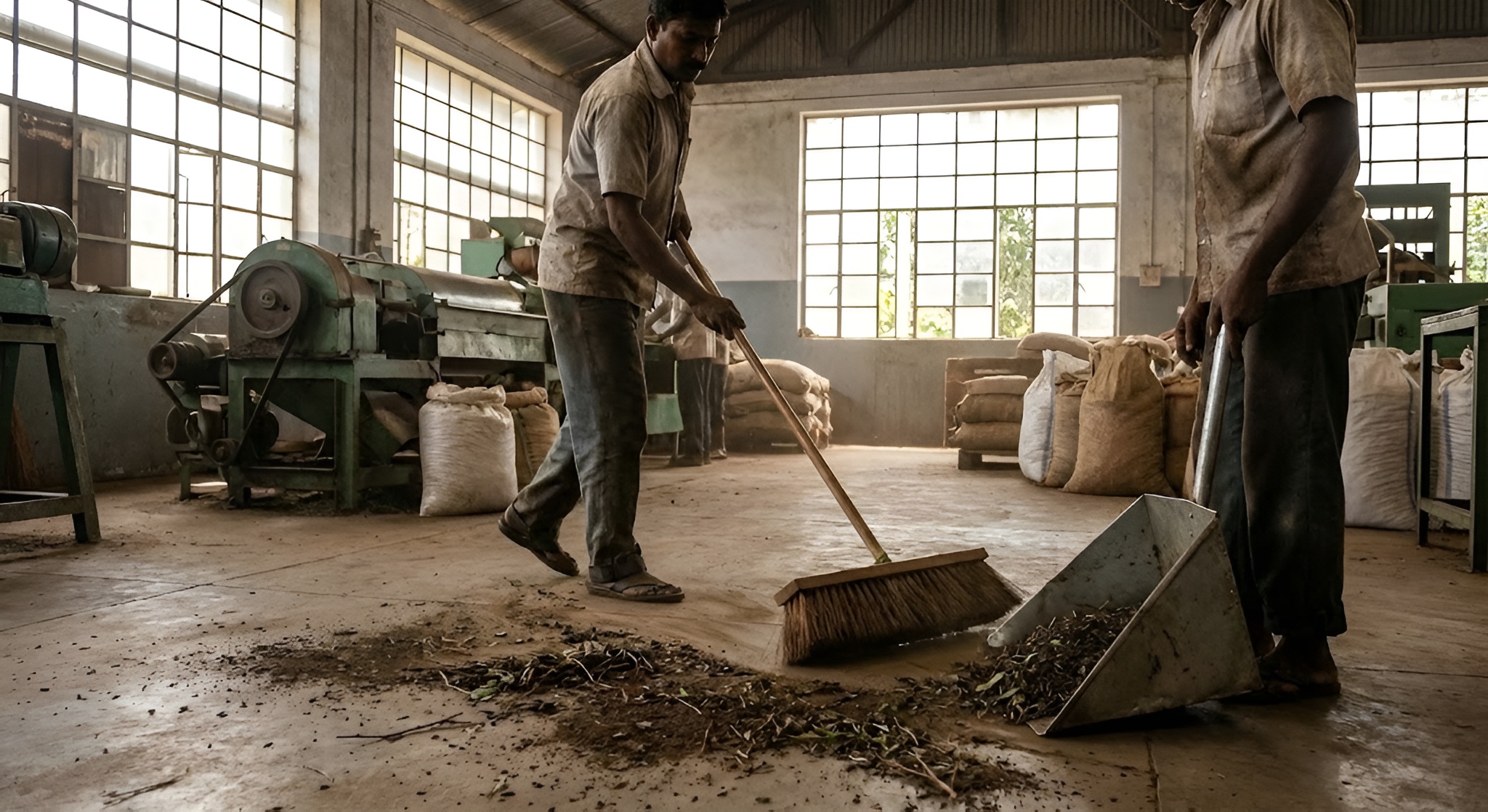
1. The "Floor" Myth vs. Factory Reality
Let's address the hygiene aspect first. Modern tea factories, particularly in Kenya and Assam (where most tea bag tea comes from), are highly mechanized, food-safe environments. The tea moves from withering troughs to rollers to dryers on conveyor belts.
At the end of the line, the tea passes through Optical Sorters and Vibrating Sieves. These machines separate the tea by particle size. The large leaves go into one bin, the smaller broken leaves into another, and the finest particles into a third. At no point does a human with a broom sweep anything off the floor. That would be a massive health code violation[1].
2. Understanding Grades: Pekoe vs. Dust
In the tea industry, "Dust" is not a dirty word. It is a technical grade. The grading system relies on sieve size:
- Orange Pekoe (OP): Whole, long leaves. Visual appeal, subtle flavor.
- Broken Orange Pekoe (BOP): Smaller chunks. Faster brew, medium strength.
- Fannings: Small particles (grain of sand size). Very strong.
- Dust: The finest particles. Instant extraction.
Premium tea bags usually contain a mix of BOP and Fannings. Cheap bags contain mostly Dust. But crucially, it is all the same leaf. The "Dust" grade often sells for a higher price in local Indian markets than the whole leaf because it makes a stronger cup of chai.
3. The Physics of Flavor: Surface Area
Why do manufacturers chop the tea up? It's simple physics.
Surface Area = Extraction Speed.
A whole leaf takes time to uncurl. Water has to penetrate deep into the leaf structure to pull out the flavor compounds (the polyphenols and caffeine). This takes 3 to 5 minutes.
A tiny particle of "Dust" has massive surface area relative to its volume. The water hits it and instantly extracts the color and tannins. This is why a tea bag turns the water dark brown in 30 seconds. It is designed for the "Quick Brew"—perfect for the morning rush when you need a caffeine hit, fast.
When Dust is Actually Better
If you are making Masala Chai, you want dust or fannings. Whole leaves are too subtle to stand up to the boiling milk and spices. The dust grade provides the "body" and "grip" that cuts through the fat. Check our reviews of the Best Strong Chai Bags →
4. CTC vs. Orthodox: The Manufacturing Split
The tea in your bag wasn't "accidentally" broken; it was likely manufactured using the CTC Method (Cut, Tear, Curl). Invented in the 1930s, this machine passes withered leaves through toothed rollers that crush and tear them into tiny, uniform pellets[2].
| Feature | Orthodox (Loose Leaf) | CTC (Tea Bag) |
|---|---|---|
| Appearance | Twisted, whole leaves | Small, round pellets |
| Processing | Gentle rolling | Aggressive crushing |
| oxidation | Slow, nuanced | Rapid, complete |
| Flavor Profile | Floral, fruity, complex | Malty, bold, brisk |
| Best With | Plain water | Milk and Sugar |
5. The Real Problem: Staling and Materials
If the leaf isn't "trash," why do tea bags often taste worse than loose leaf? Two reasons:
- Staling: That massive surface area is a double-edged sword. While it allows fast brewing, it also allows fast oxidation. Oxygen attacks the tiny particles, causing the essential oils to evaporate quickly. A tea bag goes "stale" months faster than whole leaf tea.
- The Bag Itself: Many cheap bags use bleached paper or contain microplastics (polypropylene) to seal the edges. This can impart a papery taste. (Always look for plastic-free, biodegradable bags).
The "Quality Check" Test
Instructions:
- The Cold Brew Test: Place a tea bag in a glass of cold water.
- Watch the Color: High-quality CTC tea will release amber swirls slowly. If the water turns murky brown/grey instantly, it may be heavily dyed or extremely old "dust."
- Open the Bag: Cut a dry bag open. The contents should look like uniform grains of sand (CTC). If it looks like grey, fluffy dust or powder, it is low-quality residue.
6. Verdict: Don't Be a Snob, Be Specific
There is a time and place for "Dust." If you want a delicate afternoon experience to sip without milk, choose Orthodox Loose Leaf. But if you want a punchy, wake-up-call mug of tea with milk and sugar (or salt!), a high-quality CTC Tea Bag is actually the superior chemical choice.
The "floor sweepings" myth is just that—a myth designed to make loose-leaf drinkers feel superior. The reality is just efficient engineering.
Scientific References
- Hampton, M. G. (1992). Production of black tea. in Tea: Cultivation to consumption (pp. 459-511). Chapman & Hall.
- Werkhoven, J. (1974). Tea processing. FAO Agricultural Services Bulletin.
Comments