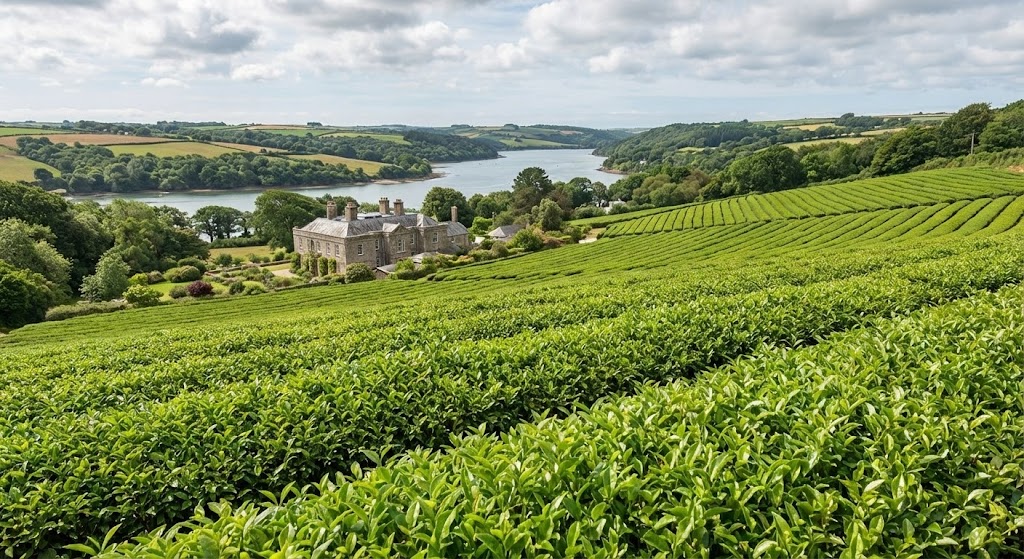
1. Tregothnan: The Estate That Changed Everything
To understand English tea, you have to understand Tregothnan. This isn't a new startup; the Boscawen family has lived on this estate near Truro since 1334. But the tea story really begins in the early 19th century, when the family introduced ornamental Camellias to the UK outdoors. At the time, Victorian botanists scoffed, believing these delicate Asian flowers needed heated glasshouses to survive the British winter. They were wrong then, and the tea skeptics were wrong in 1999.
The Science of the "Fal Estuary"
How does tea survive here when it freezes in London? The secret is the Fal Estuary. This deep-sea creek acts as a massive thermal battery. Water has a high specific heat capacity, meaning it holds onto heat much longer than air or soil. During the day, the tidal river absorbs solar energy; at night, it releases it slowly, moderating the air temperature in the valley. This creates a frost-free zone that is technically warmer than Darjeeling in winter.
While tea bushes in the Himalayas go dormant in winter due to the altitude and cold, Cornish tea plants often keep growing, albeit very slowly. This continuous, slow metabolic rate creates a leaf structure that is robust, thick, and rich in complex carbohydrates. This translates to a cup that is naturally sweeter and less astringent than a fast-grown tropical tea. It is "stress-grown," a concept we see taken to the extreme in the tea gardens of Scotland.
Expert Tip #1: The Manuka Factor
Walk through the tea gardens at Tregothnan, and you'll see tall hedges of Manuka (Leptospermum scoparium) protecting the tea bushes. These aren't just for show. Manuka, native to New Zealand, thrives in the same soil. It acts as a windbreak, protecting the tea from salt-laden Atlantic gales, and provides nectar for bees. Some experts believe the tea actually picks up a subtle, honeyed floral note from growing in such close proximity to the Manuka flowers.
2. The Jersey Tea Company: Island Terroir
If Cornwall is the "Darjeeling of the West," then Jersey is the "Taiwan of the Channel." Further south, on the island of Jersey, another quiet revolution is happening. The Jersey Tea Company is a small, artisanal operation that is redefining what British tea can be. Jersey is technically a Crown Dependency, but geologically and culturally, it's a key part of this story.
Jersey has a unique terroir. It boasts the highest sunshine hours in the British Isles but maintains a maritime climate that ensures high humidity—vital for keeping tea leaves soft and pliable. The soil is granite-based, ancient, and rich in minerals, imparting a distinct "minerality" to the tea, often described as having a crisp, clean finish reminiscent of a sea breeze.
Hand-Rolled Perfection
The Jersey Tea Company differentiates itself through processing. While much of the global tea industry relies on mechanization (CTC machines that crush the leaf), Jersey focuses on Whole Leaf, hand-processed teas. They pluck the "two leaves and a bud" by hand and then roll the leaves manually. This is labor-intensive and expensive, but it preserves the cellular integrity of the leaf. Unlike the mechanized industry that produces tea for bags, hand-rolling allows the leaf to uncurl slowly in the pot, releasing flavor in complex layers over multiple infusions.
Expert Tip #2: Is it Green or Oolong?
Jersey's green tea is fascinating. It is steamed (Japanese style) but rolled by hand (Chinese style). This creates a flavor profile that is often compared to high-end Taiwanese Oolongs rather than grassy Sencha. It is savory, sweet, and has a texture that coats the mouth. If you usually find green tea bitter, try Jersey tea. It's a completely different experience.
3. The "Classic" Debate: Blended vs. Single Estate
If you buy a box of "Tregothnan Classic," you are drinking a blend. This often confuses new buyers who expect 100% English leaves. "Wait, I paid £15 for this, why is there Assam in it?" The answer lies in two very practical realities of British agriculture.
1. Volume Constraints: English estates are tiny. Tregothnan has about 20,000 bushes. That sounds like a lot, but it is a drop in the ocean compared to a single estate in Assam which might have millions. They simply cannot produce enough volume to supply the supermarkets or export markets alone. Blending allows them to stretch the precious domestic crop to meet demand, ensuring that "English Grown" tea is accessible to more people.
2. The British Palate: We like our tea strong. The British palate is trained on Assam (Malty) and Kenyan (Bright) tea. We want it dark, tannic, and able to stand up to milk and sugar. English-grown tea is naturally lighter and more floral (closer to Darjeeling or a light Oolong). If you gave a builder a cup of 100% pure Cornish tea, they might find it too weak or "perfumed." By blending the home-grown leaves with premium Assam, Tregothnan creates a tea that feels familiar—it has the body and punch of a breakfast tea—but has a unique, fresh "English" top note that lifts the whole experience.
However, if you want purity, look to Wales. The Peterston Tea Estate focuses almost exclusively on single-estate, unblended teas, offering a purer (but lighter) expression of British terroir.
Taste the Revolution
We reviewed Tregothnan's Classic Tea alongside the single-estate teas from Scotland and Wales. Which one is right for your palate?
Review: Best UK Grown Teas4. Sustainability and the "Food Miles" Argument
The biggest argument for English tea isn't just taste; it's environmental. Most tea travels 5,000 miles to reach your cup, shipping from India, Kenya, or China. It sits in container ships for weeks, potentially losing freshness or absorbing moisture. Tregothnan tea travels maybe 200 miles to London. For UK residents, it is arguably the lowest-carbon tea available.
The estates also practice Regenerative Agriculture. They typically use no pesticides because the pests that plague tropical tea gardens (like the tea mosquito bug) simply don't exist in the English winter. The cold weather acts as a natural insecticide. Furthermore, estates like Tregothnan encourage biodiversity. They are home to the world's only "Bee Brick" hotel in a tea garden, supporting pollinators that are crucial for the Manuka honey production. Drinking this tea isn't just a novelty; it supports a model of agriculture that is kinder to the planet and supports local British ecosystems.
Expert Tip #3: Afternoon Tea Pairing
Because English-grown tea is lighter and more floral, it pairs exceptionally well with light afternoon tea snacks like cucumber sandwiches or Victoria Sponge. It doesn't need to be drowned in milk and sugar to taste good. Try drinking it black with a slice of lemon to highlight the citrus notes, similar to how you would treat a Welsh Black Tea.
5. The Cultural Impact: A New Identity
The success of Tregothnan and Jersey has changed the conversation around British tea. It has proven that tea is not just a colonial import; it can be a domestic crop. This has sparked interest in "Tea Tourism," with people visiting Cornwall specifically to walk through the tea gardens, something previously only possible in Asia. It has also forced big brands to up their game, realizing that consumers are becoming more educated about provenance.
Tregothnan isn't just famous; it's Royal. It was reportedly a favorite of Prince Philip, who planted a bush there himself. Drinking this tea is quite literally drinking a brew fit for royalty. It has become a symbol of British innovation and resilience, thriving in a climate where it has no business growing.
Expert Tip #4: Cooking with Tea
The floral notes of Cornish tea make it excellent for cooking. Use it to smoke fish, or infuse it into heavy cream for desserts. Check out our Tea-Glazed Scone Recipe for the ultimate British tea time experience.
Expert Tip #5: The Gift Factor
Because it is unique and beautifully packaged, English-grown tea makes the ultimate souvenir or gift. It is a conversation starter—"Did you know this tea was grown in Cornwall?"—that beats a standard box of Yorkshire Gold any day. It's a luxury item that tells a story.
Comments