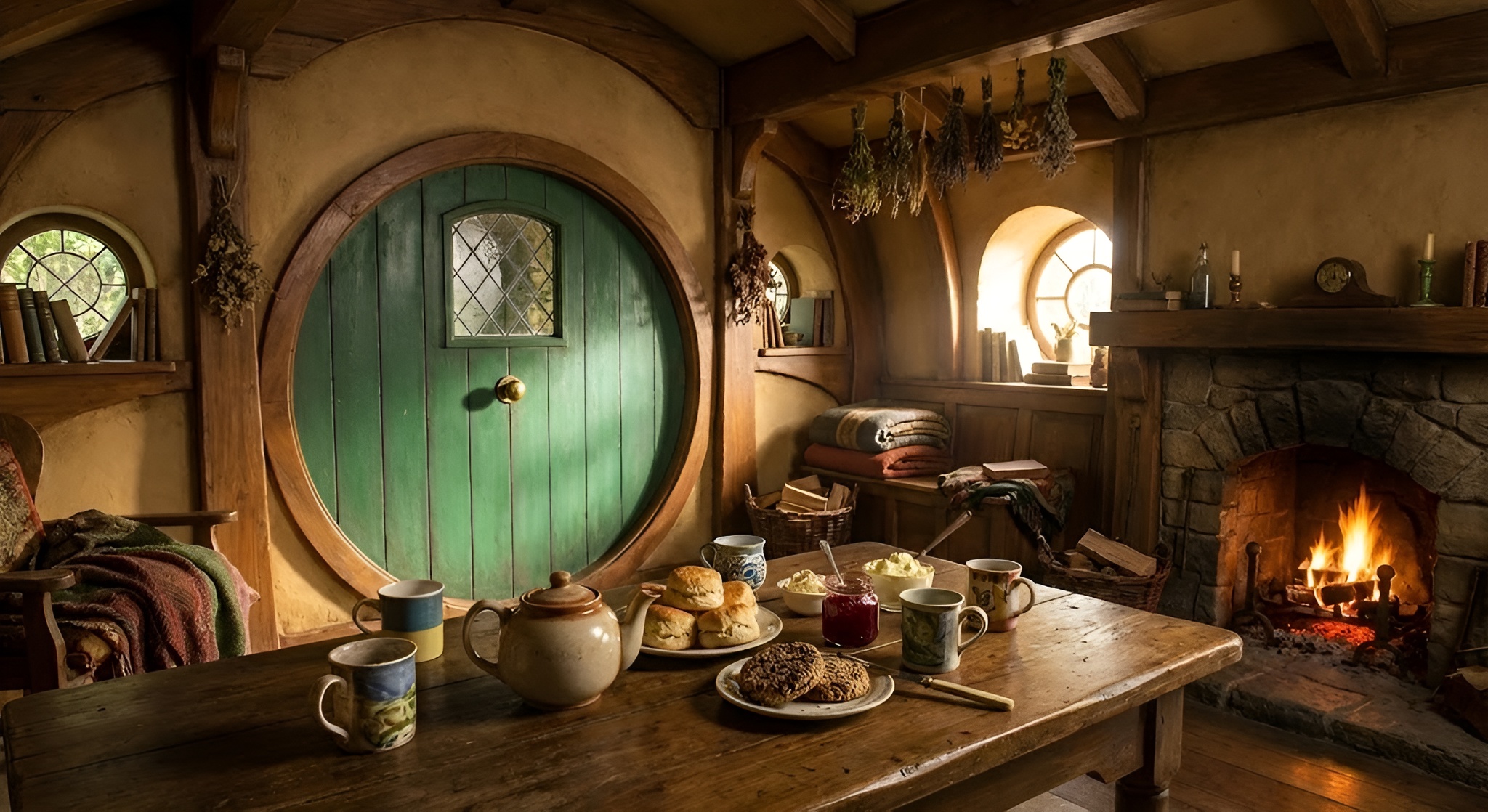
1. The Unexpected Party: An Etiquette Nightmare
The first chapter, "An Unexpected Party," is a comedy of manners that sets the tone for the entire saga. Bilbo has just sat down for tea (presumably around 4 PM) when the doorbell rings. One by one, thirteen dwarves arrive. They order ale, coffee, seed cakes, buttered scones, and mince pies.
The Violation of British Manners: In Edwardian England (Tolkien's inspiration), tea time was a sacred ritual of order. Guests were invited. The host poured. The food was dainty. The dwarves shatter this frame. They demand "red wine" and "raspberry jam." They treat Bilbo's pantry as a tavern.
Bilbo's distress isn't just about food shortage; it's about the disruption of his tea ritual. To a Hobbit, a missed tea is a tragedy. This scene establishes the central conflict: the comfortable, rule-bound world of the Hobbit versus the chaotic, hungry world of the Dwarves. Yet, Bilbo feeds them. His commitment to hospitality overrides his annoyance, proving his moral fiber before he even leaves the door.
Expert Tip: The "Seed Cake"
Balin specifically asks for "seed cake." This is a very traditional British cake flavored with caraway seeds (not poppy or sesame). It has a distinct, savory-sweet anise flavor that pairs perfectly with strong black tea. If you want to host your own Hobbit party, check out our guide to Pairing Tea with Traditional Cakes.
2. What Tea Did Hobbits Drink? (A Botanical Investigation)
Tolkien never specifies the cultivar of tea (Camellia Sinensis) in Middle-earth, but we can deduce it from the setting. The Shire is an agrarian, temperate society, modeled on the West Midlands of England.
A. English Breakfast (The Staple)
Hobbits are practical. They eat six meals a day. They need a strong, tannic tea to cut through the richness of buttered scones, bacon, and sausages. A sturdy English Breakfast or Assam would be the staple of Bag End. It provides the "comfort" and the caffeine needed to garden all day.
B. Smoky Tea (The Pipe-Weed Connection)
Hobbits love pipe-weed (tobacco). The aroma of smoke is associated with relaxation and home. It is highly likely they would appreciate a smoked tea like Lapsang Souchong, which mimics the comforting aroma of a hearth fire or a pipe. This tea pairs exceptionally well with the savory cheeses and cold meats found in a Hobbit pantry.
C. Herbal Forage
Being close to nature, Hobbits would certainly brew what they grow. Nettle Tea, Sage, and Chamomile would be pantry staples for medicinal purposes. Nettle, in particular, is a traditional British forage plant rich in iron—perfect for a weary traveler.
Expert Tip: Earthenware Pots
Bilbo likely used earthenware or stoneware teapots (like a classic Brown Betty). These retain heat well—essential for a long, lingering "Second Breakfast." Fancy porcelain would be too fragile for a Hobbit's hairy feet and clumsy guests. See our guide to Earthenware Teapots.
3. "Second Breakfast" & The Meal Schedule
The concept of "Second Breakfast" has become a meme, but it speaks to the Hobbit philosophy: life is for enjoying. Hobbits eat: Breakfast, Second Breakfast, Elevenses, Luncheon, Afternoon Tea, Dinner, and Supper.
Elevenses: This is the prime tea hour (11:00 AM). It bridges the gap between breakfast and lunch. It is usually lighter—a cup of tea and a biscuit. In the wild, Aragorn tosses an apple to Pippin for "Second Breakfast," highlighting the brutal contrast between the comforts of the Shire and the reality of the road.
When Bilbo leaves the Shire without his pocket handkerchief, he is leaving behind civilization. But leaving behind his kettle? That is leaving behind his soul. The journey is defined by the absence of tea.
4. Tea as the "Anchor" to Sanity
Throughout the journey to the Lonely Mountain, Bilbo constantly dreams of his home. Specifically, he dreams of his kettle whistling. In the dark of Mirkwood or the desolation of Smaug's mountain, the memory of tea keeps him grounded.
This is a common literary trope: the "pastoral anchor." Tea represents the world that is worth saving. Why fight the dragon? So that one day, you can sit in your armchair and have a cup of tea in peace. It frames the entire quest not as a search for gold, but as a defense of the simple life.
Tolkien wrote The Hobbit and Lord of the Rings during the rise of industrial warfare. The Shire's tea culture is a stand-in for the humanity that war threatens to destroy. As Thorin Oakenshield says on his deathbed: "If more of us valued food and cheer and song above hoarded gold, it would be a merrier world."
"At Your Service"
The phrase "At your service and your family's" is standard Hobbit politeness. It implies a readiness to host. When Bilbo eventually serves tea to the dwarves, he is fulfilling this oath literally. He serves them, despite his annoyance, proving that his manners (and his tea supply) are stronger than his fear. This adherence to protocol is what eventually helps him outwit Gollum (a creature who has forgotten manners entirely).
5. The Legacy: Tea in Fantasy
Tolkien's use of tea established a trope in fantasy literature: the cozy inn. From the Prancing Pony to the inn at the crossroads, tea and ale are the signals of safety. When characters drink tea, the monsters are held at bay.
In modern adaptations, tea scenes are often used to show character vulnerability. Bilbo fussing over his tea set makes him relatable. He isn't a warrior; he's a person who misses his creature comforts. This makes his eventual bravery even more impressive. He isn't fearless; he is just a tea-drinker doing his best.
6. Conclusion: The Road Goes Ever On
In the end, Bilbo returns to Bag End. The kettle sings again. But the tea tastes different now. He has seen elves, dragons, and mountains. The ritual of tea is no longer just a habit; it is a hard-won luxury.
So, the next time you feel "butter scraped over too much bread," or the urge to run out the door without your handkerchief, brew a strong cup of Assam. Drink it for Bilbo, for Thorin, and for the simple joy of a filled pantry.
Build Your Hobbit Pantry
Want to stock up like a Baggins? We curated a list of the best "rustic" teas and accessories for a cozy Shire afternoon.
Review: Best Everyday "Builder's" TeaRelated Reading in Literature & Film
- Narnia's Mr. Tumnus Tea: CS Lewis's Moral Infrastructure
- Emma: Tea as Social Currency in Regency England
- The Remains of the Day: Butler's Tea Service as Emotional Repression
- Brideshead Revisited: Tea, Class, and Aristocratic England
- Agatha Christie's Tea Murders: Poison and Afternoon Tea
- Cranford: Victorian Ladies Governing Through Tea
- Doctor Who's Tea Culture: 60 Years of British Tea
- Sense and Sensibility: Tea as Social Survival Exam
Comments