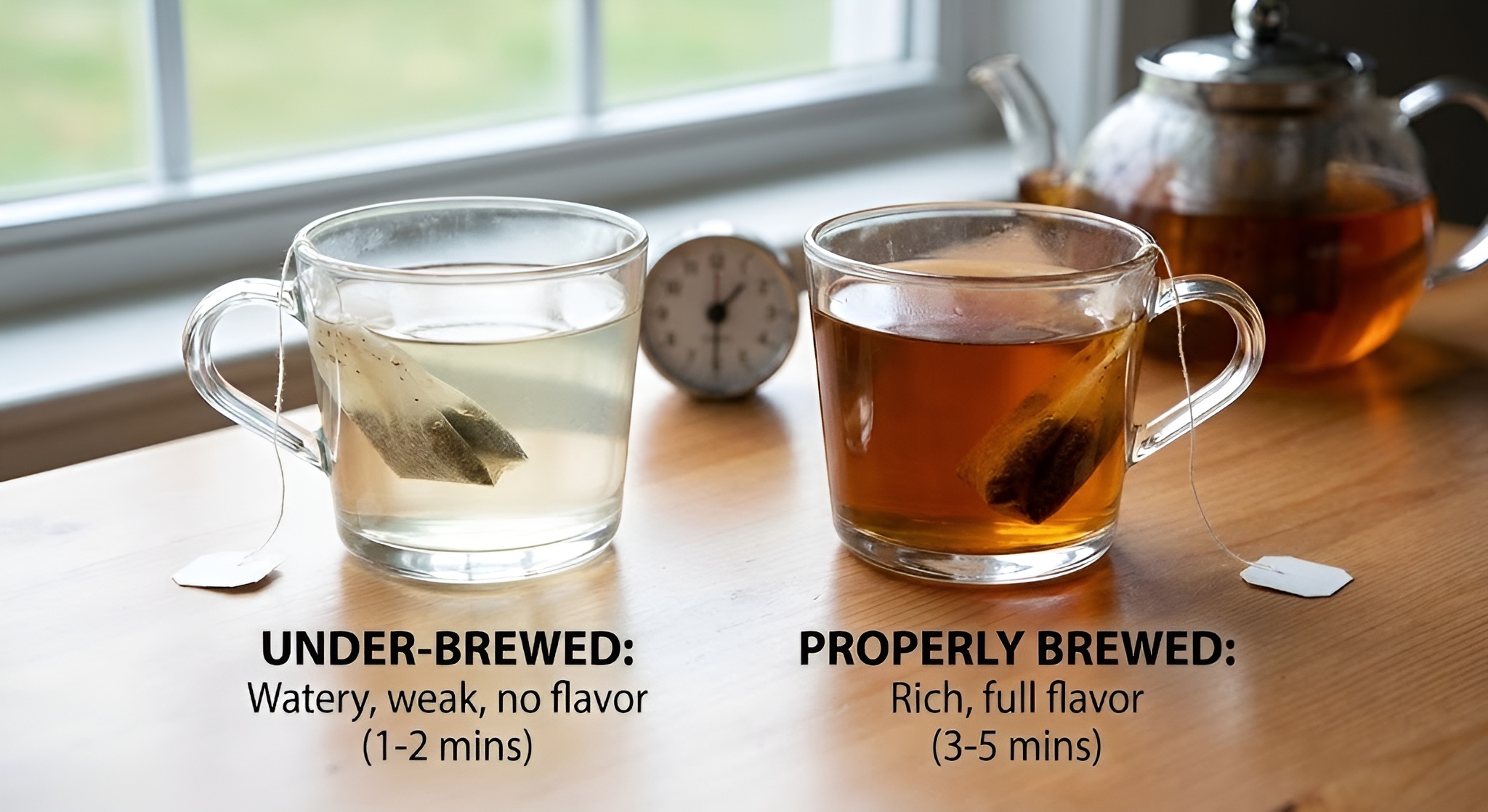
1. The Leaf-to-Water Ratio (The #1 Mistake)
The most common reason for weak tea is simple physics: dilution. Most standard tea bags contain 1.5g to 2g of tea dust. This amount is designed to brew a small, traditional teacup (approx 150-200ml).
However, modern mugs are massive. A standard "Sports Direct" or office mug can hold 350ml to 450ml of liquid. If you put one standard tea bag into a 400ml mug, you are effectively using half the required amount of tea. The result is a watery, weak brew.
The Fix:
- Two Bags: If you use a large mug, use two tea bags.
- Weigh It: If using loose leaf, use the "Golden Ratio" of 2.5g of tea per 200ml of water. Don't guess with a teaspoon; leaf sizes vary wildy. Learn more about weighing tea here.
Visualizing the Ratio
Think of it like cordial. If you put a drop of cordial in a pint of water, it tastes like water. Tea compounds need a specific concentration to register on your palate.
2. Temperature Trouble (Too Cool = Weak)
Extraction is driven by heat. The hotter the water, the faster the molecules move, and the more effectively they can pull flavor out of the leaf. This is especially critical for Black Tea and Pu-erh.
The Problem: Many people boil the kettle, then let it sit while they find a mug, or they pour the water from high up (cooling it down as it falls). By the time the water hits the tea bag, it might be 85°C. For a robust English Breakfast or Assam, 85°C is too cold. It will extract some color, but the heavy, malty polyphenols that give tea its "body" require 95°C - 100°C to dissolve properly.
The Fix: Pour the water the second it boils. Keep the kettle spout close to the cup. Check our comprehensive Brewing Guide for temperature charts.
Pre-Heat Your Mug
If you pour boiling water into a cold ceramic mug, the ceramic instantly absorbs the heat, dropping the water temperature by 10-15°C in seconds. This kills extraction. Always swirl a little hot water in your mug to warm it up before brewing.
3. Time (Patience is Flavor)
Are you a "Dunker"? Dunking a tea bag 5 times and throwing it away is not brewing. It is rinsing.
Tea needs time for Diffusion. Water needs to penetrate the dry leaf, hydrate the cells, dissolve the compounds, and diffuse back out into the cup.
- The First Minute: Mostly caffeine and color comes out.
- The Second Minute: Essential oils and aroma release.
- The Third Minute: Tannins (body/astringency) release.
If you stop at minute 1, you have colored caffeine water. You need at least 3-5 minutes for black tea to develop "mouthfeel." Learn why astringency is important here.
Cover It Up!
While waiting for those 3-5 minutes, cover your mug with a saucer or lid. This traps the heat (keeping extraction active) and prevents the volatile aroma oils from evaporating into the room. If you can smell the tea in the air, that's flavor that isn't in your cup.
4. Water Chemistry (The Invisible Ingredient)
You can buy the most expensive tea in the world, but if your water is bad, it will taste flat.
- Hard Water (High Calcium): Calcium binds with tea polyphenols to form a "scum" layer on top. It prevents flavor compounds from dissolving fully, leading to a chalky, weak taste. What is Tea Scum?
- Distilled/RO Water: Water that is *too* pure (no minerals) can taste flat and aggressive.
- The Fix: Use filtered water to remove chlorine and excess calcium, or try a bottled spring water with a neutral pH (around 7).
Read our deep dive on Water Quality for Tea.
5. The Leaf Quality (Bagged vs. Loose)
If you have fixed your ratio, temperature, time, and water, and the tea is still weak, it's the leaf.
Stale Tea: Tea leaves absorb moisture. If your box of tea bags has been sitting open in the cupboard for 6 months next to the spice rack, it has likely absorbed moisture and gone stale. Stale tea loses its volatile oils, leaving only woody cellulose behind. Does Tea Expire? Find out here.
Dust Grade: Cheap supermarket tea bags use "Dust" grade tea. While this brews fast (color), it often lacks the complexity and depth of larger leaf grades (OP/FOP). The flavor curve spikes quickly and then drops off into bitterness without ever achieving "body." Upgrading to a better quality bag or Loose Leaf can instantly fix the "watery" problem.
To Squeeze or Not To Squeeze?
Should you squeeze the tea bag? For a stronger cup, Yes. Squeezing forces out the liquid trapped inside the bag, which is the most concentrated, tannin-rich part of the brew. However, this also releases more bitterness (tannins). If your goal is strength, squeeze away. If your goal is smoothness, let it drip.
Troubleshooting Checklist
| Symptom | Likely Cause | The Fix |
|---|---|---|
| Pale color, weak taste | Not enough leaf / Too much water | Use 2 bags or reduce water to 200ml. |
| Good color, weak taste | Water too cool / Hard water | Use boiling water instantly. Filter your water. |
| Bitter but thin body | Dust grade tea (Low quality) | Switch to Whole Leaf or higher grade bags. |
| Flat / Cardboard taste | Stale tea | Buy fresh tea. Store in airtight tin. |
Comments