The Collapse of Coffee: An Empire's End
For over 400 years, the Ottomans ruled the coffee trade. Coffee beans flowed freely and cheaply from Yemen, which was part of the Empire, to the coffeehouses of Istanbul. Coffee was social currency; it was hospitality; it was identity.
But in the aftermath of World War I, the Ottoman Empire disintegrated. Yemen was lost. Suddenly, coffee became an import—a foreign luxury that had to be bought with hard currency. The young Turkish Republic, founded in 1923 by Mustafa Kemal Atatürk, was economically shattered. It could not afford to bleed money importing beans from Brazil or Yemen.
Atatürk, a visionary pragmatist, realized the nation needed a new drink. It had to be something they could grow themselves, on their own soil, to ensure self-sufficiency. He looked at the map, and his finger landed on the wet, green coast of the Black Sea.
The Father of Turkish Tea: Zihni Derin
The man tasked with this agricultural miracle was Zihni Derin, an agronomist from Muğla. In the early 1920s, the eastern Black Sea region was suffering. The decline of the Russian Empire had cut off traditional labor markets, and the locals were destitute.
Derin visited Batumi in neighboring Georgia (then part of the USSR), where he saw tea gardens flourishing in a climate identical to Rize's. In 1924, armed with seeds and saplings from Batumi, Derin established the first tea nursery in Rize. The government passed Law No. 407, officially designating Rize as a tea-growing zone and offering subsidies to farmers who cleared their nut groves to plant tea.
It was a slow start. The first few decades were rife with failure as farmers learned how to process the leaf. But by 1947, production had scaled enough to open the first dedicated Tea Factory in the Fener district of Rize. The era of Turkish Tea had begun.
The Terroir: Snow on the Bushes
Rize is an anomaly in the tea world. Almost all other major tea regions—Kenya, Sri Lanka, Assam, Indonesia—are tropical or sub-tropical. They never see frost. Rize, however, sits at a high latitude for tea.
In winter, the steep gardens of Rize are frequently blanketed in snow. This harsh weather is the secret to Turkish tea's purity. In tropical climates, tea bushes are plagued by insects, mites, and fungi year-round, often necessitating heavy pesticide use. In Rize, the snow acts as a natural sterilizer. It kills off the pests and bacteria, allowing the bushes to rest.
As a result, Turkish tea is one of the only mass-produced teas in the world that requires zero pesticides. Even the standard, non-organic brands from Rize are chemically cleaner than many "premium" teas from other regions. This snowy dormancy also alters the chemistry of the leaf, giving it a rugged, thick structure that can withstand the intense boiling method used in Turkish brewing.
Expert Tip: The Three Flushes
Unlike Kenya, which harvests year-round, Rize has three distinct harvest seasons (flushes). The May Flush (First Flush) is considered the highest quality, bursting with stored winter nutrients. The July Flush is more abundant but slightly less flavorful. The September Flush is the final harvest before winter sets in. Connoisseurs always look for "Mayıs Çayı" (May Tea).
The Culture: Rabbit's Blood and Tulip Glasses
In Turkey, tea is not a mealtime drink; it is a lifestyle. It is the lubricant of social interaction. You cannot buy a carpet, wait for a bus, or visit a friend without being offered a glass of tea. To refuse is considered rude.
The vessel is just as important as the liquid. Turkish tea is never served in a porcelain cup with a handle. It is served in a small, clear, tulip-shaped glass called ince belli ("thin-waisted"). This shape is functional engineering:
- The Clear Glass: Allows you to admire the color. A perfect brew must be Tavşan Kanı—"Rabbit's Blood" red. If it's murky or brown, it's bad tea.
- The Thin Waist: Allows the tea at the bottom to stay hot, while the flared rim cools down enough for your lips.
- The Saucer: Holds the two sugar cubes (which are traditionally not stirred in, but held between the teeth while sipping—a style called kıtlama in Erzurum).
The Brewing Method: The çaydanlık
You cannot talk about Rize tea without talking about how it's made. Unlike the British "brew and remove" method, Turkish tea uses a double boiler called a çaydanlık.
- Bottom Pot: Boils plain water.
- Top Pot: Contains a very strong, bitter tea concentrate (dem) kept hot by the steam from below.
To serve, you pour a small amount of concentrate into a tulip-shaped glass and dilute it with the boiling water from the bottom kettle. This allows every guest to have their tea exactly as they like it: Koyu (dark/strong) or Açık (light/weak). This method allows one pot to serve an entire family with different preferences for hours.
Expert Tip: Why is it "Dusty"?
If you open a bag of Çaykur Rize Turist, you might be shocked by how small the leaves are. Unlike orthodox whole-leaf tea, Turkish tea is processed into small broken pieces. This is intentional. The small surface area allows for maximum extraction during the intense brewing process. It's not low quality; it's purpose-built for the çaydanlık.
Modern Challenges: Chernobyl and Labor
The history of Rize tea is not without its shadows. The 1986 Chernobyl nuclear disaster in nearby Ukraine sent a radioactive cloud drifting over the Black Sea coast right as the tea harvest was beginning. The Turkish government, fearing economic collapse, initially downplayed the risks, leading to a generation of controversy regarding radiation in that year's crop. Today, strict testing ensures safety, but the memory lingers in the region.
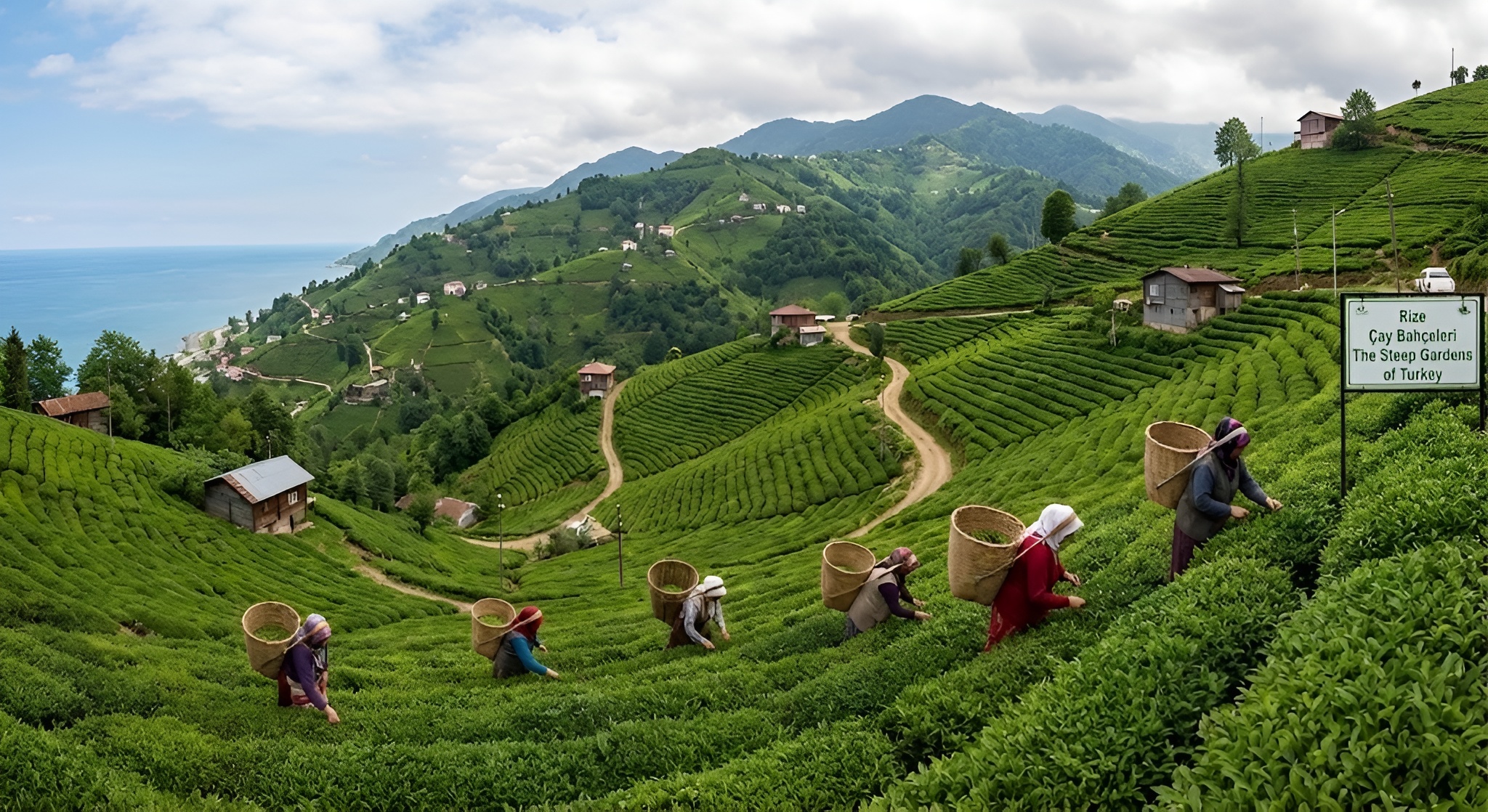
More recently, the challenge is labor. Picking tea on the near-vertical slopes of Rize is grueling, back-breaking work. As Turkey's economy modernized and young people moved to Istanbul for office jobs, the local labor force vanished. Today, the harvest is largely dependent on migrant workers from neighboring Georgia, who cross the border every season to pick the leaves that fuel Turkey's national habit.
Tea Tourism: The Ayder Plateau
Today, Rize is becoming a destination for "Tea Tourism." The lush Firtina Valley and the Ayder Plateau offer stunning views of emerald-green tea gardens rising into the clouds. Visitors can stay in wooden eco-lodges, pluck tea alongside the farmers, and visit the Çaykur research gardens to see the original bushes planted by Zihni Derin nearly a century ago.
From a desperate economic experiment to the beating heart of Turkish culture, the tea gardens of Rize are a testament to how agriculture can shape the destiny of a nation. So the next time you hold a tulip glass of ruby-red tea, remember: you are drinking the snow of the Pontic Mountains.
Comments