Why Tea Doesn't Leave Streaks (Unlike Soap)
Streak-free glass requires cleaner that evaporates without residue. Soap leaves streaks because surfactant molecules (sodium lauryl sulfate) don't fully evaporate—they leave microscopic film that diffracts light, visible as streaks. Tea contains no soap-like surfactants, only water-soluble tannins and polyphenols that evaporate completely with water, leaving zero residue. This chemistry applies broadly.
The chemistry: when tea dries on glass, only water evaporates (leaves at 100°C). Tannins and polyphenols are water-soluble, so wiping with damp cloth removes them completely vs soap residue which is amphiphilic (sticks to glass even when wiped). Result: tea-cleaned glass is optically clear, soap-cleaned has nano-film causing streaks. Similar principles apply to brewing and water chemistry.
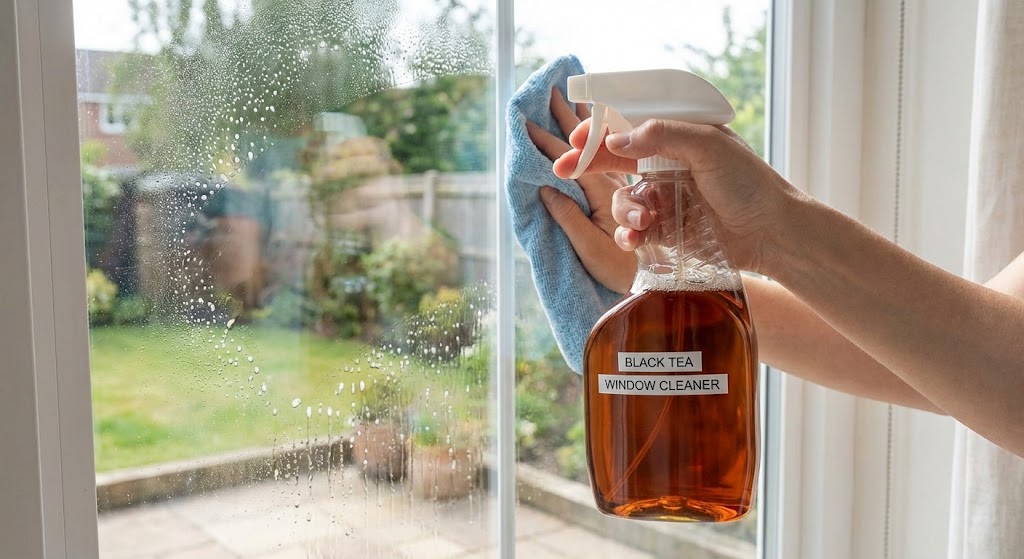
Streak-Free Window Formula
Brew 2 black tea bags in 500ml boiling water, steep 10 minutes, cool completely. Pour into spray bottle. Spray window liberally, wipe with microfiber cloth in circular motion, finish with vertical swipes. No streaks, no buffing, no chemical smell. Bottle lasts 2-3 weeks refrigerated.
Tannic Acid Cuts Hard Water Spots
Hard water spots (white calcium/magnesium deposits) form when mineral-rich water dries on glass. These alkaline deposits resist water-only cleaning. Tannic acid in tea (weak acid, pH 5-6) dissolves calcium carbonate: CaCO₃ + tannic acid → calcium tannate (water-soluble) + CO₂. The dissolved minerals wipe away instead of requiring abrasive scrubbing. See water minerals and pH effects.
| Glass Surface | Contaminant | Tea Effectiveness | vs Windex | vs Vinegar |
|---|---|---|---|---|
| Window Glass | Dust, fingerprints | 95% streak-free | Equal clarity | Better (no smell) |
| Bathroom Mirror | Toothpaste, water spots | 90% effective | Better (cuts minerals) | Equal |
| Shower Glass | Soap scum, hard water | 80% effective | Better (minerals) | Weaker (vinegar stronger) |
| Car Windshield | Rain spots, bugs | 85% effective | Better (no streaks) | Better (ammonia-free) |
| Eye Glasses | Skin oils, dust | 90% effective | Equal | Better (gentler on coatings) |
The Microfiber Cloth Requirement
Tea provides chemistry (dissolves minerals, no residue) but cloth provides mechanics (lifts dirt without scratching). Microfiber cloths have 200,000 fibers/sq inch vs 500 for cotton—this density traps particles instead of pushing them around. Pairing tea with microfiber eliminates streaks: tea dissolves, microfiber lifts, nothing remains.
Cost comparison: Commercial glass cleaner (Windex) £3-4 per 750ml = £0.40-0.53 per 100ml. DIY tea spray: £0.05 for 2 bags + water = £0.01 per 100ml. Tea is 40-50x cheaper with equal or better results (streak-free, cuts minerals, no ammonia fumes). Environmental bonus: biodegradable, no VOCs, safe for septic, compostable spent bags. This same polyphenol chemistry from tea processing applies to other household tea applications and rust conversion, degreasing, wood finishing.
Comments