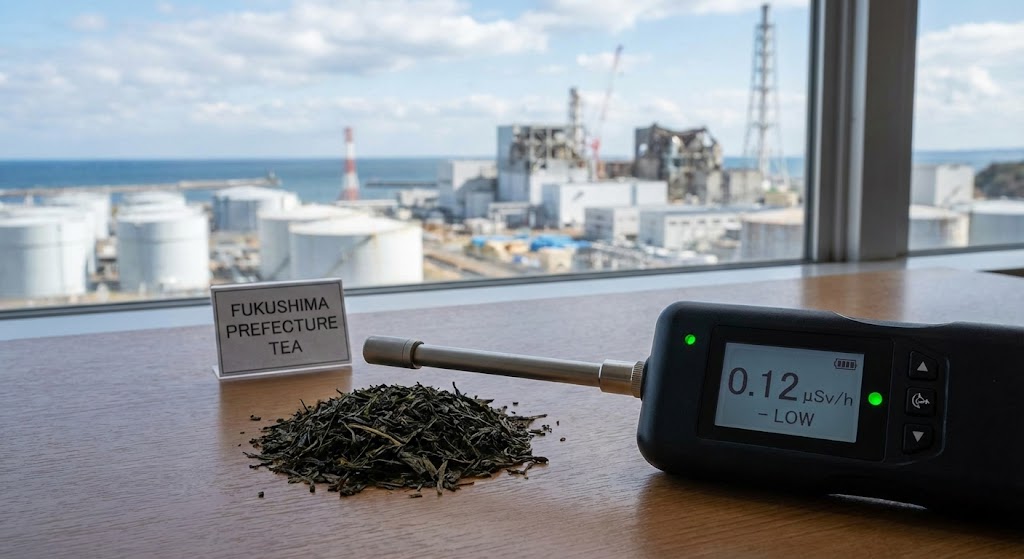
Why Tea Contains Radioactive Cesium-137
Tea plants (Camellia sinensis) accumulate radioactive isotopes from soil—primarily Cesium-137 (Cs-137) and Strontium-90 (Sr-90) from nuclear weapons testing (1950s-1960s) and nuclear accidents (Chernobyl 1986, Fukushima 2011). Cs-137 chemically resembles potassium, so plants actively uptake it through potassium transport channels. Tea accumulates 10-50 Bq/kg dry weight globally, higher in contaminated regions (Japan post-Fukushima: 100-500 Bq/kg in some prefectures). This accumulation mechanism parallels tea processing concentration effects.
The chemistry: Potassium (K⁺) is essential nutrient for plants—required for enzyme activation, cell turgor, photosynthesis. Cesium (Cs⁺) is chemically similar (same +1 charge, similar ionic radius) so plant transporters can't distinguish between K⁺ and Cs⁺. This "ionic mimicry" means radioactive Cs-137 enters plants through normal nutrient uptake, concentrating in leaves (the harvested tea part). Similar chemical similarity causes toxicity in pyrrolizidine alkaloids and safrole metabolism.
Is My Tea Radioactive? Testing and Safe Limits
EU safety limit for tea: 600 Bq/kg Cs-137 (Becquerels per kilogram—radioactive decay events per second). Typical UK tea: 10-30 Bq/kg (well below limit). Japanese tea post-Fukushima: tested batch-by-batch, rejected if >100 Bq/kg. Your annual radiation dose from tea: ~0.01 mSv (millisieverts)—compare to background radiation 2-3 mSv/year, chest X-ray 0.1 mSv. Tea radiation is negligible compared to natural sources.
Fukushima 2011: The Modern Tea Contamination Case
2011 Tōhoku earthquake triggered Fukushima Daiichi nuclear disaster—reactor meltdowns released Cs-137 plume across northeastern Japan. Tea-growing Shizuoka Prefecture (400km from Fukushima) detected elevated Cs-137 in tea harvests: 500-700 Bq/kg in some batches vs pre-accident background 10-20 Bq/kg. Government imposed temporary bans on shipments exceeding 500 Bq/kg, testing continues today.
The contamination pathway: Cs-137 released as gas/particles, deposited on soil via rainfall, absorbed by tea plant roots, concentrated in young growing shoots (the harvested flush). First flush spring 2011 showed highest contamination (direct deposition on leaves), subsequent flushes lower as plants uptake soil Cs-137 rather than airborne. Half-life of Cs-137 is 30 years—soil contamination decreases slowly, requiring decades of monitoring. Compare to: British tea safety history, kratom regulation, and coca tea international standards.
| Radiation Source | Dose (mSv/year) | Type | Health Risk | Avoidability |
|---|---|---|---|---|
| Background (cosmic/radon) | 2-3 | Continuous exposure | Baseline (unavoidable) | Zero—environmental |
| Tea consumption (10 cups/day) | ~0.01 | Ingested Cs-137 | Negligible (0.3% of background) | Avoidable (stop drinking tea) |
| Transatlantic flight | ~0.05 per flight | Cosmic radiation | Negligible (2% of annual background) | Avoidable (don't fly) |
| Chest X-ray | ~0.1 per image | Medical X-ray | Negligible but cumulative | Partly avoidable |
| Smoking (1 pack/day) | ~13 | Polonium-210 in tobacco | Significant (lung cancer) | Completely avoidable |
Biological Half-Life: Why Cesium Doesn't Accumulate
Even though Cs-137 physical half-life is 30 years (time for radioactivity to decay by half), biological half-life in humans is only 70-110 days (time to excrete half via urine/feces). This means Cs-137 from tea doesn't accumulate in body long-term—it's continuously excreted. Regular tea drinkers reach equilibrium: daily intake equals daily excretion, maintaining low constant body burden. Unlike caffeine overdose, radiation exposure is negligible for tea consumption.
The excretion mechanism: Kidneys filter cesium like potassium, excreting it in urine. Unlike Strontium-90 (bone-seeker with 18-year biological half-life) or Plutonium (decades in lung tissue), cesium is water-soluble and readily eliminated. Calculations: drinking tea with 30 Bq/kg daily adds ~0.3 Bq to body, while excreting ~0.3 Bq daily. Equilibrium body burden remains trivial compared to natural Potassium-40 radioactivity in body (~4000 Bq from dietary potassium).
Chernobyl 1986: The First Modern Tea Scare
1986 Chernobyl disaster released 400x more Cs-137 than Fukushima, contaminating European tea-growing regions (Turkey, Georgia). Turkish tea from Black Sea region showed 100-300 Bq/kg in 1986-1990, declining gradually as Cs-137 decayed and washed deeper into soil away from roots. EU monitoring continues—current levels 20-50 Bq/kg in previously affected areas. This established the 600 Bq/kg regulatory limit still used today. Turkish tea culture adapted brewing practices and water quality concerns during recovery.
Lesson learned: nuclear accidents have multi-decade agricultural impacts. Cs-137 persists in soil, plants continue uptaking it for generations. Tea is particularly vulnerable because harvested leaf material is where Cs accumulates (vs grains where seed is harvested). However, health risk remains negligible even at elevated levels—600 Bq/kg consumed daily for year delivers ~0.1 mSv extra dose (5% of background).
Minimizing Tea Radiation Exposure (If Concerned)
- Choose post-2011 tested Japanese tea: All commercial Japanese tea tested for Cs-137, rejected if >100 Bq/kg. Safer than unregulated tea from contaminated regions
- Brew with Cs-137 removal in mind: First flush (early spring) has higher Cs than later flushes. Cs partially water-soluble—discarding first 30-second rinse removes 10-20%
- Avoid Turkish/Georgian tea from pre-1990: Vintage tea from Chernobyl era may have elevated Cs-137. Modern production is tested and safe
- Put it in perspective: Flying London-New York gives more radiation dose than year of tea drinking. Smoking delivers 1000x more radiation than tea. Tea radiation is non-issue.
- Don't fear-monger: "Radioactive tea" sounds scary but the dose is insignificant. Bananas contain Potassium-40 (radioactive)—eating 1 banana = 1 week of tea radiation
Modern testing: UK Food Standards Agency randomly tests imported tea for Cs-137—has never found levels exceeding safety limits. Japan maintains world's strictest monitoring post-Fukushima. Commercial tea is safe, radioactive contamination is real but trivial compared to other cumulative exposure risks. Forensic testing methods distinguish environmental contamination from intentional adulteration.
Comments