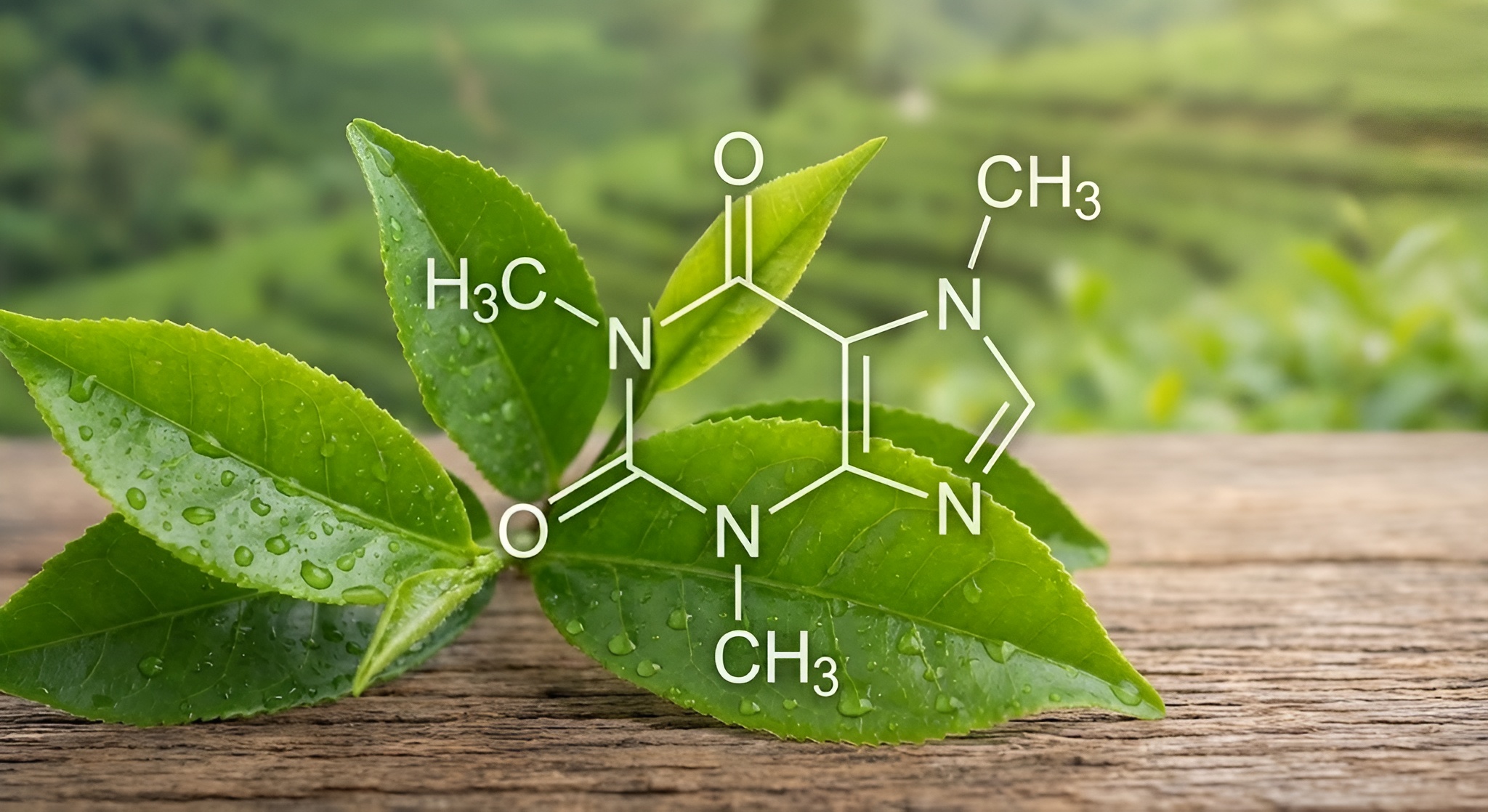
1. The "Color Myth" (Green vs. Black)
The most persistent myth in tea is that oxidation level (Green vs. Black) determines caffeine content. This is false.
Caffeine is a stable molecule. It does not break down significantly during oxidation or roasting. A tea leaf that starts with 30mg of caffeine when green will still have ~30mg of caffeine when fully oxidized into black tea.
The Real Variable: The Leaf Grade
The caffeine content is determined by which part of the plant was plucked.
- The Bud (Tip): ~4-5% Caffeine by weight. This is the future of the plant, so it is heavily defended. Found in Silver Needle (Fuding Da Bai) and High-Grade Matcha.
- The Second Leaf: ~3% Caffeine. Found in High Mountain Oolong (Qing Xin).
- The Stems/Stalks: ~0.5% Caffeine. Found in Kukicha and lower-grade Bancha.
Conclusion: A "Green" tea made from tips (like Gyokuro) will have more caffeine than a "Black" tea made from large, mature leaves (like Lapsang Souchong).
2. Botany: Why Does Tea Have Caffeine?
Evolutionarily, caffeine is expensive for a plant to produce. It requires a lot of Nitrogen. Why bother?
1. The Defense Hypothesis: Caffeine is a potent neurotoxin to small insects. If a beetle eats a caffeine-rich bud, it becomes paralyzed or dies. This explains why the tender buds have the highest concentration—they have no tough cellulose to protect them yet.
2. The Allelopathy Hypothesis: When caffeine-rich leaves fall to the ground, they leach caffeine into the soil. This inhibits the germination of competing seeds nearby, keeping the tea bush's territory clear.
3. The Nitrogen storage Hypothesis: Some botanists believe caffeine acts as a "Nitrogen Bank" for the plant, storing valuable nutrients that can be re-metabolized later during periods of rapid growth.
3. Pharmacokinetics: Tea vs. Coffee in the Body
Why does a double espresso make you jittery, while a bowl of Matcha makes you focused? The molecule is the same, but the delivery system is different.
The Coffee Spike
Coffee caffeine enters the bloodstream rapidly (peak plasma concentration in 15-45 minutes). It antagonizes adenosine receptors, triggering a spike in adrenaline and cortisol. This is the "Fight or Flight" response.
Side Effects: Tachycardia (fast heart rate), anxiety, and a rapid crash once the adrenaline wears off.
The Tea Plateau (L-Theanine Synergy)
Tea contains L-Theanine, a unique amino acid found almost exclusively in Camellia sinensis.
L-Theanine is a glutamate analog. It crosses the blood-brain barrier and antagonizes the stimulating effects of caffeine.
1. Alpha Waves: Theanine promotes alpha-wave generation in the brain (associated with meditation and creative focus).
2. GABA Production: It boosts GABA levels, which calms the nervous system without inducing sleepiness.
The Result: The caffeine keeps you awake, but the Theanine prevents the adrenaline spike. You get a sustained plateau of energy that can last 4-6 hours without a crash. This state is often called "Zenergy."
| Drink (8oz Cup) | Caffeine (mg) | L-Theanine (mg) | Effect Profile |
|---|---|---|---|
| Matcha (Thick) | 80 - 120mg | 40mg+ | High Energy, Laser Focus (Best Ratio) |
| Coffee (Drip) | 95 - 140mg | 0mg | Jitters, Adrenaline, Crash |
| Silver Needle (White) | 50 - 75mg | High | Clean, Head-high, Euphoric |
| Assam (Black) | 60 - 90mg | Low | Physical Energy ("The Wake Up") |
| Hojicha (Roasted) | 10 - 20mg | Low | Relaxation, Digestion |
4. Extraction Physics: Fick's Law
Just because the leaf has caffeine doesn't mean it ends up in your cup. Extraction follows Fick's Law of Diffusion.
1. Temperature: Caffeine is highly soluble in hot water. At 100°C, extraction is rapid. At 80°C, it is slower. This is why Green Tea (brewed cooler) often yields a cup with less caffeine than Black Tea (brewed boiling), even if the dry leaves had the same amount.
2. Time: About 80% of the available caffeine is extracted in the first 60 seconds of brewing. The "Rinse Method" (rinsing tea for 30 seconds to decaffeinate it) is a myth. You simply remove the surface caffeine and the best flavor compounds, leaving the deep caffeine behind.
3. Surface Area: A broken leaf (dust/fannings in a tea bag) extracts caffeine almost instantly. A whole leaf (Tie Guan Yin ball) releases it slowly over multiple infusions.
5. The Decaf Dilemma
If you are sensitive to caffeine, you might choose Decaf Tea. But be warned: not all decaf processes are equal.
Method A: Ethyl Acetate (The Chemical Solvent)
Leaves are soaked in a chemical solvent (found in nail polish remover) which bonds to the caffeine.
Pros: Cheap.
Cons: Strips flavor, leaves a chemical residue taste. Often used for mass-market tea bags.
Method B: CO2 (Supercritical Fluid Extraction)
Leaves are placed in a high-pressure chamber with Carbon Dioxide. Under high pressure, CO2 becomes a "supercritical fluid"—it acts like a liquid solvent but diffuses like a gas. It selectively dissolves caffeine while leaving larger flavor molecules (polyphenols) intact.
Pros: Retains 90% of the flavor and antioxidants. Non-toxic.
Cons: Expensive. Only used for premium loose leaf.
Find Your Focus
Looking for the ultimate "Focus" tea? We recommend high-grade Shade-Grown Gyokuro or Matcha. These teas maximize the Caffeine/Theanine ratio for the perfect cognitive boost.
Shop High-Focus Tea
Comments