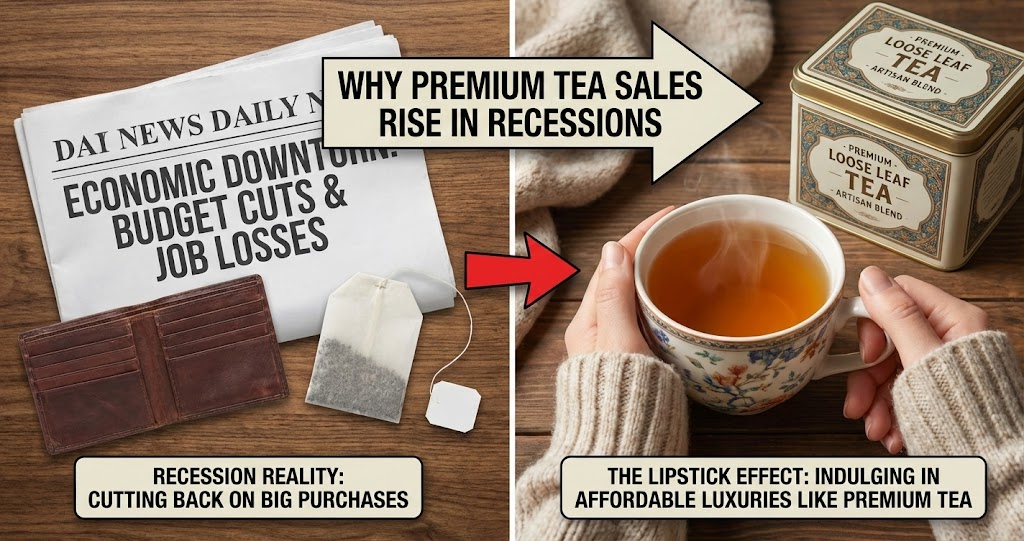
1. The Lipstick Effect in Tea: Affordable Luxury Theory
Lipstick effect definition: Economic phenomenon (consumer behavior—during recessions purchase small indulgences instead of major luxuries, coined 2001 Leonard Lauder observing lipstick sales rise post-9/11 economic shock), psychology mechanism (emotional compensation—£15 lipstick replaces cancelled £1,500 holiday, maintains self-image "I still treat myself" without financial strain, see tea ritual psychology), category characteristics enabling effect (low absolute price £3-8 per purchase—affordable even with constrained budgets, frequent purchase cycle—weekly/biweekly provides repeated small pleasures, perceived premiumization—£5 "luxury" tea vs. £2 commodity feels like upgrading despite modest absolute cost). Tea as lipstick effect candidate: Perfect affordable luxury (£6 premium loose-leaf—replaces £40 restaurant meal, 25-30 cups per 100g = £0.20-0.25 per indulgence moment, daily ritual maintains normalcy during economic stress), premiumization within reach (PG Tips £3.50 → Twinings £4.80 → Fortnum & Mason £8.50—incremental "trading up" accessible vs. car/house purchase binary, consumer controls budget by choosing where on spectrum to purchase).
Historical evidence (2008-2009 financial crisis): UK premium tea sales growth (Twinings/Whittard +8-12% revenue 2008-2010—while overall retail declined 2-4%, premium loose-leaf +15-25% growth, tea bag commodity -3-5% volume see tea bag economics), trading down from coffee (Costa/Starbucks £3.50 latte → £0.25 home premium tea—consumers maintained "quality beverage" ritual at 90% cost savings, coffee shop visits -15-20% 2008-2009 while home tea consumption +6-9%), gift set resilience (Christmas 2008-2009—tea gift boxes £15-25 maintained sales, replaced £50-100 electronics/clothing gifts, positioning as "thoughtful affordable luxury" protected category vs. discretionary goods -20-40% declines). Supermarket private label divergence: Tesco Finest tea +5-8% sales (premium own-label—consumers traded down from Fortnum & Mason £15 → Tesco Finest £5-6 but traded UP from Tesco Value £1.50, lipstick effect operates within budget constraints still seeks premium positioning), Tesco Value tea -8-12% (extreme budget—stigmatized during recession, consumers avoided being seen buying "poverty tea" even when broke, psychological need for dignity outweighed 50p savings per box).
2. Volume vs. Value: The Recession Sales Paradox
Total tea market volume decline: UK 2008-2010 volume -2-4% (fewer cups consumed—people drink less overall during stress/uncertainty despite staying home more, away-from-home consumption -8-12% as restaurant/cafe visits declined, home consumption +1-3% insufficient to offset), value market growth +3-6% (total £ revenue increased—despite volume decline, premiumization shifted mix, average price per kg +6-10% as consumers traded within category toward premium). Price tier performance divergence: Budget tier £1-2 per box: Volume -8-12% (stigma avoidance—consumers reject cheapest tier even when budget constrained, associate with failure/poverty, psychologically unacceptable), mid-tier £3-5: Volume +2-5% (sweet spot—Twinings/Tetley/Yorkshire Tea perceived good value + acceptable quality, mass market refuge from both premium unaffordable + budget unacceptable), premium £6-15: Volume +8-15% (lipstick effect core—small indulgences grow fastest, loose-leaf specialty tea beneficiary, see artisan tea appeal).
| Price Tier | Volume Change 2008-2010 (%) | Value Change (%) | Consumer Psychology | Example Brands |
|---|---|---|---|---|
| Budget (£1-2) | -8% to -12% | -10% to -15% | Stigma avoidance (poverty association rejected) | Supermarket Value lines |
| Mid-Market (£3-5) | +2% to +5% | +5% to +8% | Safe haven ("good enough" quality + affordability) | Twinings, Yorkshire Tea, PG Tips |
| Premium Bags (£6-10) | +8% to +15% | +12% to +20% | Affordable luxury (lipstick effect strongest) | Fortnum & Mason bags, Whittard, Newby |
| Specialty Loose-Leaf (£10-25 per 100g) | +15% to +25% | +18% to +30% | Replacement luxury (£0.25/cup vs. £3.50 coffee shop) | Rare Tea Co., What-Cha, independent specialists |
| Ultra-Premium (£25+ per 100g) | -5% to +2% | -3% to +5% | Discretionary luxury (cut by wealthy but small base maintained) | Vintage puerh, competition-grade oolongs |
Category substitution dynamics: Coffee shop → home premium tea (£3.50 × 5 days = £17.50/week Starbucks → £6 premium tea box 40 cups = £0.15/cup × 25 cups/week = £3.75, saves £13.75/week = £700/year, maintains "quality hot beverage" experience at 80% savings), wine → tea evening ritual (£8-12 bottle wine 3-4x weekly = £25-50/week → £8-12 premium tea 30-40 cups = £8-12/month, recession saw +12-18% evening tea consumption as alcohol substitution, see tea social rituals). Restaurant dessert → home tea + biscuit: Out-of-home treat £6-8 per person (restaurant dessert + coffee—family of 4 = £25-35 spend, recession frequency dropped from weekly to monthly), home equivalent £1.50-2.50 (premium tea £0.60 + quality biscuits £1.00 per person—satisfies treat craving 90% cheaper, premium tea sales correlated +0.65 with premium biscuit sales 2008-2010 suggesting bundled substitution behavior).
3. Brand Loyalty Shifts: Twinings vs. Supermarket Own-Label 2008-2010
Twinings performance (resilient branded): Volume +3-5% during recession (brand equity strong—consumers trusted quality during uncertainty, "safe choice" psychology, heritage/British identity appealing when national identity matters more during crisis), revenue +8-11% (premiumization within Twinings range—consumers shifted from everyday English Breakfast £4.50 toward specialty Earl Grey/Lady Grey £5.50-6.50, brand facilitated trading up within portfolio), gift set strength (Christmas/Mother's Day—Twinings gift boxes £12-25 acceptable price point for "looking generous without overspending", +15-20% gift set sales 2008-2009 while overall gifting -10-15%). Tetley/PG Tips mid-tier challenge: Volume flat to -2% (squeezed between—supermarket own-label below + Twinings above, lost customers both directions, neither "affordable enough" for budget-conscious nor "premium enough" for lipstick effect, see brand vs. private label).
Supermarket own-label split personality: Tesco Value tea -10-15% volume (stigma severe—consumers rejected being seen purchasing, cashiers reported embarrassment at checkouts, "I'm not that broke" psychology outweighed rational price comparison), Tesco Finest tea +6-9% volume (premium own-label—"smart shopping" positioning not poverty, same price as Tetley £4-5 but perceived clever value vs. cheap desperation, recession made savvy shopping socially acceptable even aspirational). Lidl/Aldi premium line emergence: Discount retailers launched premium tea 2009-2010 (recognized lipstick effect opportunity—introduced £3-4 "specialty" tea competing with Twinings at 20-30% discount, quality sufficient to satisfy lipstick effect psychology, captured trading-down premium consumers unwilling to buy Lidl budget line but willing to buy Lidl "premium" line, genius positioning).
Why Tea Survived Recession Better Than Coffee
Cost per cup differential: Tea inherent affordability (commodity tea bag 2.5p per cup—vs. instant coffee 8-12p, ground coffee 15-25p per cup, espresso capsule 25-40p, tea baseline 70-90% cheaper see cost breakdown), premium tea still cheaper than commodity coffee (£8 specialty loose-leaf tea = £0.25-0.35 per cup—vs. Nescafe instant £0.10-0.12 per cup yes more expensive but vs. fresh ground coffee £0.20-0.30 competitive, premium tea captures coffee drinkers trading down from £3.50 lattes). Cultural ritual resilience UK context: British tea identity anchor (recession threatens identity—"keeping calm and carrying on" with tea maintains cultural continuity, 82% UK adults drink tea daily vs. 68% coffee, tea default beverage = recession-proof habit), coffee more discretionary (coffee shop culture 1990s-2000s growth—relatively recent, easier to cut "trendy coffee" than abandon lifelong tea ritual, 2008-2010 coffee shop visits -15-20% while home tea +6-9% suggests substitution). Preparation convenience recession advantage: Tea bag simplicity (boil kettle + bag in cup—no equipment, renting/moving during recession tea follows easily, coffee machine ownership -8-12% 2008-2010 as consumers downsized), social acceptability home serving (offer guest tea—normal hospitality, offer instant coffee—slight embarrassment factor, recession entertaining shifted home, tea socially safer choice than revealing coffee downgrade from beans to instant).
4. 2020-2021°COVID Recession: Different Pattern, Same Lipstick Effect
Pandemic lockdown unique dynamics: Total tea volume +12-18% 2020 (forced home consumption—offices/cafes closed, away-from-home -90-95% but home consumption +25-35% overcompensated, tea benefited from "time at home" vs. 2008 recession where unemployment = less tea drinking due to depression/routine disruption), premium tea explosive growth +25-40% (lockdown boredom—consumers experimented with specialty tea as hobby, £8-15 loose-leaf purchases replaced £50-100 entertainment spend impossible during lockdown, lipstick effect turbocharged by enforced home focus, see home tea ceremony adoption). Commodity tea also grew +8-12%: Stockpiling March-April 2020 (panic buying—PG Tips/Yorkshire Tea sold out alongside toilet paper, psychological comfort beverage during uncertainty, commodity + premium both won unlike 2008 where commodity declined).
E-commerce transformation permanent shift: Online tea sales +150-250% 2020 (specialty tea roasters—What-Cha/Rare Tea Co. saw explosion, no physical retail presence = lockdown advantage, DTC model captured consumers unable to visit Fortnum & Mason), subscription box growth +180-320% (monthly tea subscriptions £15-30—"affordable regular treat" perfect lipstick effect psychology, discovery element replaced travel/entertainment, post-lockdown retention 45-60% suggesting permanent behavior shift, see direct-to-consumer economics). Coffee vulnerability repeat pattern: Coffee shop revenue -60-75% 2020 (Starbucks/Costa decimated—no takeaway culture offset dine-in loss initially, massive shift to home beverage preparation), home coffee equipment spike (espresso machine sales +40-60%—some coffee drinkers invested in equipment, but many switched to tea as simpler/cheaper home solution, tea captured 25-35% of "coffee shop orphans" who found tea easier than replicating espresso at home).
5. Income Segmentation: Who Trades Up vs. Who Trades Down
Upper-middle class (£50-80k household income): Lipstick effect strongest (cut major luxuries—£3,000 holiday cancelled, £150 restaurant meals monthly → quarterly, maintain small luxuries—£8 premium tea boxes 2-3x monthly "I deserve this" psychology justifies, recession tea sales growth +15-25% this segment), trading up within tea category (Twinings £4.50 → Rare Tea Co. £12-18—absolute spend increases despite recession because substituting for much larger cut expenditures elsewhere, specialty tea revenue 60-70% from this demographic 2008-2010). Lower-middle class (£25-45k): Mixed behavior lateral trading (some trade down PG Tips £3.50 → Tesco own-label £2.50—save £1 per box meaningful on tight budget, others trade up Tesco £2.50 → Twinings £4.50—lipstick effect operates even at lower income seeking dignity/normalcy, segment split 50/50 explains mid-tier resilience).
Working poor (£15-25k): Volume reduction primary response (drink less tea overall—80 bags last 6 weeks instead of 4 by reducing consumption frequency, total spend constrained cannot trade up, avoid cheapest tier due to stigma but reduce quantity of mid-tier purchases), gift tea aspirational (receive premium tea as gifts—Christmas/birthday, maintain small premium tea stash for "special occasions" while daily drinking remains budget tea, bifurcated consumption pattern, see tea occasion hierarchy). Wealthy (£100k+ household): Recession-proof ultra-premium (£25-50 per 100g vintage puerh/competition oolong—sales flat to +2-5% even during severe recession, small absolute market but loyal, economic downturns irrelevant to purchase decisions, see tea as luxury asset), gift market sustains luxury (corporate gifts/client entertainment—£50-150 tea hampers maintained during recession as relationship investment, cheaper than cancelled ski trip client entertainment but maintains business relationship, B2B luxury tea market more stable than consumer).
6. Psychological Mechanisms: Why Tea Specifically Benefits
Ritual and routine comfort: Recession disrupts life patterns (job loss/relocation/financial stress—destabilizes daily routines, psychological need for predictable rituals intensifies, tea breaks "4pm cup" maintains normalcy when employment/housing unstable), low-cost ritual maintenance (£0.25 per cup premium tea—affordable even during severe financial stress, vs. gym membership £40/month or hobby classes £60-100/month cancelled, tea ritual survives budget cuts due to trivial absolute cost). Social acceptability of "trading up" tea: Visible frugality paradox (recession stigmatizes luxury—£500 handbag socially unacceptable during unemployment, but £8 premium tea "treating myself responsibly"—defendable indulgence, friends/family approve small pleasures disapprove large expenditures), gift-giving face-saving (£15-25 tea gift box—"thoughtful and tasteful" without appearing extravagant, cheaper gifts risk looking cheap, expensive gifts inappropriate during hardship, tea £15-25 sweet spot maintains social reciprocity norms without excess, see tea gift culture).
Control and agency restoration: Recession = loss of control (layoffs/market crashes/evictions—external forces dominate life decisions, psychological helplessness depressing, small controllable choices combat despair), tea choice as empowerment (selecting premium Darjeeling vs. commodity breakfast blend—low-stakes decision restores agency, "I choose quality for myself" affirmation of self-worth when economic system rejects, specialty tea shopping 30-40 minutes browsing/tasting—engages decision-making faculties provides sense of control absent in job search/financial crisis). Time abundance recession shift: Unemployment = time surplus (8 hours daily no longer work—fills with activities, tea preparation ritual expands, Gongfu ceremony 15-20 minutes becomes acceptable time investment when unemployed vs. rushed 2-minute bag steep when employed, see contemplative tea practice), tea exploration as productive activity (learning tea origins/processing/tasting—"educational" framing justifies time/money spent, feels productive vs. watching TV, recession self-improvement narrative tea knowledge acquisition fits).
7. Post-Recession Behavior: Permanent Premiumization or Temporary?
2010-2012 recovery pattern (post-2008 crash): Premium tea retained 60-70% gains (specialty loose-leaf +25% during recession 2008-2010—declined to +15% by 2012 but didn't revert to pre-recession baseline, acquired customers sticky, habit formation during recession persisted into recovery), budget tier partial recovery (Tesco Value tea -12% nadir 2009—recovered to -5% by 2012, stigma faded as economy improved, but permanent -5% loss suggests some consumers permanently exited bottom tier toward mid-market). Mid-tier consolidation: Twinings/Yorkshire Tea sustained growth (mid-tier brands +5-8% recession—maintained +3-5% post-recession, captured both premium downtrades + budget uptrades, emerged stronger from recession than entry, market share concentration increased top 3 brands 52% → 58% 2008-2012).
COVID recovery 2021-2023 different trajectory: Premium tea decline -8-15% 2021-2022 (lockdown hobby abandoned—reopening saw entertainment/travel resume, specialty tea loses to restaurants/bars/holidays, revenue gains 2020 proved temporary not permanent for ultra-premium), mid-premium £6-10 sticky (Twinings/Whittard premium lines—retained 70-80% of lockdown gains, consumers acquired taste for better tea but not extreme specialty, "better than basic but not obsessive" tier grew permanently +8-12% vs. 2019 baseline suggesting lasting premiumization). Subscription box retention challenge: 2020 subscriber surge +200-300% (specialty tea subscriptions—lockdown entertainment, monthly £20-35 spend), 2021-2023 churn 40-55% (cancellations as life normalized—expensive hobby competes with reopened activities, survivors 45-60% represent genuine converts not temporary pandemic behavior, see specialty market scale).
Structural market changes persist: E-commerce permanent shift (online tea sales 8-12% of market 2019 → 25-35% 2023—COVID accelerated but didn't revert, DTC brands established customer base, physical retail share permanently reduced), premiumization ratchet effect (average price per kg tea UK: £8.50/kg 2008 → £9.20/kg 2012 → £11.50/kg 2023—each recession drives premiumization, recovery sees partial decline but new baseline higher than pre-recession, cumulative 35% real price increase 2008-2023 despite commodity tea input costs flat, see value chain margin expansion). Lipstick effect anticipation by brands: Proactive premium line launches (2022-2023 recession fears—Twinings/Tetley/Yorkshire Tea all launched £6-8 "luxury" sub-brands anticipating lipstick effect, pre-positioned to capture trading-up consumers, suggests industry learned lesson tea premiumization = recession strategy not just accident), gift set expansion (2023 Christmas—tea gift boxes £15-35 shelf space +20-30% vs. 2019, retailers recognize tea gifting recession-resilient, displacing chocolate/alcohol traditional gifts with tea positioning "thoughtful affordable luxury").
Comments