1. History: The "Bragger's Tea" Legend
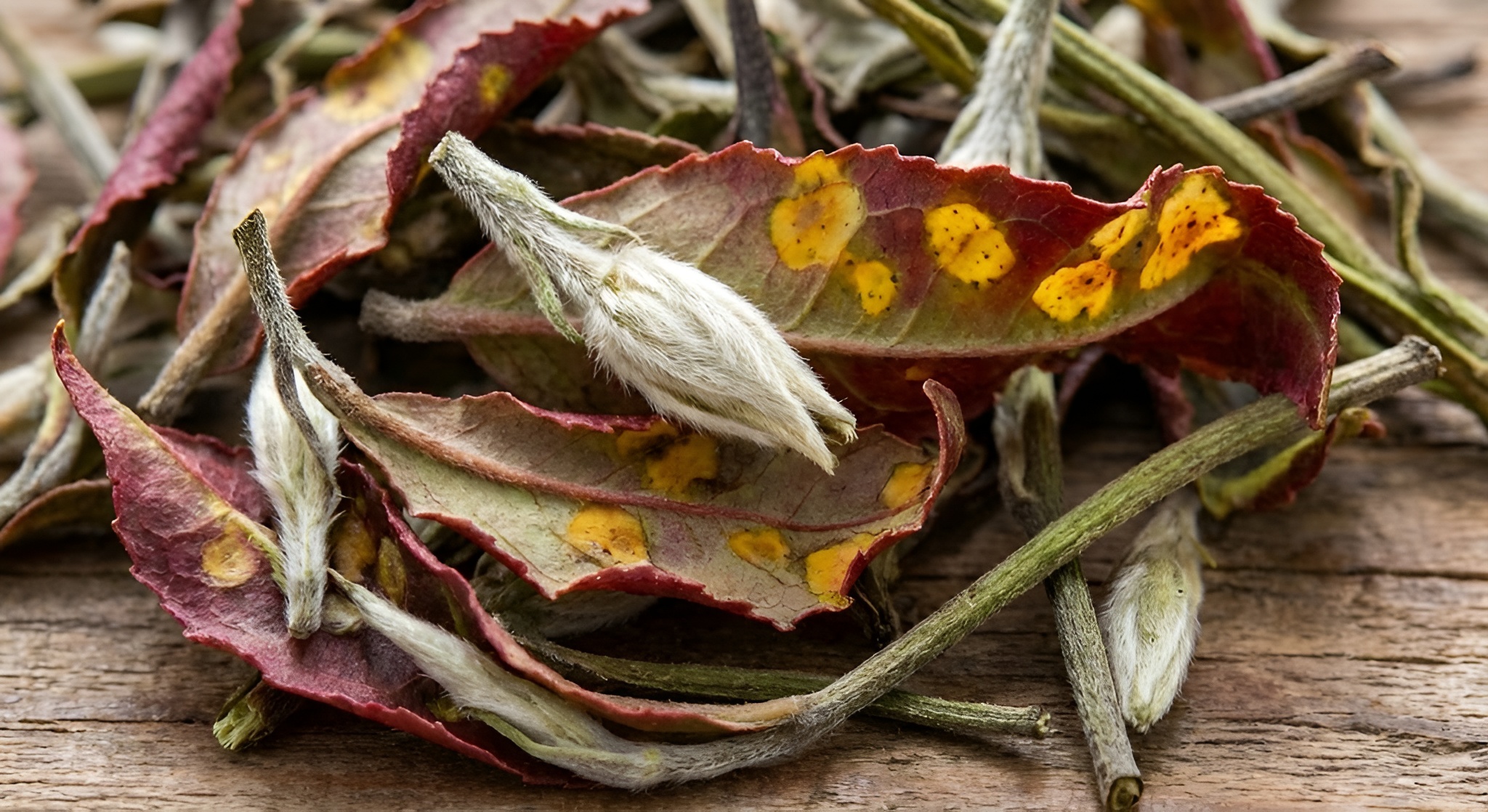
The history of Oriental Beauty is steeped in folklore. The most famous story dates back to the late 19th century in Beipu, Hsinchu. A tea farmer returned to his fields in summer to find them devastated by swarms of small green insects. The leaves were yellow, stunted, and chewed.
Instead of destroying the "ruined" crop, the frugal farmer decided to process the leaves anyway. He took the resulting tea to the market in Taipei. To everyone's surprise, the tea had an intoxicating honey aroma that buyers had never smelled before. It sold for a remarkably high price.
When the farmer returned to his village and boasted about the price, his neighbors accused him of lying ("Peng Feng" in the Hakka dialect). Thus, the tea was originally named Peng Feng Cha (Bragger's Tea).
Later, it was allegedly presented to Queen Victoria of England. Upon seeing the beautiful multi-colored leaves dancing in the crystal glass like a woman in a dress, she named it "Oriental Beauty." While this royal connection is likely a marketing myth, the name stuck and elevated the tea to global fame.
2. The Biology: Nature's Chemical Warfare
How exactly does a bug bite create flavor? It is a complex biological defense mechanism.
The insect is the Tea Green Leafhopper (Jacobiasca formosana). It appears in early summer (June/July) when the weather is hot and humid. It has a needle-like mouthpart that pierces the phloem (sap channel) of the tender bud and stem to suck out the nutrient-rich juices.
The Plant's Response:
1. Recognition: The tea plant detects not just the mechanical damage, but specific enzymes in the leafhopper's saliva. It knows it is being eaten.
2. Synthesis: To defend itself, the plant activates specific metabolic pathways to synthesize Phytoalexins and volatile Terpenes.
3. The Weapon: Specifically, the leafhopper's bite triggers the release of Methyl Salicylate (The Wintergreen Molecule) as a defense mechanism. During the heavy oxidation process, these compounds degrade and interact with others to form Beta-Damascenone, which provides the signature honey-like aroma, alongside the fruitiness of Hotrienol.
The Purpose: In nature, these scents serve as an "SOS Signal" to attract the natural predators of the leafhopper, such as jumping spiders and parasitic wasps. The plant is literally calling for air support. To humans, however, these distress signals smell like wild honey, muscat grapes, and ripe peaches.
Expert Tip: The "Champagne" Effect
Some vendors sell this tea as "Champagne Oolong." This refers to its distinct muscatel grape note. Interestingly, this links Oriental Beauty directly to Second Flush Darjeeling. In Darjeeling, the "Muscatel" flavor is also caused by Jassid (Green Fly) attacks stimulating Geraniol production. They are essentially chemical cousins separated by geography.
3. The Cultivar: Qing Xin Dapan
While Oriental Beauty can be made from various cultivars (including the omnipresent Qing Xin), the traditional choice is Qing Xin Dapan.
This cultivar has larger leaves and grows vigorously, which helps it survive the stress of the insect attacks. The bugs stunt the growth of the buds, making them small and white-haired. Because the yield is so low (about 50% of a normal harvest), the price of authentic Oriental Beauty is consistently high.
4. Processing: Respecting the Bite
Processing Oriental Beauty is an art form that differs significantly from other Taiwanese Oolongs.
Plucking: It requires a strict "One bud, two leaves" pluck. The presence of the white, hairy bud is crucial for the texture (see our Fuding Da Bai page for more on trichomes).
Oxidation (60-70%): This is the highest oxidation level for any Oolong. The leaves are withered for a long time and shaken extensively. Sometimes, farmers use a "Wet Cloth" covering technique to increase humidity and temperature, accelerating the enzymatic browning. This high oxidation turns the bug-induced terpenes into deeper, darker notes—transforming "Fresh Flower" into "Dried Fruit" and "Spiced Honey."
Kill Green & Rolling: The tea is pan-fried to stop oxidation, then rolled.
No Roasting: Unlike Wuyi Rock Tea or Hojicha, Oriental Beauty is usually not roasted. The honey flavor must come entirely from the leaf chemistry (Oxidation), not from the Maillard reaction of the fire.
5. What About Caffeine?
You might assume that because the plant is stressed, it produces more Caffeine (its natural pesticide). This is partially true—the plant is trying to defend itself. However, because the leaves used are quite mature (the bugs stunt them, but they are harvested in summer), the caffeine levels are moderate compared to a Spring Silver Needle. The high level of oxidation also rounds out the harshness, making the tea feel gentle on the stomach despite its chemical potency.
6. Brewing: Cool it Down
Despite being heavily oxidized (like a black tea), Oriental Beauty is delicate. The buds are rich in amino acids but the bug-bitten leaves are fragile.
Temperature: 85°C - 90°C (185°F - 195°F).
Do not use boiling water. Boiling water can sometimes make the "Spicy" terpenes too sharp or astringent. Dropping the temperature slightly highlights the honey sweetness and the silky texture.
Vessel: A Porcelain Gaiwan or glass teapot is best. You want to see the "dancing" colors of the leaves. Avoid unglazed clay pots (like Yixing) for lighter roast Oriental Beauties, as the clay might mute the delicate high notes.
Taste the Miracle
Authentic Oriental Beauty is expensive because yields are low and the labor is intense. We have sourced a competition-grade lot from Hsinchu that defines the genre with its distinct honey aroma.
Shop Oriental Beauty
Comments